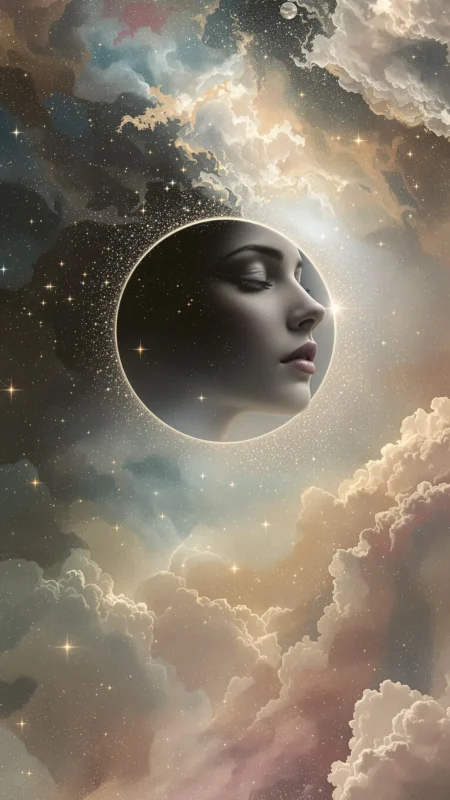


Eclipse

Archetype Meaning & Symbolism

Transformative, sudden, obscuring, revealing, cyclical, liminal, numinous, unsettling, rare, pivotal

  • Do not fear my shadow. It is only in the temporary absence of light that you can see the stars that were always there.

If Eclipse is part of your personal mythology, you may...

Believe

  • You may believe that profound truth is only revealed when the ordinary world is disrupted.

  • You may believe that periods of darkness and confusion are not failures but necessary rites of passage.

  • You may believe that your identity is not a constant, but something that is periodically dissolved and reformed.

Fear

  • You may fear that the light, once gone, will never return, that this time the darkness is permanent.

  • You may fear that your cyclical nature makes you fundamentally unlovable and that others will abandon you during your periods of shadow.

  • You may fear being unseen, that your true, brilliant self is only visible during rare moments of crisis that you would rather avoid.

Strength

  • You may possess an extraordinary resilience and an ability to navigate chaos with a strange, almost supernatural calm.

  • You may have a rare capacity for radical transformation and personal reinvention, allowing you to shed old selves with grace.

  • You may be able to perceive hidden patterns and truths that are invisible to others in the bright, distracting light of the everyday.

Weakness

  • You may be prone to a pattern of self-induced crisis, subconsciously creating chaos in order to feel alive or precipitate a needed change.

  • You may struggle with maintaining consistency and stability in your life, making long-term planning and mundane routines feel impossible.

  • You may alienate loved ones who cannot understand your cyclical nature and interpret your necessary withdrawals as personal rejection.

The Symbolism & Meaning of Eclipse

In your personal mythology, the Eclipse archetype symbolizes the sudden, non-negotiable interruption. It is not the gentle fade of twilight but the swift, almost violent drawing of a cosmic curtain. Life under this influence is not a gradual ascent but a series of brilliant illuminations punctuated by profound and totalizing shadow events. These moments are liminal spaces: you are no longer who you were, but not yet who you will become. The eclipse is the universe hitting pause on your story, demanding your full attention for a revelation that could not occur under normal circumstances, a sacred and unsettling caesura in the rhythm of your life.

The core of the Eclipse’s meaning lies in its duality of obscuring and revealing. The sun, a symbol for the ego, the conscious mind, and the external identity, is temporarily blocked. This might feel like a crisis: a loss of purpose, a confusion of self. Yet, it is precisely this blockage that allows something else to become visible. The corona, the hidden energetic field, or the constellations, the deeper cosmic patterns, can now be seen. The Eclipse suggests that only by silencing the loud, bright ego can we perceive the subtle, powerful truths of the soul or the underlying structure of our reality. It is a forced meditation, a moment of inverted sight.

Its power is amplified by its rarity. An eclipse is not a daily sunset. This quality suggests that the transformative crises in your mythos are infrequent but foundational. They are the load-bearing pillars of your life's architecture. Their cyclical nature promises that the light will always return, but the person viewing that light is irrevocably changed. The world itself seems subtly altered after witnessing such a cosmic spectacle. The archetype teaches that these rare encounters with profound darkness are not flaws in the system, but an essential, albeit terrifying, part of the design of your personal cosmos.


Eclipse Relationships With Other Archetypes

The Sun

The Eclipse’s relationship with The Sun archetype is one of temporary, non-fatal suppression. It is the only force that can command The Sun, representing the ego and conscious vitality, to stand down. In a personal mythos, this suggests that your brilliant, radiant, public self requires periodic, humbling moments of being overshadowed. This is not to extinguish your fire but to prevent the hubris and burnout that come from uninterrupted shining. The Eclipse forces a necessary retreat, ensuring that when your inner sun returns, it does so with a deeper appreciation of its own light and a newfound awareness of the shadows it casts.

The Moon

Often, the Eclipse is enacted by The Moon, the archetype of intuition, emotion, and the subconscious. That the smaller, subtler body can block the larger, brighter one is deeply significant. It speaks to a personal narrative where a powerful feeling, a gut instinct, or a flood of subconscious imagery can suddenly halt the progress of your rational, day-to-day life. The Moon's intervention as the eclipsing agent suggests that your emotional and intuitive reality holds the ultimate power to demand attention, capable of shutting down the entire external operation until its message is received and integrated.

The Crossroads

The Eclipse is a temporal crossroads. While the traditional Crossroads archetype presents a choice of physical paths, the Eclipse is a moment in time where the path is chosen for you. It is a forced stop, a universal decree that the old direction is no longer viable. You do not arrive at an eclipse and ponder which way to go: you are simply there, suspended between a past that has been definitively concluded and a future that is still entirely dark. The relationship is one of event versus choice: the Crossroads asks “What will you do?,” while the Eclipse states “This is what is happening to you.”

Using Eclipse in Every Day Life

Navigating a Career Change

When the sun of your professional identity is suddenly blocked, perhaps by a layoff or a crisis of meaning, the Eclipse archetype offers a map. Instead of rushing to restore the old light, you could embrace the twilight. This is a time to perceive the hidden corona of your skills and the distant stars of your dormant passions, things invisible in the glare of your previous role. The darkness is not an end, but a necessary pause for recalibration before the light returns on a completely new trajectory.

Ending a Significant Relationship

A breakup can feel like a total personal eclipse, where the light of your shared life is extinguished. This archetype suggests seeing this darkness as a moment of profound revelation. With the other person no longer eclipsing your view, who are you? What parts of your own identity, your own corona, were invisible before? The event is a cosmic disruption that, while painful, forces a confrontation with the solo self and reveals the true, un-occluded shape of your own heart.

Confronting a Personal Truth

The Eclipse may represent a moment of forced self-honesty. The everyday sun, the conscious ego with its defenses and narratives, is momentarily shoved aside. In that sudden quiet, a deeper, perhaps uncomfortable truth can make itself known. It might be the realization that a long-held belief is false or that a path you're on is no longer yours. This archetype provides the courage to stand in that disorienting shadow and listen, allowing a more authentic self to be revealed when the light returns.

Eclipse is Known For

The Concealment of Light

Its primary identity is the dramatic and temporary obscuring of a celestial body by another. This act of veiling the familiar source of light serves as a powerful metaphor for the sudden interruption of the known, the normal, and the conscious.

The Corona's Revelation

During the brief moments of a total solar eclipse, the sun’s ethereal and otherwise invisible outer atmosphere, the corona, is revealed. This symbolizes the hidden truths, secret knowledge, or deeper aspects of the self that can only be perceived when the blinding glare of the everyday is removed.

The Omen of Change

Across cultures and history, an eclipse has been viewed as a portent of immense change, a disruption of the cosmic order that heralded major endings and beginnings. It represents a non-negotiable pivot point in a narrative, after which nothing can be the same.

How Eclipse Might Affect Your Personal Mythology

How Eclipse Might Affect Your Mythos

To have the Eclipse in your mythos is to structure your life story around pivotal, world-altering events rather than a seamless narrative of gradual progress. Your personal history is likely demarcated by “before” and “after” the eclipse moments: before the sudden illness, after the unexpected move, before the shocking revelation. These are not mere incidents but narrative black holes whose gravity organizes everything else around them. Your life story may not be a gentle stream but a string of volcanic islands, each one forged in a fiery, light-obscuring eruption that ultimately created new ground to stand upon.

This archetype also infuses your mythos with a sense of destiny and cosmic significance. The events that shape your life may not feel random but fated, like astronomical conjunctions scheduled billions of years in advance. You may see your greatest challenges not as personal failings or misfortunes but as sacred appointments. This turns a story of suffering into a story of initiation. Your mythos becomes a chronicle of these rare alignments, and your purpose is transformed from merely living into bearing witness and being remade by these profound, celestial dramas.

How Eclipse Might Affect Your Sense of Self

Your sense of self may be unusually fluid, defined not by a stable identity but by your capacity for radical transformation. You might not see yourself as a stone, solid and unchanging, but as a sky, capable of holding both brilliant sun and profound darkness. This could grant you a deep resilience, a core trust that even if your current identity is completely obscured, it is a temporary phase. You may know, on a cellular level, that you can survive the dissolution of the self and will be reborn on the other side of it, different but intact.

This could also cultivate a self-view that is somewhat detached, as if you are an astronomer observing your own life. You may learn to watch your own crises with a kind of awed curiosity, knowing that something hidden is about to be revealed. This can create a disconnect from your own immediate suffering but allows for a broader perspective. You might see yourself less as the hero of the story and more as the sacred vessel through which a cosmic event is unfolding, granting you a strange and powerful humility.

How Eclipse Might Affect Your Beliefs About The World

An Eclipse worldview tends to be skeptical of permanence and deeply respectful of hidden forces. You may operate on the assumption that the status quo is fragile and that the visible structures of life: careers, relationships, societies: are merely temporary arrangements of light. You might not be surprised by sudden market crashes, political upheavals, or personal crises because your worldview accepts radical disruption as a fundamental, if infrequent, cosmic principle. This isn’t cynicism, but a kind of preparedness that allows you to find your footing while others are still blinded by the unexpected darkness.

Furthermore, your worldview could be perpetually focused on what lies beneath the surface. You may believe that the most important truths are not found in the bright, public square but in the shadowy liminal spaces. You might be drawn to conspiracy theories, esoteric knowledge, psychology, or spirituality, anything that promises to reveal the corona: the invisible power structure, the subconscious drive, the spiritual reality. You look at the world and see not what is there, but what is being momentarily obscured, believing reality's true face is only shown in a flash, during a crisis.

How Eclipse Might Affect Your Relationships

In relationships, the Eclipse archetype could manifest as a draw towards connections that are intensely transformative. You may not be interested in comfortable, stable partnerships but in soulmate-level conjunctions that feel like destiny. These relationships might begin with a sudden, world-stopping intensity, effectively eclipsing your former life. The connection itself becomes the pivotal event, a force so powerful it reorrows your personal history into a “before” and “after” you met them. The purpose of relationship, for you, may be less about companionship and more about mutual, radical transformation.

This pattern may also create a need for periodic withdrawal that can be confusing to others. You may require phases where you “eclipse” yourself from your social circle or even a primary partner, needing to retreat into your own shadow to process, regenerate, or simply be. For this to work, you require partners who understand that your disappearance is not a rejection but a necessary part of your cycle. Without that understanding, you may find yourself in a painful loop of drawing people close with your intensity, only to push them away with your subsequent need for darkness, making lasting intimacy a significant challenge.

How Eclipse Might Affect Your Role in Life

You might perceive your role in any system—family, company, community—as that of the catalyst or the bringer of inconvenient truths. Like a celestial body moving into alignment, your presence might inadvertently block the “business-as-usual” light, forcing everyone to confront a reality they were happily ignoring. You may be the person who asks the question that reveals a project's fatal flaw, or whose actions expose a family's unspoken dysfunction. This is often an unconscious role, and it can be a lonely one, as people may resent you for being the harbinger of a crisis, even if it’s a necessary one.

Alternatively, you could see your role as a guide through the darkness for others. Having navigated your own profound eclipses, you may feel your purpose is not to prevent crises but to be a calm presence within them. When a friend or an organization is plunged into chaos, you are the one who knows how to operate in the low light. Your role is to sit with them in the unsettling twilight, point out the unexpected beauty of the corona, and hold the faith that the sun—in a new and altered form—will eventually return.

Dream Interpretation of Eclipse

In a positive dream context, an eclipse is a potent symbol of imminent and welcome transformation. It may suggest that your ego's grip is loosening, allowing for a major spiritual or creative breakthrough. The dream could be preparing you for a period of introspection that will yield profound insights. Seeing the corona in the dream is particularly auspicious, indicating that you will soon gain access to hidden knowledge or a deeper understanding of your own potential. The dream advises you to surrender to the coming change, trusting that the temporary darkness is a necessary part of your soul's unfolding.

When experienced negatively, dreaming of an eclipse may signify a deep-seated fear of being overshadowed or annihilated. It could point to a powerful external force in your life—a demanding job, a dominant personality, or a restrictive belief system—that is blocking your own light and individuality. The dream might be an expression of profound depression, a feeling that your own vitality has been extinguished. It serves as a warning that you are losing your sense of self and may need to take action to move out of the shadow that is being cast over you.

How Eclipse Archetype Might Affect Your Needs

How Eclipse Might Affect Your Physiological Needs

The Eclipse archetype can manifest physiologically as a life lived in cycles of extremes, a kind of all-or-nothing energetic system. You may experience periods of manic, sun-like productivity where you need little sleep and feel capable of anything, followed by a sudden and total crash. This is not gentle fatigue, but a profound systemic shutdown requiring a retreat into a cave of darkness and sensory deprivation. Your basic need for rest is not a negotiation: it is an absolute, non-negotiable demand from your body, mirroring the sudden totality of an eclipse.

There could also be a heightened somatic sensitivity to transitions and liminal states. You might feel upcoming changes in your body: a peculiar tension before a major life event, a strange stillness in the air. Your physiological well-being could be deeply entwined with your external environment's stability. When things are in flux, your sleep may be disrupted, your digestion unsettled, as your body physically registers the feeling of being in a suspended, uncertain state, waiting for the light to declare its new form.

How Eclipse Might Affect Your Ideas of Belonging

Your need for belonging may be fulfilled not by a large, boisterous tribe but by a few fellow souls who understand the language of shadow and light. You might feel truly seen and loved by those who are not afraid of your intensity or your periodic need to disappear. True intimacy could be defined by a companion who can sit with you in the dark without needing to fix it, who trusts in your return without demanding guarantees. Belonging, for you, is finding the other people who look up at the sky in wonder, not in fear, when the world goes dark.

This archetype, however, can create a profound sense of alienation. Your cyclical nature may be persistently misinterpreted by others as instability, unreliability, or rejection. This can lead to a heartbreaking pattern of failed connections, where your deepest need for solitary recalibration is the very thing that severs your ties to community. The feeling of belonging might feel like a state you can only visit, a temporary alignment before your orbit inevitably carries you back into a solitary, shadowed path.

How Eclipse Might Affect Your Feelings of Safety

For one with the Eclipse in their mythos, the need for safety is not met by building high walls but by learning how to live without them. True security may be found not in the illusion of a predictable life but in cultivating radical adaptability. You might build your safety through a diversity of skills, multiple sources of income, and strong, resilient relationships that can withstand shocks. Your safe harbor is not a place but a state of being: an internal preparedness for the fact that the sun can go out at any moment, and a deep trust in your ability to navigate by starlight.

This can also manifest as a fundamental distrust in institutions and a feeling that conventional safety nets—pensions, insurance, social structures—are unreliable. You may feel a deep, primal need to be self-sufficient, preparing for a world where you can only rely on your own resources. This isn't just about practicality: it's a psychological need to know that when the collective lights go out, your personal generator will kick in. Your sense of safety is directly proportional to your independence from fragile external systems.

How Eclipse Might Affect Your Views of Esteem

Your esteem needs may be met not by accumulating steady successes but by surviving and integrating profound failures or crises. Self-worth could be forged in the dark. You might derive a quiet pride from your resilience, from the knowledge that you have faced the dissolution of your world and are still standing. Your respect for yourself is not based on your achievements in the light but on the wisdom you’ve brought back from the shadow. You are proud of your scars and the stories they tell.

Conversely, self-esteem might be dangerously fragile, entirely dependent on being in a “sun” phase. When you are shining, productive, and visible, your self-worth is high. But during an eclipse period—a time of confusion, inactivity, or retreat—your esteem may collapse entirely. You might feel worthless and invisible if you are not performing your brilliant, external role. The core challenge for your esteem is to build a sense of self that is inherent and unchanging, a value that persists even when it is completely obscured from view.

Shadow of Eclipse

In its shadow aspect, the Eclipse archetype can foster a destructive addiction to crisis. If you only feel authentic or alive during moments of high drama and total upheaval, you may begin to subconsciously engineer them. This can manifest as starting fights in stable relationships, sabotaging a successful career, or engaging in reckless behavior to invite disaster. You become a chaos agent in your own life, perpetually chasing the profound feeling of the eclipse, but in doing so, you burn down the very structures that could offer you peace and genuine growth, mistaking the fire alarm for the fire itself.

Another shadow is a pervasive, crippling fatalism. Instead of viewing the eclipse as a rare and transformative event, you may come to see it as the only truth. This can lead to a worldview steeped in anxiety and pessimism, where you are constantly waiting for the other shoe to drop. You cannot enjoy periods of sunlight because you are convinced they are just brief interludes before the next inevitable blackout. This robs you of joy, prevents you from investing in the future, and isolates you in a state of perpetual bracing, unable to ever fully relax into the simple, uncomplicated light of a normal day.

Pros & Cons of Eclipse in Your Mythology

Pros

  • You are uniquely equipped to handle sudden, life-altering events with grace and resilience, often becoming a source of strength for others in crisis.

  • You have access to profound moments of insight, creativity, and self-discovery that are largely unavailable during times of normalcy.

  • Your life is rarely stagnant, marked by periods of dramatic growth and exciting reinvention that keep your story compelling.

Cons

  • Your life path can be deeply unsettling for yourself and for those around you who desire stability and predictability.

  • You risk becoming addicted to the intensity of crisis, unable to function in or appreciate the value of peaceful, uneventful times.

  • You may experience profound periods of disorientation, isolation, and a frightening loss of identity during the “dark” phases of your cycle.