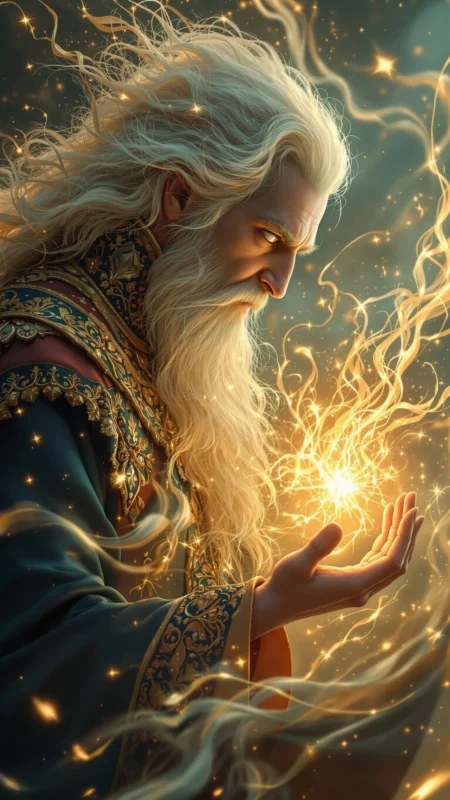
Dumbledore

Archetype Meaning & Symbolism

Wise, manipulative, benevolent, secretive, powerful, eccentric, patient, calculating, reassuring, flawed

  • It is our choices, Harry, that show what we truly are, far more than our abilities.

If Dumbledore is part of your personal mythology, you may...

Believe

  • You may believe that love is the most ancient and powerful magic, an invisible shield that can ultimately conquer any form of darkness or tyranny.

    You may believe that information is a form of power that must be wielded responsibly, and that it is sometimes an act of kindness to withhold the truth until someone is ready to hear it.

    You may believe that every soul has both light and dark within it, and that one's true character is defined not by innate talent or purity, but by the choices one makes.

Fear

  • You may fear that your good intentions will pave the way for a catastrophic outcome, that a choice made with love will inadvertently lead to someone's suffering.

    You may fear that the people you look up to are using you for their own ends, and that their benevolent guidance is a form of masterful manipulation.

    You may fear that you lack the strength to fulfill your own potential, that when the critical moment comes, you will choose the easy path over the right one.

Strength

  • You may possess an extraordinary capacity for long-term thinking, able to sacrifice immediate gratification for a distant, more meaningful goal.

    You may have a profound ability to see the potential in others and to act as a wise, patient, and effective mentor, guiding them toward their own strength.

    You may hold a deep, resilient well of hope, capable of finding light and purpose even in the most dire and desperate of circumstances.

Weakness

  • You may have a tendency toward secrecy and emotional withholding, creating distance in relationships under the guise of protecting others.

    You may feel a crippling weight of responsibility for events and people beyond your control, leading to deep-seated guilt and regret over past mistakes.

    You may struggle to see people as they are, instead viewing them as pieces in a larger puzzle, which can lead to unintentional manipulation and instrumentalizing of relationships.

The Symbolism & Meaning of Dumbledore

The Dumbledore archetype is the embodiment of flawed, burdened wisdom. He is the quiet king on the cosmic chessboard, seeing ten moves ahead and understanding, with a deep ache, the cost of every piece's movement. To have him in one's personal mythology is to court the idea that life is not a series of random events, but a tapestry woven with invisible threads, its pattern discernible only to those with the patience and perspective to see the whole. This archetype symbolizes the weight of knowing, the loneliness of leadership, and the profound ethical ambiguity of shaping another's destiny, even for their own protection. He is the lantern in the dark, but his light consciously leaves some corners in shadow, suggesting that some truths are too dangerous to face head-on.

He is also a symbol of power tempered by love, a force that could easily become tyrannical but is instead bridled by a deep, albeit complicated, affection for those he guides. This archetype suggests that the greatest strength is not raw power but the wisdom to know when and how to deploy it, and more importantly, when to restrain it. His presence in one's life story could signify a reckoning with one's own potential for influence, both light and shadow. He represents the painful choice to shoulder responsibility for the future, to make decisions that will not be understood or appreciated by those they are meant to save, and to live with the ghosts of past mistakes.

Ultimately, Dumbledore could be the patron saint of the 'greater good.' He personifies the belief that individual sacrifices are sometimes necessary for the survival of the collective, a deeply uncomfortable but persistent idea in human storytelling. He is the mentor who loves his protégé enough to lead him toward his painful destiny. His symbolism is a paradox: he is both a safe harbor and the one who pushes the ship into the storm, a comforting grandfather and a calculating general. To embrace this archetype is to embrace complexity itself, to find a strange peace in the knowledge that you can be both good and manipulative, both loving and distant, both right and terribly, tragically wrong.


Dumbledore Relationships With Other Archetypes

The Chosen One

The Dumbledore’s bond with The Chosen One may be less that of a simple teacher to a student, and more akin to the solemn, almost sacrificial relationship between a master luthier and a singular, irreplaceable violin. Every lesson, every hardship, every cryptic piece of advice could be seen as another layer of varnish, another tightening of a string, a meticulous, sometimes painful, calibration. The instrument is cherished, perhaps even loved, but its ultimate purpose is not its own comfort; its purpose is to play one perfect, world-altering note. The Dumbledore, as the luthier, may know that this final, magnificent resonance could be the very thing that shatters the vessel he has so carefully crafted.

The Shadow Self

With The Shadow Self, or The Dark Lord, The Dumbledore could be said to be in conversation not with a mere adversary, but with a haunted mirror. The conflict is rarely one of simple good versus evil; it is, perhaps, a terrible intimacy, a chess match between two players who learned the game at the same table. The Shadow may represent a path not taken, a corruption of shared ideals, a chilling reflection of what power without wisdom, or knowledge without love, can become. In the enemy’s face, The Dumbledore might see the ghost of his own youthful hubris, a constant, grim reminder that the line between a savior and a tyrant is a thread of shadow that one must walk for a lifetime.

The Secret

The Secret, for The Dumbledore, is perhaps less a key to be guarded and more a pearl forming around a shard of glass in the gut. It is not an inert piece of information but a living, internal burden that dictates posture and perspective. Its weight demands the construction of nacreous, shimmering layers of half-truth, misdirection, and noble lies, all to contain the sharp, wounding reality at its core. This agonizing process may yield something of great value to the larger world—a strategic advantage, a necessary hope—but for the keeper, it remains a constant, internal source of pain, a beautiful, terrible luminescence that is born only of a wound that cannot be allowed to heal.

Using Dumbledore in Every Day Life

Navigating a Difficult Choice:

When faced with a decision where both paths seem fraught with peril, the Dumbledore archetype within your mythos might urge you to look beyond the immediate outcome. It is not about choosing the easy path, but the one that aligns with a deeper, perhaps unarticulated, principle. You may find yourself playing a longer game, accepting a short-term loss for a future victory that only you can vaguely sense, trusting the strange music of your own intuition.

Assuming a Mentorship Role:

When someone younger or less experienced looks to you for answers, the Dumbledore archetype could guide you to provide not solutions, but tools. You might offer cryptic advice, a pointed question, or a resource that seems disconnected at first. The goal is not to solve their problem for them, but to gently nudge them toward their own discovery, understanding that true growth, like a phoenix's rebirth, must come from their own ashes.

Processing Betrayal:

In the wake of being wronged by someone you trusted, this archetype could offer a more complex lens than simple victimhood. It may allow you to hold two conflicting truths at once: the reality of the wound and the intricate, perhaps tragic, humanity of the one who inflicted it. This perspective does not demand forgiveness, but it shifts the narrative from a simple story of good versus evil to a more profound, and perhaps more sorrowful, understanding of human fallibility.

Dumbledore is Known For

Mastery and Power

An almost mythical level of skill and knowledge in his chosen field. He is not merely competent; he is the standard by which all others are measured, a repository of secrets and forgotten arts.

Strategic Secrecy

A penchant for withholding crucial information, revealing truths only at the most opportune or critical moments. This is not for malice, but from a belief that knowledge can be a burden or a weapon, and its timing is everything.

Benevolent Manipulation

Guiding events and people towards a desired outcome, often for a perceived greater good. He moves individuals like pieces on a chessboard, always with a kind of sorrowful affection for the pawns he must position for sacrifice.

How Dumbledore Might Affect Your Personal Mythology

How Dumbledore Might Affect Your Mythos

When the Dumbledore archetype takes root in one's personal mythos, a life story may begin to feel less like a biography and more like a sacred text full of prophecy and hidden meaning. Ordinary challenges are no longer just obstacles; they are tests, pieces of a larger puzzle arranged by an unseen, benevolent intelligence. You might interpret your personal history as a long, slow training montage for a battle you have yet to face. Your mythos becomes one of a 'chosen one,' not necessarily in a grandiose sense, but in the feeling that your specific struggles and talents are uniquely preparing you for a specific, vital purpose. The narrative arc bends toward a future confrontation with a great 'darkness,' whether that be a societal ill, a personal demon, or a family legacy.

This archetype also infuses one's mythos with a sense of curated destiny. You may feel that key people and opportunities did not arrive by chance, but were placed in your path. A chance encounter with a mentor, a book that falls off a shelf at the right moment, a sudden setback that forces a new direction: all of these could be seen as moves orchestrated by the Dumbledore of your psyche. Your life story is no longer solely your own creation; it is a co-authored work. This can be profoundly comforting, a belief that you are being guided and protected. But it can also be unsettling, introducing the question of how much of your life is truly your own choice, and how much is simply following a script written for you.

How Dumbledore Might Affect Your Sense of Self

To view oneself through the lens of this archetype is to see a vessel of untapped potential. You may believe that your true capabilities are immense, but dormant, waiting for the right key or the right guide to unlock them. This can foster a deep-seated humility, a sense that you are perpetually a student in life's great school. However, it may also lead to a kind of passive exceptionalism, a belief in one's own specialness that is contingent on external validation from a mentor figure. Your self-worth might become tied not to your accomplishments, but to your perceived role in a grand, unseen plan.

Furthermore, this archetype may instill a comfort with one's own complexity and contradictions. If the wisest, most powerful figure you know is also flawed, secretive, and haunted by regret, then perhaps your own imperfections are not signs of failure but badges of a shared, complicated humanity. You might see your own capacity for manipulation or secrecy not as a purely negative trait, but as a tool that could be used, for good or ill. This creates a self-concept that is less a pristine statue and more a weathered, ancient tree: gnarled, scarred, but rooted in deep, unseen soil.

How Dumbledore Might Affect Your Beliefs About The World

With Dumbledore as a guide, the world may cease to be a place of chaos and circumstance. Instead, it becomes a grand, intricate mechanism, a clockwork universe where every gear, even the seemingly broken one, serves a purpose. Events are not random; they are ripples from older, more significant stones cast into the lake of time. This worldview fosters a search for patterns, for the long game, for the connections between disparate events. It suggests that behind the mundane facade of reality, a great struggle between foundational forces—love and fear, choice and fate, light and darkness—is perpetually playing out.

This perspective could also color one's view of power and authority. The world may be seen as a place that requires wise, benevolent stewards who must sometimes make difficult, morally gray decisions for the masses. It is a view that is skeptical of simple populism and more trusting of a kind of enlightened, secretive council. It can breed a deep patience with the slow pace of progress, seen as the deliberate, careful moves in a millennia-long chess match. Evil is not just an act but a persistent force, a corruption that must be managed and fought in every generation, often with tools and sacrifices the public cannot understand.

How Dumbledore Might Affect Your Relationships

In the landscape of relationships, the Dumbledore archetype may cast you in the role of the benevolent chess master. You might view your connections through the lens of purpose and potential. A friend is not just a friend; they are an ally with specific strengths. A partner is a collaborator in a grand project. You may find yourself carefully curating what you share, not out of malice, but from a protective instinct that they 'aren't ready' for the full truth. This can lead to profound and meaningful mentorships, where you guide others toward their best selves, but it can also create a subtle but palpable distance, a sense that you are always managing the relationship rather than simply being in it.

Conversely, if you see yourself as the one being guided, you may seek out Dumbledore figures in your life: older, wiser, more powerful people to whom you can apprentice yourself. These relationships can be incredibly formative, providing a sense of safety and purpose. However, they may also foster a kind of dependency, a reluctance to fully trust your own judgment without the mentor's twinkling eye of approval. Love and affection become intertwined with duty and destiny. The question in relationships may shift from 'how does this person make me feel?' to 'what role does this person play in my story?'

How Dumbledore Might Affect Your Role in Life

The Dumbledore archetype deeply informs one's perceived role in the world, often casting it in epic terms. You may feel that you are not simply living a life, but fulfilling a destiny. This role is often one of quiet, burdened significance. You might see yourself as a secret guardian, a keeper of family histories, a mentor who shapes the next generation, or the unassuming hero-in-training. Your job is not just a job; it is a 'post' or a 'watch' in a larger struggle. This imbues life with a profound sense of meaning, but it can also be an incredibly heavy mantle to wear, isolating you with a sense of responsibility that others cannot share.

This perceived role is also often one of patience and observation. You may feel your purpose is not to be the primary actor, but the one who enables the hero, the one who clears the path, the one who whispers the key piece of information at the critical moment. It is a role defined by its relationship to a central narrative. You are the strategist, not the soldier on the front lines. This can lead to a powerful sense of vicarious achievement, but also a potential for feeling like a secondary character in your own life, your own fulfillment contingent on the success of another's quest.

Dream Interpretation of Dumbledore

To dream of a benevolent Dumbledore figure, perhaps with his characteristic twinkling eyes and calm demeanor, may be a message from the deep psyche offering reassurance. It could suggest that you possess the inner wisdom to navigate a current complexity, even if you feel lost. His appearance might be an affirmation that you are on the correct path, that the difficult choices you are making are part of a larger, positive unfolding. He could represent your own highest self, the wise old man or woman within, offering you a cryptic but loving piece of advice that will only make sense in the morning light. It is a dream of being held and guided by a force you can trust, even if you cannot fully comprehend it.

However, a dream of a cold, distant, or manipulative Dumbledore can be profoundly unsettling. This shadow version might represent a deep-seated fear of being used or controlled by an authority figure in your waking life: a boss, a parent, or a partner. It could symbolize a distrust of your own 'grand plans,' a fear that your well-intentioned strategies are actually self-deceptive or harmful to others. A dream of being a pawn in Dumbledore's game may be a warning from your subconscious that you have ceded too much of your own agency, sacrificing your own needs and desires for a 'greater good' that is not your own.

How Dumbledore Archetype Might Affect Your Needs

How Dumbledore Might Affect Your Physiological Needs

When Dumbledore inhabits the personal mythos, one's relationship with basic physiological needs—food, water, shelter, sleep—may be tinged with a sense of providence. There can be an underlying belief that if one is aligned with their true purpose, these fundamental needs will simply be met. Sustenance is not something to be anxiously pursued but something that will appear, like a house-elf with a tray of treacle tart, at the appropriate moment. This can foster a remarkable lack of anxiety about material security, a faith that the universe provides for those on a righteous quest.

Conversely, a disruption in this provision can feel like a spiritual crisis. A job loss or a financial setback is not just a practical problem; it could be interpreted as a sign of falling out of favor with the guiding principle of one's life. The absence of physiological security might feel like punishment, a signal that one has strayed from the path. This transforms basic survival needs into a barometer of one's moral or destined standing, making them emotionally and spiritually charged.

How Dumbledore Might Affect Your Ideas of Belonging

Belonging, for one with this archetype, may be found less in broad social circles and more in small, elite groups with a shared, secret purpose—a personal 'Order of the Phoenix.' The deepest connections are forged not through casual affinity but through shared struggle against a common 'darkness.' Love and friendship are intertwined with loyalty, duty, and a sense of being comrades-in-arms. This can lead to incredibly intense, resilient bonds, a sense of belonging that transcends mere social interaction and becomes a shared destiny.

However, this can also foster a kind of relational elitism or isolation. Those 'not in the know' or not part of the 'war effort' may seem mundane or unimportant. A subtle hierarchy of relationships can form, with those who share the secret purpose at the top and everyone else on the periphery. The need for love and belonging is met, but it is a concentrated, insular form of connection that can leave one feeling detached from the wider community, forever separated by the secrets you keep and the burdens you carry.

How Dumbledore Might Affect Your Feelings of Safety

Safety, within a Dumbledore-inflected mythology, is not the absence of danger, but the presence of a hidden safety net. One might walk willingly into perilous situations—a difficult conversation, a risky career move, a literal journey into the unknown—with the profound conviction that they are ultimately protected. The feeling is not one of invulnerability, but of being a cherished and essential piece in a game, one that the master player cannot afford to lose just yet. Safety is a matter of narrative importance; you are safe as long as your chapter is not over.

The fear, then, is not of the danger itself, but of misinterpreting the plan. The ultimate terror is the discovery that you were not the cherished piece after all, but the calculated sacrifice. This creates a unique form of anxiety: a hyper-vigilance for signs from the 'mentor' (whether internal or external), a constant seeking of reassurance that one is still valued, still part of the grand strategy. Safety is conditional, predicated on remaining useful to the unseen narrative, and the withdrawal of that benevolent, calculating gaze is the truest threat.

How Dumbledore Might Affect Your Views of Esteem

Esteem needs, when filtered through the Dumbledore archetype, are often met through external validation from a figure of authority and wisdom. Self-worth is not inherent; it is conferred. It comes from being chosen, from being praised for one's bravery, from being entrusted with a secret, from being told 'you are more than you know.' The path to esteem is one of apprenticeship and heroic trial, and one's value is measured by how well one plays their assigned part in the unfolding drama.

This creates a powerful engine for achievement and moral courage, but it can also make self-esteem incredibly fragile, wholly dependent on the mentor's approval. A moment of disapproval or a feeling of having failed the 'test' can be crushing, as it strikes at the very foundation of one's worth. Furthermore, there can be a disconnect from one's own innate abilities. Achievements may feel less like personal triumphs and more like proof that the mentor's faith was well-placed. The esteem is not for who you are, but for the person the Dumbledore figure believes you can become.

Shadow of Dumbledore

The shadow of Dumbledore is the tyranny of the greater good. It is the quiet, calm, and utterly certain conviction that you know what is best for everyone, and that this knowledge gives you the right to orchestrate their lives. When this shadow takes hold, mentorship curdles into manipulation, and guidance becomes control. You may justify deception, emotional withholding, and the placing of loved ones in harm's way as necessary sacrifices for a future victory that only you can see. It is the arrogance of the benevolent dictator, who loves his people so much he cannot grant them the freedom to make their own mistakes. The shadow is not loud or angry; it is the quiet, sorrowful whisper that says, 'I must do this for their own good.'

In its deepest expression, this shadow creates a profound loneliness, the isolation of the spymaster who trusts no one fully. It fosters a world where love is a strategic asset and people are instruments. The goal may be noble—the defeat of a great evil—but the methods corrode the soul, transforming the wise guardian into a puppet master who pulls the strings of those he claims to love. The greatest danger of the Dumbledore shadow is that it is so seductive, so seemingly reasonable. It is the slow, tragic process by which a protector becomes a jailer, all in the name of love.

Pros & Cons of Dumbledore in Your Mythology

Pros

  • A deep sense of purpose infuses your life, making challenges feel like meaningful tests rather than random misfortunes.

    You develop a capacity for patience and long-term strategic thinking, allowing you to navigate complex situations with wisdom.

    It fosters the potential for profound mentorship, enabling you to guide others toward their own potential with compassion and insight.

Cons

  • A tendency toward passivity can develop, waiting for a mentor's guidance or a sign from the universe instead of taking decisive, independent action.

    It can justify manipulative or secretive behaviors in relationships, creating emotional distance and undermining trust.

    You may become overly dependent on external validation from authority figures, leading to a fragile sense of self-worth.