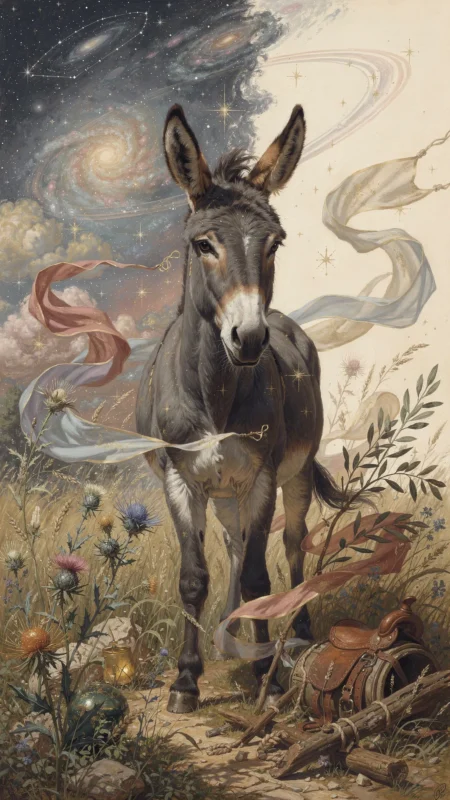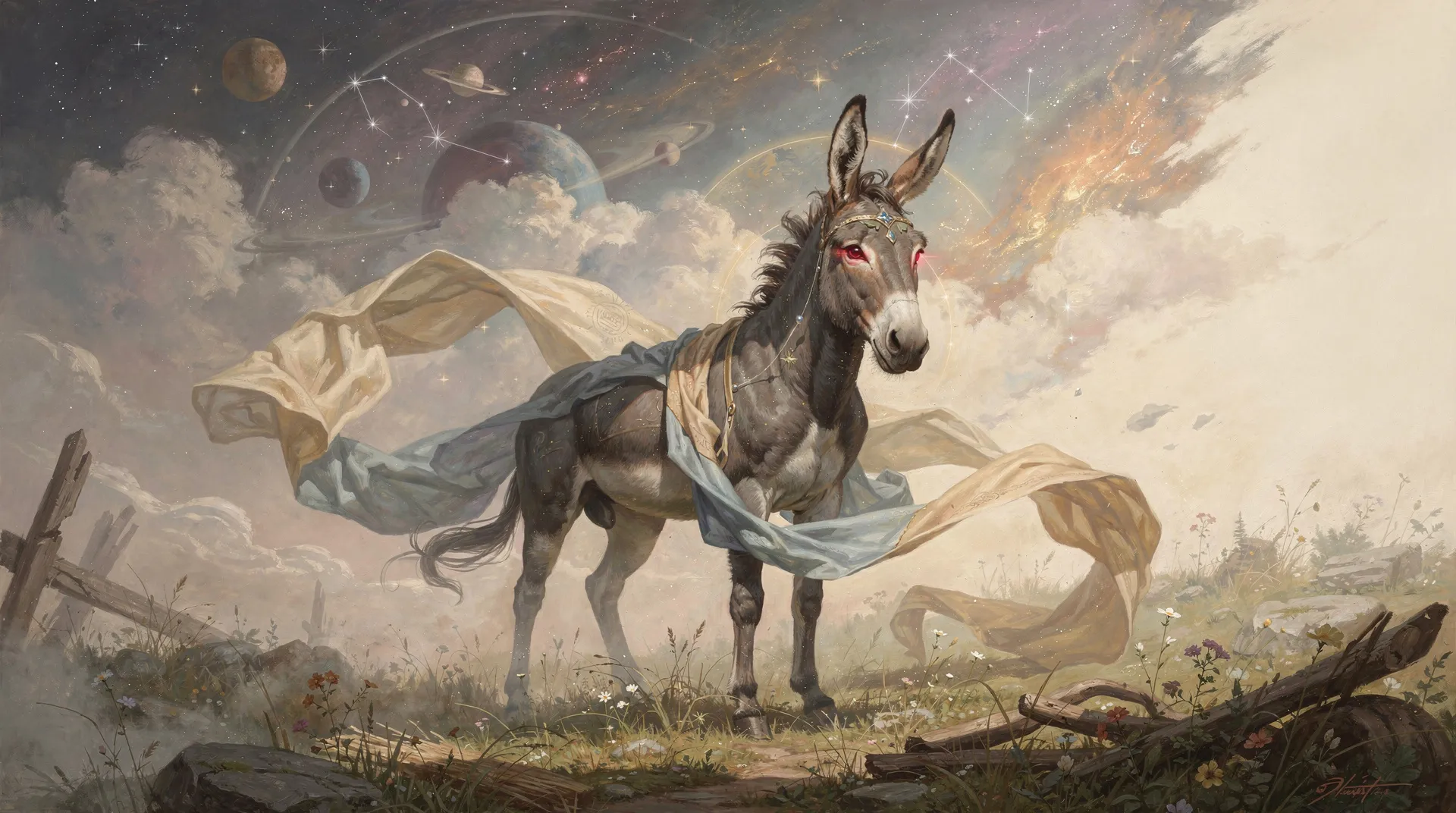


Donkey

Archetype Meaning & Symbolism

Loyal, talkative, persistent, optimistic, annoying, brave, insecure, insightful, needy, charming

  • You know what? You're right. That's it. That's it right there. That's the thing. It's the onion. You're a big, stinky, onion-layered ogre. You know what? I don't care. I'm stickin' with you.

If Donkey is part of your personal mythology, you may...

Believe

  • That no one is truly an island, and even the most fortified person has a crack where friendship can get in.
  • That talking about a problem, even incessantly, is the first and most important step to solving it.
  • That friendship is not a passive state but an active, ongoing choice that requires vocal affirmation and persistence.

Fear

  • True, irreversible silence and the profound loneliness it represents.
  • That your loyalty and emotional investment will ultimately be unreciprocated or taken for granted.
  • Being told to leave and having the door shut on you for good, with no chance to talk your way back in.

Strength

  • Unflinching loyalty: You will stick by your friends through ogre-like moods, dragon-filled castles, and royal intrigue.
  • Emotional intelligence: You can often perceive the emotional truth beneath a cynical exterior, even if you choose to address it with a joke.
  • Resilience: Rejection and insults may sting, but they rarely stop you for long. You bounce back with another question or a song.

Weakness

  • A lack of boundaries: You may not intuitively know when to stop talking, when to give someone space, or when a relationship is truly over.
  • Codependency: Your sense of self and happiness might be too heavily reliant on the approval and presence of another person.
  • Annoying persistence: Your greatest strength, when misapplied, can become a significant weakness, pushing people away instead of drawing them closer.

The Symbolism & Meaning of Donkey

The Donkey archetype is the modern incarnation of the Sacred Fool, the companion whose apparent simplicity masks a profound emotional wisdom. He is the heart that the cynical mind—the Shrek within us—desperately needs but will never admit to. In a world that prizes stoic independence, the Donkey champions the messy, vocal, and vulnerable power of connection. He symbolizes the truth that some walls are not meant to be smashed by force, but are instead meant to be dissolved by the gentle, persistent rain of unsolicited friendship. He is the song sung in the dark, the question asked when silence becomes a weapon, the stubborn hoof-fall that says, I am still here.

He is also the patron saint of the sidekick, a figure whose personal mythos redefines strength. His power is not in the sword, but in the word. He carries no weapon, yet he disarms a dragon. He does not lead the charge, yet the charge would falter without his morale-boosting chatter. The Donkey archetype suggests that true heroism may not be the solitary act of slaying the beast, but the collaborative act of making the journey bearable. He represents the vital importance of the witness, the cheerleader, the one who remembers to ask, “and then what happened?” His presence insists that no story is complete without the character who holds the emotional space for the hero’s transformation.

Perhaps most profoundly, the Donkey stands for the creation of family, not by blood, but by sheer, obstinate choice. He walks into Shrek’s swamp and, through nothing but his own refusal to leave, builds a home. He is a testament to the idea that belonging is a verb: an active, ongoing process of showing up, speaking up, and sticking around. In personal mythology, he represents the power to forge kinship in the unlikeliest of soil, to look at a lonely ogre, a cursed princess, and a lovesick dragon and see not a motley crew of outcasts, but the messy, imperfect, and beautiful shape of a family.


Donkey Relationships With Other Archetypes

The Prophet

There are, it may be said, two kinds of sight. The Prophet gazes toward the shimmering horizon, at the grand, celestial map of what is to come, and in so doing, could miss the angel shimmering in the dust of the path right before him. The Donkey, with its head perpetually bowed to the earth, its vision circumscribed by thistle and stone, may see only this immediate, terrestrial truth. Its famed stubbornness is not always a simple refusal to move, but perhaps a kind of profound, spiritual dissent; a loyalty to a reality the visionary, in his haste for revelation, has entirely overlooked. The Prophet’s grand pronouncements may thus depend, more than is ever acknowledged, on the quiet, unyielding wisdom of the beast who simply knows which way not to go, serving as a necessary anchor, a tether to the sacred and often-ignored ground.

The Open Road

The Donkey and the Open Road seem locked in a slow, peripatetic waltz, partners in a journey whose meaning is measured not in miles but in moments of endurance. The Road, for its part, may not exist to be conquered by speed, but to be understood one patient footfall at a time, a long, winding sentence that only reveals its story through a slow reading. The Donkey, in turn, could find its very soul in the grit and dust of the path, its purpose etched not in a final destination but in the ceaseless, rhythmic act of carrying on. This is not the relationship of a driver to a highway, but perhaps of a river to its ancient bed; the Road provides the channel for a life, and The Donkey is the humble, steadfast current that gives it motion, bearing its load of sorrows and small joys from one sunrise to the next, never asking for a map.

The Crown

The Crown glitters with the light of a distant heaven, a symbol of authority so absolute it often blinds those who look upon it, and sometimes, those who wear it. The Donkey, by contrast, is a creature of shadow and stable, a vessel of humility. Their meeting, therefore, could be a paradox that dismantles our very notion of power. When the Crown chooses to ride upon The Donkey, it is perhaps an admission that true sovereignty is not found in the thunder of conquest or the weight of gold, but in a radical act of lowering oneself. The Donkey doesn't become royal in that moment; rather, the Crown may become something more profound—grounded, accessible, and borne not by the force of arms, but by the quiet, unadorned strength of service. In that dusty procession, the weight of glory is perhaps finally understood not as a privilege, but as a burden to be carried with grace.

Using Donkey in Every Day Life

Breaking Through to the Cynic

When faced with a colleague, friend, or family member encased in cynicism, the Donkey archetype offers a strategy not of force, but of relentless, cheerful presence. It is the art of asking another question when the first is rebuffed. It is bringing up waffles in a tense silence. You may use this mythos to gently wear down another's defenses, not through argument, but through a stubborn refusal to believe their fortress is impenetrable, proving that connection is worth the initial annoyance.

Finding Courage in Company

The Donkey archetype provides a map for navigating fear. He is rarely brave in the stoic sense; his courage is vocal, anxious, and deeply reliant on companionship. To apply this, you might face a daunting task—a public speech, a difficult conversation, a creative risk—by bringing a friend. You don't pretend not to be scared. Instead, you talk through the fear, you make jokes about the dragon in the castle, and you draw strength not from your own solitary grit, but from the simple, shared knowledge that you are not crossing the rickety bridge alone.

Cultivating Joy in the Mundane

In the long, monotonous stretches of any journey, the Donkey finds a reason to sing. This archetype is a powerful tool against the crushing weight of a solemn quest. You can invoke it by choosing to find delight in the interstitial moments. It’s the practice of making 'are we there yet?' a game instead of a complaint. It is the belief that the conversation on the road is as important as the destination, that a good friend and a stupid song can transform a grim march into a memorable adventure.

Donkey is Known For

Unwavering Friendship

His defining characteristic is his relentless loyalty to Shrek, breaking through the ogre's isolated exterior to forge an iconic and inseparable bond.

Incessant Chatter

He is famously and comically talkative, filling every silence with questions, observations, and songs, often to the annoyance of his companions.

Romancing a Dragon

In a surprising twist, Donkey's charm and persistence win the heart of the Dragon who was meant to be his captor, representing his ability to find connection in the most unlikely of places.

How Donkey Might Affect Your Personal Mythology

How Donkey Might Affect Your Mythos

To integrate the Donkey into your personal mythos is to re-narrate your life story from a solo hero's journey into a profound duet. The pivotal moments may no longer be solitary triumphs of will, but moments of shared vulnerability and connection. The story ceases to be “how I climbed the mountain” and becomes “how we kept each other from falling, how we sang off-key to ward off the cold.” Your personal legend might be marked by the ‘before’ and ‘after’ of letting a Donkey into your swamp: a timeline defined by the shift from proud isolation to the complex, noisy, and ultimately nourishing reality of companionship.

Furthermore, your mythos may become a chronicle of persuasion, not of power. The great battles are won not in fields of combat, but in conversations. The climax of your story might be the moment you finally convince a cynical part of yourself, or another person, to believe in something better. Your life’s narrative could be seen as a series of successful, hard-won connections, where your greatest magic was the ability to talk a monster into friendship, to turn a fearsome dragon into an ally, and to insist on a “happily ever after” that includes everyone, even the annoying talking animals.

How Donkey Might Affect Your Sense of Self

With the Donkey as a guide, you may perceive your own 'annoying' qualities—your talkativeness, your emotional expressiveness, your need for reassurance—not as flaws, but as integral parts of your gift for connection. You might see yourself as an emotional catalyst, someone whose purpose is to inject heart and humor into sterile environments. Your self-worth could be deeply tied to your ability to see the good in others, especially when they cannot see it in themselves. You are the 'noble steed,' and you come to accept that your nobility lies in your spirit, not your stature.

Conversely, the Donkey archetype might cast a shadow of codependency on your self-concept. You may struggle with feeling like a 'plus-one' in your own life, your identity contingent on the 'Shrek' you have chosen to follow. A central conflict could be the quest to find your own independent worth, to realize that while you are a fantastic friend, you are also a complete person on your own. Your journey of self-discovery might be about learning to romance your own dragon, to build your own swamp, and to sing your own songs, for your own enjoyment.

How Donkey Might Affect Your Beliefs About The World

Your view of the world may be filtered through a lens of relentless optimism about the power of connection. You might see a world not of isolated, sovereign individuals, but of potential friendships waiting to be forged. Every guarded person is simply an ogre with layers, and every fearsome problem is a dragon that might just need a friend. You may believe that no conflict is truly intractable, that with enough talking, enough vulnerability, and a few ill-timed jokes, even the most hardened hearts and most dire situations can be softened.

This worldview could also be a form of rebellion against cynicism. To be a Donkey in a world that valorizes the grim, solitary hero is a radical act. It is to insist on joy in the face of despair, on conversation in the face of violence, and on togetherness in the face of isolation. Your philosophy might be that the world is not saved by grand, silent gestures, but by the small, noisy, persistent acts of showing up for one another. The world doesn't change through earthquakes, but through the slow, erosive power of a river of chatter.

How Donkey Might Affect Your Relationships

In relationships, you may often be the initiator, the pursuer, the one who refuses to let things go unresolved. You are the engine of connection, perpetually stoking the fire with conversation, affection, and forgiveness. Your relational pattern might involve being drawn to 'projects'—emotionally distant or wounded individuals whom you feel compelled to 'save' with your unwavering loyalty. You might believe that your love, if applied with enough persistence, can heal any wound and breach any wall.

This dynamic, however, can place an immense burden on you. You may perform the lion’s share of the emotional labor, constantly giving while receiving little in return, mistaking tolerance for acceptance. The Donkey mythos may teach you a hard lesson: discerning the difference between a friend who needs gentle persuasion and a person who is simply taking advantage of your good nature. The challenge becomes learning that true, reciprocal friendship doesn't require you to endlessly knock on a bolted door.

How Donkey Might Affect Your Role in Life

You may perceive your role in any group or system as the social and emotional adhesive. You are the heart, not the head. You may not be the one to chart the course or make the final decision, but you are the one who ensures everyone feels seen, heard, and valued along the way. Your function is to maintain morale, to foster communication, and to remind the 'heroes' of their own humanity. You find purpose in being the indispensable companion, the one whose absence would make the entire enterprise feel colder and heavier.

This can lead to a feeling of being perpetually in a supporting role, your vital contributions overlooked in favor of more visible, traditionally heroic achievements. The hero gets the kingdom; you might feel you only get the quirky, unconventional prize. A significant part of your life's work could be to claim the importance of your role, to advocate for the value of emotional labor, and to understand that the one who helps the hero become a hero is, in fact, a hero themselves.

Dream Interpretation of Donkey

In a positive dream context, the appearance of the Donkey is a powerful omen of connection and emotional breakthrough. He may arrive when you are feeling isolated or when a relationship has grown cold and distant. His presence could be your subconscious urging you to speak your truth, to risk vulnerability, or to persist in a friendship that matters. To dream of Donkey is to be reminded that you are not alone on your journey, and that joy can be found by simply sharing the road with another.

In a more challenging dream, Donkey could represent a gnawing fear of being annoying or a feeling that your emotional needs are a burden to others. He might appear when you feel your voice is being ignored or when you suspect your loyalty is being exploited. A frantic, unheard Donkey in a dream could symbolize a part of you that feels codependent, desperate for external validation from a 'Shrek' figure in your waking life. He might be a warning that you are losing yourself in the service of another, and that it is time to find your own voice, for your own sake.

How Donkey Archetype Might Affect Your Needs

How Donkey Might Affect Your Physiological Needs

When the Donkey archetype shapes your personal myth, your basic physiological needs may feel inseparable from companionship. Hunger is not just a need for calories, but a need for someone to make waffles with. Rest is not just about sleep, but about feeling safe enough to close your eyes because someone you trust is nearby. Being alone might register not just as an emotional state, but as a low-grade physiological threat, a subtle hum of anxiety that only dissipates with social contact. Sustenance, for you, is both physical and relational.

This archetype could also manifest as a distinct physical energy: a restlessness in the limbs, a need to be in motion, a voice that fills silence instinctively. Stillness might feel unnatural, even dangerous, as if ceasing your chatter or your movement could cause you to disappear or be forgotten. Your body may run on a kind of nervous, social fuel, always seeking the next interaction to feel grounded and regulated. The physiological baseline is not calm, but an energetic, engaged hum.

How Donkey Might Affect Your Ideas of Belonging

Belonging, in the Donkey mythos, is not a passive state of being accepted but an active, often arduous, act of creation. You may believe that you belong where you decide you belong, and you are willing to put in the work to make it so. Rejection is not a final verdict but simply an obstacle to be talked around. You might be the one to forge a family from a group of strangers, to insist on community where there is only isolation. Your sense of belonging is a house you build yourself, often on land where you were not initially welcome.

This relentless drive for inclusion can lead to a profound lack of boundaries. The deep-seated belief that love is always attainable through persistence can cause you to ignore clear signals that your presence is not wanted. You may exhaust yourself trying to pry open doors that are meant to stay closed, mistaking another's boundaries for a challenge to be overcome. The danger is that in your quest to belong everywhere, you may lose the sense of where you, as an individual, truly begin and end.

How Donkey Might Affect Your Feelings of Safety

For one who carries the Donkey mythos, safety is not a place; it is a person. The high walls of a castle or the solitude of a swamp offer no real security. True safety is the unwavering presence of a friend who has your back. The greatest terror is not the fire-breathing dragon, but the prospect of facing it by yourself. You may feel most secure when you are part of a team, your vulnerability shielded not by armor, but by the strength of a shared bond. Safety is the knowledge that if you fall, someone will complain loudly while helping you up.

This reliance on others for safety can become a liability. Your fear of isolation may be so profound that you remain in situations or relationships that are no longer secure, simply because the alternative—being alone—feels more dangerous. The Donkey’s need for companionship can cloud judgment, leading you to trust too readily or to ignore red flags. The shadow of this need is a safety that becomes codependence, where the perceived security of a toxic relationship is chosen over the frightening freedom of solitude.

How Donkey Might Affect Your Views of Esteem

Your self-esteem is likely fueled by your utility and loyalty to your chosen companions. You feel a profound sense of worth when you have successfully broken through someone’s defenses, offered comfort, or demonstrated your unwavering friendship. Being called a “noble steed” is the highest compliment, confirming your value as a steadfast and supportive ally. Your esteem is a reflection in the eyes of those you love; you feel good about yourself when you know you have made their journey brighter.

However, this can create a persistent struggle against feeling secondary. You may measure your own worth against the more traditionally heroic deeds of others and find yourself wanting. The 'hero' gets the glory, and you might feel your contributions are relegated to the footnotes of the story. A core challenge to your self-esteem is learning to value your own qualities—your humor, your emotional bravery, your resilience—as primary strengths, not just as assets in service of someone else's quest.

Shadow of Donkey

When the Donkey archetype falls into shadow, it becomes a suffocating force. The charming chatter devolves into a desperate, anxious monologue that sucks the oxygen from a room, a filibuster against the terror of silence. Loyalty warps into a form of emotional entrapment; the constant presence is no longer a comfort but a cage, guilt-tripping others into staying. This shadow does not respect boundaries, viewing a closed door not as a need for privacy but as a personal affront to be overcome. It is the need for connection twisted into a parasitic demand for attention, driven by a fear of abandonment so profound that it steamrolls the autonomy of others.

The repressed shadow of the Donkey is the bitter cynic who secretly yearns for connection. This is the Shrek before the quest, stewing in a swamp of self-imposed isolation. Having been hurt or rejected, this shadow archetype scoffs at vulnerability and dismisses optimism as naive. It’s a performance of proud independence that masks a deep well of loneliness. This shadow keeps everyone at arm's length with sarcasm and grumpiness, all the while harboring a secret, desperate hope that someone will be persistent and foolish enough to see through the act and refuse to leave.

Pros & Cons of Donkey in Your Mythology

Pros

  • You build deep, meaningful, and incredibly resilient friendships that can withstand almost any trial.
  • You bring light, humor, and a contagious optimism to even the darkest of situations, raising the morale of everyone around you.
  • You are exceptionally skilled at breaking down emotional barriers and helping guarded people connect with their own vulnerability.

Cons

  • You may be perceived by others as annoying, needy, or lacking in social awareness.
  • Your tendency to forgive and persist can lead you into one-sided or unhealthy relationships where your emotional labor is taken for granted.
  • You might struggle with feeling like a supporting character in your own life, your own needs and accomplishments perpetually overshadowed by those you support.