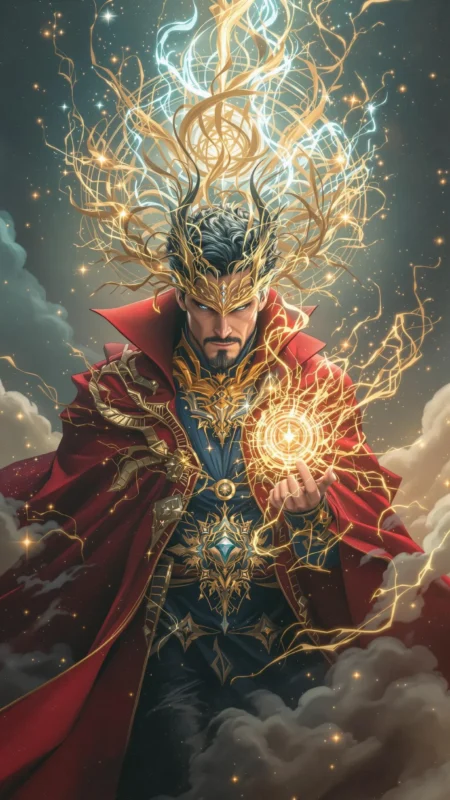
Doctor Strange

Archetype Meaning & Symbolism

Intellectual, Arrogant, Transcendent, Disciplined, Sacrificial, Inquisitive, Esoteric, Precise, Detached, Visionary

  • We don't get to choose our time. Death is what gives life meaning. To know your days are numbered, your time is short.

If Doctor Strange is part of your personal mythology, you may...

Believe

  • You may believe that reality is a conversation, not a statement, and that with the right syntax, you can add to it.
  • You may believe that the greatest limitations are not external, but are self-imposed constructs of the ego that can be dismantled through discipline and humility.
  • You may believe that knowledge confers not power, but a profound and heavy responsibility.

Fear

  • You may fear that some doors of perception, once opened, can never be closed, leaving you permanently untethered from the comfort of common reality.
  • You may fear that in the pursuit of cosmic understanding, you will lose your own humanity, forgetting how to connect with the simple, grounding truths of love and friendship.
  • You may fear the ultimate bargain: that the price of saving everything might be sacrificing the one thing you hold most dear.

Strength

  • You may possess a formidable intellect and an unshakeable capacity for mental discipline, allowing you to master complex subjects that overwhelm others.
  • You may have the ability to perceive underlying patterns and long-term consequences, making you a brilliant strategist and problem-solver.
  • You may embody a deep, quiet resilience, having been forged in the crucible of a profound personal loss that you transformed into your greatest strength.

Weakness

  • You may have a tendency toward intellectual arrogance, sometimes dismissing the wisdom or concerns of those who operate on a different intellectual or spiritual plane.
  • You may struggle with emotional availability and intimacy, holding others at a distance to maintain a sense of control or perspective.
  • You may feel compelled to carry the world's burdens alone, refusing to ask for help and isolating yourself under the weight of your own responsibilities.

The Symbolism & Meaning of Doctor Strange

To invite Doctor Strange into your personal mythology is to court a fundamental schism between the seen and the unseen. He is the patron saint of the disillusioned empiricist, the man of science who hit a wall and discovered the wall was, in fact, a door. His symbolism is rooted in this rupture: the scalpel exchanged for the sigil, the MRI scan for the astral projection. He represents the belief that the universe is not a machine to be understood but perhaps a language to be learned, a piece of music to be felt. Your life, in this context, might become a similar search for the hidden syntax of reality, looking for the backdoors and cheat codes not for personal gain, but for a glimpse of the source code itself.

The Cloak of Levitation, the Eye of Agamotto: these are not mere accessories. They are externalizations of an inner state. The cloak could symbolize a perspective that allows one to float above the petty squabbles of the day-to-day. The eye may represent a piercing intuition that sees the long, complex causal chains of life, the way a decision made today will ripple across a decade. In your own life, this symbolism may manifest as a pull toward ancient knowledge, a fascination with complex systems, or the development of a long-term vision that others find baffling or impractical. It is the symbolism of the cartographer of unseen realms, a role that demands both intellectual rigor and a courageous leap of faith.

Ultimately, this archetype embodies the profound paradox of control through surrender. Stephen Strange only gains power when he admits his powerlessness. He has to unlearn a lifetime of certainty to grasp a truth that is fluid and conditional. For one's personal mythology, this means the moments of greatest potential may be disguised as moments of total failure. He symbolizes the wisdom in the wound, the idea that only by being broken open can one make room for the cosmos to rush in. He is the promise that at the end of your rope, you may not find an abyss, but a thread leading to an entirely different tapestry.


Doctor Strange Relationships With Other Archetypes

The Broken Compass

The relationship between the Doctor Strange archetype and the Broken Compass may be one of spiritual kinship, a camaraderie of the shattered instrument. Before his fall, the surgeon's hands were his true north, a compass of unerring precision pointing toward material solutions. When that instrument was broken, he was left spinning, unmoored from the world he so thoroughly commanded. The Broken Compass, however, does not signify an end to navigation, but perhaps the beginning of a truer form of it. It ceases to point toward the charted, terrestrial world, and in its wild spinning, it could be seen as faintly tracing the contours of all other, unseen dimensions. It is an artifact that has exchanged mundane utility for mystical sensitivity, a journeyer’s tool that now points not to a place, but to a state of being, a necessary disorientation before the discovery of a cosmic pole star.

The Unsolvable Koan

For an intellect as sharp and arrogant as a scalpel, the Unsolvable Koan could initially appear as a profound antagonist. It is a locked gate of logic, a riddle that does not bend to the force of a superior mind but instead mocks its very structure. Doctor Strange, the man of science, might have once approached such a paradox with the intent to dissect and solve it, only to find its meaning evaporating under his analytical gaze. The archetype’s true journey, however, may involve a slow surrender. His relationship with the Koan is not one of conquest but of inhabitation. He does not find the answer; he becomes the living space in which the question resides. He learns that the point of the paradox is not to be resolved, but to crack open the vessel of the rational mind, allowing a much stranger light to pour in.

The Keeper of the Orrery

In the Keeper of the Orrery, the Doctor Strange archetype may see a ghost of a former self, a master of a universe both elegant and reassuringly finite. The orrery, with its brass planets spinning on predictable tracks, represents a clockwork cosmos, a reality that can be known, charted, and maintained. It is the beautiful, silent ballet of Newtonian physics. Doctor Strange, however, has graduated from this role to become the guardian of a far more terrifying and alive mechanism—a multiverse whose gears are entire dimensions and whose cosmic dust is the stuff of raw creation. His relationship with the Keeper is thus one of poignant transcendence. He has traded the polished model for the chaotic original, standing guard not over the predictable orbits of celestial bodies, but over the fragile membrane that separates their silent dance from the cacophonous symphony of all that could be.

Using Doctor Strange in Every Day Life

Navigating Career Crises:

When a foundational pillar of your identity, perhaps a career you spent decades building, crumbles, the Strange archetype offers a path through the wreckage. It is the story of losing the use of the surgeon’s hands only to discover the mind’s capacity to bend reality. This mythos doesn't offer a replacement career: it suggests a transmutation of purpose, from a role defined by external skill to one defined by internal, esoteric wisdom. You may find yourself drawn not to a new job, but to a new discipline, a new way of seeing that renders the old loss a necessary prologue.

Confronting Existential Dread:

In moments when the material world feels like a closed, meaningless loop, the Doctor Strange myth invites you to knock on a different door. It is the archetype of the ultimate empiricist forced to accept phenomena beyond measurement. To use this mythos is to consciously entertain the impossible, to read the arcane text, to meditate on the mandala, to accept that the universe’s operating system is far stranger than you imagined. It turns dread into curiosity, a confrontation with the void into a conversation with it.

Rebuilding After Personal Failure:

The journey to Kamar-Taj is a pilgrimage of profound humility. When your own arrogance or error has led to ruin, this archetype provides a blueprint for recovery that is not about apology, but about ablation of the ego. It involves submitting to a rigorous new form of learning, accepting that you are once again a novice. This path suggests that the most potent form of rebuilding is not restoring what was lost, but dissolving the self that failed and forging a new one with the discipline to wield its new power responsibly.

Doctor Strange is Known For

Mastery of the Mystic Arts

His defining capacity, representing the triumph of disciplined intellect and spiritual surrender over the apparent laws of physics. It symbolizes the idea that reality is a construct that can be edited with sufficient will and knowledge.

The Eye of Agamotto

A tangible symbol of cosmic insight. It represents not just the power to see possibilities or manipulate time, but the immense burden of that knowledge

the responsibility of knowing the cost of every choice.

Transformation from Arrogance to Wisdom

His core narrative arc is a journey from a self-obsessed materialist to a selfless guardian of reality. This is the archetype’s central promise

that the most broken parts of the self can become the foundation for the most profound strength.

How Doctor Strange Might Affect Your Personal Mythology

How Doctor Strange Might Affect Your Mythos

When Doctor Strange becomes a key figure in your personal narrative, your life story may cease to be a linear progression and instead become a spiral of initiation. The mythos shifts from one of acquisition: of wealth, status, or relationships: to one of perception. Major life events are no longer milestones but portals. A lost job is not a failure but the destruction of a false self. A period of isolation is not loneliness but a necessary hermitage for study. Your personal history might be re-contextualized as a series of lessons in humility, each one stripping away a layer of ego to reveal a more essential, resilient core.

The narrative arc may pivot toward a great sacrifice. The story is no longer about what you can get, but what you are willing to give up for a purpose larger than yourself. This could be comfort, conventional success, or even the understanding of your peers. Your mythos becomes one of a guardian, a keeper of a secret flame. You might see yourself as one who stands on a precipice, holding a line against some form of chaos: perhaps the chaos of misinformation, of spiritual nihilism, or of corporate conformity. Your life is no longer just your own; it's a chapter in a much older, larger story.

How Doctor Strange Might Affect Your Sense of Self

Integrating this archetype could radically redefine your concept of self. The ego, once the protagonist of your story, may be demoted to a supporting character, or even an obstacle. Self-worth might detach from external achievements and anchor itself in internal discipline and understanding. You might see the 'self' not as a fixed entity, but as a lens, a tool for perceiving reality that can be ground, polished, and refocused. This can be profoundly liberating, freeing you from the tyranny of personal ambition and the fear of failure. The goal is no longer to build a successful self, but to become a clear conduit for something greater.

This transformation, however, carries the risk of detachment. In seeing the larger patterns, the individual moments and emotions that constitute a life can begin to seem trivial. You may perceive your own pain, joy, and desires from a great remove, as data points in a larger equation. This could lead to a calm, imperturbable demeanor, a state of enlightened observation. Or, it could foster a cold intellectualism, a self that is so identified with the cosmic perspective that it forgets how to be a person, how to connect with the messy, beautiful, illogical experience of being human.

How Doctor Strange Might Affect Your Beliefs About The World

Your worldview may become layered, like a palimpsest. Beneath the surface of ordinary, consensus reality, you might perceive other dimensions, other possibilities, other rules. The world is no longer a solid, predictable place governed by Newtonian physics alone; it is a quantum foam of potential, a multiverse of branching timelines. This perspective fosters a profound sense of wonder and curiosity. Nothing is merely what it seems. A coincidence could be a synchronicity, a moment of déjà vu could be a glimpse into another timeline, a political crisis could be a manifestation of a deeper archetypal struggle.

This expanded view can also be profoundly isolating. The concerns that animate most of society: the stock market, celebrity gossip, partisan politics: may seem like shadows on a cave wall. You might feel like an astronomer at a party where everyone else is looking at their shoes. This can lead to a quiet withdrawal from the mainstream, a preference for the company of books, complex ideas, or the very few who share your view of a deeper, stranger reality. The world is infinitely more interesting, but you may feel, at times, like its only conscious inhabitant.

How Doctor Strange Might Affect Your Relationships

Relationships may be viewed through a cosmic or karmic lens. A connection with another person is not just a meeting of two personalities; it could be a lesson to be learned, a debt to be paid, or a partnership in a task that transcends both individuals. This can lend a profound sense of meaning and purpose to your connections. You might approach relationships with immense patience and a desire to understand the deeper dynamics at play. You may feel a selfless duty to protect or guide those you love, seeing them as integral parts of the cosmic pattern you are sworn to uphold.

However, the Strange archetype can foster a difficult emotional distance. The tendency to see the big picture can make it hard to be present in the small moment: the shared joke, the comforting touch, the mundane complaint. You may seem aloof, preoccupied, or condescending, as if you are operating on a different plane of existence. Intimacy may be a challenge, as true intimacy requires a vulnerability and immersion in the personal that the archetype resists. There is a danger of treating people as concepts or roles in your grand narrative rather than as unique, sovereign individuals with their own messy, beautiful lives.

How Doctor Strange Might Affect Your Role in Life

Your perceived role in the world may shift from participant to guardian. You are not here to win the game, but to ensure the game can continue. This might manifest as a professional calling in fields that deal with complex systems: a theorist, a strategist, a coder building foundational architecture. Or it could be a more personal, unspoken role: the family's secret keeper, the friend who offers disturbingly accurate but difficult advice, the quiet observer in a community who sees the underlying fractures no one else will acknowledge. Your role is defined by knowledge and responsibility, not by status or reward.

This sense of responsibility can be a crushing weight. The archetype is defined by sacrifice: Strange gives up his life, his love, his hands, his peace, all in service of his role. You may feel a similar compulsion to take on immense burdens alone, believing that only you can see the true nature of the threat or the complexity of the problem. This can lead to a heroic, but deeply lonely, existence. The role of the Sorcerer Supreme is a solitary one; you may find your own role demands a similar, painful isolation from the very world you are trying to protect.

Dream Interpretation of Doctor Strange

To dream of Doctor Strange in a positive light is often to receive a call from the subconscious to expand your mind. His appearance might signal that your current ways of thinking are too limited and that you are ready to explore new philosophies, spiritual practices, or complex fields of knowledge. The dream could be an encouragement to embrace a difficult intellectual challenge or to trust your intuition about the hidden patterns in your life. He may appear as a mentor, handing you a key or a book, symbolizing that you already possess the tools for the next stage of your development. It is an invitation to become the architect of your own reality.

In a negative context, dreaming of this archetype can be a warning from the psyche about the dangers of intellectual arrogance and emotional detachment. He might appear cold, dismissive, or trapped in a kaleidoscopic prison of his own making, representing a fear of getting lost in abstractions and losing touch with grounded, emotional reality. Such a dream could indicate that your pursuit of knowledge has become a defense mechanism, a way to avoid confronting messy feelings or intimate relationships. He might be battling a formless monster, symbolizing a struggle with a problem that logic alone cannot defeat, urging you to integrate heart and mind.

How Doctor Strange Archetype Might Affect Your Needs

How Doctor Strange Might Affect Your Physiological Needs

The Doctor Strange archetype represents a profound reordering of Maslow's hierarchy, where physiological needs are not the base but an inconvenience to be mastered or transcended. If this figure resonates within your mythos, you may treat your body as a tool, a vehicle for the mind, rather than a source of pleasure or a core part of your identity. Sustenance, sleep, and comfort could be seen as mere operational requirements, secondary to the pursuit of knowledge or the execution of a higher duty. This can foster incredible discipline and resilience: fasting, all-night study sessions, or ignoring physical discomfort become badges of honor, proof of the mind's dominion over the flesh.

This mastery, however, can easily curdle into neglect. The body, when treated merely as a servant, can break down. The mythos of Strange begins with a physical breaking: the destruction of his hands. To live this archetype is to walk a fine line between disciplining the body and punishing it. There is a risk of developing a deep disconnect from your physical self, ignoring signals of exhaustion, illness, or stress until a crisis forces you to pay attention. The challenge is to care for the vessel not for its own sake, but because a clear mind requires a functioning instrument, integrating physical well-being into the spiritual practice rather than seeing it as a worldly distraction.

How Doctor Strange Might Affect Your Ideas of Belonging

The need for belongingness, when filtered through the Doctor Strange archetype, shifts from a desire for broad social acceptance to a search for a sacred order. You may feel a sense of profound alienation from mainstream groups, whose concerns seem trivial and whose beliefs seem superficial. Conventional social gatherings can feel like speaking a different language. Belonging is not found in the crowd but in a lineage: a connection to the great thinkers, mystics, and guardians who came before. It is the quiet community of the library, the esoteric school, the select few who have also glimpsed the world behind the world.

This can result in a small, yet intensely meaningful, circle of relationships. You may find your 'tribe' among fellow seekers, academics, or creators who share your passion for deep, complex truths. The bond is not one of shared experience, but of shared perception. Yet, the cost is often a pervasive loneliness. The role of the Sorcerer is a solitary one, and you may feel a similar isolation, set apart by the very knowledge that defines you. The challenge is to build a bridge back to the world, to find a way to love and belong to a humanity that may never fully understand the burdens you carry or the realities you perceive.

How Doctor Strange Might Affect Your Feelings of Safety

Safety, within this archetypal framework, is radically redefined. The conventional markers of security: a stable income, a safe neighborhood, a predictable routine: may lose their primacy. The pursuit of this kind of safety could even be viewed as a trap, a gilded cage that prevents true growth. Instead, safety might be sought on a metaphysical level. The greatest danger is not physical harm, but a closed mind, spiritual stagnation, or a failure to uphold a cosmic responsibility. You might feel safer in a library of arcane texts than in a fortified home.

This redefinition could lead you to actively court what others perceive as danger. You might embrace intellectual or existential risks, deliberately destabilizing your worldview to provoke a breakthrough. The comfort zone is the enemy. However, this can manifest as a form of recklessness, a neglect of practical, real-world dangers. The focus on mystical threats can blind you to the mundane ones. There is a danger of being so focused on defending reality from Dormammu that you forget to look both ways before crossing the street. True safety, in the synthesis of this myth, lies in mastering both realms: navigating unseen dimensions while still respecting the unforgiving laws of the physical world.

How Doctor Strange Might Affect Your Views of Esteem

Esteem needs are inverted by the Doctor Strange mythos. The craving for external validation, applause, and public recognition, which defined Stephen Strange the surgeon, is the very thing that must be sacrificed. For you, self-esteem may become divorced from what others think and rooted entirely in internal metrics: intellectual mastery, spiritual discipline, and the quiet integrity of fulfilling a difficult duty. Your pride comes not from being admired, but from understanding a complex problem, not from winning an award, but from making a sacrifice no one will ever know about.

This internal locus of esteem fosters immense resilience and independence. You are not swayed by criticism or flattery. However, it can also calcify into a potent form of spiritual arrogance. The belief that your understanding is superior can lead to a condescending attitude toward others and an inability to learn from those you deem less 'enlightened.' True esteem, as the fully realized archetype demonstrates, is tempered by humility. It is the recognition that even as Master of the Mystic Arts, one is still just a single thread in an infinite cosmic tapestry, a student for eternity.

Shadow of Doctor Strange

The shadow of Doctor Strange is the magus who has fallen in love with his own reflection in the cosmic void. It is the pursuit of knowledge not for wisdom but for power, the desire to bend reality not in service but in domination. This shadow aspect manifests as a chilling intellectual superiority, a belief that one's enlightened perspective grants a license to manipulate others 'for their own good.' It is the hubris of the surgeon reborn in the sorcerer, a man who believes he is the singular intelligence in a world of fools. This path leads not to enlightenment, but to a gilded cage of solitude, a universe where every other being is merely a pawn on a chessboard of infinite dimensions, and love is a tactical error.

Another facet of the shadow is a crippling analysis paralysis. Faced with the infinite possibilities glimpsed through the Eye of Agamotto, the shadow self becomes unable to act. Every choice is shadowed by a million alternate outcomes, every decision negated by a potential, more optimal path. Instead of becoming a master of reality, one becomes its prisoner, trapped in a kaleidoscopic hell of pure potential, unable to commit to the single, messy, imperfect timeline of lived experience. The shadow Strange is not the one who bargains with Dormammu; he is the one who, in contemplating the 14,000,605 futures, never gets around to fighting Thanos at all.

Pros & Cons of Doctor Strange in Your Mythology

Pros

  • You may develop an extraordinary mind, capable of grasping complex systems and finding elegant solutions to seemingly intractable problems.
  • Your life may be imbued with a profound sense of purpose, as you see your role not in terms of personal gain but as part of a larger, meaningful cosmic order.
  • You may cultivate a deep inner resilience, knowing that you have the capacity to rebuild yourself from the ground up after even the most devastating loss.

Cons

  • You risk a profound and painful alienation from mainstream society, whose values and concerns may seem impossibly trivial and shortsighted.
  • You may struggle with personal relationships, as your emotional detachment and big-picture focus can be perceived as coldness or a lack of presence.
  • You may be crushed by the weight of the responsibility you feel, leading to burnout, isolation, and an inability to enjoy the simple pleasures of a finite life.