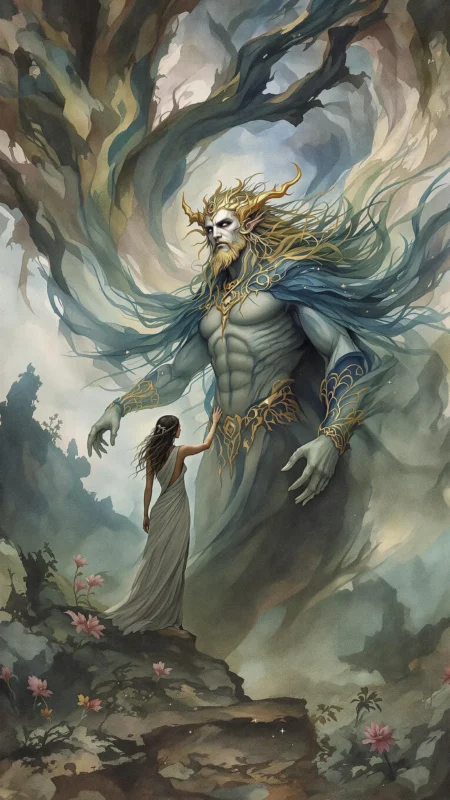
Dagda

Archetype Meaning & Symbolism

Bountiful, Earthy, Powerful, Lusty, Crude, Generous, Protective, Unrefined, Wise, Jovial

  • Feast from the cauldron of what is, not the famine of what might have been. The harvest is now; its magic is in the sharing.

If Dagda is part of your personal mythology, you may...

Believe

  • There is always enough to go around, and scarcity is a failure of imagination and generosity, not a fundamental truth of the universe.
  • True power lies in the ability to give life, to nurture, and to provide, not in the capacity to dominate or destroy.
  • The body, with all its appetites and imperfections, is a sacred vessel and a source of wisdom, not something to be conquered or transcended.

Fear

  • The cauldron running dry: a deep, existential terror of personal depletion, of having nothing left to give, and thus failing in your primary purpose.
  • That your strength will cause unintentional harm, that you will misjudge a situation and wield the destructive end of the club when the life-giving end was needed.
  • Being taken for granted, that your endless generosity will be seen not as a gift but as an entitlement, leaving you feeling used and unseen.

Strength

  • A profound and seemingly bottomless capacity for generosity. You are a natural nurturer and provider, creating stability and comfort for those around you.
  • A deep, unshakable sense of groundedness. Your presence is reassuring, and you navigate crises with a calm competence that inspires confidence in others.
  • The ability to command respect through quiet authority and potent presence, rather than through aggression or overt displays of power.

Weakness

  • A tendency towards over-indulgence or gluttony, whether with food, drink, or other sensual pleasures, blurring the line between healthy appetite and harmful excess.
  • An overbearing or paternalistic nature that can smother others' autonomy. Your desire to help and protect can easily become a need to control.
  • A deep-seated difficulty with vulnerability. Asking for help or admitting weakness can feel like a fundamental betrayal of your role as the strong provider.

The Symbolism & Meaning of Dagda

To find the Dagda in your personal mythology is to encounter the archetype of the good god, the benevolent chieftain whose power is measured not by what he conquers, but by what he provides. He is the sovereign of substance. His symbolism is not one of distant, ethereal light, but of the rich, dark soil and the bounty it yields. The Dagda represents a profound trust in the world’s cyclical abundance. His cauldron, the Coire Anseasc, is the central metaphor: a source that never runs dry, a testament to the belief that there is always enough, provided one has the wisdom to share. This is not a naive optimism, but a deep, earthy faith in the regenerative nature of life itself. He reminds you that your own capacity for creativity, love, and support might be just as bottomless.

The Dagda is also a figure of immense, dualistic power. His club, with one end to slay and the other to resurrect, is a potent symbol for the choices we face daily. Any strength can be used to build or to break, any word can be used to wound or to heal. To walk with the Dagda is to carry the weight of this responsibility. It is to understand that true authority comes from the judicious application of power, from knowing when to defend the tribe and when to heal its members. He is the master of the harp that commands the seasons and the emotions, a metaphor for achieving a kind of inner sovereignty where you are not tossed about by passing emotional storms but can, perhaps, learn to conduct them with grace.

Finally, the Dagda embodies a glorious, unashamed earthiness. He is often depicted as somewhat crude, with a great appetite for food and life, his tunic barely covering his robust form. In a modern context that often prizes asceticism and curated perfection, he is a radical symbol of embodiment. He suggests that spirituality is not found by escaping the body but by fully inhabiting it. Your appetites, your physical presence, your connection to the simple, life-sustaining pleasures of food, rest, and music are not distractions from your mythic journey; they are the very ground upon which it is built. He gives you permission to be messy, substantial, and powerfully present in your own life.


Dagda Relationships With Other Archetypes

The Sacred Grove

The Dagda’s relationship with the Sacred Grove is not one of ownership, but of mutual embodiment. He may be the consciousness of the place, the animating will that stirs in the rustle of ancient oak leaves and sleeps in the quiet of the moss. While other gods may visit a grove as one enters a temple, the Dagda could be the temple itself. His harp’s music may be found not in a strummed instrument but in the ordered chaos of birdsong at dawn; his cauldron’s endless bounty is perhaps the promise held within a single fallen acorn. The Grove is the physical syntax of his power, a space where the line between the deity and the dirt, the god and the ground, is not so much blurred as it is revealed to have never existed at all.

The Trickster

In the Trickster, the Dagda perhaps confronts the dissonant chord in his own harp, the crack in the cosmic order he otherwise commands. The Trickster is not simply an adversary but a necessary shadow, the chaotic impulse that tests the limits of the Dagda’s benevolent abundance. This figure could be the cosmic jester who points out that the all-providing father god is also a being of immense, sometimes crude, appetite; that the wielder of life and death can be, on occasion, a fool. The Trickster’s laughter may serve as a reminder that any system of perfect order, any vessel of endless plenty, is inherently fragile, always existing in a tense dance with the unpredictable, the irreverent, and the void from which it first arose.

The Sovereign

The Sovereign and the Dagda may be seen as two expressions of a single principle, like a raw ore and the crown smelted from it. Where the Sovereign archetype rules through law, decree, and the intricate chess of courtly power, the Dagda’s authority is more elemental, a kind of gravitational pull emanating directly from the land itself. He is the power that makes sovereignty possible. If the Sovereign is the king who builds the castle, the Dagda is the foundational granite beneath it, the inexhaustible well in its courtyard. Their relationship could be that of potential to actuality; the Dagda is the untamed, fertile force of leadership, while the Sovereign is that same force channeled, refined, and given a human-facing, political form.

Using Dagda in Every Day Life

Navigating Creative Blocks

When the wellspring of inspiration feels like a dry stone bed, the Dagda archetype invites you to see your creativity not as a finite resource to be hoarded but as a magical cauldron. To tap into it, you may need to stir the pot: consume new art, engage in earthy and tactile hobbies, or simply share your half-formed ideas with others. The act of giving out a little portion often magically refills the whole, reminding you that your source is inexhaustible so long as it is not sealed off in fear.

Cultivating Deep Generosity

In moments where you feel possessive of your time, energy, or resources, invoking the Dagda mythos could shift your perspective. It is the archetype of the good god who ensures no one leaves his table unsatisfied. This is not about reckless giving but about a confident generosity rooted in abundance. You might ask yourself: what can I provide here? It may not be material. It could be a moment of focused attention, a word of encouragement, or the simple, stabilizing presence that assures another person that everything will be alright.

Embracing Your Unrefined Self

The Dagda is powerful and wise, but he is also clumsy, pot-bellied, and sometimes comically crude. If you find yourself obsessed with maintaining a polished, perfect facade, this archetype offers liberation. It suggests that true strength and sovereignty do not require flawless presentation. Your power may in fact lie in your raw, unvarnished qualities: your hearty laugh, your blunt honesty, your unapologetic appetites. This is an invitation to accept your whole self, not just the curated version.

Dagda is Known For

The Cauldron of Plenty

Known as the Coire Anseasc, this cauldron is perpetually full, able to feed any number of people without ever being emptied. It symbolizes inexhaustible hospitality, abundance, and the regenerative power of generosity.

The Club of Life and Death

His great club, the Lorg Mór, has two ends. One end can kill nine men with a single blow, while the other can restore the slain to life. It represents immense power and the responsibility that comes with it: the ability to create and destroy, to harm and to heal.

The Living Harp

Called Uaithne, his harp is made of living oak and can command the emotions of all who hear it, compelling them to sorrow, joy, or sleep. It also has the power to command the seasons, signifying mastery over the natural and emotional worlds.

How Dagda Might Affect Your Personal Mythology

How Dagda Might Affect Your Mythos

When the Dagda archetype shapes your personal mythos, your life story may cease to be a hero’s journey of solitary striving and become, instead, a chieftain’s saga of communal provision. Your narrative arc might bend away from acquiring treasure for yourself and towards tending the magical cauldron for your people. Key plot points in your life may revolve around moments of profound generosity, of creating something from nothing to sustain others, or of defending your chosen clan with a formidable, protective strength. Your story is not about becoming a king on a distant throne, but the hearth at the center of the hall, the one whose presence signifies safety, abundance, and order.

The conflicts in your personal mythos may not be external dragons but internal questions of resource management. The central tension could be learning to wield your own power, symbolized by the Dagda's club, with wisdom and restraint. Your epic trials might involve facing down the fear of scarcity, resisting the urge to use your strength for selfish ends, or learning that the never-empty cauldron requires the magic ingredient of shared vulnerability, not just endless giving. Your mythos becomes one of grounded sovereignty, where your greatest victory is the thriving of those you have chosen to nurture.

How Dagda Might Affect Your Sense of Self

With the Dagda as a key figure, your view of self may shift from that of a single, separate individual to that of a source. You might begin to see your own energy, creativity, and love as a wellspring for others. This can instill a profound sense of competence and purpose. You are not just a person in the world; you are a provider, a protector, a stable center around which others can orbit. This identity is rooted in tangible ability, in the satisfaction of being able to offer a meal, a safe space, a well-timed piece of wisdom. You may see your physical body not as a thing to be disciplined or perfected, but as the very instrument of your power, a vessel of strength and appetite to be honored and enjoyed.

This self-perception also comes with a weighty sense of responsibility. You may see yourself as the one who must be strong, the one who cannot falter because others depend on your stability. This could lead to a powerful sense of self-reliance, but also a potential difficulty in showing weakness or asking for help. Your self-worth becomes deeply entwined with your capacity to give, and the thought of your own cauldron running empty can feel like a fundamental failure of your very being. You might perceive your more unrefined, 'crude' traits not as flaws, but as authentic expressions of your earthy power, a sign of being unapologetically yourself.

How Dagda Might Affect Your Beliefs About The World

Your worldview, colored by the Dagda, may become one of fundamental abundance. You might operate from a core belief that the universe is not a zero-sum game of scarce resources, but a cyclical, regenerative system. Scarcity, in this view, is often a problem of distribution and hoarding, not of genuine lack. This perspective fosters generosity not as a sacrifice, but as a natural and joyful participation in the flow of life. You may look at a forest and see not timber to be sold, but a living system of mutual support, a model for human community. Problems are seen less as crises to be panicked over and more as seasons to be managed, trusting that winter will eventually give way to spring.

This worldview also prioritizes substance over surface. You may find yourself deeply unimpressed by fleeting trends, polished marketing, and superficial displays of status. Your respect is reserved for what is real, what is lasting, what nourishes. You might value a well-tended garden over a luxury car, a heartfelt conversation over witty banter, a master craftsperson over a famous influencer. The world, to you, is not a stage for performance but a great feasting hall. The most important questions are: Is there enough for everyone? Is the music good? Is the fire warm? This is a philosophy of profound, grounded materialism, where the material world is not an obstacle to spirit but its most immediate and sacred expression.

How Dagda Might Affect Your Relationships

In relationships, the Dagda archetype may cast you in the role of the steadfast provider and protector. Your love is expressed through acts of service: cooking a meal, offering a place to stay, lending your strength in a crisis. People likely feel safe with you, seeing you as a port in any storm. You create belonging by hosting, by gathering people, by ensuring the physical and emotional comfort of your chosen family. You may be the person whose approval and support feels foundational to the group's confidence. Your partnerships, whether romantic or platonic, could be built on a bedrock of loyalty and unwavering support, where you naturally assume responsibility for the collective well-being.

However, this powerful dynamic has its own complexities. Your instinct to provide can sometimes smother others' independence, turning nurturing into a form of control. You might struggle with partners or friends who are fiercely self-reliant, feeling your primary mode of expressing care is being rejected. There can be a temptation to believe you always know best, a benevolent paternalism that disempowers those you love. Learning to balance your giving with an ability to receive, and to offer your strength without making others feel weak, may become a central challenge in your relational life. You might also find it difficult to be with those who embody a scarcity mindset, as it runs counter to your entire way of being.

How Dagda Might Affect Your Role in Life

If the Dagda resonates with your mythos, you may perceive your role in life as that of the Chieftain, the Provider, or the Foundational Stone. This is less about a formal title and more about an internal sense of duty. In any group, whether family, work, or community, you might naturally gravitate towards the position of ensuring the group's welfare. Your purpose feels tied to manifesting security and abundance for your people. You are the one who plans for the winter, who organizes the feast, who stands at the gate when a threat appears. Your role is defined by competence and generative power; you feel most aligned with your purpose when you are making things happen, building structures of support, and nurturing growth in others.

This role is not without its burdens. The weight of being the inexhaustible source can be immense. You might feel that you are not allowed a moment of weakness or uncertainty, as it could destabilize the entire group that relies on you. This can lead to a profound sense of isolation, the loneliness of the leader who must always be strong. Furthermore, your role might be misperceived by others as controlling or arrogant, when it stems from a deep-seated sense of responsibility. Navigating the difference between being a leader and being a ruler, between providing for others and making them dependent on you, is the primary developmental task associated with this archetypal role.

Dream Interpretation of Dagda

To dream of the Dagda, or a figure embodying his qualities, in a positive light is often a powerful message from the subconscious about your own inner resources. The appearance of his cauldron may signal a coming period of creative fertility, emotional replenishment, or material abundance. It is an assurance that you have what you need, that your well will not run dry. Seeing his harp could suggest a need to bring your own emotions into harmony or to use your voice to influence your environment in a positive way. To be offered food from his table or protection by his club in a dream might be a deep affirmation of your own worthiness and a reminder of the strength you possess to care for yourself and others.

Conversely, a dream featuring a negative or shadow aspect of the Dagda can be a potent warning. A Dagda who is gluttonous and withholding, keeping the cauldron for himself, may reflect a fear of your own selfishness or a part of you that is hoarding your gifts out of a scarcity mindset. His club being wielded destructively or carelessly could represent a fear of your own untamed power or anger causing unintentional harm. An empty cauldron in a dream is a classic symbol of burnout, creative block, or a feeling of being completely drained by the demands of others. A dream of a clumsy, oafish Dagda might be your subconscious pointing to a feeling of incompetence or a fear that your unrefined nature is causing you to fail in your duties.

How Dagda Archetype Might Affect Your Needs

How Dagda Might Affect Your Physiological Needs

When the Dagda is part of your mythos, your relationship with your physiological needs becomes sacred. Food is not mere fuel; it is communion, celebration, and the most basic form of love. You may find profound comfort and grounding in the acts of cooking, sharing meals, and savoring flavors. This archetype sanctifies appetite, suggesting hunger is a holy signal from the body, not a shameful weakness. There is a deep belief that a well-fed body is the foundation for a strong spirit and a sharp mind. The need for rest is similarly honored; sleep is not a waste of time but the fallow season required for the next harvest of energy and ideas.

This deep connection to the body's needs can mean you build your life around rhythms of nourishment and rest. You may prioritize a comfortable home, a well-stocked pantry, and a schedule that allows for downtime. However, it can also create a vulnerability to overindulgence. The line between feasting and gluttony, between restorative rest and sloth, may be a blurry one. The Dagda’s influence could lead to using food and comfort as a way to numb difficult emotions, turning the sacred act of nourishment into a form of avoidance. Honoring the body’s needs without becoming enslaved by its appetites is the central physiological challenge.

How Dagda Might Affect Your Ideas of Belonging

Belongingness, within the Dagda’s framework, is forged through the act of giving. You secure your place within the tribe by being its irreplaceable source of nourishment. Love and affection are demonstrated, and received, through the constant, reliable flow of provision, whether that be emotional, spiritual, or material. You are the host of the perpetual feast, and your home is the hearth around which the clan gathers. Your identity within the group is that of the anchor; your presence creates the feeling of ‘home’ and togetherness. You foster intimacy by creating spaces of comfort and safety where others can let down their guard and be replenished.

This method of creating belonging can be profoundly effective, making you a beloved and central figure in your community. The potential pitfall, however, is that your sense of belonging may become conditional on your ability to give. You might fear that if you were to stop providing, if your cauldron were to run empty, you would be abandoned. This can create a dynamic where you are endlessly performing the role of the provider, unable to show your own needs or vulnerabilities for fear of losing your place. Learning to feel loved for who you are, not just for what you can give, is a crucial step toward a more authentic sense of belonging.

How Dagda Might Affect Your Feelings of Safety

Your need for safety, under the Dagda's influence, is met through overwhelming competence and preparedness. Safety is not a passive state but an active creation. It is the full storehouse, the strong walls, the formidable presence that deters any threat. You may feel a deep, instinctual drive to build a surplus in your life: of money, of food, of skills, of goodwill. This surplus is your bulwark against chaos and uncertainty. The Dagda’s club, with its dual power, is the perfect metaphor for your approach. Your primary tool for safety is the ability to create and nurture life, but you are acutely aware of the necessity of having the power to defend and, if necessary, destroy what threatens your security.

This drive for security through strength can make you a pillar of safety for others, the person everyone knows they can count on in a crisis. However, it can also manifest as a kind of hyper-vigilance or a need to control your environment and the people in it to mitigate all possible risks. You may struggle to feel safe in situations of genuine uncertainty or when you are not in a position of authority. The feeling of being dependent on someone else for your security could be profoundly unsettling. True safety, as your mythos may teach you, comes not just from building strong walls but from trusting in your ability to handle whatever comes, wielding both ends of your metaphorical club with wisdom.

How Dagda Might Affect Your Views of Esteem

Esteem, in the mythos of the Dagda, is earned through competence and generativity. Your self-worth is not built on praise for your appearance, wit, or charm, but on the tangible evidence of your power to make things happen. You feel good about yourself when the garden is thriving, when the project is completed successfully, when the people you care about are safe and happy because of your efforts. It is the esteem of the master craftsperson, the wise chieftain, the great provider. You respect yourself when you can see the fruits of your labor nourishing the world around you. The Dagda’s harp is a key symbol here: your esteem grows as you learn to master your inner world and use your skills to create harmony in your environment.

This source of esteem is robust and grounded, less susceptible to the whims of public opinion. However, it can also lead to a relentless form of self-evaluation based solely on output. A period of failure, creative block, or inability to provide can trigger a profound crisis of self-worth. You may struggle to value yourself during times of rest or fallowness, seeing them as periods of uselessness rather than necessary cycles of regeneration. The challenge is to untangle your intrinsic worth as a person from your functional value as a provider, learning that you deserve respect even when the cauldron is not bubbling.

Shadow of Dagda

When the Dagda archetype falls into shadow, the benevolent chieftain becomes the gluttonous tyrant. The cauldron of plenty ceases to be a source of communal nourishment and becomes a private trough for insatiable appetites. Generosity is no longer a free gift but a transactional tool for creating dependency and control; the provider ensures no one can survive without him, thus securing his power. The jovial, earthy nature curdles into crude hedonism and sloth, where the responsibility to the tribe is abandoned in favor of personal indulgence. The great hall, once a place of warmth and music, becomes a stagnant, suffocating court where the chieftain's mood dictates the climate.

The shadow side of his power is equally fearsome. The club of life and death is wielded without wisdom. The protective instinct becomes violent paranoia, lashing out at perceived threats with disproportionate force. The ability to restore life is forgotten, and only the power to destroy remains. The harp that once commanded the seasons for the good of all is now used to manipulate emotions for selfish gain, creating discord and sorrow to keep others off-balance and compliant. In this shadow form, the Dagda is not a creator but a black hole, his immense gravity pulling everything into his own need, leaving his community depleted, fearful, and starved.

Pros & Cons of Dagda in Your Mythology

Pros

  • You are a source of immense stability and comfort to others, an anchor in the chaotic seas of life.
  • You possess a deep well of creativity, resilience, and energy, allowing you to manifest your goals and recover quickly from setbacks.
  • You enjoy a healthy, guilt-free relationship with your body and the pleasures of the physical world, living with a rare and potent sense of embodiment.

Cons

  • You may be perceived by others as crude, oafish, or lacking in subtlety and refinement, regardless of your inner wisdom.
  • The immense, often self-imposed, pressure to constantly provide for others can lead to significant burnout and resentment.
  • Your powerful protective instincts can easily curdle into controlling, possessive, or paternalistic behaviors that stifle the growth of those you love.