The Road
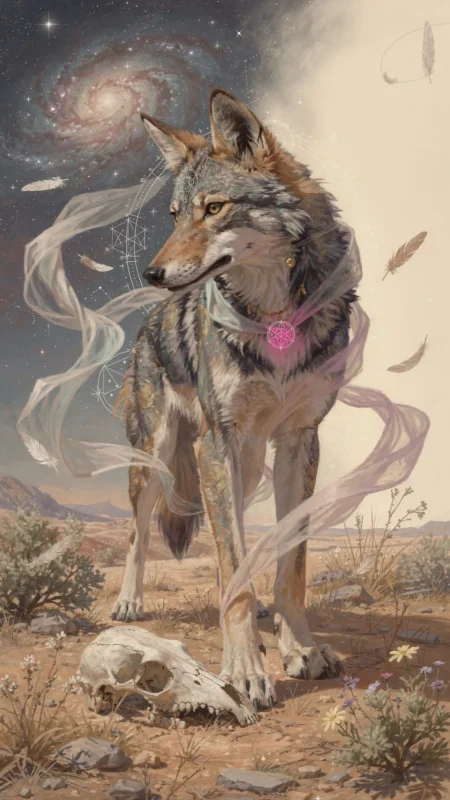
The relationship between the Coyote and The Road is one of mutual, restless definition. The Road may appear as a line of intent, a human scar of purpose drawn across a formless landscape, but the Coyote is the heat shimmer that makes this line tremble and disappear. It is the trick of perspective, the dust devil that dances in the middle lane, the sudden, unmapped detour that leads not to a destination but to an experience. While The Road could be seen as a promise of linear progress, a path from one known point to another, the Coyote is the chaotic, vital pulse that thrums just beneath its asphalt skin. It reminds us that the journey itself is a grand, cosmic joke, and that the straightest path is perhaps the most profound illusion of all, a convenience laid over a terrain that will forever belong to the wanderer and the wind.
The Inventor
The Coyote approaches The Inventor not as a student, but as a kind of holy fool, a zealous disciple whose very devotion reveals the absurdity of the faith. In the blueprints of The Inventor, one finds the elegant promise of reason, the seductive whisper that the universe is a machine to be mastered. The Coyote, clutching its mail-order catalog of contraptions, could be the ultimate test of this premise. Each backfiring rocket skate, each spring-loaded boxing glove that punches its owner, is not merely a failure of execution but perhaps a sublime commentary on the hubris of the endeavor itself. The Coyote’s workshop is a charnel house of elegant theories, a place where the clean logic of mechanics is undone by the clumsy, unpredictable grit of reality. Through its spectacular ineptitude, the Coyote may suggest that the gap between a perfect design and its chaotic application is where the real truth of existence—messy, hilarious, and stubbornly resistant to control—can be found.
The Shadow
One might say that the Coyote does not have a relationship with The Shadow so much as it serves as its garish, howling emissary. If The Shadow is the cellar of the psyche, where society asks us to lock away our inconvenient hungers and anarchic glee, then the Coyote is the one who picks the lock, throws a party downstairs, and invites the neighbors. It is the public unveiling of our private disavowals. While the archetype of The Shadow often carries a weight of portent and hidden trauma, the Coyote could be its comedic expression, dragging our repressed instincts into the harsh sunlight not for a grim confession, but for a bawdy, instructive burlesque. The Coyote, in its amoral antics, may teach us that what we banish to the dark does not die. It simply waits, not as a monster, but as a necessary corrective, a laughing, vital force poised to shatter the fragile artifice of the self we present to the world.


 Believe
 Fear
Fear Strength
 Weakness