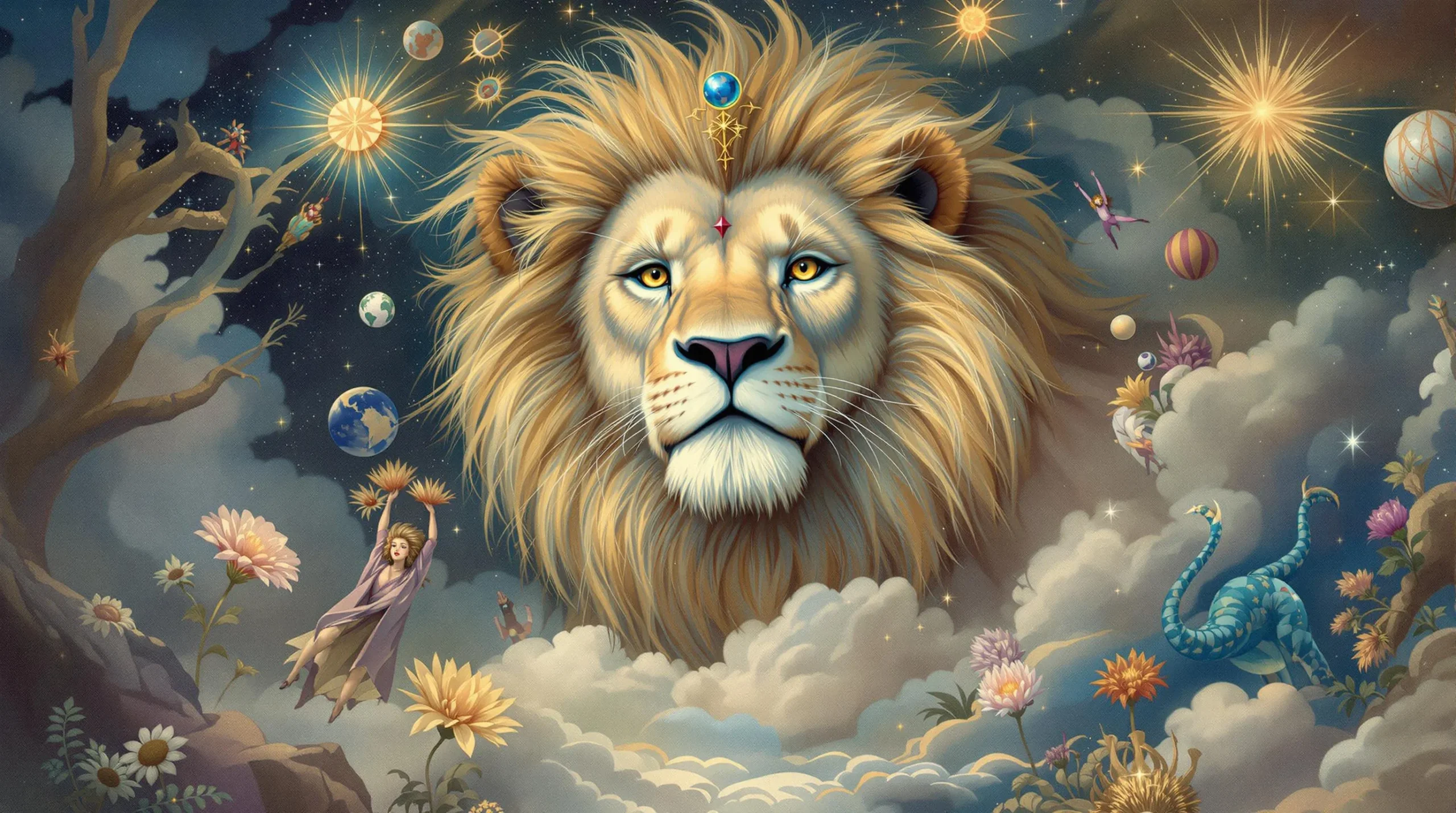


Cowardly Lion

Archetype Meaning & Symbolism

Fearful, loyal, insecure, boastful, warm-hearted, gentle, vulnerable, seeking, self-doubting, companionable

  • Put 'em up, put 'em up! Which one of you first? I'll fight you both together if you want. I'll fight you with one paw tied behind my back. I'll fight you standing on one foot. I'll fight you with my eyes closed.

If Cowardly Lion is part of your personal mythology, you may...

Believe

  • I am defined by my fear, and my primary task is to find a way to conquer or eliminate it.
  • True worthiness must be granted by an external authority; it cannot be generated from within.
  • My survival and success are entirely dependent on the loyalty and protection of my chosen companions.

Fear

  • That a moment of crisis will arrive and I will be exposed as a complete fraud, letting down everyone who depends on me.
  • Being abandoned by my friends or loved ones should they discover the true depth of my insecurity.
  • That I will reach the end of my life and realize I never became the brave person I was meant to be.

Strength

  • A profound capacity for empathy, especially towards those who are anxious or struggling. Your own familiarity with fear makes you a gentle and non-judgmental confidant.
  • An unshakeable loyalty. Because you value your companions so deeply, you will go to extraordinary lengths to support and protect them, often surprising yourself with your own ferocity.
  • A humble self-awareness that can, with time, blossom into wisdom. You do not suffer from heroic delusions, which makes you a grounded and reliable presence.

Weakness

  • A tendency toward analysis paralysis, where the cataloging of potential risks prevents you from taking necessary and timely action.
  • A reliance on external validation for your sense of self-worth, making you vulnerable to manipulation and overly sensitive to criticism.
  • A habit of boastful compensation, where you talk a bigger game than you feel you can play, which can undermine your credibility.

The Symbolism & Meaning of Cowardly Lion

The Cowardly Lion archetype speaks to a fundamental paradox of the human condition: the coexistence of perceived weakness and immense, untapped strength. He is the patron saint of the perpetually insecure, the figurehead for anyone who has ever felt like a fraud in their own skin. His symbolism is not about cowardice itself, but about the agonizing awareness of one's own fear. To have him in your personal mythology is to be on intimate terms with the chasm between the person you present to the world, the King of Beasts, and the trembling creature you feel yourself to be inside. His journey suggests that courage is not the absence of fear, but the willingness to act in the service of something you love, even when your knees are knocking together like castanets.

His meaning has deepened in a modern context saturated with curated confidence and performative success. The Lion is the avatar of imposter syndrome, that quiet, internal whisper that you are not qualified, not ready, not brave enough for the life you are living. He represents the search for external validation, the belief that if only a wizard, a boss, or a lover would grant us a medal, a promotion, or a declaration of affection, our internal state would finally align with our external role. His ultimate lesson, however, is the poignant realization that the journey itself was the thing that forged the courage he sought. The acts of loyalty, of facing down threats for his friends, were the proof. He had the quality all along, he just lacked the self-awareness to recognize it.

Ultimately, the Cowardly Lion is a symbol of profound self-acceptance. He embodies the grace of being gloriously, transparently imperfect. His story suggests that vulnerability is not a liability but a prerequisite for true connection. His companions do not love him because he is brave, they love him because he is theirs, fear and all. He gives us permission to be afraid, to feel inadequate, and to still show up for the journey. He reminds us that the heart of a lion is measured not by its roar, but by its capacity for loyalty and its willingness to walk the road, one terrified step at a time.


Cowardly Lion Relationships With Other Archetypes

The Yellow Brick Road

The Cowardly Lion may see the Yellow Brick Road not as a path to liberation, but as a kind of gilded fissure in the earth, a scar of promise he is forced to trace. For him, every sun-drenched brick could be a stage and every shadow a critic, amplifying his internal inadequacy. The road, as an archetype of The Journey, represents a tyranny of the straight line; it insists on forward momentum, on a destination of supposed betterment, while the Lion’s own spirit is a creature of hesitation, of the circular logic of anxiety. His relationship with this path is, perhaps, one of resentful dependence. He needs its direction to find his courage, yet he suspects the road itself is a long, unforgiving witness to the very cowardice he wishes to shed, its golden surface reflecting a distorted, trembling version of the king he ought to be.

The Medal

The Medal, bestowed as a cure, could also be seen as the most elegant cage. It is a relationship of transactional faith; the Lion invests this small, cold sun with the power to name him "courageous," and in return, it hangs upon his chest as a heavy, public lie. Perhaps this tangible proof is a necessary placebo, a piece of borrowed light that allows the performance of bravery to begin. But it may also be a perpetual reminder of an absence, a beautiful, hollow object that outsources the very quality it claims to represent. The Medal could be a barrier to the real thing, its metallic gleam distracting from the more difficult, internal alchemy required to forge true courage from the base metal of fear.

The Shadow

More than any jungle beast or cackling witch, the Lion's most intimate antagonist may be his own Shadow. This is not merely the absence of light, but the archetype of the unacknowledged self—a silent, ink-blot companion that mocks the volume of his roar. His flight is not from external threats, but from this persistent, darker twin that proves his substance and, therefore, his capacity for fear. The relationship is a frantic dance of avoidance. The Lion casts a grand silhouette, the very shape of power, yet he is terrified by this undeniable, quiet evidence of his own existence. True courage, then, might not be a gift to be received, but the simple, terrifying act of turning to face that dark shape on the ground and realizing it is not a monster to be outrun, but a part of himself to be integrated.

Using Cowardly Lion in Every Day Life

Navigating a Professional Crossroads

When the path forks into the familiar, well-trod lane of your current career and a shadowed, uncertain trail toward a new vocation, the Lion emerges. It is the voice that catalogues every potential failure, every monster in the woods. Yet, it is also the part of you that knows staying put is a different kind of death. To use this archetype is to acknowledge the trembling, to name the fears aloud to trusted companions, and to take the first step not because you feel brave, but because your desire for a different life is, in that moment, marginally stronger than your terror.

Confronting a Difficult Truth in a Relationship

The Cowardly Lion lives in the silence before a necessary, painful conversation. He is the sweat on your palms as you consider admitting a vulnerability or drawing a boundary. To channel his myth is to recognize that the roar you need is not for attack, but for the articulation of your own heart. It is the courage to say, “I am afraid of your response, but I must tell you this.” This act transforms the fear of rejection into an offering of profound trust, inviting a deeper, more authentic connection, whatever the outcome.

Embarking on a Creative Project

Every blank page or empty canvas is a dark forest. The Lion within you whimpers at the specter of inadequacy, the certainty that the execution will fall short of the vision. He is the internal monologue of imposter syndrome. Engaging with his energy means you begin anyway. You make a mark. You write a terrible first sentence. You acknowledge that the fear of judgment is real, but the act of creation, of joining your companions on the road to Oz, is the only antidote. Courage here is not a feeling, but a verb.

Cowardly Lion is Known For

The Quest for Courage

A journey predicated on the belief that bravery is an external object to be obtained, a medal to be won, rather than an internal quality to be discovered through action.

Boastful Bluster:

A transparently thin veneer of aggression and bravado, a noisy performance designed to mask a profound and trembling insecurity from the world and from himself.

Unwavering Loyalty:

A fierce, almost primal devotion to his chosen companions, demonstrating that his capacity for love and friendship can, when tested, override his instinct for self-preservation.

How Cowardly Lion Might Affect Your Personal Mythology

How Cowardly Lion Might Affect Your Mythos

When the Cowardly Lion is a central figure in your personal mythos, your life story is not one of heroic destiny but of a reluctant quest. Your narrative arc may be defined by a search, not for a golden fleece or a holy grail, but for an internal state of being: confidence, validation, a sense of worthiness. Major life events might be framed as trials not of strength, but of nerve. The inciting incident of your tale may not be a call to adventure, but a moment of profound inadequacy that sends you stumbling onto the yellow brick road, seeking a wizard to fix what you believe is broken within you.

This personal myth is colored by a dramatic tension between potential and performance. You may see yourself as a king in exile, possessing all the symbolic trapping of power—the strength, the intelligence, the capacity—but hamstrung by a core belief in your own deficiency. The supporting characters in your mythos become essential: a fellowship of the heart, a found family whose belief in you serves as a necessary scaffold until you can build your own. Your story culminates not in a grand battle against an external dragon, but in the quiet, internal confrontation where you finally award yourself the medal you've been seeking all along.

How Cowardly Lion Might Affect Your Sense of Self

To see yourself through the Lion's eyes is to live with a constant, humming awareness of the gap between your inner self and your outer presentation. You may possess considerable capabilities, yet feel like an absolute beginner, a pretender waiting to be unmasked. This can foster a habit of harsh self-judgment, where every hesitation or moment of anxiety is seen as proof of a fundamental character flaw. You might measure your self-worth against an impossible standard of unflinching bravery, a standard you perpetually fail to meet.

However, this perspective could also cultivate a profound and rare form of self-compassion. Recognizing your own fear in the Lion's journey allows you to treat your anxieties not as shameful secrets, but as familiar companions. This self-view encourages gentleness. It reframes the goal from eradicating fear to learning how to function alongside it. Over time, you may come to see your vulnerability not as a weakness, but as the very thing that makes you relatable, kind, and fiercely loyal to others who also tremble in the dark.

How Cowardly Lion Might Affect Your Beliefs About The World

Your view of the world may be that of a winding, unpredictable road, punctuated by dark forests and fields of soporific flowers. It is a landscape of potential threats, a place where one must be perpetually on guard. You might be predisposed to seeing the risks before the rewards, to cataloging the potential dangers in any new endeavor. The world is a place that demands a certain kind of courage that you feel you inherently lack, making navigation an exercise in constant anxiety and effort.

Yet, this worldview is not entirely bleak. It is also a world of unexpected companionship and miraculous aid. Because you are so aware of your own need, you may be more attuned to the possibility of allies. You might believe that the world, for all its terrors, provides the precise companions one needs for the journey. This perspective fosters a belief in the power of the collective. The world is too scary to face alone, but with a scarecrow, a tin man, and a determined girl from Kansas, any forest can be traversed, any wizard confronted.

How Cowardly Lion Might Affect Your Relationships

In relationships, the Cowardly Lion archetype fosters a profound need for a safe harbor. You may seek partners and friends who are deeply reassuring, who can see past your blustering defenses to the gentle heart within. The core fear is that of being found wanting, of being abandoned once your perceived cowardice is revealed. This can lead to a dynamic where you test the loyalty of others, or where you become fiercely, almost desperately loyal in return, hoping your devotion will be enough to make them stay.

Connection is therefore a double-edged sword. It is the thing you crave most deeply: a fellowship that provides safety and belonging. Yet it is also the arena of your greatest fear. This can create a push-pull dynamic, a dance of intimacy and retreat. True, lasting relationships may only form when you risk authenticity, when you let your companions see you tremble and find that they do not run. It is in these moments that you learn love is not contingent on your performance of bravery.

How Cowardly Lion Might Affect Your Role in Life

You may perceive your role in life as that of the reluctant protector or the supportive ensemble member, but never the star. There is a sense that the role of “leader” or “hero” belongs to someone else, someone naturally endowed with the confidence you lack. You might find yourself in positions of responsibility, yet feel perpetually underqualified, a stand-in for the real king who has yet to arrive. Your contribution, in your own mind, is defined by what you overcome to be there at all.

This can lead to a powerful form of servant leadership, where your actions are motivated not by ego or ambition, but by a genuine desire to support the quest and protect the fellowship. You may not seek the throne, but you will defend the people you love with a surprising ferocity when danger threatens. Your role is not static; it is a becoming. You are the understudy who, through the course of the play, discovers they have known the lines all along, and that their performance of courage has slowly, imperceptibly, become the real thing.

Dream Interpretation of Cowardly Lion

To dream of the Cowardly Lion in a positive context is to receive an invitation from your subconscious to embrace your own vulnerability as a strength. The Lion may appear as a warm, gentle guide, leading you through a mildly intimidating landscape. His presence suggests that you are becoming aware of a challenge on your horizon, but that you have the necessary internal resources—and perhaps the support of others—to face it. He is a symbol of latent courage, the recognition that you are ready to proceed despite your fear, and that this very act is the definition of bravery.

Conversely, when the Cowardly Lion appears in a negative or distressing dream, he often represents a state of being paralyzed by fear. He might be cowering in a corner, roaring without sound, or running from a trivial threat. This dream narrative could reflect a waking-life situation where your anxieties and self-doubt are preventing you from taking crucial action. He is the embodiment of your imposter syndrome, a symbol of feeling utterly unequal to a task. The dream is a call to action: to confront the wizard of your own psyche and question the belief that you are fundamentally lacking.

How Cowardly Lion Archetype Might Affect Your Needs

How Cowardly Lion Might Affect Your Physiological Needs

When the Lion’s mythos is deeply ingrained, your physiological baseline may be one of high alert. The body becomes a listening post for threat, real or imagined. This could manifest as a perpetually clenched jaw, shallow breathing, or a knot of tension in the solar plexus. The fight-or-flight system may be exquisitely sensitive, triggered not just by genuine danger, but by social evaluations, workplace challenges, or the mere anticipation of conflict. Your very cells are attuned to the narrative of fear, keeping the body in a state of readiness that can be exhausting.

This somatic story is one of containment. It's the physical effort of holding back a fearful roar, of trying to appear solid and calm when the nervous system is screaming. There may be a disconnect between the body's signals and conscious awareness, a numbness or dissociation used to manage the chronic overwhelm. The quest for courage, then, becomes a physiological one: the journey to teach the nervous system that it is safe, to finally exhale, to convince the body that the dark forest is, for now, just a quiet wood.

How Cowardly Lion Might Affect Your Ideas of Belonging

The need for belongingness and love becomes the central gravity of your world. If you are a Cowardly Lion, a 'pride' is not just a desire, it is a survival requirement. You may believe you can only face the world's terrors if you are securely embedded within a fellowship of trusted souls. This can foster an incredible capacity for loyalty and empathy, making you a devoted and cherished friend. You understand the need for reassurance because you need it so acutely yourself, and you give it generously.

However, this deep need is shadowed by the fear of not being worthy of that belonging. You may engage in people-pleasing behaviors, suppressing your own needs to secure your place in the group. There is a persistent fear of being 'found out'—that if your friends or partner saw the full extent of your fear, they would deem you a liability and leave. The journey towards healthy belonging involves the risky revelation of your authentic, fearful self, and the profound discovery that true companions do not require you to be fearless, only to be you.

How Cowardly Lion Might Affect Your Feelings of Safety

Your need for safety may feel like a vast, unquenchable thirst. The world is perceived through a lens of potential harm, making the establishment of security a primary life focus. This is not just about physical safety, like locking doors and avoiding dark alleys, but extends to emotional and psychological realms. You might avoid risks of all kinds—in career, in relationships, in self-expression—preferring the safety of the known, even if it is unsatisfying. The core belief is that one is not equipped to handle the unexpected, so life must be managed, controlled, and fortified against it.

This constant pursuit of safety can, paradoxically, make you feel less safe. By focusing so intently on what could go wrong, you might construct a cage of your own making, a life buffered by routines and defenses that ultimately insulates you from joy and growth as much as from danger. The feeling of safety remains elusive because the perceived threat is not external, but internal. True security only begins to dawn when you realize your own capacity to handle challenges, a realization that can only come from venturing, however timidly, outside the fortress walls.

How Cowardly Lion Might Affect Your Views of Esteem

Esteem is the crux of the Cowardly Lion’s journey. Your self-worth may be fragile, almost entirely dependent on external validation. You look to others—authority figures, partners, society—to bestow upon you the 'medal' that will finally prove you are courageous, worthy, and good. Without this external proof, you may feel hollow, a king of beasts in title only. This can lead to a constant, exhausting performance of confidence, or a desperate seeking of praise and accolades to quiet the inner voice of doubt.

The path to stable self-esteem is paved with a radical reinterpretation of evidence. It requires shifting focus from what a wizard says to what you have actually done. It is the slow, arduous process of reviewing your own history and acknowledging the times you acted despite your fear, the times you were loyal, the times you protected someone. Esteem ceases to be a future reward to be earned and becomes a present reality to be recognized. It is the moment you realize you don't need a medal because your actions have already minted it.

Shadow of Cowardly Lion

The shadow of the Cowardly Lion manifests in two terrifying extremes. The first is a complete capitulation to fear. This is the Lion who never leaves his patch of forest, who refuses the call to adventure entirely. In a person, this shadow creates a life of profound limitation and retreat. It's the paralysis that keeps one in a soul-crushing job, a toxic relationship, or a state of isolated stasis. The roar is silenced, the limbs refuse to move, and the great heart calcifies from disuse. This is a life haunted by the ghost of potential, a quiet tragedy of a journey never taken.

At the other pole, the shadow overcompensates with brutish aggression. This is the Lion who, so terrified of being seen as a coward, becomes a bully. He picks fights to prove his strength, roars to silence any dissent, and asserts dominance not from a place of true confidence but from a wellspring of terror. In this shadow form, the desire for safety twists into a need for control, and the loyalty to a fellowship curdles into a demand for fealty. He becomes the very monster he fears, proving his courage through acts of cruelty and forgetting that true strength is found in gentleness and the protection of others.

Pros & Cons of Cowardly Lion in Your Mythology

Pros

  • Your inherent vulnerability makes you exceptionally approachable; others feel safe to be their authentic, imperfect selves around you.
  • You cultivate deep, meaningful relationships, as your fierce loyalty inspires the same in others, creating a powerful found family.
  • Your journey towards courage is a conscious one, fostering a high degree of self-awareness and the potential for profound personal growth.

Cons

  • You may be chronically underestimated by others, and worse, by yourself, causing you to shy away from opportunities for leadership and success.
  • Your need for reassurance can become a dependency, placing an emotional burden on your relationships.
  • You may live with a persistent, low-grade anxiety and sense of inadequacy that saps your energy and joy.