 Believe
 Fear
Fear Strength
 Weakness
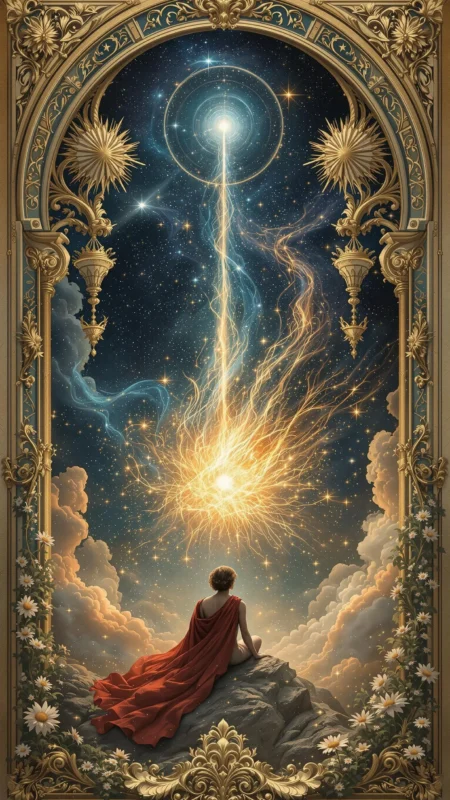
The Comet is a messenger from the cold, forgotten edges of the psyche. It does not speak in the steady, warm tones of The Sun or the cyclical whispers of The Moon. It arrives, unannounced, a brilliant gash in the velvet fabric of the ordinary. To have the Comet as a feature in one's personal mythology is to be aligned with the power of sudden revelation and radical change. You may not be a builder of institutions, but a bringer of insight that makes new construction necessary. Your wisdom is not the accumulated lore of the village elder, it is the crystalline truth of the outsider, the truth one can only see from a vast and lonely distance before plunging into the heart of things for a brief, spectacular moment.
Its meaning is also tied to a profound, almost painful, beauty. The Comet is beautiful because it is rare, because it is fleeting. Its presence in your mythos could suggest a life orientation that prizes intensity over duration, impact over stability. You might find more meaning in a single, transformative conversation than in years of casual acquaintance. It is an archetypal pattern for the artist’s furious burst of creation, the activist’s sudden, system-shaking protest, the lover whose brief appearance reorients a life's trajectory. It symbolizes the uncomfortable truth that some of the most important things are not meant to last, they are meant to happen.
Furthermore, the Comet carries the symbolism of the cosmic traveler. It connects the deep, interstellar void with the intimate sphere of a personal world. This could manifest as a feeling of being ancient, of carrying memories or potentials from a place beyond normal human experience. You may feel that your life is guided by a grander, unseen orbit, and that your periodic feelings of alienation are simply the long, outward arc of your journey. The Comet mythologizes the experience of being a catalyst: an agent who arrives from elsewhere, mixes elements together in a fiery display, and then recedes, leaving the world permanently altered by its passage.