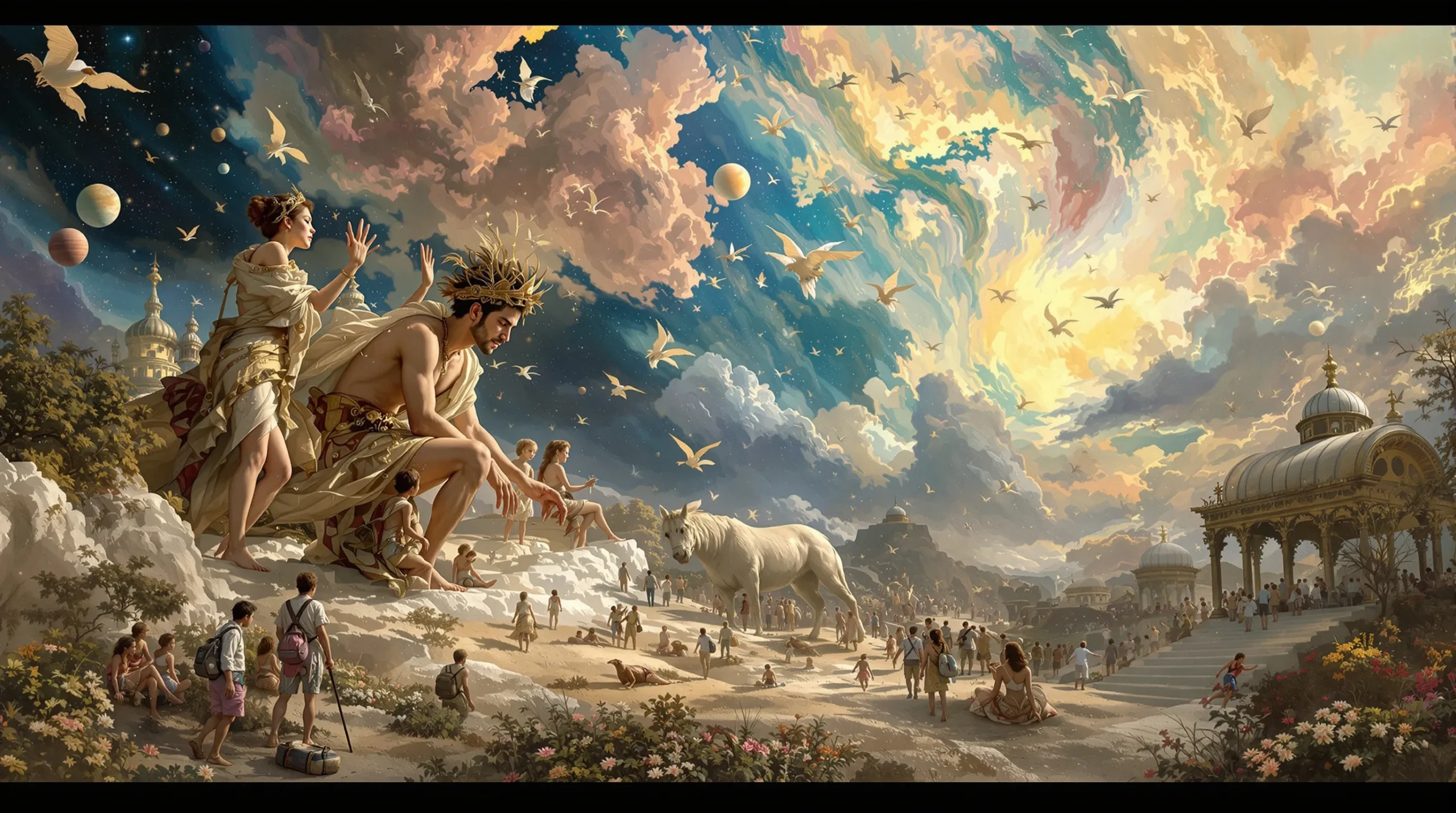


Colonization

Archetype Meaning & Symbolism

Expansionist, imposing, systematic, extractive, pioneering, structuring, relentless, transformative, dominating, orderly

  • My map erases what was: my grid dictates what will be. Growth requires the fiction of empty space.

If Colonization is part of your personal mythology, you may...

Believe

  • A blank slate is the greatest of all opportunities. True progress requires a complete break from the past.

    My way of organizing and living is not just a preference; it is objectively more logical, efficient, and superior.

    Anything can be fixed or improved with the right system. The solution to any problem is a better structure.

Fear

  • The return of the 'natives': the resurgence of old, suppressed habits, emotions, or versions of yourself.

    Losing control and having your carefully constructed world descend into the chaos you worked so hard to escape.

    The discovery that the 'wilderness' you paved over held something more valuable and authentic than the city you built.

Strength

  • An unparalleled ability to enact radical, positive change in your own life and the lives of others.

    Vision and determination. You can see the blueprint of a better future and have the discipline to build it.

    A talent for creating structure, stability, and clarity in chaotic environments.

Weakness

  • A profound lack of appreciation for existing ecosystems, whether in yourself, in others, or in organizations. You may fix what isn't broken.

    A tendency to be domineering and controlling, overriding the will and wisdom of others in your pursuit of a 'better' way.

    Emotional detachment. You may manage your feelings so effectively that you lose the ability to genuinely feel them.

The Symbolism & Meaning of Colonization

In the personal mythos, Colonization represents the potent, often severe, drive for radical transformation through imposition. It is the part of the psyche that looks upon the tangled wilderness of the self—the messy emotions, the contradictory beliefs, the ingrained habits—and sees not a complex ecosystem to be understood, but a territory to be tamed, cleared, and rebuilt in a new image. This archetype may manifest as a sudden, all-encompassing dedication to a new philosophy, diet, or lifestyle, one that requires the complete demolition of the old. It is the internal pioneer who believes progress is a straight line, drawn with a surveyor’s tool across the unruly contours of the soul, convinced that a better self can only be built on a cleared foundation.

The symbolism is one of maps and flags. To embody this archetype is to be constantly mapping your own psyche, defining its borders, and claiming territory from the unknown. You might be the one who plants a flag of ‘Rationality’ over a province of ‘Intuition,’ or establishes an outpost of ‘Discipline’ in a land of ‘Spontaneity.’ This internal cartography is an act of power, an assertion of the conscious ego over the deeper, native currents of the self. The danger, and the power, lies in what the map leaves out. It prioritizes the legible and the controllable, perhaps ignoring the sacred groves, the winding rivers, and the ancient spirits of the inner landscape that do not fit neatly into its grid.

Ultimately, the Colonization archetype speaks to a deep human yearning for order and control in the face of life’s inherent chaos. It is the belief that a perfect system can be designed and implemented, creating a utopian inner state free from the pests and famines of the old world. It is the architect of the New Jerusalem built within, a shining city on a hill of the psyche. This can be a source of immense strength, the engine of profound self-betterment. Yet, it may also carry the ghost of that which it displaced, a quiet mourning for the wildness, the authenticity, and the messy, vibrant life that was paved over to make way for the new construction.


Colonization Relationships With Other Archetypes

The Explorer:

The Explorer is the precursor, the scout sent into the unknown. Where The Explorer is content to journey, to witness, and to report back on the wonders of the inner landscape, the Colonization archetype follows with the ships, the soldiers, and the builders. The Explorer may chart the river of a deep-seated grief, but Colonization arrives to dam it for emotional energy or divert it for more productive purposes. Their relationship is one of sequence and intent: The Explorer opens the door, and Colonization marches through to redecorate the house, often forgetting to ask the original inhabitants if they appreciate the new wallpaper.

The Sovereign:

The Sovereign is the ultimate goal of the Colonization archetype. The entire project of clearing land, building infrastructure, and imposing laws is done to establish a stable and prosperous kingdom over which the ego can rule. The Sovereign represents the state of achieved order, the successful establishment of the new regime. However, a Sovereign who rises to power through a brutal colonization may rule a silent, sterile kingdom. They may sit on a throne in a land that no longer speaks its native tongue, haunted by the ghosts of what they destroyed to secure their reign, their legitimacy forever shadowed by the violence of their ascent.

The Wilderness:

The Wilderness is the great antagonist and, paradoxically, the source of all of Colonization’s resources. It represents the untamed, the unconscious, the organic, and the chaotic aspects of the psyche. Colonization defines itself in opposition to The Wilderness, seeking to fence it in, plow it under, and build cities where forests once stood. Yet, it is utterly dependent on it. Without the raw material of The Wilderness—the untamed emotions, the raw creativity, the primal energies—Colonization has nothing to conquer, nothing to refine. It is a constant battle, where every manicured lawn is a temporary victory against the persistent, creeping vines of the unmanaged self.

Using Colonization in Every Day Life

Reinventing Your Career Path:

When you feel your professional life is an overgrown, untamed wilderness of mismatched jobs, the Colonization archetype may emerge. You might not just find a new job: you might bulldoze the entire landscape. This could look like quitting a stable career to meticulously plan and execute a new one from the ground up, imposing a rigid structure of learning, networking, and strategic moves. You are not merely visiting a new country: you are building a new settlement, with its own laws and economy, on the ruins of your former professional identity.

Overhauling Personal Habits:

In the face of ingrained, destructive habits, this archetype provides the blueprint for a total takeover. It is not about gentle integration but a systematic replacement. One might create a life operating system with strict rules for diet, exercise, and screen time, effectively overwriting the native, chaotic culture of impulse. The old ways are not negotiated with: they are declared obsolete, and a new, more 'civilized' regime is installed by force of will. The self becomes a project of radical infrastructure development.

Structuring a Creative Project:

Confronted with the vast, intimidating emptiness of a blank page or canvas, the Colonization impulse can provide a necessary foothold. It is the act of imposing a strict outline on a sprawling novel idea, creating a rigid chord progression for a chaotic melody, or building a detailed wireframe for a nebulous app concept. This archetype fells the forest of infinite possibility to create a manageable plot of land, establishing the borders and foundational grids from which a new world can be built according to the creator's specific vision.

Colonization is Known For

Imposing New Order

This archetype is defined by its impulse to replace existing, often organic, systems with a new, rationalized, and centrally-planned structure. It brings the map, the grid, and the rulebook to territories it perceives as chaotic or underdeveloped.

Resource Extraction

Colonization is fundamentally about identifying and utilizing the resources of a new territory for the benefit of the colonizing power. In personal mythology, this could mean mining past experiences for lessons, harnessing untapped emotional energy, or exploiting one's own time and body for a singular goal.

Cultural Overwriting

A core function of this archetype is the replacement of an indigenous culture with a new one. This involves supplanting old beliefs, languages, and ways of being with a new, imported system, often with the conviction that the new way is superior or more advanced.

How Colonization Might Affect Your Personal Mythology

How Colonization Might Affect Your Mythos

When Colonization is a central force in your personal mythos, your life story may be framed as a series of radical reinventions, a narrative of 'Before' and 'After.' The plot points are not gentle evolutions but decisive conquests. There was the chaotic era before you discovered stoicism, the indulgent period before your conversion to minimalism, the messy years before you implemented a rigorous life-management system. Your myth is one of progress defined by demolition and construction. You are the protagonist who terraforms their own world, and the central conflict is always between the pioneering self and the stubborn, native landscape of your old habits and beliefs.

This narrative may glorify the 'Founder' aspect of your identity. Your personal story is not one of inheritance but of self-creation, of building an empire of the self from scratch. You might see yourself as having escaped a primitive or fallen state, and the story you tell is how you brought enlightenment, order, and prosperity to the benighted lands of your own past. This can create a powerful, heroic mythos, but one that may require you to vilify or dismiss your former selves, casting them as ignorant natives who needed to be saved from themselves, creating a deep and perhaps tragic disconnect from your own history.

How Colonization Might Affect Your Sense of Self

Your view of self may be that of a project under constant, active development. The self is not a thing to be discovered so much as a thing to be built, and often, rebuilt. You might possess a powerful sense of agency, believing that any flaw or inefficiency can be engineered away with the right system or philosophy. This can lead to a proactive, highly capable persona, one who is unafraid to make dramatic changes to improve their life. You may see yourself as a disciplined commander, directing the unruly troops of your own impulses and emotions with a firm, strategic hand.

However, this perspective could also foster a profound sense of alienation from your own core being. The ‘manager’ self might become disconnected from the ‘managed’ self. You may begin to treat your emotions, your body, and your intuition as inconvenient, primitive populations to be controlled, rather than as integral parts of your own sovereign state. This can create an inner tyrant, a colonizing ego that suppresses dissent and dismisses the wisdom of the native inhabitants of your psyche, leading to a feeling of being a stranger in your own land, ruling over a territory whose language you no longer speak.

How Colonization Might Affect Your Beliefs About The World

The world, through the lens of the Colonization archetype, may appear as a series of systems to be optimized or territories to be improved. You could look at a disorganized company, a chaotic social event, or even a friend's messy life and instinctively begin drafting a plan for its restructuring. This worldview prioritizes efficiency, logic, and order, and may be quick to judge organic, less structured ways of being as inherently flawed or inferior. It is a perspective that sees potential everywhere, but the potential it sees is often for that thing to become something else entirely, something more aligned with your own model of perfection.

This can lead to a worldview that is profoundly un-nostalgic and relentlessly forward-looking. The past is seen as a place of mistakes to be corrected, and tradition is often viewed as an obstacle to progress. You may have little patience for ambiguity or complexity that cannot be neatly categorized and addressed. The world becomes a grand chessboard, and you are a player seeking to impose your strategic will upon it. While this can make you an effective leader and agent of change, it might also blind you to the subtle beauty and wisdom embedded in the very chaos you seek to eliminate.

How Colonization Might Affect Your Relationships

In relationships, the Colonization archetype can manifest as a powerful, and sometimes destructive, impulse to 'improve' one's partner or the relationship itself. You may see your partner's quirks, habits, or beliefs as undeveloped territories in need of your enlightened governance. This isn't always malicious; it often comes from a genuine desire to help, to create a more 'perfect' union. You might be the one who introduces a shared calendar, a budget spreadsheet, a conflict resolution protocol—imposing a new administrative system on the wild, emotional landscape of the relationship.

This impulse can, however, feel deeply invalidating to the other person. They may feel as though their authentic 'native' culture is being systematically erased and replaced by your imported one. Intimacy may become a project of settlement and assimilation rather than a process of mutual discovery. You risk becoming a benevolent dictator in a relationship of two, always expanding your own emotional and logistical territory, planting your flag on every decision, and leaving your partner feeling like a resident of a land they no longer recognize as their own.

How Colonization Might Affect Your Role in Life

Your perceived role in life might be that of the system-builder, the reformer, the bringer of order. Whether in your family, your workplace, or your community, you may naturally assume the position of the one who sees the chaos and feels a profound responsibility to fix it. You are the homesteader who arrives in a new, unstructured environment and immediately begins clearing land, building fences, and establishing a new set of laws. This role can be invaluable, as you are often the one who can turn a failing project into a success or bring stability to a volatile situation.

This can also be an exhausting and isolating role. You may feel that progress and order are solely your burdens to bear, that without your constant intervention, everything would revert to wilderness. This can lead to a sense of superiority, but also a deep-seated loneliness. You are the administrator of the colony, but you may feel separate from its people. Your role is to manage life, not necessarily to live in it, and you may find yourself perpetually on the outside of the very communities you work so hard to build and maintain.

Dream Interpretation of Colonization

In a positive context, dreaming of colonization may symbolize a successful and necessary overhaul of your inner world. You might dream of arriving on a barren moon and building a beautiful, self-sustaining biodome, representing your ability to create a thriving life from a place of emotional desolation. The dream could feature the orderly planting of crops in a previously chaotic field, signifying the successful imposition of healthy new habits. These dreams feel constructive, hopeful, and powerful, affirming that your efforts to bring order to your life are creating a place of genuine growth and prosperity.

In a negative context, such dreams can be deeply unsettling. You might dream of paving over a vibrant, beautiful rainforest to build a grey, concrete parking lot, reflecting a fear that your quest for order is destroying something precious and wild within you. The dream could involve you imposing a new language on a group of people who weep because they can no longer speak their native tongue, a clear manifestation of guilt over suppressing your authentic emotions or intuitions. These dreams often have a sterile, oppressive atmosphere, a warning from your unconscious that your inner colonial project has become a tyrannical occupation.

How Colonization Archetype Might Affect Your Needs

How Colonization Might Affect Your Physiological Needs

This archetype may translate into a rigid and systematic approach to the body's needs. Your physiology is not a mysterious ecosystem to be listened to but a machine to be optimized. This could manifest as strict adherence to a quantified-self regimen: tracking every calorie, monitoring sleep cycles with technology, and following an exercise plan with military precision. The body’s 'native' signals—subtle hunger cues, feelings of fatigue—might be viewed as unreliable data points to be overridden by the superior logic of the system you have imposed. Sustenance becomes fuel intake; rest becomes a scheduled downtime for system repair.

While this can lead to remarkable feats of physical discipline and health, it can also create a profound mind-body disconnect. The body can become an occupied territory, its natural rhythms and wisdom suppressed in favor of an external, rationalized authority. There is a risk of ignoring crucial signals of distress or exhaustion because they do not align with the plan. The quest for physiological order can, paradoxically, lead to a state of internal rebellion: burnout, injury, or illness, the body’s last-ditch effort to overthrow the colonial regime and reclaim its sovereignty.

How Colonization Might Affect Your Ideas of Belonging

Belonging, under the influence of the Colonization archetype, is often conditional and engineered. Instead of finding a tribe to fit into, you may be more inclined to build your own. You establish the settlement and then invite others to live there, but only if they agree to abide by the culture, laws, and customs you have established. Love and friendship might be contingent on the other person's willingness to assimilate into your way of life, to adopt your communication styles, or to participate in the systems you've created for 'our' benefit.

This can make true, unconditional love and acceptance difficult to achieve. You may struggle to belong to any group where you do not hold the administrative power. The deep, vulnerable work of adapting to another person's world or co-creating a new one from two existing cultures can feel like a loss of sovereignty. As a result, you might surround yourself with 'settlers' rather than peers, leading to relationships that are orderly and functional but may lack the dynamic, unpredictable spark that comes from the meeting of two truly independent worlds.

How Colonization Might Affect Your Feelings of Safety

For this archetype, safety is synonymous with control and well-defined borders. A sense of security is found not in adaptability, but in fortification. You may build formidable structures in your life—rigid routines, strict personal policies, meticulously curated social circles—to act as walls against the unpredictable chaos of the outside world. The unknown is not an adventure; it is a threat to be neutralized. Your safe space is a well-managed territory where all variables are accounted for, all residents are vetted, and all laws are strictly enforced.

This pursuit of safety through control can become a prison of your own making. The walls designed to keep threats out may also prevent new and positive experiences from getting in. You might find yourself living in a sterile fortress, safe from invasion but also isolated from the vibrant, messy, and ultimately enriching life happening outside your self-imposed borders. True security, which involves resilience and the ability to navigate uncertainty, may be sacrificed for the illusion of safety that comes from total, but brittle, control.

How Colonization Might Affect Your Views of Esteem

Esteem is directly tethered to the success of your colonial projects. Your self-worth is a measure of what you have built, organized, and improved. A successfully implemented budget, a perfectly executed morning routine, a life transformed according to your master plan—these are the monuments to your competence and value. You feel good about yourself when your territory is expanding, your systems are running smoothly, and your control is absolute. Your esteem is that of the successful founder, the benevolent ruler of a prosperous and orderly kingdom.

Consequently, your self-esteem can be incredibly fragile, built upon a foundation of external control. When a system fails, when chaos breaches your walls, or when an 'insurrection' of old habits occurs, it is not just a practical setback; it is a deep existential threat. A failure in discipline can trigger a catastrophic collapse in self-worth. This makes you vulnerable, as your value is not inherent but is constantly being proven by the state of your empire. You are only as good as the last territory you successfully tamed.

Shadow of Colonization

The shadow of Colonization is the tyrant. When this archetype operates unconsciously or to an extreme, the well-intentioned pioneer becomes a ruthless dictator of the self and others. The drive to improve becomes a compulsion to purify, leading to the eradication of any part of the psyche deemed 'unproductive' or 'impure.' Spontaneity, vulnerability, and playfulness are not just managed; they are exiled. The inner landscape becomes a monoculture, a sterile and efficient farm that produces a single, approved crop, but is susceptible to a single blight and devoid of the resilience that biodiversity provides. The shadow colonizer starves its own soul for the sake of a perfect, predictable harvest.

In relationships and the external world, this shadow manifests as an imperialistic force that cannot tolerate difference. It is the friend who bulldozes your feelings with unsolicited advice, the partner who systematically rewrites your habits and social life, the leader who dismantles a functional company culture to install a soulless, hyper-efficient new regime. The shadow is not content to rule its own territory; it feels a manifest destiny to expand. It justifies its conquests with the rhetoric of progress and enlightenment, all the while leaving a trail of broken spirits and erased histories, blind to the fact that the silent, orderly world it creates is a wasteland.

Pros & Cons of Colonization in Your Mythology

Pros

  • You possess the capacity for profound and rapid self-transformation, capable of breaking deep-seated negative patterns.

    You are a natural leader and builder, able to bring order and functionality to chaotic situations.

    Your focus and discipline allow you to achieve ambitious, large-scale goals that others might find overwhelming.

Cons

  • You risk destroying valuable parts of your own history and personality in the quest for a 'perfected' self.

    Your need for control can alienate you from others and prevent deep, authentic connection.

    You may create a life that is orderly and successful but also sterile, brittle, and lacking in genuine joy and spontaneity.