Believe
 Fear
Fear Strength
 Weakness
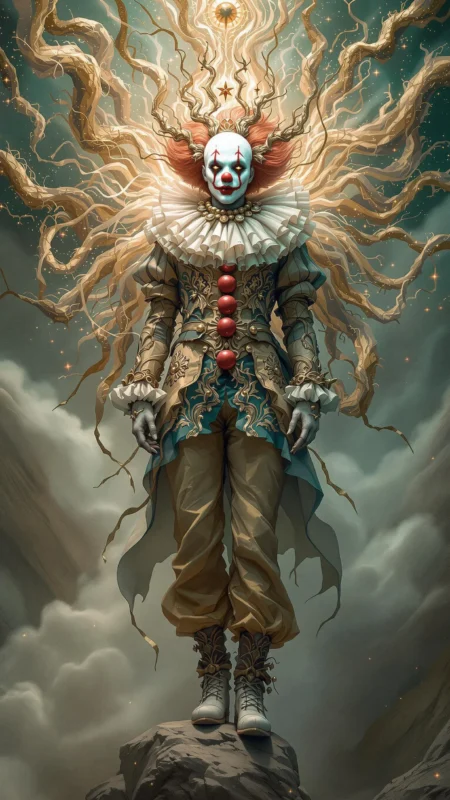
In your personal mythology, the Clown may symbolize the sacred fool, the one who walks the razor’s edge between chaos and insight. This is not about telling jokes; it is about embodying a kind of existential buoyancy. The Clown suggests that reality is fundamentally absurd and that the most sane response is not to impose order but to learn the art of the tumble. To have Clown as part of your mythos is to carry the secret knowledge that our grandest tragedies and our most humiliating failures are often just a shift in perspective away from being profound comedies. This archetype represents a radical permission slip: permission to be imperfect, to fail spectacularly, and to find liberation in not being taken seriously.
The presence of the Clown might also point to a deep engagement with the paradox of the mask. You may feel that your social self is a performance, a carefully constructed persona designed to entertain, disarm, or protect. This painted smile might be a tool of immense social power, allowing you to navigate complex situations with a unique grace. Yet, it could also be a source of profound loneliness, a fear that if the makeup were ever wiped away, the face beneath would be unrecognizable or, worse, unlovable. The Clown archetype forces a constant negotiation between the performed self and the authentic self, asking which is the mask and which is the face.
Ultimately, the Clown in one’s personal narrative is a figure of profound resilience. It is the part of you that gets knocked down nine times and stands up ten, not with a roar of defiance, but with a quizzical look and a newly acquired limp that can be worked into a funny walk. This archetype symbolizes the power of humor as a spiritual practice, a way of metabolizing pain into wisdom. It is the understanding that the universe is a great, cosmic circus, and your role is not to be the flawless acrobat on the high wire, but the one who, by falling into the net, reminds everyone that it is safe to fall.