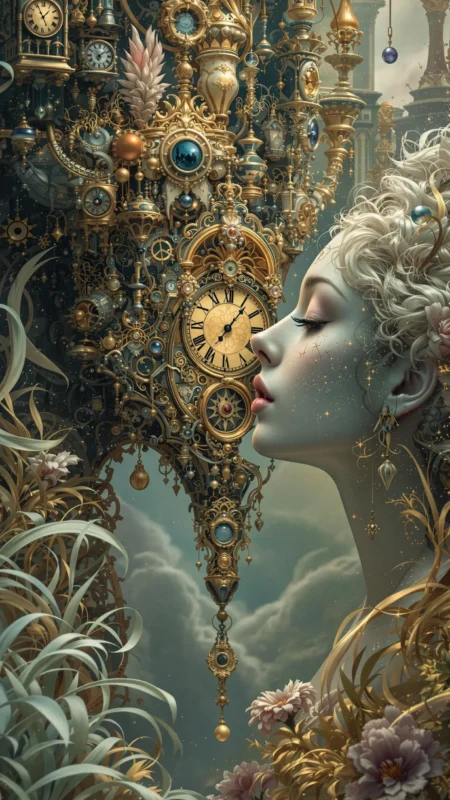
Clock

Archetype Meaning & Symbolism

Precise, rhythmic, orderly, relentless, cyclical, impartial, demanding, measured, intricate, inevitable

  • The moment is not lost, only passed. Find your gear, not your brake. The present is the only point of contact with eternity.

If Clock is part of your personal mythology, you may...

Believe

  • That order is a form of moral good, and a well-managed schedule is the fundamental architecture of a virtuous and meaningful life.

    That every moment is a vessel for a specific purpose, and to waste time is not just inefficient but a kind of spiritual negligence.

    That the universe operates on principles of cause and effect that are as knowable, logical, and predictable as the internal gears of a fine timepiece.

Fear

  • The existential void of unstructured time, the quiet terror of a blank calendar page with no instructions.

    A persistent, nagging feeling that life is passing you by, that you are falling 'behind schedule' on some invisible but universally understood timeline of achievement.

    Chaos in all its forms: spontaneity, disruption, and anything that threatens the delicate, carefully constructed mechanism of your daily existence.

Strength

  • An almost unparalleled capacity for discipline, long-term planning, and execution, allowing you to achieve ambitious goals that require sustained effort over time.

    A profound sense of reliability and responsibility. When you commit to a time, you are there; you are a person of your word, a rock of dependability for others.

    The ability to cultivate immense patience, rooted in the understanding that great things are built not in a flash of inspiration, but through the steady, relentless accumulation of moments.

Weakness

  • A potential rigidity of mind and spirit that struggles to adapt to unexpected change, making it difficult to pivot when a plan is no longer working.

    A tendency to unconsciously prioritize efficiency over emotional connection, which can lead to a sense of detachment from your own inner world and the feelings of others.

    A susceptibility to chronic, low-grade anxiety rooted in the feeling that you are never doing enough, never moving fast enough, never fully optimized.

The Symbolism & Meaning of Clock

The Clock is perhaps humanity's most elegant attempt to domesticate the wild, formless river of time. It represents the imposition of order, logic, and predictable structure upon the chaotic flow of existence. To have the Clock in your personal mythology could suggest a deep-seated need for a comprehensible world, a life built on schedules, rules, and the comforting certainty of a plan. It is the architect of the day, the week, the five-year plan. This archetype does not merely observe time; it corrals it, it divides it into digestible portions, making the infinite manageable and giving a shape to the days of our lives. It is the triumph of the rational mind over the ambiguous and the eternal, a belief in the power of structure to create meaning.

At its heart, however, the Clock is an impartial and relentless symbol of mortality. Its hands sweep away possibilities as surely as they reveal new ones. It is the engine of narrative, the force that pushes every story toward its inevitable conclusion, demanding that choices be made and that consequences be faced. For someone whose mythos is informed by the Clock, life may be felt as a series of crucial moments, deadlines, and countdowns. The ticking is a constant companion, a reminder that the account of one's life is finite. This is not necessarily a morbid perspective: it can be a powerful catalyst for action, a call to live with intention, to make every second count not by filling it with frantic activity, but by filling it with presence.

Furthermore, the Clock symbolizes the beauty and fragility of interconnected systems. Just as one misplaced gear can halt the entire mechanism, this archetype speaks to the intricate web of cause and effect in one's life. It suggests a worldview where every action, no matter how small, has a cascading impact on the whole. A personal mythology shaped by the Clock might involve a profound sense of responsibility, an awareness that one's personal functioning is critical to the functioning of their family, their community, their cosmos. This can lead to a meticulous attention to detail in one's own life, a belief that maintaining one's own internal balance is a service to the world at large.


Clock Relationships With Other Archetypes

The River

The Clock stands in eternal tension with The River, which symbolizes the ceaseless, formless, and unmeasurable flow of existence. While the Clock seeks to name and divide every moment, The River simply is. A person holding both archetypes in their personal mythology may experience a constant internal negotiation between structure and surrender. They might build meticulous plans for their week (Clock) only to abandon them for a spontaneous journey (River). This relationship is not necessarily adversarial; it can be a dance. It may be the quest to build a sturdy enough vessel (Clock) to navigate the powerful, unpredictable currents of life (River).

The Gardener

The Gardener and the Clock can find a deep, synergistic harmony. The Gardener understands that the Clock is not just the tyrant of the second hand but the keeper of grander, natural cycles: the slow turning of seasons, the waxing and waning of the moon, the daily arc of the sun. The Gardener does not try to force a seed to sprout in winter; they understand timely action. In a personal mythos, this relationship fosters a profound patience and a trust in organic processes. It suggests a life lived in accordance with natural rhythms, where work and rest, planting and harvesting, are done with a deep wisdom of the right time for all things.

The Rebel

The Rebel's very essence is often defined by the desire to smash the Clock. To the Rebel, the Clock is the ultimate symbol of societal control, the cage of the nine-to-five, the metronome of conformity. The Rebel seeks to live in moments of timeless intensity, to defy the regimentation of productivity and rest. For an individual wrestling with both these archetypes, life could be a battlefield. One part of them craves the security of a schedule and the approval that comes with being 'on time,' while the other part feels suffocated by it, yearning to live by impulse and passion alone. The core conflict becomes one between responsibility and a radical vision of freedom.

Using Clock in Every Day Life

Finding Rhythm in Chaos

When the external world feels like a storm of demands and distractions, the Clock archetype can be invoked to create an internal sanctuary of order. This is not about frantic scheduling, but about establishing a personal cadence, a quiet and steady internal ticking. It could manifest as a non-negotiable ten minutes of silence at dawn, the ritual of preparing tea with mindful precision, or a commitment to a single, focused task for a set period. You use the Clock not to race, but to create pockets of deliberate time, proving that personal rhythm can be maintained even in a hurricane of obligations.

Confronting Mortality

The Clock may serve as a potent memento mori, a reminder not of doom, but of the preciousness of the finite. To engage with this archetype is to look at the sweeping second hand and see not time lost, but opportunity arriving. Each tick becomes an invitation to act, to speak a truth, to create, to connect. This practice could turn procrastination into purpose. You might use it to finally begin the novel, make the call to an old friend, or simply to decide what is truly worth your allotment of moments, editing your life with the gentle ruthlessness of passing time.

Mastering Patience

In a culture of immediacy, the Clock archetype teaches the profound wisdom of patience. It demonstrates that certain processes: growth, healing, the building of trust, the mastery of a craft: have their own inviolable timetables. You cannot force a gear to turn faster than its design allows. By internalizing this, you may learn to work with time, not against it. You might apply this to a creative project, allowing it to unfold at its own pace, or to a relationship, trusting that understanding will deepen not through pressure, but through shared, steady duration.

Clock is Known For

Measurement of Time

Its fundamental purpose

the conversion of the abstract, flowing nature of existence into knowable, manageable units. It creates the seconds, minutes, and hours by which we build our lives and civilizations.

Mechanical Precision

The symbol of intricate systems working in perfect, complex harmony. A universe of gears, springs, and balances, all synchronized to produce a single, reliable, and consistent output: the steady march of the hands.

The Incessant Tick

The audible heartbeat of passing moments. It is a constant, impartial soundscape that may serve as a comfort, a motivator, or a source of profound anxiety, reminding all who hear it of progression, finality, and the non-negotiable nature of now.

How Clock Might Affect Your Personal Mythology

How Clock Might Affect Your Mythos

When the Clock is a central feature of your personal mythology, your life story may be framed as a precisely calibrated narrative. Events are not random; they are appointments. Turning points arrive “right on time.” Your mythos could be one of a race against a deadline, or conversely, a slow and deliberate construction, like building a cathedral over generations. The core virtues in your story might be punctuality, foresight, and the masterful management of your allotted moments. You may see your life not as a meandering path, but as a well-plotted chart, where each phase is a prerequisite for the next, and the grand finale is the logical sum of all the preceding, perfectly timed parts.

Alternatively, your personal mythos could be defined by its very opposition to the Clock's dominion. Your story’s protagonist—you—might be the one who constantly “loses track of time,” not out of carelessness, but because you are accessing a deeper, more timeless reality. Your greatest moments of insight and connection may arrive when the schedule is abandoned. The central conflict of your life might be the struggle to protect your sacred, unstructured time from a world that wants to colonize every minute with productivity. Your mythos champions the wisdom of the pause, the beauty of the detour, and the idea that the most important parts of life happen between the ticks.

How Clock Might Affect Your Sense of Self

An identity shaped by the Clock may be one of high function, purpose, and efficiency. You might view yourself as a finely tuned instrument, and self-worth could be directly proportional to your productivity and your ability to execute plans flawlessly. There could be a deep, quiet satisfaction in a day where every moment was used as intended, a sense of personal order that feels like a reflection of cosmic harmony. You are reliable, you are capable, you are on track. This view of self is one of a competent manager of the resource of life itself.

This perspective, however, can lead to a perception of the self as a machine that is either working or broken. Emotions, fatigue, or spontaneous desires may be seen not as essential parts of your humanity, but as glitches in the system, inefficiencies to be corrected. This could create a subtle but profound dissociation from your own body and inner world. You might not ask, “What do I feel like doing?” but rather, “What is scheduled to be done?” The self is not a being to be explored, but a mechanism to be optimized, which can lead to a life that is impressively functional but emotionally arid.

How Clock Might Affect Your Beliefs About The World

To see the world through the lens of the Clock is often to perceive a grand, clockwork universe. Reality may appear as an intricate and logical system of cause and effect, perhaps set in motion by a divine Watchmaker or governed by immutable physical laws. This can be an immensely comforting worldview. It suggests that behind the apparent chaos of life, there is an underlying order, a predictable pattern. Events are not random acts of cosmic caprice; they are the logical unfolding of a pre-existing mechanism. Everything has its time, its place, its reason.

Yet, this mechanical worldview can also feel profoundly deterministic and soulless. It might leave very little room for magic, for miracles, for radical free will. If the universe is a perfect clock, then we are merely cogs, our paths determined by the gears that came before us. History unfolds with a grim inevitability. This perspective can strip events of their emotional resonance, reducing love, tragedy, and triumph to mere ticks in a cosmic process, devoid of any transcendent meaning and leaving a feeling of cold, indifferent machinery at the core of existence.

How Clock Might Affect Your Relationships

In relationships, the Clock archetype can manifest as a powerful sense of reliability and devotion expressed through the careful management of time. Anniversaries, birthdays, and important dates are likely sacred, observed with precision. Time spent with loved ones may be explicitly designated as “quality time,” protected from other obligations. You are the person who shows up, on time, every time. Love may be demonstrated through consistency and the dependable investment of your moments, building a foundation of trust and predictability that can be deeply comforting to a partner, family, and friends.

However, this same temporal rigidity can feel constricting or even impersonal to others. A partner might feel less like a cherished presence and more like an appointment in a busy schedule. Spontaneity, the lifeblood of many romances and friendships, may be difficult for you, and you might grow impatient with the messy, inefficient, gloriously unpredictable nature of human connection. There is a risk of valuing punctuality over presence, of checking the box of “time spent” without ever truly surrendering to the shared, timeless moment.

How Clock Might Affect Your Role in Life

Your perceived role in life, under the Clock's influence, may be that of the Regulator, the Pacesetter, or the Orchestrator. You are the one who keeps the project on schedule, who gets the family out the door on time, who ensures the rhythm of the organization is maintained. You may find a deep sense of purpose in creating structure not just for yourself, but for others. You are the reliable heartbeat of your social and professional circles, the one who transforms chaotic potential into tangible, timely results. This role provides a clear sense of identity and importance.

This role, however, can easily become a crushing burden. It may foster a belief that if you were to stop, to rest, to falter for even a moment, the entire enterprise would collapse into chaos. This can lead to a lonely sense of responsibility, an inability to delegate or trust in the capabilities of others. The role of Regulator ceases to be a choice and becomes a relentless, self-imposed duty. You are no longer a person with a valuable skill for organization; you are the gear that must never, ever stop turning.

Dream Interpretation of Clock

In a positive dream context, a clock that is running smoothly, chiming a beautiful melody, or whose hands you can direct with your will, may symbolize a profound alignment with your life's path. It could suggest that you are in sync with your true purpose, and that the timing is auspicious for a new beginning or the culmination of a long-term effort. Such a dream may bring a feeling of peace about the passage of time, a sense that your past, present, and future form a coherent and meaningful whole. It can be an affirmation that you are exactly where you need to be, right on time.

In a negative context, a dream of a clock can be a vessel for anxiety. A clock that is broken, melting, spinning wildly backward or forward, or showing a nonsensical time may reflect a deep-seated fear that life is out of control. It could point to anxieties about aging, mortality, or a painful awareness of missed opportunities. A clock with no hands is a particularly potent symbol of feeling lost, directionless, and disconnected from any sense of narrative or forward momentum in your life. It is the dream symbol of paralysis, of being stuck in a moment that has no future.

How Clock Archetype Might Affect Your Needs

How Clock Might Affect Your Physiological Needs

The Clock archetype may dictate that physiological needs are met not according to the body’s signals, but according to a strict schedule. Sleep is not a response to fatigue, but a task to be performed at a designated hour. Meals are consumed at noon and six, regardless of hunger. For some, this imposition of external order onto the body can create a highly efficient, regulated system, optimizing health and energy through sheer discipline and the power of habit. It is the belief that the body can be trained, like any other mechanism, for peak performance.

This approach, however, risks creating a profound schism between mind and body. The body’s innate wisdom—its subtle cues of hunger, thirst, fatigue, and desire—may be systematically ignored until they are no longer heard at all. This can lead to a state of chronic, low-level stress, as the body’s natural rhythms are constantly overridden. The body is no longer a living, breathing partner in the project of life, but a machine to be fueled and maintained on a timetable, potentially leading to burnout or a sudden, unexpected system failure.

How Clock Might Affect Your Ideas of Belonging

A sense of belonging, under the Clock's influence, may be built upon shared rhythms, rituals, and traditions. You belong to your family by showing up for Sunday dinner every week. You belong to your community by participating in the annual town festival. Love and friendship are reinforced through the reliable observance of birthdays and anniversaries. Connection is demonstrated through the consistent, predictable investment of time, creating a stable and secure social fabric where everyone knows their part and when to play it.

This can, however, make it difficult to form or maintain bonds with people who operate on a different temporal frequency. The perpetually late friend may be seen not as free-spirited, but as disrespectful. The partner who thrives on spontaneity might feel constrained or misunderstood. Belonging becomes conditional upon syncing with your personal rhythm, potentially isolating you from the rich diversity of human connection and creating a social world that is safe and predictable, but also small and homogenous.

How Clock Might Affect Your Feelings of Safety

For a person aligned with the Clock archetype, safety is a fortress built of predictability and planning. Security is found in the meticulously crafted schedule, the five-year financial plan, the regular retirement contributions, and the annual health check-up. The vast, threatening uncertainty of the future is tamed by charting it, by creating timelines and milestones that make it feel known and manageable. Safety is the result of foresight and the diligent, day-by-day execution of a long-term strategy for stability.

The primary threat to safety, then, becomes the unexpected: the sudden job loss, the unplanned expense, the disruptive event that shatters the timeline. This can foster a deep anxiety about spontaneity and a defensive rigidity that makes it difficult to adapt to real-world changes. Safety becomes a fragile construct, wholly dependent on the world conforming to the plan. When chaos inevitably intrudes, the entire sense of security can collapse, as the foundational belief in an orderly, predictable world is proven false.

How Clock Might Affect Your Views of Esteem

Esteem is earned through accomplishment and measured against the timeline. Self-worth is derived from a checklist of achievements: the degree earned by 22, the promotion by 30, the mortgage by 35. The person in the mirror is judged by their productivity, by their ability to conquer the day's to-do list, and by their progress along a pre-determined path of success. Esteem is the quiet hum of a life running smoothly, efficiently, and 'on schedule.'

This makes self-esteem incredibly brittle and vulnerable to the slightest deviation from the plan. A period of rest, a creative fallow, or a professional setback can trigger a devastating crisis of self-worth. There is little intrinsic value in simply being; worth must be constantly generated through timed performance. This creates a relentless internal pressure to always be moving forward, always achieving, leaving no room for the messy, unproductive, but essential human experiences of doubt, wandering, and simple repose.

Shadow of Clock

When the Clock's archetype falls into shadow, it becomes a tyrant. Life ceases to be a dance with time and becomes a ruthless war against it. Every second is audited, every activity is judged by its return on investment, and rest is seen as a moral failing. This is the shadow of the micromanager, the burnout artist, the individual whose internal ticking is so loud it drowns out the heartbeat of their own humanity. Relationships are networked, not nurtured; joy is scheduled, not felt. The beautiful, intricate mechanism of the Clock becomes a prison, its precision a form of self-flagellation. The goal is no longer a life well-lived, but a life perfectly optimized, even if that perfection is sterile and empty.

In its other shadow form, the Clock's influence appears as a complete and total rebellion against its principles, leading to a state of chronic inaction and paralysis. This is the shadow of the 'broken clock,' the person so overwhelmed by the passage of time that they refuse to participate in it. They are perpetually late, they miss every opportunity, they live in a state of suspended potential, forever waiting for the 'perfect time' that never arrives. Out of fear of getting it wrong, they do nothing at all. They see the Clock not as a tool but as an enemy, and in their attempt to defy it, they become its ultimate victim, drifting aimlessly as their own life story unfolds without them.

Pros & Cons of Clock in Your Mythology

Pros

  • You possess a powerful sense of discipline and focus, which enables the realization of complex, long-term goals that might overwhelm others.

    Your life likely has a clear and comforting structure, providing a sense of purpose, stability, and constant forward momentum.

    You are almost certainly perceived by others as exceptionally reliable, trustworthy, and organized, building a strong foundation for professional and personal respect.

Cons

  • You may inadvertently miss the profound beauty of spontaneous moments and the serendipitous discoveries that arise from deviating from a set path.

    You might be prone to a persistent, low-level anxiety related to productivity, deadlines, and the deep-seated fear of wasting your finite time.

    Your relationships can be strained by an unconscious rigidity, making it difficult to be fully present and adaptable in unstructured social or emotional situations.