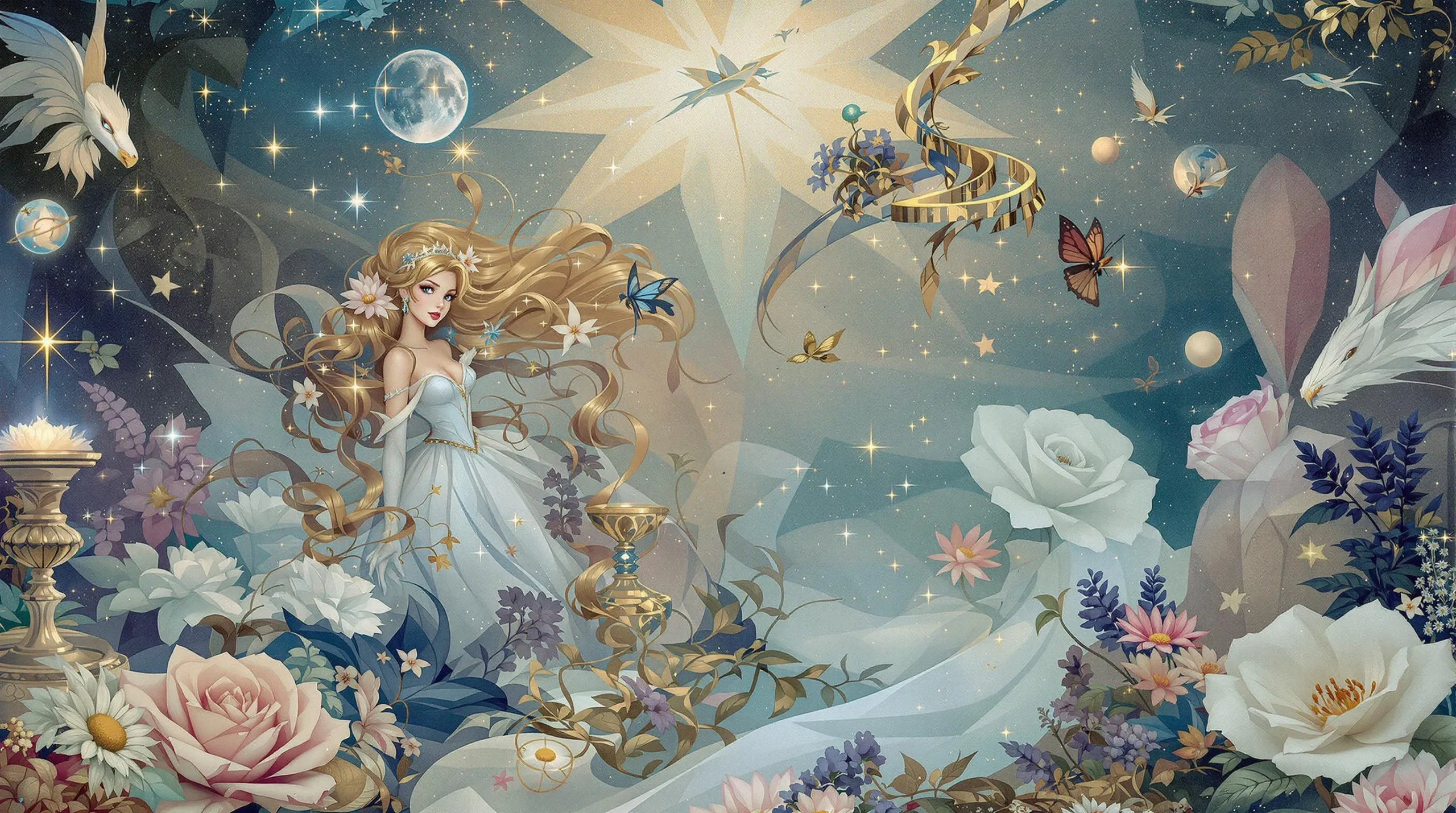


Cinderella

Archetype Meaning & Symbolism

Hopeful, resilient, patient, virtuous, industrious, overlooked, kind, enduring, dreamy, transformative

  • Have courage and be kind.

If Cinderella is part of your personal mythology, you may...

Believe

  • You may believe that your innate goodness and kindness are a form of silent power that will, in time, conquer cruelty and neglect.
  • You may believe that your current struggles are not your final destination but a temporary and meaningful chapter in a much larger, grander life story.
  • You may believe that there is a perfect, destined opportunity or person who holds the key to unlocking your true potential and life.

Fear

  • You may fear that you will never be truly seen, that you will live and die in the cinders, and your inner worth will remain a secret forever.
  • You may fear that your good fortune is a temporary illusion, that the clock will strike midnight and you will be exposed as someone who doesn't belong in the palace.
  • You may fear that without external transformation or rescue, you are fundamentally unworthy of love, happiness, and respect.

Strength

  • An almost supernatural resilience, the capacity to endure significant hardship with grace and without becoming bitter.
  • A profound and unwavering kindness, especially towards those who are also overlooked or suffering, creating a deep well of empathy.
  • An unshakeable core of hope, a belief in the possibility of a better future that can sustain you through the darkest of times.

Weakness

  • A tendency toward passivity, a habit of waiting for circumstances to change or for a rescuer to arrive rather than taking decisive action yourself.
  • A vulnerability to exploitation, as your self-sacrificing nature may lead you to tolerate unfairness and neglect for far too long.
  • A propensity to define your self-worth through external sources, particularly a romantic partner, making your happiness contingent on their approval.

The Symbolism & Meaning of Cinderella

To have the Cinderella archetype woven into your personal mythology is to hold a quiet, almost secret, contract with hope. It is the belief that virtue is not a transactional bargaining chip for immediate reward, but a state of being, a form of light tended in the dark. The hearth, the place of soot and service, is re-imagined: it is not a prison but a crucible. Here, in the story you tell yourself, your character is forged in the fires of disregard, your kindness tested against the whetstone of cruelty. This narrative suggests that your current circumstances are merely a disguise for a truer, more radiant self awaiting its proper context, its moment of revelation.

The modern meaning of this archetype has evolved beyond a simple “waiting for a prince” trope. It could be a powerful narrative of psychic survival in the face of systemic injustice or emotional abuse. The “magic” is perhaps the sudden arrival of an opportunity—a scholarship, a job offer, a mentor—that aligns perfectly with a potential you have been cultivating in private. The story champions a specific kind of strength: not the warrior’s, but the survivor’s. It is the power of endurance, the refusal to let bitterness corrupt the soul, the quiet rebellion of remaining gentle in a harsh world. It suggests that your time of trial is not a life sentence, but a chapter.

Yet, the symbolism is a delicate dance on a glass-thin edge. It can be interpreted not as a story of patience, but of passivity. It could codify the idea that goodness must be paired with suffering to be valid, and that one must be “rescued” from their circumstances rather than seizing the agency to change them. The slipper itself is a paradox: is it a symbol of your unique soul that no one else can fill, a testament to your irreplaceability? Or is it a fetishized object of external validation, the thing you need to prove you are worthy of love and a new life? Its meaning in your mythos dictates whether you are patiently cultivating your own garden or simply waiting by the gate for someone else to open it.


Cinderella Relationships With Other Archetypes

The Hearth

The Hearth, in its quiet accumulation of ash and secrets, may be Cinderella’s first and most profound confidante. It is a dual-faced god of the domestic sphere: a site of thankless servitude, where soot becomes a kind of second skin, yet also the crucible where dreams are forged in the low, murmuring light of embers. One might say the cold chimney is a throat that has swallowed all the home’s warmth, mirroring Cinderella’s own suppressed voice. It is a silent witness to her degradation, but it could also be seen as the keeper of a latent fire, a promise of the heat and light she holds within. In its daily cinders, she is paradoxically purified, stripped down to an essence that no finery can grant and no grime can truly extinguish.

The Clock Tower

The Clock Tower stands as the unfeeling arbiter of Cinderella’s borrowed reality. Its chimes are not a song but a sentence, the cold, mechanical heartbeat of a world to which she does not yet belong. It is, perhaps, the ultimate symbol of the transactional nature of her magic—a beautiful, fleeting illusion bought on a strict and unforgiving schedule. The Tower’s shadow could be said to stretch over the entire ballroom, a stark, vertical line of order against the swirling chaos of the dance. It represents a kind of paternalistic authority, the ticking conscience of a society that dictates when the masquerade must end. For Cinderella, its face is a mirror showing not a princess, but a fleeting dream whose time is, and always was, running out.

The Glass Slipper

More than mere footwear, the Glass Slipper seems a vessel of pure, crystallized truth. It is the antithesis of the soot and rags that define Cinderella's daily existence—a thing of impossible clarity and form. Its legendary fragility may speak to the precariousness of her transformation, a single misstep away from shattering the entire illusion. Yet, its power lies not in its beauty but in its uncompromising fit; it is a key cut for a single lock. The Slipper could be viewed as an object of profound, unassailable identity. It rejects all pretenders, its crystalline structure refusing to yield to any foot but the one it was destined for, suggesting that one’s true self is, perhaps, a measure that cannot be faked, stretched, or broken by the ambitions of others.

Using Cinderella in Every Day Life

Navigating Injustice at Work

When you feel overlooked for a promotion or your contributions are claimed by another, the Cinderella mythos may offer a framework not of resignation, but of patient integrity. It encourages you to continue your work with diligence and kindness, not as a performance for your superiors, but as an act of maintaining your own inner standards. Your focus shifts from demanding immediate recognition to polishing your own skills in the quiet, believing that true quality, like a unique glass slipper, will eventually find its match in the right opportunity.

Preparing for a Life Transition

Facing a monumental life change, such as moving to a new city or starting over after a setback, can feel like waiting for a fairy godmother that may never arrive. This archetype suggests that the “magic” is not a sudden gift, but the culmination of your own quiet preparations. It is about tending to your dreams even in confinement, being kind to the “mice” in your life—those small, seemingly insignificant allies or skills. The transformation is not an escape, but an emergence you have been preparing for all along.

Reclaiming Self-Worth in Isolation

During periods of loneliness or feeling misunderstood by your family or community, the Cinderella story serves as a private mythology of intrinsic worth. It whispers that being relegated to the hearth does not diminish the spirit. You may learn to see your solitude not as proof of your insignificance, but as a protected space where your unique character is being forged, away from the corrupting influence of the stepsisters’ envy. Your value is not determined by their invitation to the ball, but by your own unwavering spirit.

Cinderella is Known For

The Glass Slipper

A symbol of a unique and perfect fit, representing a destiny that cannot be usurped or faked. It is the undeniable proof of identity, the one thing that connects the radiant princess back to the girl in the cinders.

The Cruel Stepmother and Stepsisters

An embodiment of unjust familial hierarchy and jealousy. They represent the external forces of oppression that seek to diminish, conceal, and exploit innate goodness and beauty for their own gain.

The Magical Transformation

The moment when inner worth is made visible to the world. A pumpkin to a carriage, rags to a ballgown

this symbolizes the potential for a dramatic shift in fortune, facilitated by benevolent, almost spiritual, intervention that allows the true self to be seen.

How Cinderella Might Affect Your Personal Mythology

How Cinderella Might Affect Your Mythos

When Cinderella is a cornerstone of your personal mythos, your life story is often framed as a tale of two acts: the time in the cinders, and the time after the ball. Every struggle, every moment of being underestimated, is cataloged not as a failure but as a necessary part of the narrative's rising action. You may view your suffering as purposeful, a temporary state of disguise that makes the eventual reveal of your true self all the more dramatic and meaningful. This narrative structure gives hardship a certain nobility and infuses the future with a sense of fatedness: your happy ending is not just a possibility, it is a promise waiting to be fulfilled.

This archetype imbues the mundane with sacred weight. The act of performing a thankless task, of showing kindness to those who are cruel, of holding onto a private dream against all odds—these are not just moments to be endured, they are the central, heroic acts of your story. Your personal myth is not about grand battles, but about the quiet, persistent glow of a single ember in a cold hearth. This internal narrative can make you profoundly resilient, capable of finding dignity in humility. The world may see service, but your mythos tells you that you are secretly reigning over your own inner kingdom, preparing it for the day its borders expand.

How Cinderella Might Affect Your Sense of Self

Your perception of self may be one of a hidden gem. There might be a quiet, unshakeable certainty of your own intrinsic value, a core of goodness and potential that feels immune to external judgment. This creates a powerful inner sanctum, allowing you to withstand neglect and disdain without internalizing it as a true measure of your worth. You are not what they say you are; you are the person you know yourself to be, in waiting. This can foster a profound self-possession, a secret confidence that anchors you through storms of invalidation.

Conversely, this archetype could tether your sense of self to a future moment of external recognition. The self is perceived as incomplete, a draft awaiting its final, validating edit from a significant other, a powerful institution, or a fateful event. “I will be my true self when…” becomes the prevailing thought. This makes the present feel like a perpetual audition, and your self-worth becomes fragile, contingent on being “chosen.” The danger is that the girl in the cinders may start to believe she is nothing without the ballgown, her identity wholly dependent on the magic of another's gaze.

How Cinderella Might Affect Your Beliefs About The World

To view the world through the Cinderella lens is to believe in a universe that, despite its apparent cruelty and randomness, possesses a hidden, moral logic. Injustice is real and painful, but it is temporary. Fairness is not a given, but it is an eventuality. This worldview fosters a deep and abiding optimism, a faith that the scales will eventually balance and goodness will be recognized. It can, however, also cultivate a certain naivete, an underestimation of systemic issues that require more than a fairy godmother to be dismantled. It’s a belief that the world is a fairy tale that has simply not yet reached its final, tidy chapter.

This perspective might also lead you to categorize the world and its inhabitants into stark archetypal roles. People are not just people; they are potential stepsisters (competitors, saboteurs), stepmothers (unjust authorities), fairy godmothers (mentors, benefactors), or princes (rescuers, soulmates). This can simplify complex human motivations into a pre-written script, making it easier to navigate social dynamics but also robbing them of their nuance. You may find yourself constantly casting the people in your life, waiting for them to play their assigned part in your story, rather than seeing them as protagonists in their own.

How Cinderella Might Affect Your Relationships

In relationships, you may unconsciously seek a dynamic of rescue and recognition. A romantic partner is not just a companion, but “The One” who will finally see past the soot to the soul beneath. This places an immense, often unspoken, pressure on them to fulfill a mythic role: to be the prince who elevates you, validates you, and provides the “happily ever after” that your past has earned you. The relationship becomes the climax of your personal story, the reward for all your patient suffering, which can be a heavy burden for any mortal partnership to bear.

With friends and family, you might adopt the role of the endlessly giving, patient caretaker, the one who absorbs hardship and offers kindness without expecting it in return. This can foster deep, nurturing bonds with those who appreciate your gentle spirit. However, it also creates a risk of profound imbalance. You may perpetually sideline your own needs, believing that your role is to serve and that your self-sacrifice will eventually be recognized and rewarded. When it is not, a quiet, deep-seated resentment can begin to smolder beneath the surface of your relentless generosity.

How Cinderella Might Affect Your Role in Life

Your perceived role in life may be that of the “undiscovered noble.” You might feel that your current station—be it your job, social circle, or family dynamic—is a temporary and unfitting disguise. It is a test of character, a period of humble apprenticeship before your true destiny is revealed. This allows you to perform roles that others might see as beneath them with a sense of dignity and purpose, as you believe you are playing a part in a much grander narrative arc where you are the secret protagonist.

This can also manifest as a form of strategic passivity in your professional and personal life. You may excel in your duties but hesitate to actively campaign for a promotion, believing that your good work should speak for itself and that you should be “discovered” rather than self-advocate. Your role, as you see it, is to be worthy of being chosen, not to do the choosing yourself. This can lead to a career of being the indispensable number two, the power behind the throne, while secretly believing you were meant to wear the crown.

Dream Interpretation of Cinderella

In a positive context, dreaming of being Cinderella or discovering a glass slipper may signify a burgeoning awareness of your own unique potential and readiness for change. It could be your subconscious telling you that your period of quiet preparation is ending and a moment of recognition is at hand. The dream is an affirmation of your inner worth and an invitation to step out of the shadows and onto the ballroom floor of your life. It suggests that you are, at last, prepared to receive the good fortune you feel you deserve.

In a negative light, a dream where the clock strikes midnight and your finery turns to rags, where you are barred from the ball, or where the slipper cruelly refuses to fit, points to a deep-seated fear of being unworthy or an imposter. It may symbolize a terror that your happiness is fleeting and conditional, and that you will inevitably be returned to your former state of lack and obscurity. This dream could be a manifestation of imposter syndrome or a profound anxiety that your true self, once revealed, will be judged as inadequate.

How Cinderella Archetype Might Affect Your Needs

How Cinderella Might Affect Your Physiological Needs

The Cinderella mythos may teach the body a language of austerity. You might learn to subsist on the bare minimum, to find comfort in meager portions and a single patch of warmth by the fire. Your physiological baseline for what constitutes “enough”—food, shelter, rest—could be set remarkably low, fostering a physical toughness and an ability to make do. This is a body accustomed to waiting, to conserving its energy, to enduring discomfort as a familiar state of being.

This learned deprivation can also create a profound, almost sacred, appreciation for sensory pleasure when it finally arrives. The feel of silk instead of rags, the taste of rich food after a diet of scraps, the freedom of a spacious room after confinement: these are not mere comforts, they are transcendent experiences. This can lead to a life of deep gratitude for simple pleasures, but also a potential for being overwhelmed by abundance, as the body and mind have been so thoroughly conditioned for scarcity.

How Cinderella Might Affect Your Ideas of Belonging

The defining wound of the Cinderella archetype is a profound sense of not belonging. To be in a family but not of it, to live in a house that is not a home—this creates a lifelong search for true acceptance. Belonging is envisioned not as a messy, negotiated process, but as a moment of perfect, fated recognition. It is the click of the glass slipper fitting onto the foot: an undeniable, tailor-made sense of place. This may lead you to seek communities or relationships that promise this kind of perfect, almost magical, fit.

When you do find a person or group where you feel you belong, your loyalty may be fierce and your gratitude immense. You may go to extraordinary lengths to preserve this hard-won sense of connection. The shadow of this is a terror of being cast out again, which can lead you to self-efface, to suppress your own needs and opinions to maintain harmony. You might constantly try to “earn” your place through service and agreeableness, fearing that if you stop being useful, your cherished sense of belonging will be revoked.

How Cinderella Might Affect Your Feelings of Safety

Within this personal mythology, safety is often not a present condition but a future prize. The current environment, the symbolic “stepmother’s house,” is understood to be fundamentally unsafe, a place of emotional peril and instability. Security is not something to be built in the here and now, but something to be achieved through escape or rescue. This can result in a high tolerance for unhealthy dynamics and a tendency to endure unsafe situations, sustained by the hope of an eventual, dramatic deliverance.

Consequently, your sense of security may become externalized, dependent on a person, an event, or a “magical” change in fortune. The belief system might not prioritize the development of personal agency in creating safety. Rather than learning to build your own fortress, you may find yourself waiting for a prince to storm the castle and slay the dragons. This can leave you vulnerable, as your safety plan relies on the arrival of an outside force rather than the cultivation of your own strength and resources.

How Cinderella Might Affect Your Views of Esteem

The effect on esteem is a profound paradox. On one side, there can be a core of inviolable self-worth, a secret belief in your own innate nobility that no amount of external degradation can touch. This is a powerful form of psychological armor, the conviction that you are a princess in rags, and that the dirt on your face does not soil your soul. This inner narrative provides a deep well of resilience and allows you to maintain your dignity in the face of humiliation.

On the other side, esteem can be perilously fragile, as it is ultimately contingent on external validation for its proof. The inner belief in your specialness remains a private fantasy until it is confirmed by the prince's choice or the slipper's fit. Without that external anointing, self-worth can feel unproven and precarious. This creates a deep-seated need for recognition and approval from others to feel whole, making you susceptible to seeking validation in places or from people who may not have your best interests at heart.

Shadow of Cinderella

The shadow of Cinderella manifests as a deeply entrenched martyr complex. It is the quiet, passive-aggressive power of weaponized suffering. Kindness is no longer a genuine expression but a transactional tool deployed to induce guilt. This shadow self doesn't simply endure hardship; it curates it, polishing its own misfortune so that it gleams, making sure everyone sees the soot on its face. The core desire is not actually to go to the ball, but for the ball to be cancelled so that everyone can sit in the dark and appreciate the depth of your sacrifice. Resentment simmers beneath a placid surface, and every act of service comes with an invisible invoice that you expect to be paid with pity and deference.

Another dark facet is the entitled victim. This is the Cinderella who believes her period of suffering has earned her a cosmic blank check. She is not just hopeful for a better life; she feels entitled to it, and she can become contemptuous and demanding in her expectation of rescue. The world and everyone in it are assessed based on their utility to her narrative of ascension. The kindness evaporates, replaced by a sullen impatience. The glass slipper is no longer a symbol of a unique fit but a crown she believes she is owed, and she may become as cruel as her tormentors to anyone she perceives as standing in the way of her coronation.

Pros & Cons of Cinderella in Your Mythology

Pros

  • You develop a powerful capacity for hope, which allows you to maintain a positive outlook and persevere through challenges that would break others.
  • Your mythology fosters a deep well of empathy and kindness, enabling you to form sincere, nurturing relationships with others.
  • It provides a strong moral compass rooted in the belief that integrity and virtue will ultimately be recognized and rewarded.

Cons

  • The narrative can foster passivity, leading you to wait for external solutions to your problems instead of creating your own agency.
  • It risks establishing a lifelong pattern of self-neglect, where you consistently prioritize the needs and wants of others over your own well-being.
  • Your self-worth may become dangerously dependent on external validation, particularly from a romantic partner, leading to unstable self-esteem.