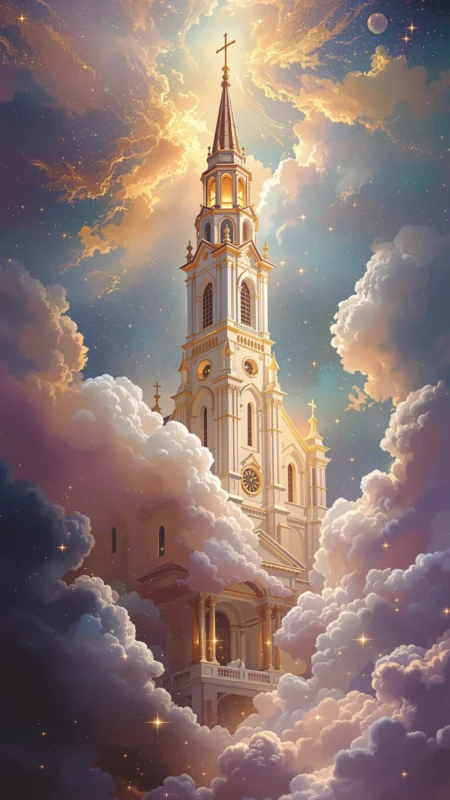


Church

Archetype Meaning & Symbolism

Sanctuary, Dogma, Community, Ritual, Judgment, Hierarchy, Transcendence, Tradition, Exclusion, Asylum

  • Within my walls, the whisper of eternity is amplified. Listen not for answers, but for the shape of your question.

If Church is part of your personal mythology, you may...

Believe

  • That there is a correct and sacred way to live, and that this path is discoverable through discipline and devotion.

    That community built around a shared, transcendent purpose is the most powerful force for good.

    That structure and ritual are not limitations but the very architecture of a meaningful life.

Fear

  • Excommunication: being cast out from the group and losing the safety of the collective.

    Heresy: the terrifying possibility that your own core beliefs are fundamentally wrong.

    Meaninglessness: the silent, echoing void of a world without a divine plan or a sacred order.

Strength

  • A profound sense of purpose and unwavering conviction that can weather almost any storm.

    The ability to build and sustain deep, meaningful communities based on shared values.

    A capacity for discipline, ritual, and long-term commitment to a higher ideal.

Weakness

  • A tendency toward dogmatism, rigidity, and an inability to tolerate ambiguity or dissent.

    A potential for judgment, exclusion, and a clear division of the world into 'us' and 'them.'

    A vulnerability to guilt and shame, driven by a constant striving for an unattainable moral perfection.

The Symbolism & Meaning of Church

In personal mythology, the Church archetype is the internal architecture of your belief system. It is the cathedral you build inside yourself, with stained-glass windows of cherished memories, foundation stones of core values, and a steeple that points toward your highest aspiration. It represents not a specific religion, but the very human instinct to create a sacred space for the soul. This inner church is where you go to consult your deepest truths, to find sanctuary from the noise of the world, and to perform the quiet rituals that give your life meaning. Its bells may toll for moments of profound joy, its pews may be filled with the figures who have shaped you, and its altar is where you make your most solemn commitments to yourself.

This archetype also embodies the fundamental tension between the institution and the individual spirit. The nave is for the congregation, for the safety and power of the collective, while the confessional booth is for the solitary, whispered secret. In your own mythos, this may play out as the struggle between your need to belong to a community—a family, a company, a culture—and your need for authentic, individual expression. The Church archetype asks: which rules will you follow? Which rituals will you adopt? And when will you become a heretic to your own established order, smashing a window to let in a new and terrifying light?

Furthermore, the Church is a vessel of time and tradition. Its very stones seem saturated with the prayers and hopes of generations past. When this archetype is active in your mythos, you may feel a powerful connection to your ancestors or to the long lineage of a particular craft or idea. You are not just living your life; you are a custodian, a link in a sacred chain. Your life's work might feel like the slow, patient craft of a stonemason, adding your own small, carved stone to a cathedral that was started long before you were born and will continue long after you are gone. It is the part of you that understands that true meaning is built over time, through devotion and continuity.


Church Relationships With Other Archetypes

The Heretic

The Heretic is the Church's necessary shadow, its defiant child. The Church provides the walls of doctrine, and The Heretic is the one who tests every brick, looking for cracks, questioning the foundation itself. Their relationship is one of symbiotic antagonism. Without The Heretic's sharp-edged questions, the Church's faith may become brittle, complacent, and tyrannical. In a personal mythos, the Church represents your established beliefs, while The Heretic is the nagging, internal voice of doubt that pushes you toward a more authentic, hard-won truth. The Church fears The Heretic, but it also desperately needs them to evolve.

The Forest

The Church is often an attempt to build order against the chaotic, untamed spirituality of The Forest. Where The Forest is a place of wild, immanent divinity—God in every leaf and shadow—the Church is a structure of transcendent, hierarchical order—God in a specific, consecrated place. One seeks truth in the tangled roots and unpredictable cycles of nature; the other seeks it in scripture, liturgy, and a divinely ordained plan. In your own story, you may find yourself torn between these two poles: the desire for the safety and clarity of a defined spiritual home and the longing for the wild, mysterious, and sometimes frightening freedom of the deep woods.

The Judge

The Judge often holds court within the Church's walls, for it is the Church that writes the lawbook The Judge uses to deliver verdicts. The Church provides the moral architecture—the definitions of sin and virtue, sacred and profane—and The Judge enforces it. This relationship can provide a clear moral compass, a comforting sense of right and wrong. However, it can also become a source of merciless self-flagellation, where your inner Judge uses the Church's rigid dogma to condemn every human flaw, creating a personal mythology of perpetual guilt and the impossible pursuit of perfection.

Using Church in Every Day Life

Navigating a Crisis of Faith

When external belief systems fail, the Church archetype can be used to construct an inner sanctuary. This doesn't require faith in a deity, but rather faith in a process. You might design personal rituals: a morning coffee brewed with intention, a weekly walk through a specific park to commune with your thoughts, a journal entry written as a prayer to your higher self. This builds a personal cathedral of practice, a place of refuge defined not by inherited dogma but by chosen devotion, allowing you to weather spiritual storms from a place of self-made sanctity.

Building Intentional Community

The structure of a church—a regular meeting time, a shared purpose, roles for its members, and common rituals—can be a potent blueprint for creating meaningful connections. If you feel isolated, you could invoke this archetype to form a modern 'congregation.' This could be a monthly 'philosophy dinner' where a sacred text is a challenging article, the 'hymns' are a shared playlist, and the 'sermon' is a vulnerable, round-table discussion. It uses the archetype’s power for connection, creating a fellowship bound by inquiry rather than doctrine.

Finding the Sacred in the Mundane

The Church archetype excels at elevating the ordinary to the level of the sacred. You can apply this to a monotonous job or a draining routine. By reframing your tasks as liturgical acts, you can transform your experience. Answering emails could become a ritual of mindful connection. Cleaning the house might be seen as purifying a sacred space. This practice doesn't change the tasks themselves, but it imbues them with a resonant significance, turning your daily life into a quiet, continuous ceremony of purpose.

Church is Known For

Sanctuary

It offers a haven, a place set apart from the profane chaos of the world where one can seek refuge, solace, and a connection to something transcendent.

Ritual

It provides structured, repeatable actions and ceremonies that give form to belief, mark the passage of time, and unify a community in shared symbolic practice.

Dogma

It codifies a system of beliefs, doctrines, and moral laws, creating a coherent framework for understanding the world and one's place within it.

How Church Might Affect Your Personal Mythology

How Church Might Affect Your Mythos

When the Church is a central archetype in your personal mythos, your life story is not just a sequence of events; it's a liturgy. The narrative arc may follow a sacred pattern: periods of wandering in the desert of doubt, moments of revelation that feel like divine grace, and acts of service that are a form of prayer. Your personal history might be organized not by years but by eras of faith, schisms, and reformations. A major life change is not just a 'new chapter' but an 'excommunication' from an old way of being, followed by the difficult pilgrimage to find or build a new spiritual home. The characters in your story are saints, sinners, apostles, and tempters, each playing a role in the grand, unfolding drama of your soul's journey.

Your mythos could also be a story of architecture, the tale of building your own internal cathedral of meaning. Childhood is the laying of the foundation stones, often with materials you did not choose yourself. Adolescence and young adulthood are the raising of the walls and the ambitious, perhaps flawed, construction of a steeple. Mid-life might be the painstaking installation of the stained-glass windows: moments of profound beauty, suffering, and insight that filter the light of your experience. Your story becomes one of a master builder, a restorer, and a custodian of this sacred inner space, constantly working to ensure its integrity against the weathering forces of time and doubt.

How Church Might Affect Your Sense of Self

Your sense of self may be anchored to a firm set of principles, a personal creed that functions as your spiritual backbone. Identity is not something fluid and ever-changing, but something solid, defined by what you believe. You might see yourself as a 'pilgrim' on a specific path, a 'guardian' of a certain truth, or a 'disciple' of a particular philosophy. This provides a powerful sense of stability and purpose. The question 'Who am I?' is answered by pointing to the altar of your deepest convictions. This can be a source of immense strength, a clear identity that is not swayed by passing trends or external pressures.

Conversely, the Church archetype could lead you to define yourself by what you are not. Your identity might be forged in the fire of apostasy, in the conscious rejection of the 'church' of your upbringing—be it a religion, a family ideology, or a societal norm. You are the reformer, the protestant, the one who nailed their theses to the door. In this narrative, the self is not found within the walls but in the wilderness outside. Selfhood is a continuous act of liberation from dogma, and your personal integrity is measured by your courage to question and stand apart from the congregation.

How Church Might Affect Your Beliefs About The World

The world, through the lens of the Church archetype, might appear as a place imbued with sacred order and moral structure. Events are not random occurrences but parts of a grand, unfolding narrative, perhaps guided by an unseen hand. There is a perceptible hierarchy: some places are holy ground, some actions are sacraments, and some are sins. This worldview provides a map for navigating the complexities of life, offering clear distinctions between right and wrong, meaningful and meaningless. It transforms the chaotic noise of existence into a cosmic choir, where everything has its place and its purpose in a divine or ethical composition.

This archetype can also foster a dualistic worldview, splitting reality into the sacred and the profane. The material world may be seen as a fallen place, a realm of trial and tribulation, a temporary waystation on a journey to a higher, more perfect reality. The primary goal of life, then, is not to immerse oneself in worldly affairs but to transcend them. This can lead to a kind of noble detachment from earthly concerns, but it can also create a deep sense of alienation from the beauty and messiness of the physical, human experience, which is seen as a distraction from or an obstacle to a more important spiritual destination.

How Church Might Affect Your Relationships

Relationships may be perceived through the framework of a sacred covenant or a fellowship. Your closest friends and family form your personal 'congregation,' a circle of souls bound not just by affection but by a shared belief system and common rituals. There is a clear, protective boundary between those who are 'in' the community and those who are outside. Loyalty and ideological alignment are paramount, creating bonds of immense strength and solidarity. You don't just have friends; you have fellow parishioners in the church of your life, offering each other sanctuary, confession, and communion.

This sacred view of relationships means that conflict can feel like sacrilege. A betrayal is not merely a personal wound; it is a desecration of a holy pact, a breaking of the faith. Forgiveness might not be a simple act but may require a structured process akin to penance and absolution to restore the sanctity of the connection. The archetype could create a dynamic where love and acceptance are conditional upon adherence to the shared 'doctrine' of the relationship, making dissent or individual evolution feel like a threatening act of heresy.

How Church Might Affect Your Role in Life

You may see your primary role in life as a 'calling' or a vocation, rather than simply a job or a series of responsibilities. Your work, whether it is art, parenting, science, or craftsmanship, is your ministry. It is the sacred duty you were appointed to perform. This perspective imbues even the most mundane tasks with a profound sense of purpose and significance. You aren't just earning a living; you are engaged in a form of worship, offering your skills and energy as a tribute to a higher ideal. This can be an incredibly powerful motivator, transforming your role from a burden into a blessing.

Alternatively, your perceived role might be that of a custodian of tradition. You are the archivist, the elder, the one who keeps the sacred flame burning. Whether within your family, your community, or your profession, you feel a deep responsibility to preserve and pass on the core beliefs, the essential stories, and the vital rituals that define the group. You are a living cornerstone, connecting the past to the future. This role provides a strong sense of identity and importance, grounding your existence in a continuity that transcends your own individual lifespan.

Dream Interpretation of Church

In a positive context, dreaming of a church often symbolizes a connection to your higher self and a sense of inner harmony. A dream of a beautiful, light-filled cathedral could represent the successful construction of a personal value system that provides you with sanctuary and meaning. Walking into a welcoming church might signify finding your place within a community or feeling at peace with your spiritual path. Participating in a joyful service could reflect a deep sense of communion with others and with the core principles that guide your life. It is the psyche's affirmation that your inner temple is sound and sacred.

When the dream context is negative, a church can represent dogma, guilt, and spiritual crisis. A crumbling or decaying church may point to a belief system that is no longer serving you, one that is collapsing under the weight of its own rigidity. Being locked out of a church could symbolize feelings of alienation, judgment, or excommunication from a group or from your own sense of worthiness. A dark, oppressive, or empty church might be a potent symbol of a loss of faith, a hollowing out of meaning, or the terrifying silence where a comforting divine presence used to be.

How Church Archetype Might Affect Your Needs

How Church Might Affect Your Physiological Needs

When the Church archetype is integrated in a healthy way, the body may be regarded as a sacred temple. This is not about vanity, but about reverence. Physiological needs are attended to as a form of spiritual practice. Eating becomes an act of providing communion for the body's cells; exercise is a moving prayer; rest is a sabbath for the soul's earthly vessel. The rhythms of the body—breath, sleep cycles, heartbeat—are seen as the quiet liturgy of existence. This perspective fosters a deep, respectful connection to one's physical being, treating it as a precious and holy instrument for experiencing life.

However, this archetype can also create a profound and damaging split between spirit and flesh. The body may be viewed as a sinful, corrupting force, a beast to be tamed, disciplined, or denied. Physiological needs and desires might be framed as temptations that pull the soul away from its higher purpose. This can lead to asceticism, a neglect of the body's signals, or a chronic sense of being trapped in a shell that is fundamentally at odds with one's spiritual aspirations. The body is not a temple to be cared for, but a prison from which the spirit longs to escape.

How Church Might Affect Your Ideas of Belonging

Belongingness is found through communion. It is the profound sense of being a part of a congregation, a 'we' united by a shared, sacred purpose. This archetype provides a blueprint for creating deep and resilient communities, where individuals are bound together by covenant, shared rituals, and a common language of belief. This form of belonging can be incredibly powerful, offering a deep well of support, identity, and solace against the isolation of modern life. You are not just known; you are a fellow believer, a member of the flock, safe within the fold.

The price of this belonging, however, may be a conditional acceptance. To remain a member in good standing, one must often adhere to the community's doctrines and norms. Dissent, questioning, or significant personal change can be seen as a betrayal, leading to the terrifying threat of excommunication. This can foster a dynamic where love and belonging feel contingent on conformity, forcing individuals to suppress parts of their authentic selves to maintain their place in the community. The fear of being cast out can become a powerful force for maintaining the status quo, even when it is no longer life-giving.

How Church Might Affect Your Feelings of Safety

A sense of safety may be deeply rooted in the structural certainty that the Church archetype provides. In a world of overwhelming choice and moral ambiguity, a clear set of doctrines, rituals, and community standards can feel like a fortress. Safety lies in knowing the rules, in the predictability of the liturgy, and in the belief that you are on the 'right' path. This psychological and spiritual structure provides a powerful bulwark against the existential dread of meaninglessness, creating a well-defended inner space where you feel protected from the chaos of the outside world.

The shadow side of this is that the very walls built for safety can become a prison. The need for certainty may calcify into a profound fear of the unknown, the different, and the 'other.' Safety becomes conditional on conformity. Any challenge to the doctrine, any question that threatens the structural integrity of the belief system, is perceived not as an opportunity for growth but as a mortal threat. True safety is then sacrificed for the illusion of security, and the world outside the church walls becomes a place of perceived peril and damnation.

How Church Might Affect Your Views of Esteem

Esteem might be derived from one's faithful adherence to the tenets of the personal or collective 'church.' A sense of worth comes from fulfilling your role within the sacred structure: being a devoted acolyte, a wise elder, a charitable servant, or simply a pious member of the congregation. Your value is measured by your piety, your service, and your commitment to the group's ideals. This can provide a clear and reliable source of self-worth, as your actions are constantly validated by a moral framework that you hold as true and absolute.

Conversely, the Church archetype can be devastating to esteem if it is built upon a foundation of inherent unworthiness or original sin. Self-worth is not a given but something that must be perpetually earned, and is easily lost through transgression. You may exist in a constant state of striving for a moral perfection that is forever out of reach, with an inner Judge cataloging your every failing. Esteem becomes a fragile thing, constantly threatened by guilt and the fear of a final, unforgiving judgment from a higher power or from the self.

Shadow of Church

The shadow of the Church arises when its structure becomes more important than the spirit it was meant to house. This is the archetype of the Grand Inquisitor: the internal or external authority that hunts for heresy and punishes doubt in the name of preserving doctrinal purity. In a personal mythos, this shadow turns the inner sanctuary into a prison. The self-policing becomes ruthless; every unorthodox thought is a sin, every moment of questioning is a betrayal. This creates a brittle, sterile faith, terrified of contradiction and devoid of grace. The goal is no longer connection to the divine, but absolute control over belief.

Another facet of the shadow is the empty cathedral. This is the church of hypocrisy, where all the rituals are performed flawlessly but are devoid of any meaning or presence. The prayers are rote, the hymns are tuneless, and the community is a gathering of strangers playing a part. In one's own life, this manifests as a commitment to the outward form of a belief system—a relationship, a career path, an identity—long after the inner spirit has died. It is a profound spiritual emptiness masked by a beautiful, but hollow, facade. The worship is of the image of piety, not of the mystery itself.

Pros & Cons of Church in Your Mythology

Pros

  • Provides a powerful framework for meaning, community, and moral clarity.

    Offers sanctuary and solace in times of personal and collective crisis.

    Fosters a sense of connection to history, tradition, and something larger than the self.

Cons

  • Can foster rigidity, intolerance, and a fear of the unknown.

    May lead to the suppression of individuality in favor of group conformity.

    Its structures can be used to justify judgment, exclusion, and control.