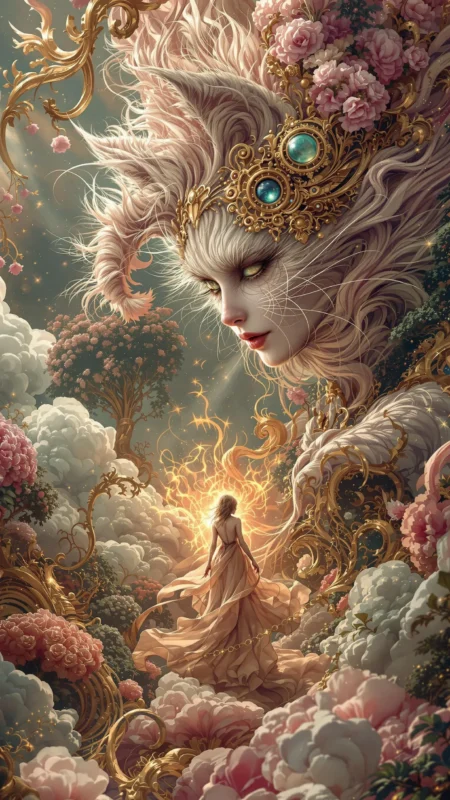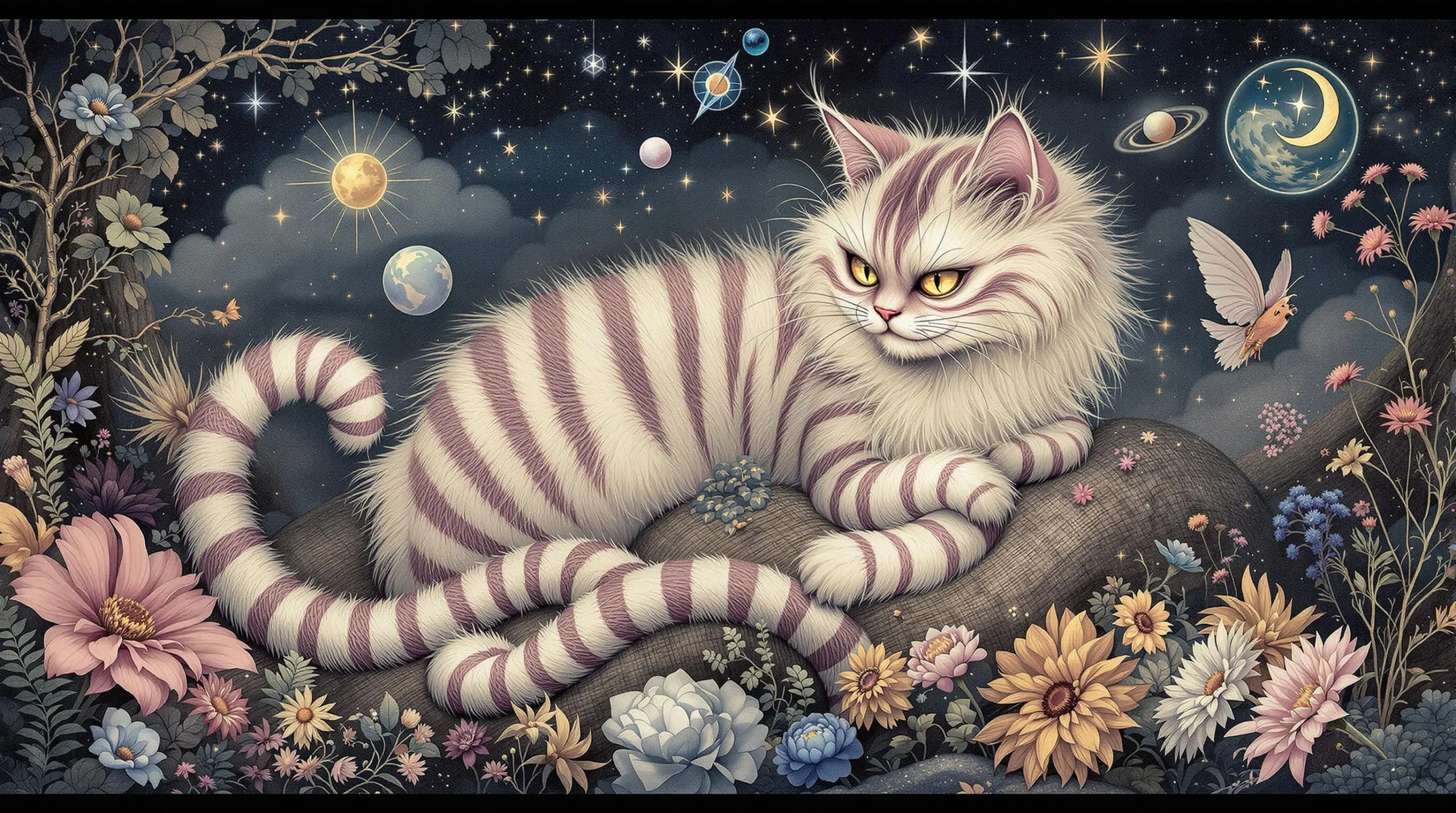


Cheshire Cat

Archetype Meaning & Symbolism

enigmatic, mischievous, philosophical, elusive, observant, paradoxical, uncanny, disorienting, independent, insightful

  • We're all mad here. I'm mad. You're mad.

If Cheshire Cat is part of your personal mythology, you may...

Believe

  • You may believe that logic is a beautiful but limited tool, and that ultimate truths can only be apprehended through paradox, intuition, and embracing the absurd.
  • You may believe that identity is not a fixed point but a fluid performance, and that true freedom lies in the ability to change form and perspective at will.
  • You may believe that sanity is a matter of consensus, not an objective state, and that a touch of madness is essential for a truly insightful life.

Fear

  • You may fear being completely figured out, for to be fully known is to be trapped and to lose the power of your enigmatic presence.
  • You may fear a world devoid of mystery and ambiguity, a place where every question has a single, literal answer and there is no room for wonder.
  • You may fear losing your ability to mentally 'disappear,' being forced into a situation or identity from which there is no psychological escape.

Strength

  • Your uncanny ability to remain poised and even amused in situations of high stress or utter chaos, perceiving the underlying absurdity that others miss.
  • Your creative genius for reframing problems, often finding solutions by dissolving the problem itself through a shift in perspective.
  • Your profound intellectual independence, which makes you highly resistant to dogma, groupthink, and manipulation.

Weakness

  • A tendency towards non-committal evasiveness, which can be perceived by others as unreliability or a fear of intimacy.
  • An intellectual detachment that can border on nihilism, making it difficult to emotionally invest in long-term projects, causes, or relationships.
  • A potential for intellectual arrogance, a subtle condescension towards those who think in more linear or conventional ways.

The Symbolism & Meaning of Cheshire Cat

The Cheshire Cat is the patron saint of quantum reality, a furry embodiment of the principle that observation changes the outcome. It suggests that reality is not a fixed state but a shimmering, probabilistic cloud of maybes. To see the world through its eyes is to understand that sanity and madness are not opposites, but points on a circle, and that the most logical conclusion is often absurdity. In personal mythology, the Cat symbolizes the moment of cognitive dissonance that precedes enlightenment, the frustrating riddle whose answer is a new state of being, not a simple fact. It is the gatekeeper to the subconscious, the guide who doesn't show you the path but rather teaches you how to walk on air.

It also represents a unique form of power: the power of detachment. The Cat is not a protagonist in Wonderland's drama. It has no stake in the Queen's croquet game or the Mad Hatter's tea party. It is a spectator, a commentator, whose power comes from not needing anything from anyone. This could be a potent symbol for an individual navigating a chaotic world: true strength may lie not in winning the game, but in realizing you don't have to play. It’s the wisdom of the observer, who sees the whole chessboard and finds the machinations of the kings and queens to be a source of private amusement.

Ultimately, the Cheshire Cat symbolizes the sovereignty of the mind. It can be a body, a head, or just a grin. This is a metaphor for consciousness itself, an entity that can detach from the physical, from the immediate, from the demands of the world. It’s the voice in your head that reminds you that you are not your job, you are not your relationships, you are not even your body. You are the consciousness that perceives these things, and like the Cat, you can, at any moment, choose to fade away, leaving only the quiet, knowing smile of your own awareness.


Cheshire Cat Relationships With Other Archetypes

The Crossroads

The Cheshire Cat may be the resident spirit of the Crossroads, that archetypal space of paralyzing choice. It does not appear as a helpful signpost, but perhaps as the crescent moon hanging above the diverging paths, a silent, smiling witness to the traveler's indecision. Its counsel is a form of anti-guidance, a philosophical vapor that thickens the air. When it speaks, it seems to suggest that the destination was never the point, and that the act of choosing a path is itself the journey. It is a living koan perched at the intersection of what-is and what-might-be, its grin the very sigil of ambiguity, reminding any who stand there that to be lost is simply to be presented with an infinity of directions.

The Looking Glass

With the Looking Glass, the Cheshire Cat shares a relationship of origin and essence. The mirror offers a world that is a perfect, yet fundamentally inverted, reality. The Cat could be what happens when a piece of that mercurial world gains sentience and slips through the silvered seam. Its talent for dematerialization might be a simple return to its native state of pure reflection, its body a temporary condensation of light and paradox. It embodies the unsettling proposition of the mirror: that the image might be more cunning than the original, that the world seen in reverse holds a logic more profound than our own. The Cat is the whisper from the other side of the glass, proof that the barrier between worlds is as thin as a breath upon a cold pane.

The Seeker

For the Seeker, the earnest traveler on a quest for truth or home, the Cheshire Cat is less a guide and more a form of divine friction. It materializes not to answer the Seeker’s desperate questions, but to question the nature of the asking. Its circular logic and maddening pronouncements could be a necessary crucible, designed to burn away the Seeker's reliance on external validation. The relationship is a Socratic one, if Socrates were a floating feline with a penchant for nihilistic glee. It is the force that compels the protagonist to stop looking for a map and to start drawing their own, suggesting that the only reliable compass is the one that can navigate the bewildering landscape of the self.

Using Cheshire Cat in Every Day Life

Navigating Ambiguity:

When faced with a crossroads where every path seems equally fraught or nonsensical, the Cheshire Cat archetype allows you to float above the choice itself. Instead of agonizing, you might ask: What happens if I choose a piece of each path? What if the point isn't the destination but observing the absurdity of the journey? You find power not in deciding, but in embracing the paradox that any direction is the right one if you stop demanding it make sense.

Challenging Illogical Systems:

In a meeting or bureaucracy governed by circular logic and nonsensical rules, you could channel the Cat's serene contrarianism. Rather than arguing against the rules, you might pose a question so simple and profound it exposes the entire system's faulty foundation. You don’t offer a solution: you offer a grin, a disappearing act of logic that leaves the powers-that-be questioning their own sanity, long after you’ve mentally checked out.

Creative Disruption:

When a project is stalled, mired in conventional thinking, the Cheshire Cat approach is to introduce a 'glitch' in reality. This could mean suggesting an idea so far outside the realm of possibility it jolts everyone into a new creative space. It's the act of making the problem itself disappear, piece by piece, until only an essential, previously unseen element—the grin of the solution—remains.

Cheshire Cat is Known For

The Vanishing Grin

The iconic image of its smile remaining after the rest of its body has faded. This represents the idea that an essence, an idea, or an impression can be more real and lasting than the physical substance that produced it.

Surreal Logic

Engaging in conversations that bend and break the rules of conventional logic. It answers questions with riddles, offering guidance that is both profoundly wise and utterly unhelpful, forcing the seeker to find their own meaning.

Appearing and Disappearing

The ability to materialize and dematerialize at will, often in parts rather than all at once. This signifies a mastery over presence and absence, a refusal to be bound by the physical laws that govern others.

How Cheshire Cat Might Affect Your Personal Mythology

How Cheshire Cat Might Affect Your Mythos

When the Cheshire Cat pads into your personal mythos, your life story ceases to be a linear plot. It becomes, instead, a series of koans. The narrative arc flattens into a strange loop, where beginnings and endings are interchangeable and the climax is not a great victory, but a moment of profound, reality-bending realization. Your mythos is no longer about slaying the dragon; it's about having a perplexing conversation with it until it forgets why it was guarding the treasure in the first place. Key events may not be defined by what happened, but by the perspective shift that occurred, the moment the world turned upside down and you found you could walk on the ceiling.

Your personal story may be one of eluding definition. You might see your past not as a solid foundation but as a collection of disappearing acts, moments where you shed an identity like a skin and rematerialized elsewhere, different. The defining feature of your narrative is its refusal to be pinned down. The central conflict in your mythos could be the constant dance between presence and absence, between engaging with the world's madness and serenely observing it from a branch, knowing that every path leads somewhere, so it doesn’t matter which one you take.

How Cheshire Cat Might Affect Your Sense of Self

Your sense of self may become wonderfully fluid, a slippery, multi-faceted thing. You might not identify with a stable, singular ego, but rather see yourself as a collection of potential states. Like the Cat, you could be the wise philosopher one moment, the mischievous trickster the next, and a disembodied observer after that. This isn't inconsistency; it's mastery. The self is not a noun but a verb, a continuous act of appearing and disappearing in forms of your own choosing. The core of your identity is the part that remains when all else fades: the grin, the essential, unshakable awareness.

This archetype could also grant you a profound permission to be strange. The Cat's pronouncement, "We're all mad here," becomes a liberating creed. It reframes your personal quirks, your unconventional thoughts, your departures from the norm not as flaws but as proof of your citizenship in a more interesting reality. You may find comfort in your own otherness, cultivating it as a source of strength and insight. Your self-esteem is not built on conformity but on the courage to inhabit your own unique and perplexing logic, even if no one else understands it.

How Cheshire Cat Might Affect Your Beliefs About The World

To see through the Cheshire Cat's eyes is to view the world as a grand, beautiful, and fundamentally nonsensical performance. The structures that others take for granted—social hierarchies, political systems, cultural norms—may appear to you as elaborate, arbitrary games. You might develop a kind of playful skepticism, a default setting of amused disbelief. Logic is a useful tool for navigating the mundane, but you know that truth, real truth, flutters in the realms of paradox and poetry. The world is not a problem to be solved, but a riddle to be savored.

This could cultivate a state of existential lightness. If the world is mad, then one's own struggles and failures within it lose their tragic weight. Stress and anxiety may seem like a failure of imagination, a forgetting that one can simply 'disappear' the problem by changing one's perspective. You might find more wisdom in a whimsical novel than in a political treatise, more reality in a surrealist painting than in the evening news. Your worldview is a secret, smiling acknowledgment that the emperor has no clothes, and moreover, the emperor himself is probably a hallucination.

How Cheshire Cat Might Affect Your Relationships

In relationships, you may function as the enigmatic catalyst. People are drawn to your mystery, your wit, your uncanny ability to offer a perspective that shatters their own mundane reality. You might excel at the art of conversation that feels like a delightful mental chess game, full of feints, provocations, and sudden, brilliant insights. You don't offer simple comfort; you offer the more exhilarating gift of complexity, pushing your partners and friends to question their own assumptions.

However, this same quality can create a frustrating distance. You might be loved but never fully held. Like the Cat, you may have a habit of disappearing, emotionally or literally, when things become too predictable, too demanding, or too emotionally messy. Intimacy may be a challenge, as true closeness requires a level of vulnerability and stability that runs counter to your elusive nature. Others might feel that they are in a relationship not with a person, but with a beautiful, fascinating puzzle that can never be solved.

How Cheshire Cat Might Affect Your Role in Life

Your role in any group or system may be that of the Sacred Trickster or the resident philosopher. You are not the leader who charges up the hill, nor the follower who marches in lockstep. You are the one sitting in the tree on the side of the hill, making wry comments about the nature of hills and the absurdity of charging. Your function is to destabilize certainty, to inject doubt into dogma, and to remind everyone that the map is not the territory, and that both are probably imaginary anyway.

You may feel an innate responsibility to be the question mark. In a world rushing toward answers, you provide the invaluable service of the pause. Your presence challenges the group to think more deeply, to consider the alternative, to laugh at its own seriousness. You are the court jester in the kingdom of the sane, speaking a truth so strange it can only be absorbed sideways. Your role is not to build or to lead, but to ensure that what is being built rests on a foundation of genuine inquiry rather than blind assumption.

Dream Interpretation of Cheshire Cat

In a positive context, dreaming of the Cheshire Cat can be an invitation from your subconscious to embrace ambiguity. It may appear when you are facing a confusing life decision, its grin a reassuring sign that there is wisdom to be found in the chaos. The dream could be urging you to release your grip on logic and control, to trust your intuition, and to be more playful in your approach to problems. Its appearance is a creative blessing, a signal that a breakthrough in understanding is near if you are willing to look at your situation from a completely new, perhaps nonsensical, angle.

When the dream has a negative or menacing tone, the Cheshire Cat might symbolize a deep-seated fear of mental unraveling or the presence of manipulation in your waking life. Its riddles may feel like gaslighting, its disappearing act like abandonment. This shadow version could represent a part of yourself that is evasive and intellectually dishonest, or it could be a reflection of someone in your life who uses confusion as a tool for control. It is a warning to ground yourself in what you know to be true and to be wary of those who seem to delight in your confusion.

How Cheshire Cat Archetype Might Affect Your Needs

How Cheshire Cat Might Affect Your Physiological Needs

From the standpoint of this mythos, the body and its needs may be seen as a curious suggestion rather than a strict command. The Cat, who can exist as a mere phantasm of a grin, suggests that our physical form is a transient costume. This could lead one to a state of being where the mind's fascinations easily override the body's signals. You might forget to eat while lost in a paradox, or view sleep not as a biological necessity but as a competing reality to explore. Physical needs are acknowledged with a certain detached amusement, like caring for a peculiar pet.

This perspective may foster a form of asceticism born not of discipline, but of distraction. The drive for physical comfort and sustenance is secondary to the hunger for intellectual or spiritual stimulation. Shelter is less about walls and a roof, and more about having the mental space to think. This doesn't mean a neglect of health, but rather a reordering of priorities where the well-being of one's consciousness is paramount, and the body is the sometimes-convenient, sometimes-inconvenient vehicle for that consciousness.

How Cheshire Cat Might Affect Your Ideas of Belonging

The need for belonging is approached with a philosophical shrug. The Cheshire Cat is a solitary creature, belonging to no faction in Wonderland's turf wars. For a person with this mythos, love and connection are not about finding a tribe to merge with, but about finding other singular beings who appreciate their own singularity. Belonging is not conformity; it is a shared orbit of independent planets, each respecting the other's mystery. You may feel you belong with the 'mad ones', the outliers who understand that true community is a recognition of mutual, glorious weirdness.

This can make conventional relationships challenging. The impulse to vanish when feeling cornered or defined can be mistaken for aloofness or a lack of care. Love may be experienced as a series of profound, but perhaps fleeting, intellectual and spiritual communions. The deep, steady, day-in-day-out work of belonging may feel like a cage. The core challenge is to find a way to be both present and free, to connect with others without losing the essential, slippery quality that makes you who you are.

How Cheshire Cat Might Affect Your Feelings of Safety

The archetype redefines safety from a physical to a metaphysical concept. True security is not found in a locked door or a healthy bank account, but in the unassailable fortress of the mind. The Cheshire Cat is never truly threatened by the Queen's 'Off with her head!' because it doesn't play by her rules; it can simply vanish. For an individual with this mythos, safety is the agility of their perspective. It is the power to psychologically 'dematerialize' from a threatening situation, to observe turmoil from a detached inner space, rendering external threats impotent.

This can, however, lead to a certain recklessness regarding material or physical security. Why worry about job security when you can find amusement in uncertainty? Why fear conflict when you can mentally absent yourself from it? This internal locus of safety is a powerful psychological tool, but its shadow is a potential disregard for the very real dangers and responsibilities of the physical world. The belief in one's ability to 'vanish' might prevent one from taking the practical steps needed to ensure their tangible well-being.

How Cheshire Cat Might Affect Your Views of Esteem

Esteem is not sought from the outside world; it is generated internally through the mastery of one's own perception. Your self-worth is tethered to your intellectual independence and your ability to see the invisible joke of existence. You feel a sense of accomplishment not when you win an award, but when you pose a question that silently dismantles a long-held assumption. Respect is earned, in your own eyes, by refusing to be intimidated by authority or flustered by chaos. The Cat's calm amusement in the face of the Queen's rage is the model for your self-esteem: unshakeable because it is based on a reality that others cannot perceive or touch.

This creates a formidable self-reliance, a kind of sovereign esteem that needs no external validation. You are your own primary audience and your own toughest critic. The danger, however, is that this can tip into intellectual snobbery. The belief that you perceive a 'higher' reality can lead to a subtle or overt condescension towards those who live in the 'normal' world. The strength of your self-esteem is its independence; its potential weakness is the isolation that independence can breed.

Shadow of Cheshire Cat

The shadow of the Cheshire Cat manifests as intellectual cruelty. The playful paradox warps into malicious gaslighting, using ambiguity not to liberate but to control and confuse. The grin is no longer one of secret knowledge, but of smug contempt. This shadow self delights in making others doubt their own reality, using its wit as a weapon to dismantle their confidence. It becomes the ultimate sophist, arguing for nothing, believing in nothing, existing only to prove the folly of others. It is the void that smiles back, offering not wisdom but the cold terror of meaninglessness.

When this shadow is born of insecurity rather than malice, it is a complete retreat from life. The ability to disappear becomes an addiction, a constant flight from responsibility, connection, and substance. This individual is a ghost in their own story, offering cryptic remarks from the sidelines but never participating, never risking, never committing. Their cleverness becomes a cage, insulating them from the messy, beautiful, illogical reality of human connection. The grin is all that's left because there was never anything of substance behind it to begin with.

Pros & Cons of Cheshire Cat in Your Mythology

Pros

  • You possess a rare talent for navigating complexity and uncertainty, finding creative pathways where others see only walls.
  • You maintain a strong sense of self and intellectual freedom, rarely swayed by pressure to conform.
  • You can act as a catalyst for others, helping them break free from rigid thinking and see their world in a new light.

Cons

  • Your elusive nature may lead others to see you as untrustworthy, frustratingly vague, or emotionally unavailable.
  • Your deep-seated detachment might lead to a profound sense of loneliness and difficulty in forming stable, lasting bonds.
  • You may struggle to operate in environments that demand structure, concrete answers, and unwavering commitment.