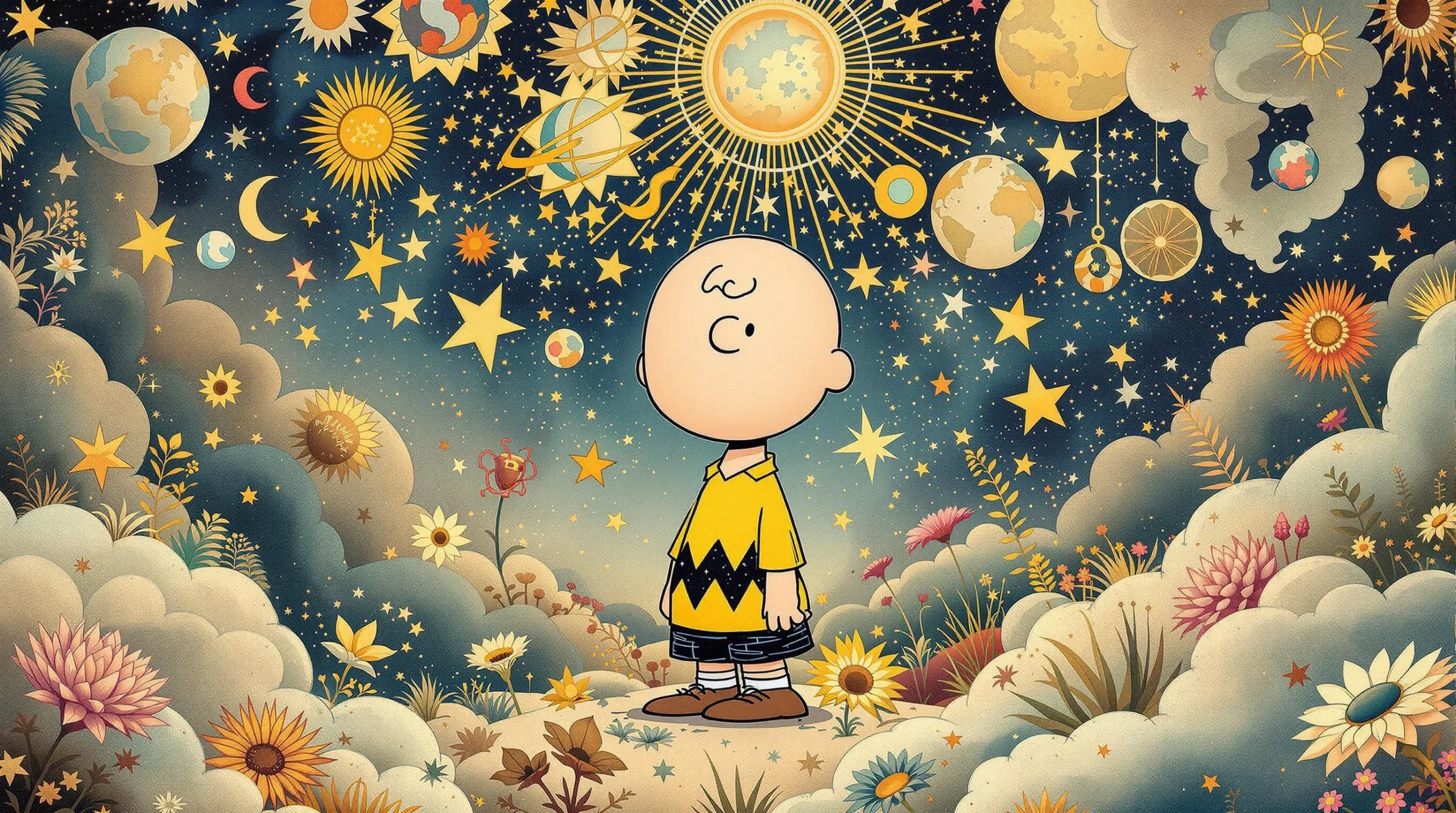


Charlie Brown

Archetype Meaning & Symbolism

persistent, melancholic, hopeful, kind, insecure, lonely, resilient, philosophical, unlucky, ordinary

  • I think I'm afraid to be happy because whenever I get too happy, something bad always happens.

If Charlie Brown is part of your personal mythology, you may...

Believe

  • You may believe that integrity is measured by your willingness to try again, not by your record of success.
  • You may believe that true friendship is forged in shared vulnerability and the ability to weather disappointment together.
  • You may believe that hope is not a feeling but a discipline, a quiet act of rebellion in a seemingly indifferent world.

Fear

  • You may fear that you are fundamentally inadequate or unlovable, and that any moment of happiness is merely a prelude to disaster.
  • You may fear that your best efforts will never be enough to change your circumstances or earn you the respect you crave.
  • You may fear both intimacy and isolation, caught in a loop of longing for connection while simultaneously believing you will inevitably be rejected.

Strength

  • Your greatest strength is an almost supernatural resilience, an ability to absorb failure and disappointment without losing your core kindness.
  • You possess a deep well of empathy, born from your own familiarity with sorrow, which makes you a profoundly loyal and compassionate friend.
  • You have a philosophical soul that allows you to find meaning, poetry, and a kind of bittersweet beauty in the struggles of ordinary life.

Weakness

  • Your tendency towards melancholy can sometimes tip into a state of learned helplessness, where you accept failure as inevitable rather than fighting it.
  • You may suffer from a crippling lack of self-assertion, making it difficult to set boundaries or protect yourself from being taken advantage of (by Lucys everywhere).
  • Your deep-seated insecurity and social anxiety might prevent you from taking risks that could lead to genuine happiness and connection.

The Symbolism & Meaning of Charlie Brown

The Charlie Brown archetype is perhaps the quiet patron saint of modern anxiety. He is the avatar of the ordinary struggle, a small, round-headed vessel for our own feelings of inadequacy and our persistent, often irrational, hope. In a culture obsessed with victory narratives and heroic arcs, he offers a counter-mythology: the nobility of the attempt. His existence suggests that character is not forged in the moment of triumph, but in the thousand quiet moments of getting back up after being knocked flat. He is the patron of Monday mornings, of letters that go unanswered, of the courage it takes to simply try again when the universe seems to have a specific, and rather personal, grudge.

His symbolism may also speak to a kind of secular grace. He is perpetually forgiven, not by a deity, but by the turning of the page, the start of a new season. His failures are never final. This cyclical nature of his suffering and resilience could mirror our own internal seasons of despair and renewal. To see oneself in Charlie Brown is to acknowledge the Sisyphean boulder we all, at times, feel we are pushing. It’s a recognition that life is not a problem to be solved but a condition to be lived, with as much gentle dignity as one can muster. He transforms the pathetic into the profound, suggesting that the most human story of all is the one about failing, and then, for no good reason at all, choosing to believe in tomorrow.

Furthermore, the archetype serves as a potent critique of a meritocratic world. Charlie Brown’s efforts rarely, if ever, correlate with reward. He studies for the spelling bee and misspells 'beagle.' He builds a beautiful kite only to have it eaten by a tree. This disconnect resonates with a deep, often unspoken, truth: the world is not always fair. In this, he is not a symbol of failure, but a symbol of reality’s capricious nature. His personal mythos gives us permission to feel the sting of this injustice, to grieve the un-won prizes, and to find community not in shared success, but in the shared, vulnerable experience of being human.


Charlie Brown Relationships With Other Archetypes

The Football

The Football may represent the most brutal and cyclical of the archetypal relationships, a covenant of hope perpetually broken. It is not merely an object of sport, but perhaps the very shape of a promise, pristine and full of potential, placed upon the altar of the earth. For the Charlie Brown, the approach is a pilgrimage of faith; the run-up, a litany of self-encouragement against the long odds of history. The kick itself, however, never connects. The ball is a phantom, a mirage of glory that vanishes at the final, crucial moment, leaving only the sound of a body hitting the ground and the lingering echo of laughter. This recurring withdrawal could be a metaphor for the universe’s cruelest trick: the notion that trust is something to be earned, only to prove that the rules were a fiction all along, and the ground, not the sky, is one’s truest home.

The Little Red-Haired Girl

In the quiet pantheon of the Charlie Brown’s world, the Little Red-Haired Girl could be seen as the silent, unattainable deity. She is less a person and more a vessel for a constellation of anxieties and aspirations, a distant star by which he navigates his own sea of inadequacy. Her presence, often just a fleeting glimpse of red hair in a crowded hallway, may consecrate the space around her, turning a simple school lunchroom into a cathedral of longing. The relationship, if one could call it that, is entirely internal, a one-sided conversation with an idea of perfection. She is perhaps the ultimate symbol of the beautiful, terrifying possibility of connection, a poem he carries in his heart but can never bring himself to recite aloud, for fear that the sound of his own voice would shatter the sublime silence.

The Kite-Eating Tree

The Kite-Eating Tree stands as an archetype of impersonal, structural doom, a silent, gnarled refutation of upward mobility. Unlike the personal betrayal of the Football, the Tree harbors no malice; it is simply an indifferent feature of the landscape, a natural law of disappointment. The kite, that fragile geometry of paper and stick, represents a pure and simple aspiration—a desire to touch the wind, to float, however briefly, above the muddle of the world. Yet, the Tree is always there, its branches a thicket of inevitability, waiting to ensnare and consume these flimsy hopes. This relationship may suggest a profound statement on fate itself: that some obstacles are not antagonists to be overcome, but are simply part of the system, a quiet, leafy bureaucracy that impassively archives our best and most fragile efforts.

Using Charlie Brown in Every Day Life

Navigating Persistent Setbacks

When faced with a project that continually fails or a goal that seems perpetually out of reach, embodying the Charlie Brown archetype allows for a re-framing of success. It is not about the win. It is about the dignity of the attempt, the quiet courage of showing up to the pitcher’s mound after another loss, and finding value in the process itself, not the fickle outcome.

Understanding Unrequited Affection

The perpetual longing for the little red-haired girl serves as a map for navigating the complex territory of one-sided love or admiration. The archetype provides a space to hold the bittersweet nature of these feelings: the hope, the anxiety, the idealization, and the quiet acceptance that some connections are meant to be powerful internal narratives rather than external realities.

Leading with Heart, Not Hubris

As the manager of a perpetually losing baseball team, Charlie Brown offers a model of leadership rooted in unwavering belief in his team, despite all evidence to the contrary. This can be a guide for leading a family, a small team, or a community group, reminding one that the role of a leader is often to absorb disappointment, foster camaraderie, and maintain morale when external validation is nowhere to be found.

Charlie Brown is Known For

The Football Gag

A recurring scene where Lucy van Pelt coaxes Charlie Brown into kicking a football, only to pull it away at the last second, has become a cultural metaphor for dashed hopes and Sisyphean struggles.

The Little Red-Haired Girl

His unspoken, unrequited love for an unseen character who represents all the idealization, longing, and social anxiety of a tender heart.

Managing the Baseball Team

His role as the pitcher and manager for the world's most unsuccessful baseball team, a testament to his eternal, if often misplaced, optimism and persistence.

How Charlie Brown Might Affect Your Personal Mythology

How Charlie Brown Might Affect Your Mythos

When Charlie Brown becomes a feature of your personal mythology, your life story may cease to be a heroic epic and instead become a poetic chronicle of endurance. The central plot is no longer about slaying the dragon or winning the kingdom; it is about learning to live with the dragon, perhaps even finding a strange companionship in its presence. Your narrative arc is not a straight line upwards but a spiral, circling the same core challenges but, one hopes, with ever-deepening wisdom. Victories are redefined: getting the kite to fly for ten seconds before the tree eats it is a triumph. Mustering the courage to walk up to the football, knowing its likely trajectory, becomes the climax.

Your personal myth may be populated by archetypal figures who mirror his world: the pragmatic cynic (Lucy), the blanket-clinging philosopher (Linus), the joyful escapist with a rich inner life (Snoopy). You may interpret your own life as a series of comic strips, some poignant, some painful, but all contributing to a larger, subtler narrative. The grand goal isn't happiness, a state Charlie Brown himself is suspicious of, but meaning. Your story becomes one of finding meaning in the persistence, of discovering the sacred in the mundane, and of realizing your personal legend is written not in accolades, but in the quiet, consistent integrity of your own heart.

How Charlie Brown Might Affect Your Sense of Self

To see yourself in Charlie Brown is to engage in an act of radical self-acceptance. It is to look at your own insecurities, your anxieties, your perceived failings, and to call them not flaws, but features. You may grant yourself permission to be melancholic, to feel the full weight of disappointment without judging yourself for not being more 'positive.' This archetype could foster a gentle internal voice, one that says “good grief” with a sigh of compassionate recognition rather than sharp critique. Your self-concept is perhaps less about what you achieve and more about who you are in the trying: kind, well-meaning, and profoundly human.

This perspective could also mean you harbor a persistent, almost secret, belief in your own potential, despite a track record that might suggest otherwise. Like Charlie Brown believing *this time* he will kick the football, you may hold a kernel of unshakeable faith in a future version of yourself. This is not the loud confidence of a hero but the quiet, durable hope of the underdog. It’s an identity built on resilience, a self that knows it can weather the storm because it has weathered so many before. Your sense of self is not brittle; it does not shatter upon failure. It may bend, it may sigh, but it does not break.

How Charlie Brown Might Affect Your Beliefs About The World

Adopting a Charlie Brown lens may lead to a worldview steeped in a kind of gentle pessimism, an understanding that the universe is not designed for your convenience. You may see life as fundamentally absurd, a cosmic stage where kites are destined to be eaten by trees and footballs are meant to be pulled away. This is not necessarily a bleak outlook; rather, it can be liberating. By expecting very little from the world in terms of fairness or rewards, you are insulated from the bitterest forms of disappointment. You are, in a sense, existentially prepared.

Yet, this worldview is not cynical. It leaves ample room for small wonders and profound connections. If the world is absurd, then a moment of genuine friendship, a kind word from a neighbor, or the simple beauty of a falling snowflake becomes a miracle. You might see the world not as a battlefield to be conquered, but as a neighborhood to be walked through, with all its strange, frustrating, and occasionally wonderful inhabitants. Your philosophy could be one of finding the sublime in the ridiculous, and the beautiful in the broken. The world isn't hostile, merely indifferent, which makes every small act of grace within it all the more significant.

How Charlie Brown Might Affect Your Relationships

In relationships, the Charlie Brown archetype might manifest as a deep-seated fear of rejection paired with an equally deep-seated longing for connection. You may perpetually feel like you are on the outside of the party, observing others with a kind of anthropological curiosity and a touch of wistful exclusion. The specter of the little red-haired girl could haunt your romantic endeavors: a tendency to idealize from afar, to rehearse conversations that never happen, and to feel that true connection is just beyond your grasp. You may be more comfortable in the role of the secret admirer than the confident suitor.

However, this archetype also cultivates an immense capacity for loyalty and an appreciation for the friends who see you, anxieties and all. You likely treasure your 'Linus,' the friend with whom you can share your deepest existential dread, and your 'Snoopy,' the one who reminds you of the possibility of joy and wild abandon. You may not have a wide circle of friends, but the bonds you do form are profound. You understand that true friendship isn't about shared victories but about huddling together in the dugout after a loss, sharing a quiet understanding that transcends words. You give and inspire a deep, unwavering loyalty.

How Charlie Brown Might Affect Your Role in Life

Your perceived role in the world, or within your social circle, may be that of the eternal underdog, the moral compass, the well-meaning striver. You are likely not the person who takes center stage, but the one whose quiet presence provides the group with its heart. You might be the 'manager' of your friend group or family, organizing the plans, worrying about the details, and taking the fall when things go awry. It is a role that carries much responsibility but little glory, a position defined by care rather than command.

This role could also be that of the reluctant philosopher. People may not come to you for practical advice on how to succeed, but they may seek you out when they need to make sense of failure or disappointment. You are the one who sits with them on the bench and helps them find the poetry in their pain. You offer not solutions, but solidarity. Your place is not to fix the world’s problems, but to bear witness to them with an open, if perpetually bruised, heart. You provide the emotional ballast, the quiet center around which the more chaotic energies of your peers can safely orbit.

Dream Interpretation of Charlie Brown

To dream of Charlie Brown or to find yourself in his iconic zig-zag shirt in a dream may, in a positive context, symbolize a burgeoning awareness of your own resilience. It could be your subconscious celebrating your ability to endure, to keep showing up despite setbacks. The dream might be a message of self-acceptance, an invitation to treat yourself with the same gentle compassion you would offer him. Seeing him successfully fly a kite or kick the football in a dream could be a powerful omen of breakthrough, suggesting that a long-held pattern of self-defeat is finally coming to an end.

In a negative context, a dream featuring Charlie Brown could highlight feelings of hopelessness, social isolation, and being trapped in a repetitive, self-defeating cycle. Dreaming of Lucy pulling the football away could represent a deep-seated belief that you will always be betrayed or that your efforts are futile. It may be a manifestation of your inner critic, the part of you that believes you are a 'blockhead.' The dream could be a stark warning from your psyche that you are caught in a narrative of learned helplessness and that it is time to question why you keep running towards a football you know will be moved.

How Charlie Brown Archetype Might Affect Your Needs

How Charlie Brown Might Affect Your Physiological Needs

While the Charlie Brown archetype doesn't directly concern itself with food or shelter, its mythos can deeply influence one's physiological state through the mind-body connection. To live within this narrative may be to carry a low-grade, chronic stress in the body. It’s the tension in the shoulders bracing for the next disappointment, the shallow breath of social anxiety, the heavy weariness that comes from carrying the weight of the world on a small frame. This is not the acute stress of fight-or-flight, but the prolonged, draining state of 'freeze' or 'fawn,' a physical manifestation of expecting the worst.

Conversely, there can be a physiological ease that comes from radical acceptance. By not constantly striving for a state of peak performance or manufactured happiness, the body might be allowed to simply be. The needs become simpler: the warmth of a blanket as offered by a friend, the physical comfort of a loyal pet resting a head on a lap, the simple pleasure of a shared meal, even a lonely one of jellybeans. It’s an embrace of homeostasis over adrenaline, finding physical peace not in victory, but in the cessation of struggle, even if only for a moment.

How Charlie Brown Might Affect Your Ideas of Belonging

The need for love and belonging is the central, aching heart of the Charlie Brown mythos. To identify with him is to be intimately familiar with the feeling of being on the outside looking in. It is the pain of not being invited to the party, or being invited and still feeling profoundly alone. It's the longing for a connection that feels authentic and effortless, a stark contrast to the anxiety-ridden, over-thought social interactions that seem to be your lot. You may feel that you are fundamentally misunderstood, that your 'good grief' is mistaken for simple sadness, when it is, in fact, a complex philosophical stance.

Yet, this powerful ache for belonging also makes the moments of true connection intensely meaningful. Belonging is not found with the popular crowd, but within a small, eccentric gang of fellow misfits. It’s the shared silence on the pitcher's mound, the collective sigh after a failed play, the quiet camaraderie of the Christmas pageant. For you, belonging isn't about being liked by everyone; it's about being truly seen by a few. The scarcity of these connections makes them sacred, and you may cherish your tribe with a fierce, quiet devotion that others, who find belonging easily, might never comprehend.

How Charlie Brown Might Affect Your Feelings of Safety

For one who identifies with Charlie Brown, the world may feel fundamentally unsafe on an emotional level. Physical threats are not the primary concern; the danger is one of heartbreak, humiliation, and betrayal. The core wound is the expectation that trust will be broken, that the football will always be pulled away. This creates a state of perpetual emotional vigilance. Safety is not found in external reassurances or promises, as these have proven unreliable. One might build elaborate internal defenses, a fortress of low expectations to protect a very vulnerable core.

True safety, then, must be cultivated from within. It is the safety of knowing that you can and will survive the next disappointment. It is the security found in the consistency of your own character: you will remain kind, you will remain hopeful, you will try again. Safety is also located in the predictable comfort of a few trusted relationships, the 'security blanket' of a friend who understands without needing an explanation. The world is capricious, but your own resilience and the loyalty of your chosen few become the only reliable shelter.

How Charlie Brown Might Affect Your Views of Esteem

Esteem, within the Charlie Brown framework, is a fragile and complicated thing. It is rarely, if ever, derived from external achievement or peer validation. There are no trophies, no victories, no widespread acclaim to bolster one's ego. To build self-esteem from a Charlie Brown foundation is an act of internal alchemy. It requires spinning the straw of failure into the gold of resilience. Esteem comes from the private knowledge that you faced the pitcher's mound again, that you tried to talk to the little red-haired girl, that you chose hope over despair for one more day.

This kind of esteem is not robust or loud; it is quiet, humble, and often riddled with self-doubt. You may struggle to accept compliments and may be quick to internalize criticism, as it confirms a core belief of being a 'blockhead.' However, the esteem you do possess is hard-won and authentic. It is the esteem of the survivor, the philosopher, the quiet hero of an unsung story. It is the deep, abiding respect you hold for the part of yourself that simply refuses to give up, even when all logic dictates it should.

Shadow of Charlie Brown

The shadow of Charlie Brown emerges when persistence curdles into self-punishment. It is the point where the noble attempt becomes a masochistic ritual. In its grip, you don't just anticipate failure, you subconsciously engineer it, creating a self-fulfilling prophecy that reinforces a core identity of victimhood. This shadow aspect refuses to learn from experience; it doesn’t recognize that sometimes, the most courageous act is not to run at the football again, but to walk away from Lucy and her games entirely. It clings to the familiar pain of the struggle because the unknown territory of success or self-assertion is far more terrifying. It is the blockhead who chooses to remain a blockhead because it is the only role he knows how to play.

Conversely, a complete rejection of this archetype can create a different kind of shadow: the brittle, cynical persona who scoffs at hope and vulnerability. This is the person who, having been disappointed one too many times, builds an impenetrable wall and calls it strength. They may become a 'Lucy' themselves, preemptively pulling the football away from others to avoid feeling the sting of their own dashed hopes. This shadow path denies the fundamental human need for connection and belief, opting for a lonely, sterile safety. It mistakes cynicism for wisdom and in doing so, misses the small, miraculous moments of grace that the true Charlie Brown, for all his sorrow, remains open to.

Pros & Cons of Charlie Brown in Your Mythology

Pros

  • You possess a profound capacity for empathy and kindness, making you a deeply cherished, if sometimes underestimated, friend.
  • Your resilience is extraordinary. You have an inner strength that allows you to weather storms that would shatter more brittle personalities.
  • You find beauty and meaning in the small, quiet corners of life, cultivating a rich inner world that does not depend on external validation.

Cons

  • You may be chronically prone to melancholy, anxiety, and a pervasive sense of inadequacy that can hinder your potential.
  • You might be perceived by others as ineffectual or passive, and may struggle to advocate for your own needs and desires.
  • Your inherent gullibility and unwavering hope can make you susceptible to being manipulated or repeatedly let down by others.