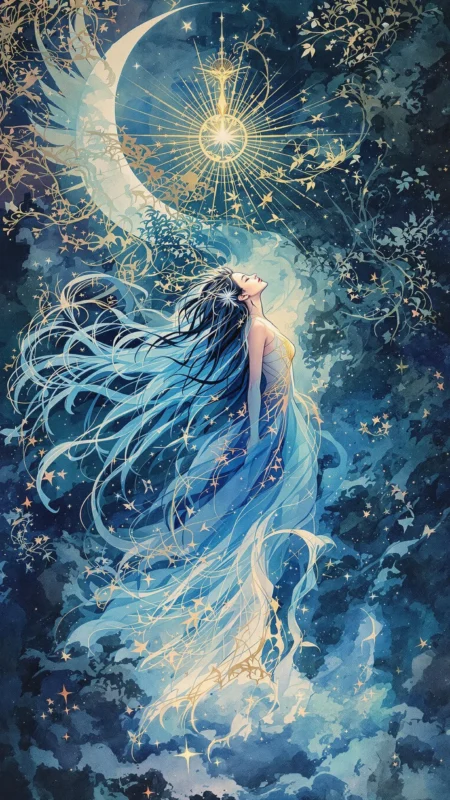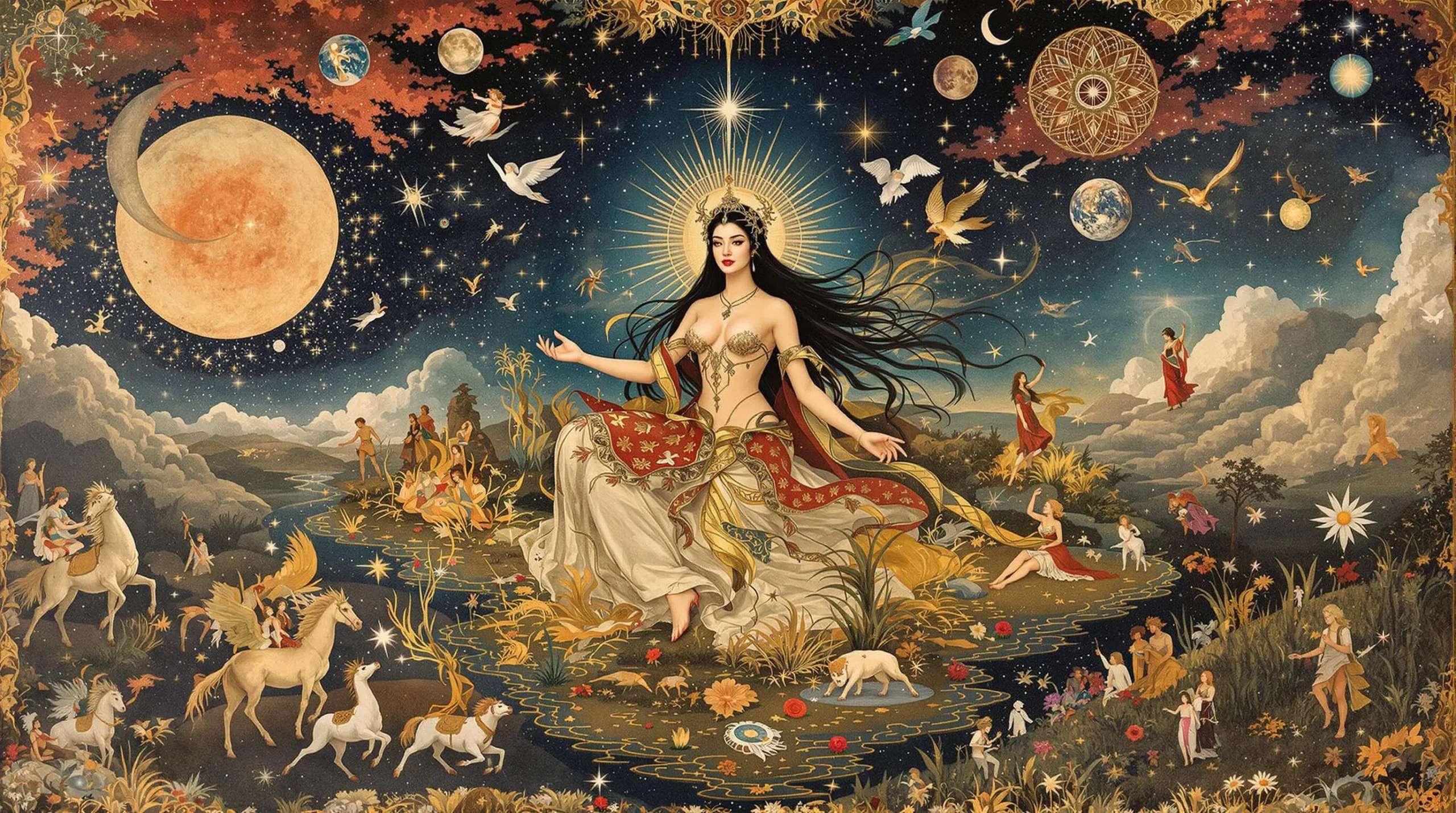


Chang'e

Archetype Meaning & Symbolism

Ethereal, isolated, melancholic, graceful, luminous, remorseful, serene, longing, immortal, elusive

  • The eternity I chose is a silent palace of silver light, where memory is the only companion and beauty, the only sustenance.

If Chang'e is part of your personal mythology, you may...

Believe

  • That the most profound beauty is often intertwined with a deep sense of melancholy, and that true character is revealed in how one bears a lonely fate.
  • That solitude is not an absence but a presence: a state that allows for a unique and powerful connection to the self, the cosmos, and the quiet truth of things.
  • That some ideals—be they art, knowledge, or personal peace—are so luminous that they are worth the sacrifice of ordinary, earthly connections.

Fear

  • The gnawing suspicion that your defining, irreversible choice was a profound mistake, and that your solitude is not a noble state but simply a cold and barren prison of your own making.
  • A terror of being utterly forgotten, of your beautiful, silent existence leaving no trace, your light unobserved by the warm, living world you left behind.
  • The chaotic messiness of true intimacy, and the fear that deep emotional connection will inevitably shatter your carefully maintained composure and pristine inner world.

Strength

  • A profound capacity for self-reliance, and the rare ability to not only endure solitude but to transform it into a source of peace, strength, and beauty.
  • A highly refined aesthetic sensibility, allowing you to perceive and create beauty in subtle, quiet, and ethereal forms that others might overlook.
  • A powerful sense of composure and grace, born from the long, slow acceptance of your own path and its unchangeable consequences.

Weakness

  • A tendency toward emotional aloofness and a difficulty in forming or sustaining the deep, reciprocal bonds that constitute human intimacy.
  • A vulnerability to a persistent, underlying melancholy or regret that can cast a pall over the present moment and prevent true contentment.
  • A subtle elitism or pride that stems from feeling set apart, which can create a barrier to empathy and deepen your alienation from the 'ordinary' world.

The Symbolism & Meaning of Chang'e

To have Chang'e as a lodestar in one's personal mythology is to understand the exquisite tragedy of a choice perfectly executed. Her story is not about a simple mistake, but about the chilling fulfillment of a wish whose consequences were inseparable from the desire itself. She is the patron saint of the beautiful cage, the symbol of an ambition so pure it transcends the very humanity it sought to preserve. Her lunar palace is the quiet, shimmering monument to the idea that to achieve a certain kind of perfection—of beauty, of life, of peace—one may have to sacrifice the warm, messy, temporal joys that define earthly existence. This archetype speaks to a soul familiar with the concept of the irreversible, the pivotal moment that cleaves a life into a 'before' and an 'after'.

Chang'e represents the profoundest solitude: not the temporary loneliness of a crowded room, but the structural solitude of being in a different state of existence. She is admired, sung about, gazed upon, but never touched. In a personal mythos, this may resonate with the feeling of being understood in concept but not in person, of being an idea to others rather than a being. Her symbolism is a meditation on consequence. Unlike myths of punishment for hubris, hers feels more like a law of spiritual physics: for the ethereal lightness of immortality, an equal and opposite weight of connection must be surrendered. She is the ghost at the banquet of life, a reminder that every choice to ascend is also a choice to leave something, or someone, behind on the ground.

Yet, her myth is not solely a cautionary tale. It is also a profound exploration of yin energy, of the power found in quiet, in reflection, in the cool, passive light of the moon. Chang'e becomes a symbol of self-sufficiency forged from necessity, of finding a way to sustain oneself on memory and beauty alone. She embodies a serene, untouchable grace, a deep and abiding peace that can only be found when one has accepted the vastness of one's own company. She is the archetype of the inner life, suggesting that the most expansive worlds can be those cultivated within the quiet of one's own heart, a universe of silver light and silent knowing.


Chang'e Relationships With Other Archetypes

The Archer

The Archer represents not so much a lost love as a fixed point of departure, the warm, terrestrial world from which The Chang’e has been eternally unmoored. Their relationship is a study in impossible distance, a bond stretched taut across the vacuum of space. He is perhaps the gravity against which she perpetually pulls, a memory of sunlight on skin now bathed only in the cold reflection of starlight. Their story could be seen as an arrow of longing shot toward a target that recedes with every passing moment, a dialogue conducted in light-years where the reply will always arrive too late. He remains the question to which her silent, silvery existence is the unending, melancholic answer.

The Elixir

The Elixir may be understood as the archetype of the irreversible choice, the single, crystalline moment that refracts a life into an entirely new spectrum of being. It is the key that, after turning in the lock, dissolves into mist, leaving one forever on the other side of the door. For The Chang’e, its consumption was not a simple act but the crossing of a metaphysical threshold, a bargain for eternity that cost the currency of a specific, treasured place in the world. This archetype speaks to the profound and often terrifying power of a single decision, the bitter draft of forever that promises immortality but may demand, in exchange, the very world that made life worth living.

The Rabbit in the Moon

In the vast, quiet palace of the moon, The Rabbit could be the embodiment of silent, faithful companionship. It is not a relationship of conversation or shared reminiscence, but of shared presence, a quiet industry that gives rhythm to an endless expanse of time. The steady, gentle pound of its pestle in the mortar may be the only heartbeat in that silver desolation, a sound that does not break the silence but rather gives it shape and measure. The Rabbit suggests, perhaps, that even in the most profound exile, a form of communion is possible—wordless, patient, and abiding, a testament to the routines that allow a soul to endure an eternity of solitude.

Using Chang'e in Every Day Life

Navigating Irreversible Choices

When you are living with the consequences of a decision that cannot be undone, the Chang'e archetype offers a path not of reversal, but of graceful acceptance. It teaches one to find the stark beauty within the outcome, to build a palace of meaning from the very materials of one's fate, however lonely that fate may be. It is the art of inhabiting your consequence, not just enduring it.

Cultivating an Inner World

In moments when external validation is scarce or the world feels loud and dissonant, Chang'e provides a blueprint for turning inward. It is about creating a rich internal landscape, a 'lunar palace' of thought, creativity, and quiet appreciation. This archetype guides you in finding that your own company can be a universe, that solitude can be a source of profound strength and aesthetic delight, not a void.

Embracing a Quiet Influence

If you feel your impact on the world is more subtle than direct, Chang'e affirms the power of passive influence. She does not act upon the world; she illuminates it. This archetype helps you value your role as an observer, a source of quiet inspiration, or a keeper of a certain mood or beauty. Your presence, like the moonlight, can change the feeling of a space without saying a word.

Chang'e is Known For

The Elixir of Immortality

Her fateful decision to consume an elixir meant for two, an act of either desperation, ambition, or sacrifice that granted her eternal life but separated her from her mortal love.

Ascension to the Moon

Her subsequent, weightless flight to the Moon, which became her beautiful, solitary palace and prison, a place of cold, clear, and everlasting exile.

The Jade Rabbit

Her only companion in the vast stillness of her lunar home, a creature also associated with pounding the elixir of life, creating a quiet tableau of shared, eternal duty.

How Chang'e Might Affect Your Personal Mythology

How Chang'e Might Affect Your Mythos

When Chang'e is woven into your personal mythos, your life story may pivot around a single, defining act of seeming finality. This could be a career change, a geographical move, or a relational decision from which there feels no return. This event becomes the central chapter, the axis upon which the rest of your narrative spins. Everything that follows is interpreted through the lens of this choice, seen as a consequence, a ripple effect from that one stone dropped into the placid water of your past. Your life might be narrated as a form of elegant exile, a journey into a rarefied state of being that is both an elevation and an isolation. You may see yourself not as a victim of fate, but as the deliberate, if perhaps melancholic, author of your own beautiful solitude.

Your personal mythology might also be a story about the pursuit of an abstract ideal at the cost of tangible connection. Perhaps your 'elixir of immortality' was the pursuit of artistic perfection, absolute freedom, or a kind of spiritual purity that necessitated a separation from the mundane world. Your life story, then, is not about accumulating victories or relationships in a conventional sense, but about tending to the flame of this one ideal. Your 'lunar palace' could be your studio, your intellectual sanctum, or your carefully curated life of minimalism. Your myth becomes a testament to the idea that a life's meaning can be derived from devotion to a singular, luminous principle, even if it means watching the rest of the world from a respectful, and lonely, distance.

How Chang'e Might Affect Your Sense of Self

With Chang'e as a personal archetype, you may perceive yourself as fundamentally set apart, defined by a quality or experience that is not easily shared. This is not necessarily a mark of arrogance, but a quiet, factual assessment of your own unique orbit. You might cultivate an aura of serene elusiveness, not as a defense, but as a natural expression of your inner state. Your sense of self is not forged in the clamor of social interaction but in the silent chamber of your own consciousness. You might feel like a visitor, an observer of the human condition, possessing a perspective that is both wider and more lonely for its detachment. This can lead to a profound self-reliance, a knowledge that you are your own most constant companion.

Your self-worth could become intricately linked to your inner life and your capacity for aesthetic appreciation. You might measure your value not by your productivity or social standing, but by the beauty you can perceive and create, by the grace with which you inhabit your own solitude. You may feel a deep kinship with the non-human world: the moon, the turning of the seasons, the quiet endurance of an old tree. In these things, you see a reflection of your own existence: beautiful, silent, and complete in itself. Your identity is that of the keeper of a quiet flame, and your esteem rests on how well you tend to that solitary, inner light.

How Chang'e Might Affect Your Beliefs About The World

Your worldview, seen through the lens of Chang'e, might be one of profound, bittersweet beauty. You may perceive the universe as a place governed by a delicate, and sometimes cruel, balance, where every gain necessitates a loss and every ascent requires a sacrifice. You could possess a heightened sensitivity to the long-term consequences of actions, viewing life not as a chaotic series of events but as a poem where every word choice alters the meaning of the whole. This perspective can lend a certain gravity and thoughtfulness to your decisions, as you are always aware of the ghosts of the paths not taken. The world is not a problem to be solved, but a beautiful, melancholic tableau to be witnessed.

This archetype might also foster a worldview that deeply values the contemplative over the active, the eternal over the ephemeral. You might find more truth in the silent, cyclical journey of the moon across the sky than in the frantic, linear narratives of human ambition. Your philosophy could be one of observation, a belief that true understanding arises not from participation but from stepping back to see the larger pattern. This can lead to a form of spiritual or intellectual detachment, a 'view from the moon' that sees human affairs with a kind of compassionate, yet distant, clarity. The ultimate reality, for you, may be found in the still, quiet spaces between the noise.

How Chang'e Might Affect Your Relationships

In the realm of relationships, the Chang'e archetype may manifest as a deep, paradoxical dynamic of longing and distance. You might yearn for profound connection, for a love that bridges the vastness of your inner world, while simultaneously fearing that such intimacy would shatter your carefully preserved solitude. This can lead you to hold others at a graceful arm's length, allowing them to admire you but not to enter your sanctuary. You may become the beloved figure on the pedestal, the poetic ideal, the distant moon to their earthbound tide. The tragedy is that this very idealization prevents the simple, human, and messy connection you may secretly crave.

Consequently, your most meaningful bonds might be formed not with a bustling circle of friends, but with a singular, quiet companion who understands your need for space: a partner who is also an island, a pet who offers silent communion, or even an intellectual or artistic muse. Like Chang'e and her Jade Rabbit, your connection could be based on a shared, unspoken purpose or a mutual appreciation for silence. Love, for you, may not be about merging, but about two solitary orbits finding a harmonious rhythm. It is a relationship defined by parallel existence rather than constant intersection, a quiet acknowledgment across a beautiful, necessary distance.

How Chang'e Might Affect Your Role in Life

Your perceived role in life, shaped by the Chang'e archetype, might be that of the watcher, the keeper of a lonely beauty. You may not see yourself as the protagonist in the heat of the action, but as the luminous figure in the background whose story serves as a symbol, a warning, or a quiet inspiration. Your power is not active or direct; it is atmospheric. Like the moon, your role is to cast a certain light on the world, to alter the mood, to evoke a sense of wonder or melancholy, simply by being. You might feel that your purpose is to embody a certain ideal—grace, tranquility, aesthetic purity—rather than to achieve a specific goal in the world.

This may lead you to feel that you are destined to inhabit a space of beautiful removal, a self-created 'lunar palace'. This could be a literal place: a remote home, a meticulously ordered studio, a garden tended with monastic devotion. Or it could be a psychological or professional role: the archivist in the quiet stacks, the researcher in the sterile lab, the artist lost in their work. Your role is to be the living heart of this quiet sanctuary, to maintain its integrity against the chaos of the outside world. Your purpose is not to go out and conquer, but to preside over the kingdom of your own choosing, however small or solitary it may be.

Dream Interpretation of Chang'e

In a positive context, a dream of Chang'e or of floating weightlessly to a silent, moonlit palace could signify a necessary and fruitful period of introspection. It may suggest that you are finding, or should seek, profound peace in your own company. The dream could be an affirmation from your subconscious that your current path of quietude or separation is leading to a higher state of self-awareness and grace. It represents an embrace of your inner world, an alignment with your more contemplative, yin nature, and the discovery of a beauty that requires no external audience. It is a sign that you are becoming self-sufficient, nourished by your own thoughts and aesthetic sensibilities.

In a negative light, dreaming of Chang'e can be an echo of deep-seated regret or a profound fear of isolation. The lunar palace may appear not as a serene sanctuary but as a cold, sterile prison, and the silence may feel deafening rather than peaceful. Such a dream might symbolize a choice you made that you now fear has permanently cut you off from warmth, love, and vital human connection. It could be a warning from your psyche that your pursuit of perfection, safety, or some other ideal has come at too high a cost, leaving you in a gilded cage of loneliness. The dream may be urging you to find a way down from your moon, to risk the messiness of earthly connection before your beautiful solitude becomes a barren eternity.

How Chang'e Archetype Might Affect Your Needs

How Chang'e Might Affect Your Physiological Needs

The Chang'e archetype might recalibrate your most basic physiological needs, framing them through a lens of aesthetics and tranquility. The need for nourishment, for instance, may transcend mere sustenance. You might find that a chaotic environment spoils your appetite, or that the beauty of a meal—its color, its arrangement, its ritual—is as essential as its caloric content. Like Chang'e, who subsists on ethereal moon dew, you may feel nourished by atmosphere itself, preferring smaller, more refined experiences over gross consumption. Your physical body may feel more sensitive to its surroundings, requiring a certain level of grace and order to feel truly at ease.

Furthermore, your body's energy system may seem uniquely tied to stillness. While others recharge through social activity or vigorous exercise, you might feel a physiological imperative for periods of absolute quiet and solitude. Noise, crowds, and excessive stimulation could feel physically taxing, as if they create a genuine energy deficit. Your nervous system may crave the 'cool, low light' of a Chang'e-like existence, and you may find that your physical health and vitality are directly linked to your ability to access these states of deep, contemplative rest. Silence, for you, is not an absence of sound but a vital nutrient.

How Chang'e Might Affect Your Ideas of Belonging

The need for love and belonging, when filtered through the Chang'e archetype, may become a source of quiet, persistent sorrow. It is the feeling of being the moon to the Earth: eternally bound, profoundly influential, but forever separate. You may feel a fundamental sense of your own singularity, an intuition that you don't quite fit into any existing tribe or social structure. This can lead to a feeling of being admired rather than loved, observed rather than embraced. You might be the cherished friend everyone comes to for calm advice, yet no one thinks to invite to the loud, chaotic party, reinforcing your role as the outsider looking in.

As a result, you might redefine belonging altogether. Instead of seeking it in a community of people, you may find it in a deep, devotional connection to an idea, a place, an art form, or a single, quiet companion. You may feel you belong more to the night sky, to the library, to your garden, than to any human group. Love may be experienced as a form of distant, reverent appreciation, both given and received. It is the love for the star you cannot touch, the poem you can recite but not embody. This creates a form of belonging that is stable and profound but lacks the warmth and reciprocity of conventional human intimacy.

How Chang'e Might Affect Your Feelings of Safety

From a Chang'e perspective, safety is redefined as emotional and aesthetic inviolability. The primary drive is not to secure oneself against physical harm, but to protect the integrity of a carefully constructed inner peace. You may seek safety by creating your own 'lunar palace'—a home, a routine, a set of personal rules—that acts as a buffer against the unpredictability and emotional chaos of the outside world. Security is found in order, beauty, and control over one's own environment. The greatest threat is not an intruder, but an emotional disruption, an unwelcome psychic noise that could shatter the delicate tranquility you equate with survival.

This can manifest as a deep-seated need to keep others, and their messy realities, at a strategic distance. The fear is not of people themselves, but of the entanglements they represent: the obligations, the conflicts, the compromises to one's own serene orbit. Safety lies in emotional self-sufficiency. By minimizing dependence on others for validation or happiness, you protect yourself from the potential pain of disappointment or betrayal. Your safety strategy is one of preemptive retreat to the high ground of your own solitude, where you are the sole monarch of your own well-being.

How Chang'e Might Affect Your Views of Esteem

Esteem, within the Chang'e mythos, is often built upon the twin pillars of self-sufficiency and aesthetic grace. You may derive a profound sense of pride from your ability to inhabit your solitude not as a void, but as a rich and cultivated space. Your self-worth is not contingent on external praise or social success but on the quiet, internal knowledge of your own resilience and elegance. You respect yourself for your composure, your refined tastes, and your ability to remain serene while the world churns. Esteem is the silent satisfaction of being the master of your own quiet, beautiful kingdom.

However, this basis for esteem can be exceedingly fragile. It may be dependent on maintaining a flawless, untouchable persona. A moment of emotional vulnerability, a surrender to a 'messy' human need, or a situation where you lose your composure could feel like a catastrophic failure, undermining your entire sense of self. Your worth is tied to being 'above it all', and a fall from that graceful height can be devastating. There is also a risk that this esteem can curdle into a form of elitism, where you judge others for their lack of composure or refined taste, further deepening your isolation under the guise of maintaining your standards.

Shadow of Chang'e

When the Chang'e archetype falls into shadow, its serene solitude curdles into a bitter, resentful isolation. The graceful queen in her lunar palace becomes a frozen prisoner in a crystal cell, consumed by what might have been. In this state, the archetype actively repels connection, mistaking its own fear for superiority. Your refined taste becomes a weapon for judgment, your quietness a hostile, punishing silence. The inner world that was once a sanctuary becomes a mausoleum of past glories and dead possibilities. You are no longer cultivating a beautiful life, but polishing the artifacts of a life you sacrificed, trapped in an elegant, sterile stasis of your own design.

The shadow can also manifest as a ghostly, vicarious existence. Instead of accepting your perch, you become a voyeur of the world you lost. You are the moon, forever peering into lighted windows, consumed with a silent, impotent envy for the warmth, the laughter, the simple, messy business of living. This can lead to a life of observation without participation, or worse, a subtle manipulation of those still on Earth, trying to experience their emotions and dramas without taking any risks yourself. It is the ultimate curse of immortality: an eternity to regret, a perfect vantage point from which to watch life pass you by, and a beauty that has no one to touch it.

Pros & Cons of Chang'e in Your Mythology

Pros

  • You develop a rare and powerful ability to be your own best company, capable of finding immense richness and meaning within your own inner world.
  • Your life may be imbued with an extraordinary sense of grace and aesthetic sensibility, making your presence, your home, and your creations uniquely and memorably beautiful.
  • You cultivate a profound long-term perspective, granting you a wisdom about the weight of choices and the intricate nature of consequence.

Cons

  • You may be shadowed by a deep and pervasive loneliness that no amount of elegant self-sufficiency can ever completely erase.
  • You risk becoming emotionally frozen, trapped by a past decision and unable to reconnect with the flow of life or form new, meaningful bonds.
  • Your natural reserve and refined nature can be easily misinterpreted by others as coldness, snobbery, or aloofness, hindering the formation of genuine relationships.