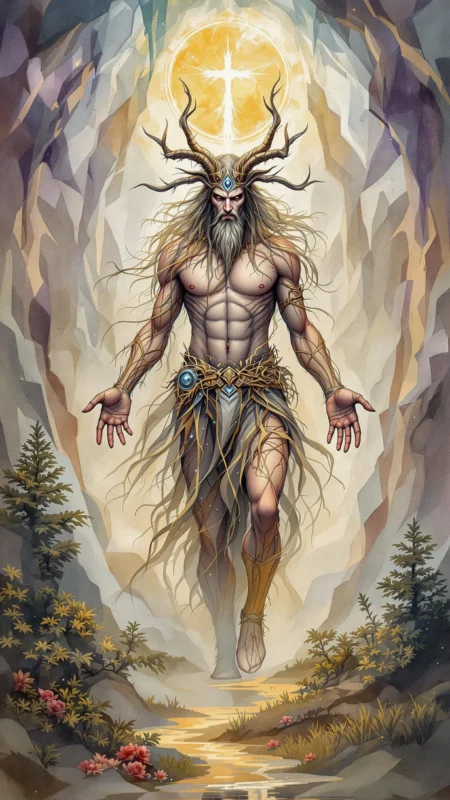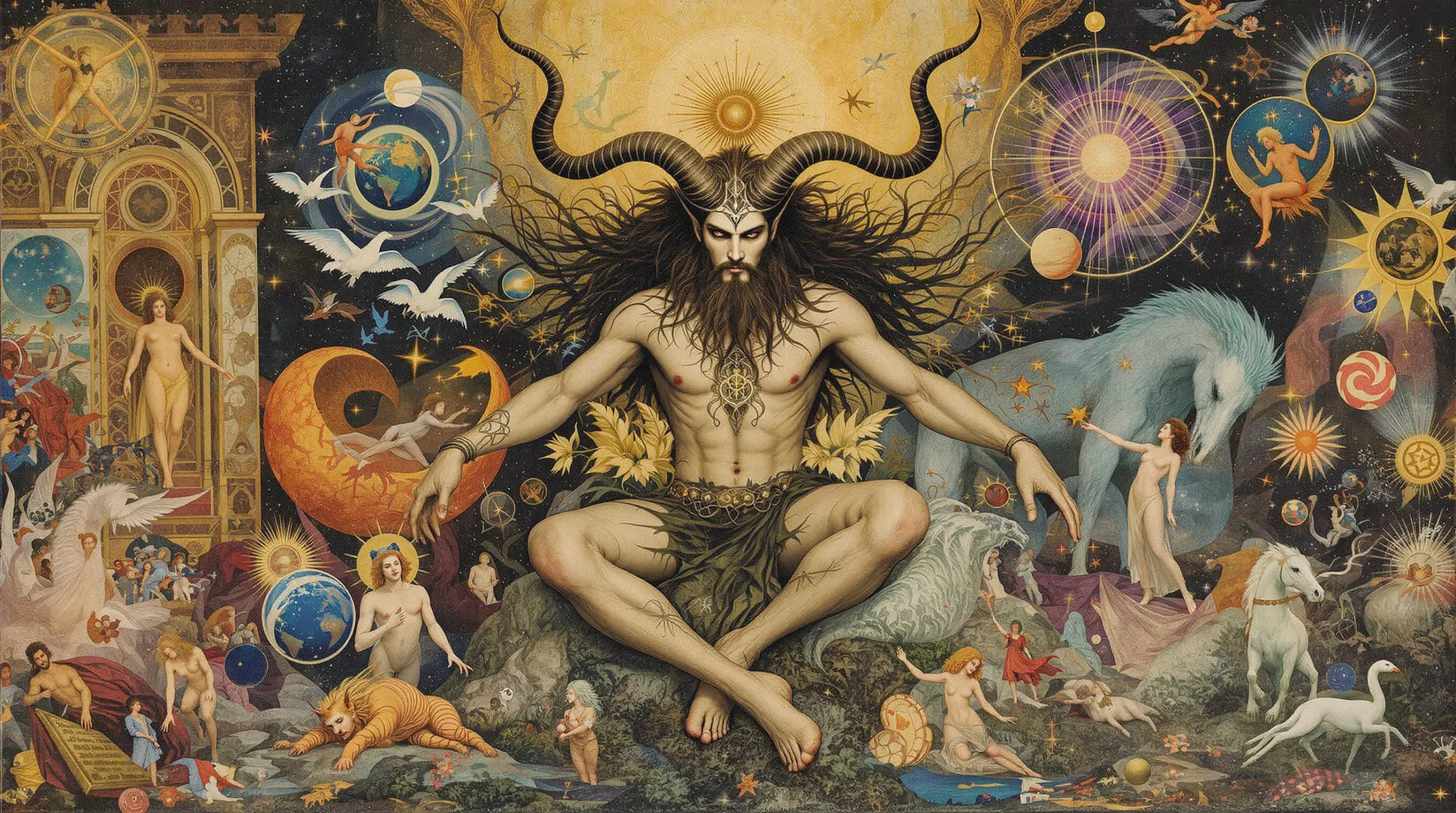


Cernunnos

Archetype Meaning & Symbolism

Wild, Sovereign, Generative, Cyclical, Liminal, Untamed, Primal, Meditative, Protective, Melancholy, Feral

  • Do not seek the path, become it. The forest grows from a single seed of intention, watered by the silence between heartbeats.

If Cernunnos is part of your personal mythology, you may...

Believe

  • That true power is not about control, but about attunement and connection.
  • That every living thing, from the weed to the wolf, possesses its own form of wisdom and sovereignty.
  • That cycles of decay and death are not endings, but necessary and sacred parts of life and renewal.

Fear

  • The finality of concrete, the sterile environment that offers no purchase for new life.
  • Losing touch with your own instincts, becoming so domesticated that you can no longer hear the call of your own soul.
  • That the wild places of the world, both internal and external, will be completely eradicated.

Strength

  • A profound resilience, born from understanding and embracing the natural cycles of growth, decay, and rebirth.
  • An unshakable sense of self-sovereignty that is not dependent on external validation.
  • A deep, instinctual wisdom and the ability to find a sense of belonging with the more-than-human world.

Weakness

  • A tendency toward isolation, preferring the company of the wild to the complexities of human society.
  • A resistance to structure, systems, and long-term planning that can feel like domestication.
  • A potential for melancholy or fatalism when confronted with the destruction of the natural world.

The Symbolism & Meaning of Cernunnos

In the modern psyche, Cernunnos represents a profound ache for the wild, an antidote to the sterile geometry of concrete jungles and digital existence. He is not a god of escape, but of integration: a call to recognize the untamed landscape within the self. His presence in personal mythology could suggest a rejection of the purely rational, an embrace of instinctual wisdom that rustles just beneath the surface of polite society. He is the quiet sovereignty found in solitude, the potent silence of the ancient woods, the part of us that remembers a time when our heartbeat was the rhythm of the world. This is not a regressive fantasy, but a radical act of re-wilding the soul, of finding our footing on the mossy, uneven ground of our own nature.

The symbolism of Cernunnos is woven from the threads of duality: life and death, masculine and feminine, human and animal, light and shadow. The torc he often wears or holds is not a shackle, but a mark of sacred kingship, a wealth that is not material but vital. The serpent, another frequent companion, speaks of chthonic knowledge, of healing and poison, of shedding old skins to allow for new growth. To have Cernunnos as a guide in your mythos is to accept that all things are cyclical, that the decay of autumn is the promise of spring. Your life story may not be a linear climb, but a spiral dance, revisiting old themes with new wisdom, shedding antlers of past identities to grow more magnificent ones.

Beyond mere fertility, his is the generativity of the entire ecosystem. He represents a form of power that is not hierarchical but connective, a web of life in which predator and prey are locked in a sacred, life-affirming dance. When this archetype emerges, it may be a sign that one must attend to their own inner ecosystem. Are there parts of you that have been over-hunted, resources depleted? Are there fallow fields of creativity waiting for the right season? Cernunnos asks us to become sovereign gardeners of our own interior world, tending to the growth of all things, even the thorny, the strange, the dark, knowing they all contribute to the whole's vibrant, chaotic, and beautiful health.


Cernunnos Relationships With Other Archetypes

The Forest

The relationship between Cernunnos and The Forest is perhaps less one of a king to his kingdom and more of a soul to its body. He may not simply rule the woods; he could be their very consciousness, the silent, brooding intelligence that knits the mycelial network into a single thought. The creak of a branch in the wind might be the cracking of his knuckles, the rustle of autumn leaves his quiet exhalation. To walk beneath the canopy is to move through the cathedral of his mind, where shadow and dappled light are the alternating currents of his mood. The forest does not merely shelter him; it is, in some profound sense, the slow, green, breathing vessel of his existence.

The Crossroads

At The Crossroads, that charged space of decision and transition, one might feel the influence of Cernunnos most acutely. He is not a psychopomp who leads, but perhaps the spirit of the threshold itself, the quiet potential that hums where one path dies and another begins. His domain is the liminal, the betwixt-and-between, and The Crossroads is its starkest geographical expression. Choosing a path could be a form of supplication to him, an acknowledgment that every journey forward is also a farewell to a world left behind. He may represent the untamed possibility that lies down every fork, the silent, horned witness to the moment a traveler trades a known past for an unwritten future.

The Shaman

The Shaman may see in Cernunnos not a deity to be worshipped from afar, but a reflection of their own deepest purpose. Where the Shaman dons the skins and skulls of animals to traverse the spirit world, Cernunnos *is* the union of animal and divine, the state of being the Shaman seeks to fleetingly touch. Their relationship could be one of resonant frequency, a master and an apprentice who never meet but are engaged in the same essential work of bridging realities. The Shaman's drumbeat might be an attempt to match the rhythm of Cernunnos's ancient heart, a percussive prayer to dissolve the self and, for a moment, to sit as he sits: perfectly poised between the wild earth and the silent stars.

Using Cernunnos in Every Day Life

Navigating Career Transitions:

When standing at a professional crossroads, you might invoke Cernunnos not to force a direction but to sit in the liminal space. This could mean embracing a period of seeming unproductivity, understanding it as a fallow season necessary for future growth. Rather than updating a resume, you might walk in a local park, attuning to the cycles of decay and renewal, letting the right path emerge organically, like a sapling through leaf litter.

Deepening Intimate Connections:

In relationships, the Horned God archetype encourages a move beyond domesticated love. It could be about acknowledging the wild, untamable parts of your partner and yourself. This might look like creating rituals that honor both solitude and union, or finding intimacy not just in shared comforts but in weathering a storm together, literally or metaphorically, recognizing that true connection thrives at the edge of chaos and order.

Cultivating a Sense of Place:

To combat modern alienation, Cernunnos may guide you to become a steward of your immediate environment. This isn’t about grand gestures, but small, sacred acts: learning the names of the weeds in your yard, leaving out water for wildlife on a hot day, or simply sitting against a tree until your own breathing syncs with the rustle of its leaves. It is about becoming part of the land’s story, not just a transient character upon it.

Cernunnos is Known For

Lord of Wild Things

He is often depicted seated peacefully among animals, a shepherd not of the domesticated, but of the forest's untamed denizens. This signifies a mastery that comes from mutual respect and understanding, not dominance.

The Antlered God:

His most iconic feature, the antlers, represents the cyclical nature of life, death, and rebirth. They are shed and regrown annually, a potent symbol of solar cycles, vegetative renewal, and the life force that persists through transformation.

Guardian of Liminal Spaces:

He presides over the threshold between the wilderness and civilization, the conscious and unconscious, life and death. He is a figure of transition, found at the forest's edge, the river's bank, the moment between breaths.

How Cernunnos Might Affect Your Personal Mythology

How Cernunnos Might Affect Your Mythos

When Cernunnos walks into your personal mythos, the narrative arc may shift from a hero’s journey of conquest to a steward’s journey of attunement. The central plot may no longer be about bending the world to your will, but about finding your authentic place within its intricate weave. Your story’s greatest triumphs might not be promotions or acquisitions, but moments of profound connection with the non-human world: the time a wild fox paused to meet your gaze, the feeling of the sun on your face after a long illness, the quiet satisfaction of growing your own food. Your life chapters might be marked not by calendar years, but by the cycles of your own internal seasons, the shedding of old skins, and the slow, powerful regrowth of what is essential.

Your personal history could be reinterpreted through this lens. Periods of isolation or depression might be recast as necessary winters, times of deep, underground germination. Failures might be seen as the decay required to enrich the soil of your soul. The antagonists in your story could become less about external villains and more about the forces of domestication, monoculture, and disconnection, both within and without. The ultimate quest becomes one of reclaiming a sovereignty that is quiet, rooted, and profoundly interconnected, a power that doesn’t shout but simply *is*, like a mountain or an ancient tree.

How Cernunnos Might Affect Your Sense of Self

An internal Cernunnos may foster a self-concept that is deeply embodied and instinctual. You might begin to trust the wisdom of your gut, the subtle signals of your nervous system, as much as you trust your rational mind. This can lead to a quiet confidence, a sense of self that is not dependent on external validation but is rooted in the earth of your own being. You may see your body not as a machine to be optimized or an ornament to be perfected, but as a sacred animal, deserving of rest, nourishment, and the freedom to move through the world with unselfconscious grace.

This archetypal presence could also engender a profound acceptance of your own dualities. You may feel less pressure to be consistently 'good' or 'positive,' recognizing that your anger, your sorrow, and your primal urges are as much a part of your wholeness as your joy and compassion. This is the acceptance of the shadow, not as something to be vanquished, but as the rich, dark soil from which your brightest aspects grow. Your sense of self may become less of a polished statue and more of a wild garden, beautiful not in its perfect order, but in its vibrant, untamed life.

How Cernunnos Might Affect Your Beliefs About The World

With Cernunnos as a lens, the world may cease to be a collection of resources to be exploited and instead reveal itself as a vast, sentient organism. You might start to perceive a form of consciousness in a river, a forest, a flock of birds, recognizing their intrinsic value beyond any utility to humans. The rigid separation between 'nature' and 'civilization' could dissolve, revealing the wildness that erupts through cracks in the pavement and the intricate ecosystems that thrive in urban parks. This worldview fosters a sense of being a citizen of a broader, more-than-human community, where our actions have ripples we may never fully comprehend.

The passage of time itself might feel different, less like a relentless, linear arrow and more like a spiral or a circle. You may become more attuned to the subtle shifts of the seasons, the phases of the moon, and the life cycles of the plants and animals around you. This perspective could challenge the modern obsession with constant progress and productivity, suggesting that there are times for action and times for stillness, times for growth and times for decay. The world becomes a sacred text written in a language of cycles, and learning to read it is a lifelong, deeply rewarding practice.

How Cernunnos Might Affect Your Relationships

In the realm of relationships, Cernunnos may champion a love that is wild and sovereign. This could mean that partnerships are founded on the principle that each individual remains whole and untamed, even in their union. The goal is not to merge into a single entity but for two sovereign wildernesses to touch, to overlap, to support one another without seeking to domesticate or possess. It may inspire a kind of love that honors solitude as much as togetherness, understanding that a connection is strongest when it allows room for each person’s primal self to breathe.

Friendships and community ties might also be affected, shifting toward a model of a pack or a herd. These are bonds forged not just in shared interests, but in mutual protection, instinctual loyalty, and a shared sense of territory, be it geographical or ideological. You might find yourself drawn to people who are not afraid of their own darkness, who can sit with you in silence, and who understand that support sometimes looks like leaving someone alone in their cave to wrestle with their own demons. It's a relational style that values authenticity over pleasantries and resilience over comfort.

How Cernunnos Might Affect Your Role in Life

Embodying Cernunnos in your personal mythos may cast you in the role of the Guardian or the Steward. This is not necessarily a role of overt leadership, but of quiet, steadfast presence. You might feel a profound responsibility for a particular place, a community, or a body of forgotten knowledge. Your purpose could be found in protecting the vulnerable, in preserving wild spaces, whether literal or metaphorical, and in reminding others of their connection to the earth and their own instinctual nature. This role is often enacted on the periphery, at the edge of things, where you can observe the whole system and intervene with quiet wisdom when needed.

This archetype could also position you as a bridge between worlds: between the tamed and the wild, the rational and the intuitive, the living and the ancestral. You may find yourself becoming a translator, helping those trapped in the sterile logic of modernity to understand the language of their own souls. Your life's work might be to create liminal spaces where others can safely encounter their own wildness. This is a role that requires immense patience and a deep trust in natural processes, a willingness to plant seeds that may not sprout for a generation.

Dream Interpretation of Cernunnos

To dream of Cernunnos in a positive light, perhaps seated peacefully in a sun-dappled glade, could be a powerful affirmation from your subconscious. It may signify that you are successfully integrating your primal instincts with your conscious life. This dream could be a sign of burgeoning creative energy, a reconnection with your own body, or an indication that you are entering a period of robust, grounded growth. The animals surrounding him in the dream may offer further clues: a stag could point to sovereignty and renewal, a snake to transformation and healing. Such a dream is an invitation to trust the wilder parts of yourself and to feel secure in your own innate power.

Conversely, a dream where Cernunnos appears threatening, or where the forest is dark and menacing, might signal a conflict with your instinctual nature. Perhaps you have suppressed your primal self for too long, and it is now rising up in a chaotic, untamed form. This could represent a fear of your own power, your sexuality, or your capacity for 'uncivilized' emotions like rage or grief. The dream might be a warning that your inner ecosystem is out of balance, that by denying the wild within, you have allowed it to become a source of fear rather than a source of strength. It is a call not to run, but to turn and face the horned shadow, to ask what it needs.

How Cernunnos Archetype Might Affect Your Needs

How Cernunnos Might Affect Your Physiological Needs

When Cernunnos is a cornerstone of your mythos, your physiological needs may be interpreted through a primal, instinctual lens. The need for food might transcend mere sustenance, becoming a desire for connection to its source: you might feel a pull toward whole foods, gardening, or understanding the ecosystem from which your meal came. Sleep may not be just a function of a clock, but a cyclical need for hibernation and retreat, honoring the body's demand for deep, restorative darkness, especially during literal or metaphorical winters. The body is not a machine to be refueled, but a wild creature whose rhythms must be heeded.

Furthermore, this archetype may heighten your awareness of your physical environment's impact. You might find yourself more sensitive to artificial light, processed air, and the lack of natural textures. A deep, physiological craving for fresh air, for the feeling of earth under your feet, or for the silence of a place untouched by mechanical noise could become prominent. This is the body's deep memory of its ancestral home, a need for sensory input that nourishes the nervous system in a way that modern environments often fail to do. Honoring these needs becomes a sacred act of self-care.

How Cernunnos Might Affect Your Ideas of Belonging

The need for belongingness, when filtered through the Cernunnos archetype, may shift away from a desire for broad social acceptance and toward a yearning for a pack, a tribe, a herd. This is a deeper, more primal form of connection, based on instinctual trust, mutual protection, and shared identity that goes beyond superficialities. You may seek friends with whom you can be your complete, untamed self, shadow and all. Love and belonging are found not in being liked by everyone, but in being truly seen and accepted by a select few, your fellow denizens of the wildwood.

Intimate relationships may be defined by a fierce loyalty and a celebration of each other's sovereignty. The Cernunnos archetype does not seek to possess or tame a partner, but to run alongside them. Love might be expressed less through conventional romance and more through acts of steadfast guardianship, creating a safe space for your partner's wild soul to flourish. Belonging is not about fitting in, but about finding the few other wild creatures with whom your spirit recognizes a kin-scent, a shared sense of home.

How Cernunnos Might Affect Your Feelings of Safety

Safety, through the Cernunnos lens, is less about locks and alarm systems and more about sovereignty and territory. A sense of security might come from knowing your own capabilities, from feeling strong and rooted in your body, and from understanding your environment. It is the safety of the wild animal that knows its terrain, its escape routes, its own strength. You might find yourself investing in practical skills—physical fitness, gardening, first aid—as a way of building a resilient foundation of self-reliance. True safety is not the absence of danger, but the confidence in your ability to meet it.

This archetype may also redefine financial security. The accumulation of wealth could seem less important than the cultivation of resources: a strong community, a robust skillset, a healthy local ecosystem. Cernunnos holds a purse overflowing with coins on the Gundestrup Cauldron, but his true wealth is the vitality of the forest around him. Your sense of safety might therefore be tied to the health of your 'forest,' the web of relationships and resources that sustain you. Security becomes less about having a large number in a bank account and more about having a rich, generative, and interconnected life.

How Cernunnos Might Affect Your Views of Esteem

Esteem, in the world of Cernunnos, is not earned through accolades, status, or external approval. It is an intrinsic quality that arises from self-sovereignty. Your self-worth could be rooted in your connection to your own instinctual wisdom, your resilience in the face of life's cycles, and your integrity as a steward of your own inner world. It is the quiet pride of the ancient tree that stands tall through all seasons, its value inherent in its very being. Esteem comes from the feeling of your own roots running deep into the earth of your own truth.

Accomplishments that build this kind of esteem might be invisible to others. They could be the successful tending of a garden, the overcoming of a deep-seated fear, the ability to sit in quiet meditation, or the courage to honor your own need for solitude. It's a shift from seeking respect from the 'village' to earning the respect of the 'forest,' the more-than-human world and the wild parts of your own psyche. You may feel most proud when you act in alignment with your deepest, most primal values, regardless of whether those actions are recognized or rewarded by society.

Shadow of Cernunnos

When the Cernunnos archetype falls into shadow, the sovereign steward can become the tyrannical wild king. This might manifest as a predatory assertion of one's own needs and desires without regard for the ecosystem of a relationship or community. The wildness becomes an excuse for unchecked appetites, aggression, and a refusal to be accountable. Instead of protecting the vulnerable, the shadow Cernunnos may prey upon them, using a veneer of primal authenticity to justify selfish or harmful behavior. The quiet confidence curdles into arrogance, and the connection to nature becomes a claim of superiority over those who are more 'civilized.'

A lack of this archetypal energy can be just as detrimental. This is the shadow of over-domestication. It could lead to a complete disconnect from one's body and instincts, a life lived entirely in the head, governed by shoulds and external expectations. There may be a deep fear of nature, of chaos, of one's own shadow, and a desperate need for control, order, and sterility. This person might feel profoundly lifeless, cut off from their own vital energy, living a gray existence devoid of passion or a sense of belonging to the world. They are a creature in a cage of their own making, having forgotten they were ever wild.

Pros & Cons of Cernunnos in Your Mythology

Pros

  • You may possess a deep, quiet confidence and a powerful connection to your own instincts.
  • You can navigate life's endings and hardships with grace, seeing them as part of a natural cycle.
  • You are likely to be a fierce and loyal protector of the people and places you hold dear.

Cons

  • You may struggle to function in highly structured, corporate, or bureaucratic environments.
  • Your need for solitude and wildness can make it difficult to maintain a wide social network.
  • You might be perceived as aloof, intimidating, or overly intense by those unaccustomed to such primal energy.