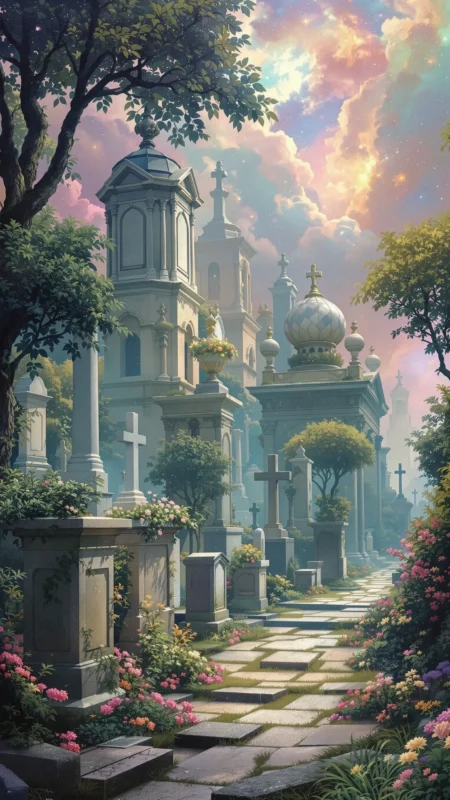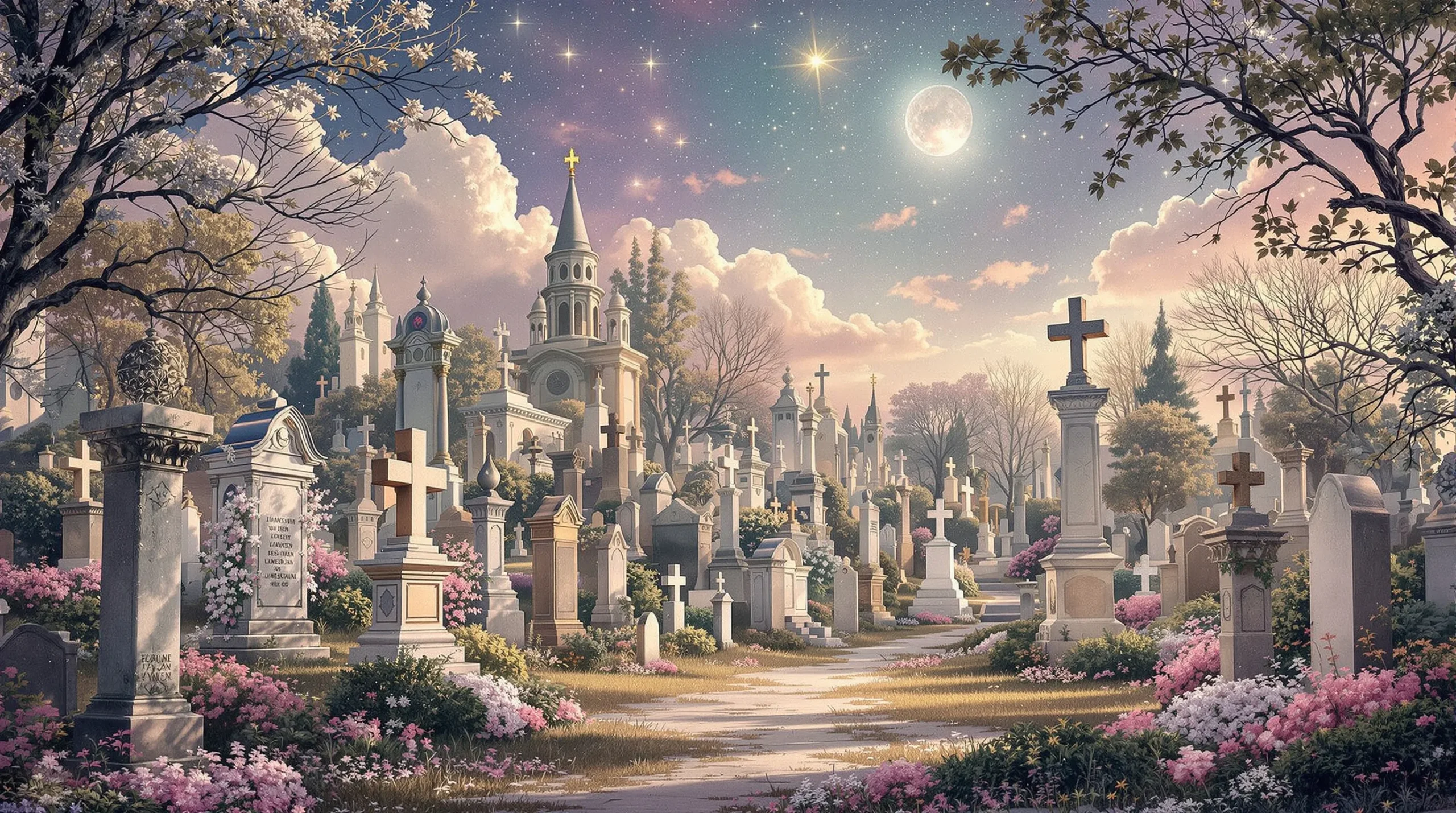


Cemetery

Archetype Meaning & Symbolism

Still, memorial, quiet, ancestral, permanent, archival, somber, peaceful, final, cyclical, reverent, grounded

  • Come, walk among the quiet names. Each one is a finished story, but their silence is the ink for yours.

If Cemetery is part of your personal mythology, you may...

Believe

  • You may believe that endings are what give life its structure and meaning.

    You may believe that we have a sacred duty to remember and honor those who came before us.

    You may believe that in silence and stillness, the most profound truths can be heard.

Fear

  • You may fear being forgotten, that your life will leave no trace upon the world.

    You may fear a shallow existence, a life devoid of depth, legacy, or meaning.

    You may fear that the past will be erased, that invaluable history and wisdom will be lost to negligence.

Strength

  • You may possess a deep and calming sense of perspective, unruffled by temporary crises.

    You may have a unique ability to honor the past and learn from it, bringing wisdom to present-day challenges.

    You may be a source of stability and comfort for others, particularly in times of loss and grief.

Weakness

  • You may have a tendency toward melancholy or nostalgia, making it difficult to fully embrace the present moment.

    You may be resistant to change, even when it is necessary, due to a deep attachment to the past.

    You may sometimes become overly serious or somber, finding it difficult to engage with life's lighter, more spontaneous pleasures.

The Symbolism & Meaning of Cemetery

The Cemetery is, perhaps, the ultimate symbol of consequence. It is the quiet, final landscape where all stories resolve. For those whose personal mythology includes this archetype, life may be viewed not as a series of disconnected moments, but as a narrative moving toward a meaningful conclusion. It is a place that strips away the trivial, forcing a confrontation with what endures: character, love, impact, legacy. It does not symbolize death as a terrifying void, but rather as a defining border that gives the entire map of a life its shape and significance. It suggests that the value of a story is not in its length, but in the truth it tells before the final page is turned.

Furthermore, the Cemetery represents a profound connection to lineage and the vastness of time. To walk through its rows is to walk through a forest of ancestors, both literal and figurative. This perspective may ground your identity in something far larger than your own ego. Your personal myth is not a solitary tale but the latest chapter in an epic that began long before you. This can be deeply comforting, a reminder that you are part of a long, unbroken chain of existence and that your own struggles and triumphs are echoes of timeless human experiences. You are not alone; you are simply the current caretaker of a story passed down through generations.

This archetype also embodies a unique form of peace: the peace of resolution. Within its gates, the frantic struggles of the world fall silent. Ambitions have been fulfilled or abandoned, conflicts have ended, questions have been answered or rendered moot. For a person, this can foster an inner landscape of calm acceptance. It suggests the possibility of finding stillness even amidst turmoil, an understanding that all storms eventually pass. It is a promise that after the sound and the fury, a quiet garden can grow, a place where memory is tended with reverence rather than regret.


Cemetery Relationships With Other Archetypes

The Gardener

The Gardener cultivates life, coaxing beauty and sustenance from the soil, while the Cemetery tends to life's conclusion. They are not opposites but sequential partners in a grand cycle. The Gardener is the archetype of present-tense creation, of nurturing potential into being. The Cemetery is the archetype of past-tense preservation, of honoring what that being became. In a personal mythos, this relationship might manifest as a tension between starting new ventures and properly concluding old ones, or a deep understanding that everything you build and nurture today will one day become a memory to be cherished.

The Library

Both archetypes are keepers of stories, yet they operate on different principles. The Library is an archive of living narratives: books can be opened, debated, reinterpreted. The stories are dynamic. The Cemetery, however, is an archive of finished narratives. The story etched in stone is final, its interpretation left to the living. The Library holds the sprawling, complex drafts of humanity, while the Cemetery holds the published, unchangeable final editions. A person influenced by both may feel a calling to be a biographer, historian, or eulogist: someone who translates the living, complex story into its essential, enduring form.

The Crossroads

The Crossroads is a moment of pure potential, a point of departure where countless futures are possible. The Cemetery is the destination, the sum of all choices made. The Crossroads hums with the anxiety and excitement of 'what if?', while the Cemetery rests in the quiet finality of 'what was.' They form the alpha and omega of a journey. A person whose mythos contains the Cemetery may approach the Crossroads with unusual gravity, deeply aware that every path chosen is also a path abandoned, and that each decision is a chisel-strike on the stone of their own future memorial.

Using Cemetery in Every Day Life

Navigating a Profound Loss

When grief feels like an endless ocean, the Cemetery archetype offers a quiet island. It provides a contained, sacred space in your mind to visit the memory of what was lost. You can go there, tend to the metaphorical headstone, speak to the silence, and then, crucially, you can leave. It suggests that grief does not have to colonize your entire inner world; it can have its own geography, a place you honor with visits, allowing you to inhabit the landscape of the living more fully.

Making a Legacy-Defining Decision

Faced with a choice that will echo for years, you might invoke the Cemetery archetype as a council of ancestors. Imagine yourself walking through the future cemetery where your own name is etched in stone. What story does the epitaph tell? This practice isn't morbid; it's a profound tool for clarity. It filters the decision through the lens of ultimate meaning, stripping away the noise of temporary fears and fleeting desires, and focusing you on the character of the legacy you wish to build.

Releasing Past Failures

Creative and professional lives are littered with the ghosts of failed projects and abandoned ambitions. The Cemetery provides a way to give these efforts a respectful burial. By consciously creating a memorial for a 'dead' project—acknowledging the work, honoring the intention, and formally letting it go—you cease to be haunted by it. This ritual clears the ground, turning old failures from ghosts thatsap your energy into ancestors that inform your wisdom.

Cemetery is Known For

A Repository for the Dead

Its most fundamental purpose

a designated landscape to house the physical remains of those who have died. It is a place of finality, where the biological story concludes and the narrative of memory begins.

An Archive of History

Each headstone is a data point, a miniature monument telling a story of a person, a family, a time period. Collectively, they form a library of stone, chronicling local history, immigration patterns, epidemics, and cultural values.

A Sanctuary of Quiet

In a world of constant noise, the cemetery is one of the few remaining socially sanctioned places for public solitude and contemplation. It is a landscape designed for reflection, where the weight of existence is acknowledged and respected.

How Cemetery Might Affect Your Personal Mythology

How Cemetery Might Affect Your Mythos

When the Cemetery is a key landscape in your personal mythos, your life story is often framed by an awareness of its ending. This isn't a morbid fixation, but a narrative device that imbues every chapter with heightened meaning. Your quest may not be for fleeting happiness or momentary success, but for a 'good death'—not in the literal sense, but in the sense of a life lived so well that its conclusion feels like a fitting, honorable final chapter. Your personal epic is written with one eye on the library of ancestors, constantly asking: will this story be worthy of being placed beside theirs?

This archetype also shapes your mythos by making you the keeper of other people's stories. You may be the family historian, the friend who remembers every anniversary, the one who safeguards the memories of those who are gone. Your narrative role is that of the chronicler, the living monument to past relationships and events. Your story becomes a vessel for other stories, a sacred trust. The central conflict in your myth may revolve around this duty: the struggle to preserve memory against the erosion of time, or the challenge of carrying the weight of the past without becoming buried by it.

How Cemetery Might Affect Your Sense of Self

Your sense of self may be characterized by a certain gravitas, a feeling of being an 'old soul.' You might perceive yourself as a temporary steward of a body and a name, part of a much longer procession. This perspective can foster a deep humility and a patient, long-term view of personal development. You may measure your self-worth not by transient metrics like popularity or wealth, but by the integrity of your character over time. The self is not a fleeting collection of impulses, but a continuous story being written, a legacy in progress.

This can also cultivate a self that is deeply comfortable with solitude and silence. While others may seek constant stimulation to distract from existential anxieties, you may find solace in the quiet contemplation the Cemetery represents. Your inner world could be a tranquil, well-tended garden of memories and thoughts. This may lead to a rich inner life and a strong sense of self-reliance, as your validation comes from a timeless, internal source rather than the fleeting opinions of the outside world.

How Cemetery Might Affect Your Beliefs About The World

Your worldview is likely filtered through the lens of deep time. You may see current events, political dramas, and cultural shifts not as unprecedented crises, but as echoes of historical patterns. This grants you a rare and calming perspective. The world is not a chaotic, unpredictable place, but a vast, intergenerational story with recurring themes and predictable cycles. You might see cities as layered archeological sites, with the ghosts of past decisions and forgotten lives shaping the present reality in invisible ways.

This perspective may also foster a profound appreciation for what endures. In a world obsessed with novelty and disruption, you might place your faith in things that have stood the test of time: enduring philosophies, classical art, traditions that bind generations. Your worldview may be one of conservation and preservation, believing that our primary duty is to be good ancestors and to pass down a world at least as rich in meaning and history as the one we inherited.

How Cemetery Might Affect Your Relationships

In relationships, you may value history and loyalty above all else. A shared past is not just a collection of memories; it is the sacred ground upon which the relationship is built. You may see love and friendship as long-form commitments, legacies co-authored over a lifetime. You might be the friend who never forgets a birthday, who holds onto old letters, who can recall the precise moment a bond was forged. For you, a relationship's strength is measured by its roots and its ability to weather the seasons of life and loss.

However, this can also mean you experience endings with profound weight. A breakup or the loss of a friend may feel like a death, requiring a period of mourning and memorialization. You may struggle to let go, building a mausoleum to a dead relationship in your heart and visiting it often. The challenge is to learn how to honor the past of a relationship without becoming a permanent resident in its cemetery, allowing the land to become fallow for a time so that something new might eventually grow.

How Cemetery Might Affect Your Role in Life

You may naturally assume the role of the anchor or the historian within any group, whether it be your family, workplace, or circle of friends. You are the keeper of the institutional memory, the one who remembers 'how things used to be'—not as a way to resist change, but to provide context and wisdom for the path forward. Your purpose may feel tied to providing stability, reminding others of their own stories and the larger story they are a part of. You are the roots of the tree.

This could also cast you in the role of the counselor or the sage. Because you are comfortable with the great, solemn themes of life—loss, legacy, the passage of time—others may seek you out in their moments of deepest crisis. You may have a gift for sitting with others in their grief, for offering the quiet presence of acceptance rather than empty platitudes. Your role is not to erase their pain, but to help them build a memorial for it, a place of honor within their own story that allows them to continue living.

Dream Interpretation of Cemetery

In a positive context, dreaming of a cemetery can be a profoundly healing experience. A dream of walking through a sun-dappled, peaceful, or beautiful cemetery may signify a state of acceptance and resolution. It could indicate that you have made peace with a past loss, integrated a difficult lesson, or are connecting with ancestral wisdom. It might represent the quiet, fertile ground from which new beginnings can grow, suggesting that by properly honoring what has ended, you have cleared space for the future. The dream is an affirmation that you are at peace with the cycles of life and death.

Conversely, a dream featuring a neglected, terrifying, or labyrinthine cemetery may point to unresolved issues in your psyche. You might be haunted by the past, stalked by a grief you have not fully processed, or trapped by old patterns of behavior. Being chased or lost in a dream cemetery could symbolize a fear of your own mortality, a terror of being forgotten, or the feeling that you are being buried under the weight of past regrets. Such a dream is not a curse, but an invitation: to turn and face the ghosts you have been avoiding, to tend to the neglected graves in your own heart.

How Cemetery Archetype Might Affect Your Needs

How Cemetery Might Affect Your Physiological Needs

When the Cemetery archetype is integral to your mythos, your physiological needs may lean toward stillness and quietude. The baseline state your body seeks might not be one of high energy, but of deliberate calm. You may find the constant sensory input of modern urban life to be genuinely taxing, creating a physical craving for silence and space. This is not about lethargy; it is a need to ground your nervous system in an environment that feels stable and unhurried, much like the slow, geological time scale of a graveyard.

This may also manifest as a deep physical connection to the earth itself. You might feel most at home with your hands in the dirt, walking barefoot on grass, or simply sitting against the trunk of an old tree. There can be a sense that your body is a temporary vessel made of the same elements to which it will return. This creates a need to honor the body not just as a tool for action, but as a sacred piece of the natural world, deserving of rest, simple nourishment, and a harmonious rhythm.

How Cemetery Might Affect Your Ideas of Belonging

Your need for belonging is likely fulfilled through a connection to lineage. You feel you belong when you can see yourself as a link in a long chain, stretching back into the past and forward into the future. Family reunions, ancestral research, and the passing down of traditions may be profoundly important to you. Love and friendship are not just about present companionship, but about being woven into the fabric of another person's history and, in turn, weaving them into yours.

This can mean that you form deep, resilient bonds, but it may also make you selective. You might not be interested in fleeting or superficial connections. You seek to belong to a 'we' that has weight and history. The love you offer and require is patient and enduring, like stone. It is a love that says, 'I will not only stand with you in life, but I will also be the keeper of your memory after you are gone.' True belonging is being given a permanent place in another's personal history.

How Cemetery Might Affect Your Feelings of Safety

For you, safety may be synonymous with permanence. You might find a sense of security not in locks or alarms, but in things that are rooted, established, and have a proven history of endurance. A home may feel safer if it is old and has sheltered many families; a job may feel more secure if the company has existed for a century. Safety is an equation of time and stability. The new and untested, by contrast, can feel inherently risky and unsafe, lacking the solid foundation of a past.

Security could also be deeply entwined with legacy and memory. The ultimate safety net, perhaps, is the knowledge that you will not be forgotten. This drives a need to create lasting bonds, to build things that will outlive you, and to live a life of such integrity that your story will be preserved in the hearts of others. The greatest threat is not physical harm, but erasure. True safety is feeling confident that your metaphorical headstone will be well-tended for generations to come.

How Cemetery Might Affect Your Views of Esteem

Esteem, for you, is not derived from fleeting praise or public accolades but from earning a sense of enduring respect. You build self-esteem by acting in accordance with timeless virtues: integrity, loyalty, honor, and courage. It's about building a character that could stand as a monument. The respect of others is valued most when it comes from those who themselves possess a deep sense of history and gravitas. You would rather have a quiet nod of approval from a respected elder than the thunderous applause of a fickle crowd.

Furthermore, your esteem needs may be met by creating a meaningful legacy. This doesn't necessarily mean becoming famous; it can be far more personal. Raising children who carry on family values, mastering a craft and passing it on, mentoring someone, or simply living a life of quiet dignity—these are the achievements that build a profound sense of self-worth. Your esteem is built stone by stone, through actions that you believe will echo positively long after you are gone.

Shadow of Cemetery

When the Cemetery archetype falls into shadow, it becomes a prison of the past. Instead of a place of quiet reflection you visit, it becomes the landscape you inhabit. You may become a ghost in your own life, perpetually haunting the tombs of past regrets, lost loves, and bygone glories. This shadow expression is marked by an inability to let go, a morbid obsession with what has been lost that prevents any new life from taking root. You might isolate yourself, believing that the world of the living is shallow and meaningless compared to the profound world of memory you have constructed. Here, the keeper of memories becomes the prisoner of memories.

The opposite shadow expression is a frantic, sterile denial of endings. It is the bulldozer that levels the old graveyard to build a gleaming, characterless monument to the now. This is a profound fear of mortality and legacy that manifests as a compulsive need to erase history, to pretend that the past has no claim on the present. This person might discard relationships, homes, and identities the moment they acquire the patina of age. They chase eternal youth and novelty, but it is a hollow pursuit. By refusing to build a relationship with endings, they live a life without chapters, an endless, meaningless single page that ultimately signifies nothing.

Pros & Cons of Cemetery in Your Mythology

Pros

  • It provides a profound sense of perspective and groundedness in a chaotic world.

    It fosters deep, loyal, and meaningful relationships built on shared history and trust.

    It encourages a life of integrity, purpose, and a focus on creating a positive, lasting legacy.

Cons

  • A tendency toward melancholy can make it difficult to experience simple, present-moment joy.

    It can lead to a resistance to change and an over-idealization of the past.

    The serious, somber nature can sometimes isolate you from others who are more lighthearted and spontaneous.