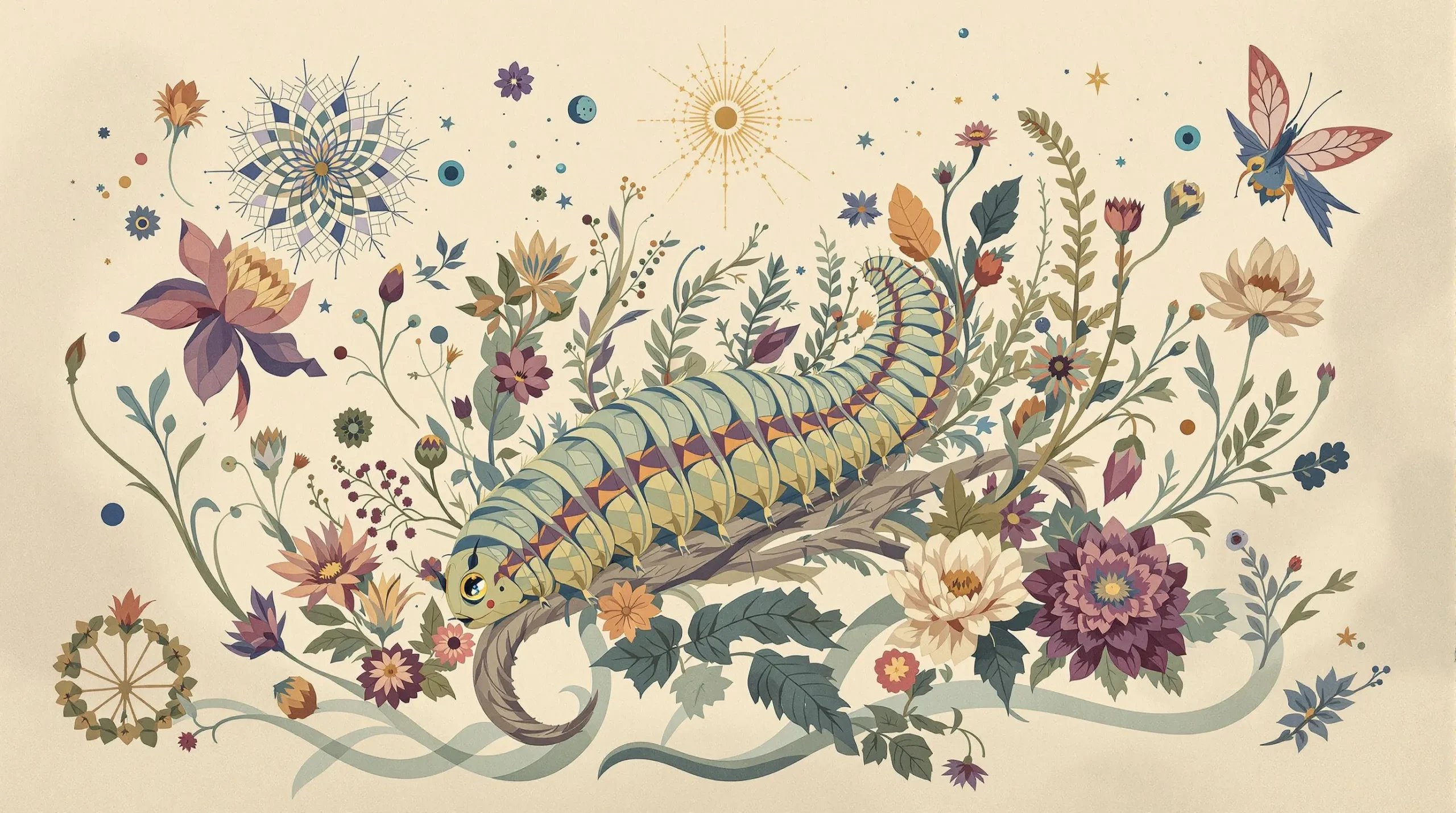


Caterpillar

Archetype Meaning & Symbolism

voracious, patient, vulnerable, transitional, nascent, potential, grounded, methodical, solitary, preparatory

  • To truly become, one must first be willing to entirely un-become. Devour the world you know; the wings are already within the design.

If Caterpillar is part of your personal mythology, you may...

Believe

  • Growth requires consumption; what I take in, be it knowledge or nourishment, literally becomes what I will be.
  • The most profound changes happen in private, in the dark, in the quiet of the cocoon.
  • My current form is not my final form; it is a beautiful and necessary stage on the way to something else.

Fear

  • That the transformation will fail, that I will enter the cocoon and dissolve into nothing, never re-forming.
  • That I will be discovered and destroyed in my vulnerable, crawling state, before I ever get the chance to build my sanctuary.
  • That after I emerge, the world I knew will be gone, or that I will no longer belong in it with my new form.

Strength

  • An immense capacity for patience and a focus on long-term, foundational goals.
  • The ability to find nourishment and resources for growth in unexpected places and experiences.
  • A deep, intuitive trust in the natural cycles of growth, dissolution, and rebirth.

Weakness

  • A tendency toward self-imposed isolation that can strain relationships and lead to loneliness.
  • A potential for gluttony, endlessly consuming information or experiences without ever acting upon them or moving to the next stage.
  • An extreme vulnerability to disruption or criticism during the sensitive, transformative phases of life.

The Symbolism & Meaning of Caterpillar

In personal mythology, the Caterpillar is the archetype of nascent potential. It represents the phase before the glory, the unglamorous but utterly essential work of becoming. To have the Caterpillar in your mythos is to understand that greatness is not spontaneous; it is grown, inch by inch, leaf by leaf. You may find sanctity in the mundane acts of preparation: the long hours of study, the repetitive practice, the slow accumulation of resources. This archetype asks you to trust a future self you cannot yet see, to nourish a promise that exists only as a faint cellular blueprint. It is the patron saint of apprentices, students, and anyone in the midst of a slow, deep change, reminding them that the quiet, crawling phase is a holy time.

The Caterpillar symbolizes a profound and necessary engagement with the material world. It is not an ethereal, spiritual archetype in this phase; it is fully, sensuously grounded. Its wisdom is in its mouth, its legs, its belly. It teaches that transformation is not merely an idea but a biological imperative, fueled by what we consume, be it food, knowledge, or experience. Your personal myth might involve a story of needing to come down to Earth, to stop dreaming of flight and start nourishing the body that will one day fly. It suggests that before you can transcend, you must first be fully present, fully embodied, and willing to do the earthly work of survival and growth.

This archetype also speaks to the courage of patience. In a world that glorifies the butterfly, the Caterpillar champions the slow, deliberate journey. It embodies a trust in natural timing, a defiance of the demand for instant results. Your story may be one of learning to inhabit the in-between spaces, the awkward and unfinished chapters of life, and to find a strange beauty in them. The Caterpillar mythos suggests that these periods of quiet, methodical progress are not a waiting room for life to begin. They are life itself, in one of its most potent and mysterious forms: the self, gathering the world into its own body, in preparation for a miracle.


Caterpillar Relationships With Other Archetypes

The Gardener

The Caterpillar's relationship with the Gardener is one of profound, and perhaps tense, codependence. The Gardener cultivates the world, tending the leaves that the Caterpillar must, by its nature, consume. In a personal mythos, the Gardener could represent a mentor, a parent, a system, or society itself—the very structure that provides for you but which you must also, in some way, deconstruct or devour for your own growth. This creates a complex dynamic: are you destroying what nurtures you, or are you fulfilling your purpose within the system the Gardener has built? The Caterpillar's existence is a constant negotiation between the sustenance it receives and the transformation that requires it to consume its own home.

The Alchemist

The Caterpillar is the living embodiment of the Alchemist's Great Work. It is the prima materia, the humble, earth-bound substance that holds unbelievable potential. The chrysalis is the alchemical vessel, the athanor, within which the great mystery unfolds. Here, the Caterpillar performs the ultimate act of solve et coagula: it dissolves its very form into a chaotic soup and then re-forms it into a higher state, the winged butterfly. For a person with this mythos, their life is not just a journey; it is a laboratory. Every experience, every meal, every lesson is an ingredient to be broken down and reconstituted into gold. The Caterpillar doesn't just use alchemy; it is alchemy.

The Trickster

The Trickster might appear to the Caterpillar as a bird offering a shortcut to the sky, or a whisper promising wings without the messy, terrifying dissolution of the cocoon. The Trickster tempts with an escape from the process. It offers transformation as a hack, a clever theft of a future state. The Caterpillar archetype, in its methodical, patient, and instinctual crawl, is a direct counterpoint to the Trickster's chaotic energy. It teaches a profound lesson: some transformations cannot be faked. They are not matters of wit or guile but of biology, time, and the courage to surrender to the process. The Caterpillar's mythos is a bulwark against the siren song of the easy way out, insisting that true change must be earned through the body.

Using Caterpillar in Every Day Life

Navigating Career Transitions

When faced with a professional pivot, the Caterpillar archetype provides a map. The initial phase is not about leaping, but about consuming: you may voraciously read books on the new field, take courses, conduct informational interviews. This is the methodical crawling along the leaf, gathering sustenance. Then comes the necessary cocoon, a period of introspection where you might update your resume, practice new skills in private, and solidify your new professional identity away from public view. To embody the Caterpillar here is to trust that this quiet, seemingly unproductive phase is where the actual transformation solidifies, before you emerge ready for the new role.

Healing from Personal Trauma

Healing can be framed as a Caterpillar's journey. The immediate aftermath of a traumatic event may be a time of pure survival, of consuming whatever resources are available: therapy, the comfort of friends, sleep, nourishing food. This stage is slow, grounded, and focused on self-preservation. Subsequently, the archetype encourages a necessary withdrawal, a cocoon of safety where the hard work of processing and integration happens. It gives you permission to be solitary, to dissolve old narratives and securities in private. The emergence is not a return to a former self, but the arrival of a new being, fundamentally altered and carrying the wisdom of the transformation.

Embracing a Creative Project

Any significant creative endeavor follows this pattern. The beginning is a period of intense consumption, the artist as Caterpillar feasting on research, influences, experiences, and ideas. There is a hunger to know, to gather. Then, the project demands a retreat. You must enter the cocoon of the work itself: the messy first draft, the solitary hours in the studio, the deep focus that shuts out the world. The Caterpillar teaches that you cannot fly while you are still gathering. You must trust the process of dissolving the raw material of your research into something cohesive and new, protected from the premature gaze of others.

Caterpillar is Known For

Voracious Appetite

The Caterpillar is known for its singular focus on consumption and growth. It may spend its entire existence doing little else but eating, storing up the energy required for its future, a potent symbol for the importance of preparation and foundational work.

Metamorphosis

Its most famous act is the radical transformation within the chrysalis or cocoon. This process, where its body dissolves into an imaginal soup before reforming into a butterfly or moth, represents profound, fundamental change and the promise of rebirth into a new state of being.

Vulnerability

As a soft-bodied, slow-moving creature, the Caterpillar is exceptionally vulnerable to predators. This aspect highlights the inherent risks of the growth phase, symbolizing how exposed one can be while gathering strength and undergoing change, before one has developed their 'wings'.

How Caterpillar Might Affect Your Personal Mythology

How Caterpillar Might Affect Your Mythos

When the Caterpillar becomes a central figure in your personal mythos, your life story ceases to be a linear ascent and becomes a series of profound cycles. You may view your past selves not as failures or awkward phases to be ashamed of, but as necessary, nutrient-rich fuel for who you are today. The story of 'you' is one of consumption, dissolution, and radical rebirth. Each major life chapter might be framed this way: the methodical gathering of a specific kind of knowledge or experience, a necessary retreat from the world to integrate it, and an emergence as someone fundamentally new. Your mythos sanctifies the 'in-between' states, finding meaning not just in the arrival, but in the slow, vulnerable crawl toward the unknown.

This archetype also imbues your narrative with a deep, biological sense of destiny, not as a fixed outcome, but as an innate potential encoded within you. You may feel that your future self—the 'butterfly'—already exists as a possibility, and your life's work is to patiently provide the right conditions for its emergence. This can create a powerful sense of purpose that is detached from external validation. Your story is not about pleasing an audience or winning a prize; it is about fulfilling a natural, internal imperative. Your personal legend becomes less about what you achieve and more about what you are brave enough to become.

How Caterpillar Might Affect Your Sense of Self

Integrating the Caterpillar may cultivate a radical form of self-patience. You may learn to be gentle with yourself during periods of awkwardness, uncertainty, and seemingly slow progress. When you feel hungry for new knowledge, new experiences, or even just rest and nourishment, you might see this not as a lack of discipline but as the healthy, voracious appetite of a self in a vital growth phase. It allows you to reframe what others might label as laziness or introversion as 'cocooning'—a necessary and productive retreat for integration and reformation. You may grant yourself permission to be unfinished.

Furthermore, this archetype could connect you to your body and its innate wisdom in a more profound way. The Caterpillar's journey is not intellectual; it is deeply physical and instinctual. You might find yourself trusting your gut feelings more, paying closer attention to your physical needs for food and rest, and seeing these bodily demands as sacred messages from your future self. Your self-worth may become less attached to your current form or accomplishments and more rooted in the promise of your own potential. You are worthy not because of what you are, but because of the incredible process you are undergoing.

How Caterpillar Might Affect Your Beliefs About The World

With a Caterpillar worldview, you may see the world not as a static stage but as a vast, living garden of resources. Every book, every conversation, every challenge, every meal is a potential leaf to be consumed for your own growth. This perspective fosters a deep curiosity and an opportunistic eye for nourishment in all its forms. It shifts the focus from achieving a final state of perfection to engaging in a continuous process of becoming. Societies, cultures, and institutions may also appear as organisms in various stages of this cycle, some voraciously consuming, others in a quiet, transformative cocoon, and others in flight.

This perspective also instills a profound trust in natural cycles of destruction and creation. You might view periods of social or personal upheaval less as catastrophic failures and more as a collective or individual 'dissolution' phase inside the chrysalis. It is the necessary chaos before a new order can emerge. This fosters a long-term perspective, a belief that even in the darkest, most confusing times, a hidden, organizing principle is at work, reforming the world from a soupy chaos into something new and, perhaps, winged. It is a worldview rooted in patient optimism and the inevitability of change.

How Caterpillar Might Affect Your Relationships

In relationships, the Caterpillar archetype may manifest as a pattern of cyclical engagement. You might have periods of intense social connection, where you are 'feeding' on conversation, intimacy, and shared experience. During these times, you are present and engaged, absorbing what the relationship has to offer. However, this may be followed by a necessary period of withdrawal. To process what you have gained and integrate it into your sense of self, you may need solitude. This can be confusing for partners or friends who don't understand that your retreat is not a rejection of them, but a requirement of your personal growth cycle.

This archetype could also change how you view the purpose of relationships. You may see certain connections as existing to provide a specific kind of nourishment for a specific phase of your life. A friendship might be the 'leaf' that gets you through a difficult career change, while a romantic partner might provide the safe 'cocoon' for deep emotional work. This is not necessarily transactional, but rather an understanding that different people help us build different parts of ourselves. It may foster a deep gratitude for what each person provides, while also accepting that not all relationships are meant to last through every transformation.

How Caterpillar Might Affect Your Role in Life

Adopting the Caterpillar as a key archetype may lead you to perceive your role in life as fundamentally transitional. You are the 'one who is becoming' rather than the 'one who is.' This can be incredibly liberating, freeing you from the pressure to have a fixed identity, a single career, or a static personality. Your role is to grow, and that role's expression changes as you move through different phases of consumption and transformation. You might be the Student, then the Hermit, then the Innovator, seeing all these roles as temporary costumes worn by the same underlying process of becoming.

This can also bring a sense of unease or ambiguity. If your identity is always in flux, it can be difficult to feel grounded or to offer a consistent 'self' to the world. You may struggle with questions like 'Who am I?' because the answer is always 'I am in process.' Your perceived role might be one of patient potential, which can be undervalued in a society that rewards definitive action and clear-cut identities. Your purpose is not to hold a position, but to move through it, gathering what you need before you are called to the quiet mystery of the cocoon.

Dream Interpretation of Caterpillar

In a positive context, dreaming of a caterpillar, especially a healthy, munching one, is a powerful symbol from the subconscious that you are in a correct and vital stage of growth. The dream may be affirming that your current focus on gathering resources—whether that's learning, healing, or simply resting—is exactly what you need to be doing. It is a message of encouragement, urging you to trust the process and have patience. Seeing the caterpillar on a lush, green leaf can signify that you are in a nourishing environment, well-supported for the journey ahead. The dream assures you that the 'butterfly' is a future certainty, if you honor the needs of the caterpillar now.

In a negative context, a dream featuring a struggling, starving, or threatened caterpillar could signify a deep fear that your growth is being stunted. It may point to a feeling of being in an environment that lacks the necessary resources for your transformation, or perhaps an internal impatience that is rushing the process. A bird or predator attacking the caterpillar might symbolize external forces—criticism, a demanding job, a toxic relationship—that threaten to derail your becoming before you have the chance to secure yourself. It could also be a warning from your shadow self, the part of you that fears the dissolution of the cocoon and is sabotaging your own progress.

How Caterpillar Archetype Might Affect Your Needs

How Caterpillar Might Affect Your Physiological Needs

When the Caterpillar shapes your mythos, your physiological needs are elevated from mundane requirements to sacred acts. Eating is not just for sustenance; it is the holy act of consuming the world to build the future self. You may find yourself drawn to specific foods or patterns of eating that feel instinctively right for your current 'growth phase.' Sleep is not lost time; it is the quiet digestive process that integrates the day's nourishment. Your mythos demands that you honor these foundational needs, viewing fatigue or hunger as messages from your destiny.

Neglecting these base needs becomes a kind of spiritual transgression. To deprive the Caterpillar-self of rest or food is to starve the future butterfly. This can lead to a life rhythm that prioritizes physical well-being as the non-negotiable foundation for all other forms of success. You may structure your days around good meals and adequate sleep, seeing them not as chores that get in the way of 'real work,' but as the most essential work of all. Your body is not a vehicle for your mind; it is the alchemical vessel itself, and it must be honored.

How Caterpillar Might Affect Your Ideas of Belonging

The Caterpillar's journey can complicate the need for belongingness. For much of its life, it is a solitary creature, focused on the singular task of eating. If this is your archetype, you may find that deep growth phases require you to be alone. Belonging may not be found in a bustling group, but in a quiet kinship with a process. You might feel a profound sense of connection not to other people, but to a lineage of 'becoming,' feeling solidarity with every student, artist, and healer who has ever undertaken a slow transformation. Your tribe is the cohort of the cocooned.

When it comes to love and intimacy, the Caterpillar mythos asks for a partner who understands the necessity of cycles. True belonging means finding someone who will not only celebrate you when you have wings, but who will also guard your cocoon. Love may mean giving each other the space to be temporarily absent, to be dissolved and unavailable, with the implicit trust of an eventual re-emergence. Belongingness is the safety of knowing that someone will be waiting on the other side of your transformation, ready to meet the new person you have become.

How Caterpillar Might Affect Your Feelings of Safety

The Caterpillar archetype highlights a specific kind of safety need: the security to be vulnerable. As a soft-bodied, slow-moving creature, the caterpillar is the embodiment of exposure. Therefore, in your personal mythos, you may feel a profound need to construct a 'safe leaf' or a 'hidden branch' in your life. This could manifest as a deep desire for a stable home, a secure job, or a predictable routine that minimizes external chaos. This external stability is not for its own sake; it is the necessary container for the risky, internal work of transformation to occur.

The ultimate expression of this safety need is the creation of the chrysalis or cocoon. This may translate into a psychological need to build strong boundaries, to have a private space—be it a room, a journal, or simply time alone—where you can undergo your dissolution and reformation without intrusion. Safety is not a fortress to keep the world out, but a sealed vessel to keep the transformative process in. You might feel deeply unsafe or anxious when your privacy is breached or when you lack a sanctuary where you can be messy, undone, and in process without judgment.

How Caterpillar Might Affect Your Views of Esteem

With the Caterpillar archetype, your esteem needs may be met in unconventional ways. Instead of seeking validation for your achievements (the butterfly's flight), you may derive a deep sense of self-worth from the process itself. Your pride might come from your capacity for patience, your methodical focus, and your courage to enter the unknown of the chrysalis. Esteem is built on the internal foundation of your own discipline and trust in your becoming, rather than on external applause.

You may learn to value your potential as much as your accomplishments. Self-esteem comes from knowing that, encoded within you, is the blueprint for a magnificent future self. This frees you from the need for constant performance. Your worth is inherent in your being-in-process. You respect yourself for honoring the crawl, for doing the unglamorous work, for having the guts to dissolve the self you know in the faith of becoming something more. Your esteem is the quiet confidence of the creature who knows it carries a miracle within it.

Shadow of Caterpillar

The shadow of the Caterpillar is the tragedy of arrested development. It is the creature that fears the dissolution of the chrysalis so profoundly that it refuses the call to transform. This manifests as a perpetual, gluttonous consumption. It is the eternal student who hoards degrees but never applies them, the spiritual seeker who collects workshops but never integrates the lessons, the creative who endlessly researches but never creates. This shadow self just keeps eating the leaves, growing larger, slower, and more burdened by its own un-used potential, stripping its environment bare out of a deep-seated terror of the void that precedes rebirth.

Another facet of the shadow is a destructive voraciousness. Instead of mindfully consuming what is needed, the shadow Caterpillar becomes a plague, driven by a neurotic fear of scarcity. It consumes relationships, resources, and opportunities with a desperate, mindless hunger, leaving a trail of depletion in its wake. This is not the healthy appetite of growth but the frantic activity of a being convinced of its own fundamental insufficiency. It is the myth of 'never enough' played out as a slow, crawling devastation, unable to trust that it already contains everything it needs to become.

Pros & Cons of Caterpillar in Your Mythology

Pros

  • You develop a profound resilience and an unshakeable trust in life's transformative processes.
  • You are able to focus intensely on foundational work and preparation, ensuring that future successes are stable and well-supported.
  • You grant yourself, and others, the grace and permission for periods of rest, introspection, and non-linear growth.

Cons

  • You may be perceived by a fast-paced world as slow, unambitious, or self-absorbed.
  • Your intense inward focus during 'cocoon' phases can lead to the neglect of important relationships and external responsibilities.
  • There is an inherent risk of getting stuck in the preparatory phase, paralyzed by the fear of the finality and uncertainty of transformation.