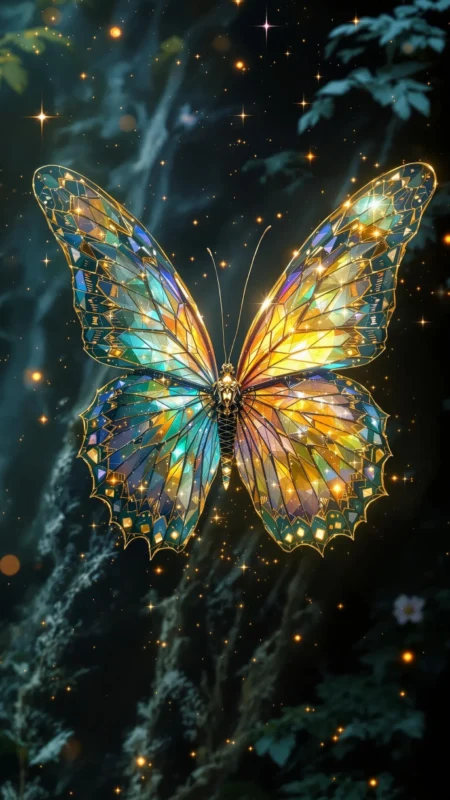


Butterfly Wing

Archetype Meaning & Symbolism

Fragile, ephemeral, intricate, iridescent, delicate, patterned, aerodynamic, weightless, transformative, symmetrical

  • Do not mistake my delicacy for weakness. The same air that can tear me can also lift me to unimaginable heights: it is all a matter of orientation.

If Butterfly Wing is part of your personal mythology, you may...

Believe

  • The most powerful forces are often the most subtle and unseen.

    Beauty is not a superficial indulgence; it is a core principle of existence and a reliable guide for navigating life.

    Your greatest strength lies in your vulnerability, as it is the source of your sensitivity, empathy, and grace.

Fear

  • Being crushed, physically or emotionally, by the carelessness and brute force of the world.

    That your intricate inner life and subtle contributions will go completely unnoticed or be dismissed as insubstantial.

    Having your freedom taken away, your wings pinned down by responsibility, expectation, or the actions of another, preventing your flight and transformation.

Strength

  • An unparalleled ability to perceive and appreciate the nuanced beauty in the world, bringing a deep richness to your experience of life.

    A natural capacity for graceful adaptation, allowing you to navigate change and transformation with a lightness that others envy.

    The power of subtle influence, enabling you to shift atmospheres, inspire minds, and foster positive change without resorting to force or demand.

Weakness

  • An extreme sensitivity to conflict and criticism, which can lead to a pattern of avoidance that stunts growth and isolates you from valuable experiences.

    A pervasive sense of fragility, both physical and emotional, that can make you feel ill-equipped to handle the inevitable roughness of life.

    A tendency to be perceived as flighty, impractical, or lacking in substance by those who operate on different principles, potentially limiting your opportunities in certain environments.

The Symbolism & Meaning of Butterfly Wing

In personal mythology, the Butterfly Wing is rarely about the struggle of transformation; it is about the state of being *after* the chrysalis. It is the arrival. To possess this archetype is to hold a story of emergence, of unfurling a new and beautiful capacity you did not have before. It symbolizes the part of you that is ready for a new element: the air. Your mythology may be defined by these moments of graceful debut, where periods of interior, unseen work culminate in the sudden, silent appearance of a new way of being, a new talent, a new perspective. The wing itself is the evidence of change, the tool for navigating the next phase of life with an unfamiliar lightness.

The archetype is also a profound meditation on the union of beauty and transience. A butterfly's life is brief, its wings fragile. A mythos shaped by the Butterfly Wing may not value permanence, legacy, or things built to last. Instead, it could consecrate the ephemeral moment. Life's meaning is found not in its duration but in its intensity, its beauty, its iridescence. This perspective fosters an appreciation for the preciousness of the now, an understanding that the most beautiful things are often the most fleeting. Vulnerability is not a design flaw; it is the very condition that makes the experience poignant and valuable.

Finally, the Butterfly Wing is the quintessential symbol of subtle influence, the namesake of the chaos theory concept where a tiny flutter can precipitate a storm elsewhere. For an individual, this may translate into a worldview where one's small, seemingly inconsequential actions have profound, unseen ripple effects. Your mythos is not one of heroic, forceful intervention. It is a story of quiet influence: the gentle question that changes a mind, the small act of beauty that inspires a movement, the subtle shift in personal energy that alters the course of a relationship. Power is not wielded; it is embodied and released into the world, its effects unfolding in ways you may never fully witness.


Butterfly Wing Relationships With Other Archetypes

The Boulder

The relationship between the Butterfly Wing and The Boulder is one of profound contrast and complementary wisdom. The Boulder speaks of permanence, of deep time, of immovable strength. The Butterfly Wing speaks of the fleeting moment, of lightness, of adaptive flight. In a personal mythos, these two might represent a fundamental tension between the desire for stable security and the soul's need for change and freedom. The Boulder provides a resting place for the wing, a point of stillness and perspective. In turn, the wing’s brief, beautiful landing upon its surface may remind the Boulder that even the most ancient things are part of a dynamic, living world.

The Spiderweb

Here lies a relationship of dangerous resemblance. Both the Butterfly Wing and The Spiderweb are marvels of intricate, lightweight design, beautiful and yet terribly fragile. But one is an instrument of flight, and the other an instrument of capture. This relationship could symbolize a critical internal conflict. It may represent the fine line between creating a life of delicate freedom and weaving a web of intricate obligations, beautiful but entrapping. For someone with the Butterfly Wing archetype, the allure of a beautifully structured but static life—a perfect job, a defined social role—can be a seductive trap that threatens the very freedom the wings are meant for.

The Wind

The Wind is both lover and executioner to the Butterfly Wing. No flight is possible without it; the wing is designed to ride its currents, to be lifted by its invisible hand. This symbolizes a necessary reliance on forces greater than oneself—inspiration, grace, social currents, fate. Yet, the same wind that enables flight can, in a gale, shred the wing to pieces. This relationship teaches a difficult lesson about power: one must learn to dance with it, to yield to it, to use it, but to never naively trust it. It fosters a mythology of respectful partnership with the unpredictable energies of the world.

Using Butterfly Wing in Every Day Life

Navigating a Creative Block

When a grand project feels impossibly large, the Butterfly Wing archetype suggests focusing on a single, small, perfectible detail. Instead of writing the novel, write one beautiful sentence. Instead of composing the symphony, find two notes that create a perfect, shimmering harmony. The wing is not built all at once; it is unfurled. By perfecting the small, intricate part, momentum for the whole may be generated, allowing the project to take flight on its own terms.

Healing from Heartbreak

The end of a relationship can feel like a tearing. The Butterfly Wing does not deny this fragility. It encourages you to sit with the delicate, papery memory of what was. But it also reminds you that this structure, however damaged, was part of a being designed for flight. The archetype prompts the question: what new pattern can emerge from this one? It shifts the focus from the damage sustained to the potential for a new, perhaps more intricate and wise, form of emotional aerodynamics.

Making a Life-Altering Decision

Faced with a choice that feels monumental, you might look for a monumental sign. The Butterfly Wing suggests the opposite. Pay attention to the barely perceptible shifts in the air around you. Which path brings a subtle feeling of lightness? Which choice, though small, seems to hold the most intricate potential for beauty down the line? This archetype trusts in the 'butterfly effect' of personal choice, believing that the smallest, most authentic gesture can recalibrate an entire future trajectory.

Butterfly Wing is Known For

Intricate Pattern

The often-symmetrical and vividly colored designs that are unique to each species. This patterning is not mere decoration; it is a language of identity, warning, and attraction, a map of beauty and survival written on the most delicate of canvases.

Fragility:

Its almost proverbial delicacy. The wings are composed of thin membranes, easily torn by rough handling, heavy rain, or a predator's grasp. This vulnerability is central to its identity and symbolic power.

Aerodynamics:

The remarkable ability to generate lift and carry the butterfly through the air. It represents a form of power that is not about force or rigidity but about yielding to and manipulating air currents with grace and precision.

How Butterfly Wing Might Affect Your Personal Mythology

How Butterfly Wing Might Affect Your Mythos

If the Butterfly Wing is a core object in your personal mythology, your life story may not follow the linear, cause-and-effect progression of a traditional hero's journey. Instead, your narrative is likely structured as a series of emergences. Your personal history is marked by chrysalis moments: quiet, internal periods of profound change followed by the unfurling of a new self. The plot points of your mythos are not battles won, but transformations gracefully revealed. You define your life by the times you learned to fly in a new way, whether it was discovering a hidden artistic talent, finding your voice after a period of silence, or learning to love after deep hurt.

Your mythos might also be characterized by a deep belief in acausal connection, or synchronicity. You are less likely to see your life as a machine you operate and more as a garden you tend. You trust that planting a small seed of beauty or kindness will, through forces you don't need to understand, blossom into something meaningful. Your story is one of subtle influence, where your greatest impacts are not deliberate and forceful but incidental and gentle, like the pollen carried on a breeze from one flower to another, creating new life in unexpected places.

How Butterfly Wing Might Affect Your Sense of Self

Your sense of self may be intricately tied to your own perceived delicacy. You might not see yourself as a fortress, built to withstand assault, but as a finely tuned instrument, designed for sensitivity and grace. Strength, in your view, is not about hardness but about agility and the ability to navigate life's currents without breaking. This can lead to a self-concept that is deeply intertwined with beauty, not as vanity, but as the expression of your inner pattern and harmony. You may feel most yourself when you are creating, appreciating, or embodying beauty.

This self-concept also entails an embrace of vulnerability. You may understand that to be open to the world, to be sensitive enough to perceive its subtle beauties, you must also be susceptible to its harshness. Rather than seeing this as a flaw to be corrected, you might view it as the fundamental condition of your existence. This allows for a certain self-acceptance, a knowledge that your fragility and your strength are two sides of the same coin, and that your capacity to be hurt is inseparable from your capacity to experience profound joy and connection.

How Butterfly Wing Might Affect Your Beliefs About The World

The world, through the lens of the Butterfly Wing, may appear as a vast, interconnected system of delicate influences. You might see societies, ecosystems, and even personal relationships as intricate webs where the smallest action can have far-reaching and unpredictable consequences. This fosters a worldview rooted in mindfulness and a sense of profound responsibility. You understand that carelessness, whether in word or deed, can tear something beautiful that you may not even see. The world is not a collection of separate objects, but a single, fragile tapestry.

Furthermore, your worldview could be deeply aesthetic. You may believe that the universe is not fundamentally a place of struggle or chaos, but one of inherent order and beauty. The patterns in a frost-covered window, the geometry of a flower, the iridescent shimmer on a puddle: these are not random occurrences but clues to the true nature of reality. This can lead to a quasi-spiritual orientation where the pursuit and creation of beauty is a way of aligning oneself with the cosmos, a way of participating in the world's underlying harmony.

How Butterfly Wing Might Affect Your Relationships

In relationships, you may operate with an exceptionally light touch. You perceive connections between people as fragile things, like the wings themselves, that can be damaged by heavy-handedness, harsh words, or careless conflict. This might lead you to be a peacemaker, one who seeks harmony and navigates disagreements with diplomacy and grace. You value the unspoken understanding, the shared glance, the gentle gesture, believing these to be the true substance of a bond, while loud declarations and dramatic scenes feel like brutish disruptions.

There may also be an acceptance of the impermanence of relationships. Like butterflies flitting through a garden, people may come into and out of your life. This doesn't make the connections less meaningful; on the contrary, it makes the time shared more sacred and precious. You might not cling to relationships or mourn their natural end with bitterness. Instead, you may appreciate them for the beauty and color they brought into your life for a season, allowing them to depart with a sense of gratitude rather than loss.

How Butterfly Wing Might Affect Your Role in Life

You may not see your role in the world as that of a builder, a warrior, or a ruler. Those roles often require a type of force or permanence that is alien to your nature. Instead, you might feel your purpose is to be a catalyst or an influencer. Your role is to introduce a new idea, a new aesthetic, a new feeling into a system and then allow it to ripple outwards. You are the muse who whispers the line of poetry that changes a writer's work, the designer whose subtle choice of color shifts the mood of a room, the friend whose quiet question opens up a new world of possibility for someone else.

You could also feel a sense of responsibility to be a witness to the ephemeral. In a culture that often worships what is big, loud, and lasting, your role may be to champion the small, the quiet, and the transient. You are here to remind others to look at the cherry blossoms, to savor the taste of a perfect meal, to appreciate the fleeting beauty of a moment. Your purpose is not to build monuments, but to teach others to see the profound beauty in the things that are destined to disappear.

Dream Interpretation of Butterfly Wing

In a positive context, dreaming of a butterfly wing, particularly one that is whole, vibrant, and in motion, is a powerful symbol of grace and imminent elevation. It may suggest that a period of internal struggle or development is complete and you are now equipped for a new, more expansive phase of your life. The dream could be affirming a newfound sense of freedom, creativity, or spiritual awareness. Seeing your own hands touch a wing gently might signify that you are learning to handle your own talents and vulnerabilities with the care they deserve. It is an omen of lightness, possibility, and alignment with your own beautiful nature.

Conversely, a dream featuring a torn, tattered, or pinned butterfly wing can evoke feelings of deep anxiety and thwarted potential. It may reflect a real-life situation where your hopes have been dashed or your spirit has been crushed by carelessness or cruelty. This dream could be pointing to a creative project that has been compromised, a relationship that has damaged your sense of self, or a fear that you are simply too fragile for the world. Seeing a single, disembodied wing lying on the ground might symbolize a feeling of being broken, unable to fly, and disconnected from your essential purpose.

How Butterfly Wing Archetype Might Affect Your Needs

How Butterfly Wing Might Affect Your Physiological Needs

Physiologically, the archetype of the Butterfly Wing may foster a deep attunement to the body as a delicate ecosystem rather than a machine. This could translate into a preference for light, clean foods, seeing nourishment as something that should not weigh the body down. The need for rest may feel paramount, not as a luxury, but as the essential time when the delicate systems of the body repair and regenerate. There's an innate understanding that pushing the body too hard is a form of violence against its nature.

This sensitivity could extend to the environment itself. Your physical well-being might feel directly tied to your surroundings. Harsh lighting, loud noises, or cluttered spaces could feel physically draining, while natural light, clean air, and harmonious aesthetics might feel genuinely restorative. The line between physical comfort and aesthetic pleasure blurs; beauty is not just seen but felt, contributing directly to a sense of vitality and health. The need for a beautiful, peaceful environment becomes as basic as the need for food and water.

How Butterfly Wing Might Affect Your Ideas of Belonging

A sense of belonging, for one with this archetype, is found in flocks of a similar feather. You may feel truly at home only with others who appreciate nuance, who speak in subtleties, and who value emotional and aesthetic sensitivity. These connections are often non-verbal, built on a shared appreciation for a piece of music, a quality of light, or a moment of quiet understanding. Belonging is not about being part of a loud, boisterous tribe, but finding the few others who can see the intricate pattern on your wings and recognize it as a language they also speak.

Consequently, a profound sense of alienation can arise in environments that prize brute force, loud competition, and pragmatic efficiency. In such settings, you may feel invisible, misunderstood, or dismissed as decorative but useless. This can lead to a feeling of being an exotic creature in the wrong habitat, fostering a withdrawal into carefully curated niches—the art gallery, the poetry reading, the quiet garden—where your nature is not a liability but a currency of connection. The search for belonging is a search for an environment that will not crush you.

How Butterfly Wing Might Affect Your Feelings of Safety

When the Butterfly Wing informs one's sense of safety, security is not found in walls, armor, or confrontation. Safety is found in agility. The primary survival strategy is not to fight or to fortify, but to be nimble, to anticipate currents of danger and gracefully move out of their path. This might manifest as a life built around minimizing risk, avoiding abrasive personalities, and cultivating an intuitive radar for potentially harmful situations. The goal is not to be invulnerable, but to be untouchable through sheer elegance of movement.

The shadow side of this is a pervasive sense of precariousness. If your primary defense is avoidance, the world can seem like a landscape filled with nets, heavy objects, and clumsy giants. A low-grade hum of anxiety may be a constant companion, a hyper-awareness of all the things that could go wrong, that could tear the delicate fabric of your life. True, deep-seated safety might feel like an impossible ideal, as you are acutely aware that your well-being is dependent on the grace of your own movement and the mercy of a world that is not always graceful.

How Butterfly Wing Might Affect Your Views of Esteem

Esteem is not built from great accomplishments or the accumulation of power, but from the successful expression of your intrinsic nature. Self-worth may be cultivated through the act of creating something beautiful, however small. It is affirmed by gracefully navigating a complex social situation, by offering a piece of advice that subtly changes someone's perspective for the better, or simply by taking a moment to fully appreciate the delicate beauty of the world. Esteem is the quiet, internal hum of knowing you are living in harmony with your own intricate design.

However, this esteem can be exceptionally fragile. Like the powdery scales on the wing, it can be brushed away by a single careless comment or a harsh critique. A creative failure or a moment of social clumsiness can feel catastrophic, grounding your spirit and making you question your own worth. The central challenge to your esteem is learning that damage is not the end of beauty. The journey is to find worth not just in the perfect, pristine wing, but in the one that is a little torn and weathered, for it carries the story of flights attempted and survived.

Shadow of Butterfly Wing

When the Butterfly Wing archetype falls into shadow, its delicacy curdles into a debilitating fragility. This is the state of the eternal victim, so convinced of their own breakability that they refuse to take flight at all. Life becomes a catalog of potential threats, and any challenge, no matter how small, is perceived as a violent assault. This shadow expression may weaponize its perceived weakness, manipulating others through guilt and emotional blackmail: 'Be careful, you might break me.' It leads to a self-imposed prison, a chrysalis that is never shed, where the potential for beautiful flight is sacrificed for the illusion of perfect safety, resulting in a life of stagnant resentment.

The other primary shadow is a descent into a shallow, detached aestheticism. Here, the love of beauty becomes a shield against reality. The person flits from one pretty surface to the next, refusing to engage with anything ugly, difficult, or messy. They become all pattern and no substance, an iridescent shell devoid of empathy or connection. This shadow wing is incapable of creating meaningful change because it refuses to touch the ground. It is the artist who cares only for form and not feeling, the socialite who values appearance over integrity, a being whose entire existence becomes a decorative but ultimately meaningless gesture.

Pros & Cons of Butterfly Wing in Your Mythology

Pros

  • Your unique sensitivity allows you to experience a world rich with nuance and beauty that is invisible to most, providing a constant source of wonder and inspiration.

    You are inherently adaptable, able to move through life's changes with a grace and lightness that allows you to discover new possibilities where others see only endings.

    You possess the rare gift of gentle influence, capable of creating significant positive change in your environment and in others through inspiration rather than domination.

Cons

  • Your delicate nature may lead you to be misunderstood or undervalued in a world that often mistakes gentleness for weakness and subtlety for a lack of substance.

    You may live with a constant, underlying sense of vulnerability, aware that your emotional and physical well-being can be easily disturbed by harsh environments or people.

    A tendency to avoid conflict and difficulty can become a significant obstacle, preventing you from facing necessary challenges and achieving your full potential for growth.