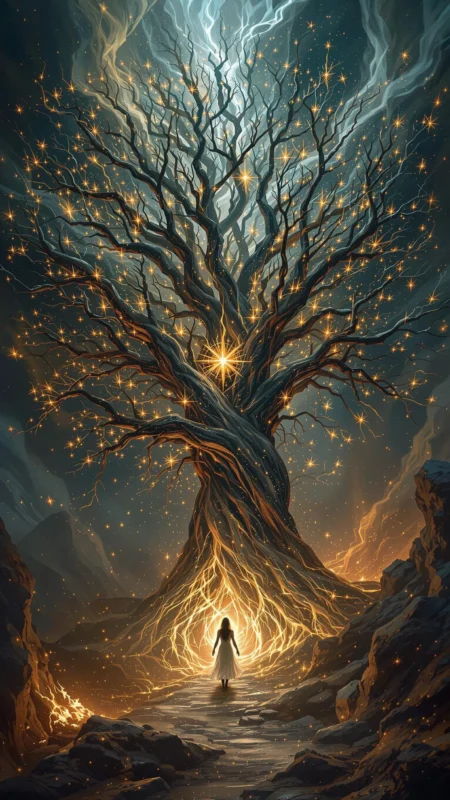


Burning Bush

Archetype Meaning & Symbolism

Revelatory, paradoxical, unapproachable, clarifying, demanding, transformative, divine, unsettling, urgent, singular

  • I am the question that burns away all your other questions. Do not ask what I am: ask what you will become now that you have seen me.

If Burning Bush is part of your personal mythology, you may...

Believe

  • You may believe that certain moments in life are not coincidence but communication, direct messages from a source of deeper meaning.

  • You may believe that your life has a specific, undeniable purpose, and that your greatest task is to align yourself with it.

  • You may believe that true passion is a force that can energize and illuminate you indefinitely, without reducing you to ash.

Fear

  • You may fear that you are wholly inadequate for the mission you have been given, and that you will inevitably fail.

  • You may fear that no one will ever understand your experience, leading to a life of profound and permanent isolation.

  • You may fear misinterpreting the revelation, becoming a false prophet who leads yourself and others into delusion.

Strength

  • You may possess an unshakable sense of purpose that acts as a compass, providing clarity even in the midst of chaos.

  • You may have the capacity to inspire others, not through rhetoric, but through the quiet, powerful conviction of your vision.

  • You may find a deep well of resilience within you, fueled by the unwavering belief that your work is not just important, but essential.

Weakness

  • You may develop a tendency towards zealotry, becoming so convinced of your vision that you are unable to hear criticism or consider alternatives.

  • You may alienate those around you by acting as if your mission gives you a pass on common courtesy, emotional availability, or shared responsibilities.

  • You may be susceptible to a spectacular burnout, mistaking the initial, intense fire of revelation for a sustainable source of daily energy.

The Symbolism & Meaning of Burning Bush

In the personal mythology of a modern life, the Burning Bush archetype represents the unignorable call to purpose. It is the moment that cleaves a life into two distinct chapters: Before and After. This is not the slow dawn of a new idea, but a sudden, extraordinary event or realization that feels both external and deeply personal, a message from the universe delivered directly to your psyche. It may be an unexpected job offer that feels like destiny, a chance encounter that reveals your true calling, or a profound insight that shatters your previous worldview. To have a Burning Bush in your mythos is to carry the memory of a moment when the world stopped making ordinary sense and began speaking a new, urgent language meant only for you.

The paradox of the bush—alight with fire but never turning to ash—is central to its meaning. It symbolizes a form of passion, creativity, or spiritual energy that is powerful yet sustainable. We speak of “burning out,” of being consumed by our work or our obsessions. The Burning Bush offers a different model: a way of being intensely alive, creatively on fire, and spiritually engaged without self-destructing. It suggests that your true calling, once discovered, may not deplete you. Instead, it could become a source of inexhaustible energy, a flame that illuminates your path without incinerating the ground on which you walk. It is the difference between a frantic blaze and a steady, holy fire.

Yet, the encounter is rarely a comfortable one. The archetype carries with it an aura of the numinous: that which is both fascinating and terrifying. The revelation it provides is often demanding, asking you to leave a place of comfort, to take on a burden you feel unprepared for, to become someone you never imagined you could be. It is a symbol of a truth so potent it cannot be approached casually. In your own story, this may translate to an opportunity that also feels like an immense weight, a truth that is liberating but also isolating, a purpose that gives you meaning but also sets you apart from your peers.


Burning Bush Relationships With Other Archetypes

The Wanderer

The Burning Bush and The Wanderer exist in a state of magnetic polarity. The Wanderer moves across the landscape of life, searching for a sign, a purpose, a home. They are defined by their seeking. The Burning Bush is the definitive end of that aimless search. It is stationary, a fixed point of revelation in the desert of uncertainty. Its appearance to The Wanderer is a dramatic culmination, transforming a journey of seeking into a pilgrimage with a clear, albeit daunting, destination. The Wanderer asks the questions; the Bush provides the singular, life-altering answer.

The Doubter

The relationship with The Doubter archetype is one of profound challenge. The Doubter, whether an external figure or an internal voice, meets the story of the Burning Bush with skepticism. It demands rational proof for a mystical experience. The Burning Bush does not argue or present evidence; its power lies in its undeniable, self-evident presence. It challenges The Doubter not by winning a debate, but by presenting a reality so potent that skepticism itself begins to feel like the more illogical position. It forces The Doubter to confront the possibility that there are truths that exist beyond the reach of their reason.

The Messenger

The Burning Bush is a source, not a vehicle. It provides the message but cannot carry it. For this, it relies upon The Messenger archetype. The encounter imbues a person with a truth so urgent it must be shared, transforming them into a herald. Think of Moses, compelled to carry the divine edict to his people and to Pharaoh. The Bush is the silent, stationary core of the revelation; The Messenger is its voice and its feet in the world. Their relationship is symbiotic: without the Bush, the Messenger has nothing to say; without the Messenger, the Bush's fire burns for no one.

Using Burning Bush in Every Day Life

Navigating a Career Crossroads

To stand at a professional fork in the road, one path safe and predictable, the other terrifying but scintillating with a strange sense of correctness. The Burning Bush archetype appears here not as a logical pro-con list but as a sudden, gut-level certainty: a project, a company, a new vocation that feels less like a choice and more like a summons. To heed it is to walk away from the carefully constructed five-year plan and toward a fire that promises not warmth, but transformation.

Confronting a Personal Truth

There are realizations about oneself that arrive not through gentle introspection but as a flash of lightning, illuminating a hidden landscape of behavior or belief. The Burning Bush is this moment of stark, undeniable self-knowledge. It is the sudden awareness of a destructive pattern, the confrontation with a long-denied aspect of one’s identity, or the recognition of a deep-seated fear. The experience doesn't offer comfort; it demands action, insisting that you can no longer pretend you do not see what has been so vividly revealed.

Answering a Creative Call

For an artist, a writer, a creator of any kind, the Burning Bush may manifest as an idea that arrives whole, urgent, and non-negotiable. It is not a fleeting inspiration but a persistent vision that demands to be made real. The archetype governs the story that keeps you awake at night, the melody that interrupts your thoughts, the image that must be painted. It feels less like your creation and more like you are its custodian, tasked with the awesome responsibility of bringing it from the ether into the world, consumed by the process but not destroyed by it.

Burning Bush is Known For

Divine Revelation

It is known primarily as a conduit for a message that transcends the mundane. The communication is not a dialogue but a proclamation, a moment where the veil thins and a truth is imparted directly, without the filter of normal human discourse.

A Call to Action

The encounter is never passive. The revelation is intrinsically linked to a mission, a directive that reorients the recipient's life. It is not knowledge for its own sake but knowledge that demands a quest, a journey, a fundamental change in one's purpose.

Paradoxical Nature

Its most iconic feature is the miracle of being aflame but not consumed. This symbolizes a power, an energy, or a truth that operates outside the known laws of existence. It represents sustainable passion, a spiritual fervor that fuels rather than incinerates.

How Burning Bush Might Affect Your Personal Mythology

How Burning Bush Might Affect Your Mythos

When the Burning Bush takes root in your personal mythos, it fundamentally alters the narrative structure of your life. Your story is no longer a linear progression of events or a series of disconnected chapters; it is bisected by a singular, luminous event. There is the person you were *before* you saw the fire, and the person you became *after*. This moment becomes the central axis around which all other life events—past and future—are reinterpreted. Past struggles may now seem like necessary preparation; future challenges may be viewed as tests of your commitment to the revelation. Your personal history ceases to be a product of chance and becomes an epic with a clear, defining plot point.

Furthermore, this archetype introduces a powerful element of destiny or fate into your life story. It counters the modern narrative of endless choice and self-invention with a more ancient, profound sense of being chosen. The mythos is no longer about *finding* yourself but about *answering* a call that has found you. This can be both empowering and terrifying. It suggests your life is not just your own but is in service to a larger purpose. Every decision is weighed against this central mission, lending your personal mythos a sense of gravity, coherence, and high stakes that it may have previously lacked.

How Burning Bush Might Affect Your Sense of Self

To integrate the Burning Bush is to see yourself as a vessel for something extraordinary. It can instill a profound, almost unsettling, sense of importance. You are no longer just an individual navigating life; you are the keeper of a sacred flame, the recipient of a crucial message. This may lead to a quiet, unshakable confidence, a core of certainty that remains steadfast even in the face of external doubt or failure. The self is redefined not by its profession, relationships, or accomplishments, but by its relationship to this central, defining experience. It is a shift from an identity based on doing to an identity based on being: being the one who saw.

Paradoxically, this can also trigger a profound identity crisis. The person you were before the encounter may feel like a stranger, their goals petty, their concerns trivial. This can create a deep sense of internal alienation, as if your new self is an ill-fitting costume. You may mourn the loss of your old, simpler identity and struggle with the immense weight of the new one. The self may feel fractured, caught between the memory of mundane contentment and the demanding reality of a newfound purpose, leading to a period of deep and often lonely self-renegotiation.

How Burning Bush Might Affect Your Beliefs About The World

The Burning Bush shatters a purely materialistic or cynical worldview. Its appearance in one's life introduces the category of the miraculous, the transcendent, the inexplicable. The world is no longer a clockwork machine governed by predictable laws but a place of potent mystery, where meaning can erupt into reality at any moment. This may foster a sense of awe and wonder, an openness to synchronicity and serendipity. The world becomes a text filled with hidden symbols and potential signs, and you have been given a key to read a part of it. It’s a fundamental shift from seeing the world as a collection of resources to seeing it as a source of revelation.

This transformed worldview might also make the ordinary world seem pale and drained of significance. Everyday concerns, societal ambitions, and common pleasures can feel hollow when measured against the intensity of the numinous encounter. This can lead to a kind of spiritual detachment from the mundane, a feeling of being an emissary from another reality temporarily stationed in this one. The world may come to be seen as a stage for a hidden spiritual drama, and its conflicts and events are interpreted through the lens of this newfound, cosmic perspective, which can be both illuminating and isolating.

How Burning Bush Might Affect Your Relationships

Relationships forged before the Burning Bush experience may come under immense strain. It can be profoundly difficult to explain the nature of your new inner reality to those who have not shared a similar revelation. Friends, family, and partners may see your new purpose as an obsession, a delusion, or a betrayal of your shared past. A chasm may open, not out of malice, but out of a fundamental difference in perspective. You may feel an aching loneliness, surrounded by people you love but who cannot see the fire that now illuminates your entire world. Many old bonds may fray or break under this new tension.

Consequently, you may find yourself drawn to new and different kinds of relationships. You might seek out fellow travelers: others who speak the language of purpose, who have had their own encounters with the sublime, who understand the weight of a calling. These connections can be intensely powerful and validating, forming a new kind of tribe bonded by shared mission rather than shared history. Relationships become less about casual comfort and more about alliance, a search for comrades who can help tend the flame and navigate the difficult path it reveals.

How Burning Bush Might Affect Your Role in Life

The encounter with the Burning Bush irrevocably changes one's perceived role in life. You are no longer merely fulfilling a social or professional function: a teacher, a doctor, a parent. You may still perform those duties, but your core identity shifts to that of a protagonist on a mission. The role becomes archetypal: you are now The Emissary, The Pioneer, The Guardian of a particular truth. This provides a deep sense of meaning to even mundane tasks, as they are all now in service of the greater calling. Your role is not defined by society's expectations, but by the directive received in that moment of revelation.

This can also create significant conflict with one's established roles. The demands of the new, sacred role may clash with the responsibilities of the old, profane ones. The call might demand you quit your stable job, move to a new place, or dedicate time and resources in a way that seems irresponsible to your family or community. One's role becomes a point of tension, a constant negotiation between the demands of the vision and the duties of everyday life. You may feel you are living a double life: the public role everyone sees, and the secret, essential role that truly drives you.

Dream Interpretation of Burning Bush

To dream of the Burning Bush in a positive context is often a powerful omen of imminent breakthrough and clarification. It may appear when you are at a crossroads, feeling lost or uncertain about your path. The dream signifies that a deep, intuitive answer is emerging from your subconscious. It suggests you are about to receive a potent insight or discover a passion that will energize you without consuming you. The dream is an invitation to pay close attention to the events and ideas in your waking life, for a calling is at hand. It affirms that you are ready to receive a new level of purpose.

In a negative context, the Burning Bush in a dream can symbolize a truth you are actively avoiding or a responsibility you feel crushed by. The fire, in this case, is not illuminating but menacing. It may represent a creative or spiritual calling that you are too frightened to answer, and its appearance in the dream is a manifestation of the psychological pressure building within you. It could also point to a fanatical or obsessive idea that is threatening to take over your life in a destructive way, a passion that is on the verge of becoming an unhealthy fixation, promising transformation but threatening only annihilation.

How Burning Bush Archetype Might Affect Your Needs

How Burning Bush Might Affect Your Physiological Needs

The proximity of the Burning Bush in one's mythos can directly impact the body's perceived needs. The urgency of the call may relegate physiological necessities like hunger and sleep to the background. An individual might be sustained by a kind of nervous, ecstatic energy, a spiritual adrenaline that overrides the body's normal signals for rest and nourishment. This is the state of the artist lost in a creative trance for days, or the activist working tirelessly, fueled by righteous conviction. The body is not the self; it is the tool, the vessel, the temporary container for the fire, and its needs may seem secondary to the mission at hand.

This relationship is not without peril. While the fire may feel like it provides its own fuel, the body has its limits. Neglecting physiological needs in the name of a higher calling is a path to burnout, illness, and collapse. The mythos of the Bush, if misinterpreted, can foster a dangerous disregard for the physical self. The challenge becomes learning the lesson of the paradox: to burn without being consumed means respecting the vessel. It requires finding a rhythm that honors both the celestial fire of the mission and the earthly needs of the body that carries it.

How Burning Bush Might Affect Your Ideas of Belonging

The experience of the Burning Bush is inherently isolating. It is a singular revelation, a moment that sets one apart from the tribe. It can make previous forms of belonging—based on shared hobbies, background, or social status—feel superficial and unsatisfying. A chasm of experience now separates you from those who have not seen what you have seen. This can lead to a profound loneliness, a feeling of being a stranger among one's own people, speaking a language no one else understands. The first impact on belonging is often its loss.

From this isolation, however, a new and more potent form of belongingness may emerge. The search for love and connection shifts from finding people who are *like* you to finding people who are *aligned* with your purpose. Belonging is no longer about fitting in, but about finding co-conspirators, fellow pilgrims, or a flock to whom you must deliver your message. The love sought is not one of easy comfort but of shared struggle and mission. This creates deeper, more resilient bonds, forming a new community forged not in the town square, but in the fire of a shared vision.

How Burning Bush Might Affect Your Feelings of Safety

The Burning Bush is an archetype that calls one away from safety. Its appearance marks the end of a life lived within comfortable, predictable boundaries. The mission it imparts almost invariably involves stepping into the unknown, confronting powerful opposition, or sacrificing material and emotional security. The desert where Moses saw the bush is a potent symbol for this landscape: a place of trial, scarcity, and vulnerability. To accept the call is to accept that your personal safety is no longer the highest priority; the integrity of the mission is.

However, the archetype may also provide a different, more profound kind of safety. While it exposes one to physical and social dangers, it can offer a powerful sense of spiritual protection. The conviction that one is on the correct path, guided by a transcendent purpose, can create a psychological armor against fear and doubt. This isn't the safety of a locked door, but the confidence of a navigator who trusts their compass in a storm. The feeling is not 'nothing bad will happen to me,' but rather 'whatever happens to me is part of this essential journey.'

How Burning Bush Might Affect Your Views of Esteem

Esteem, in the presence of the Burning Bush, becomes a paradoxical experience. On one hand, being the recipient of a divine or transcendent call can generate a powerful sense of significance. You are not random; you have been chosen. This can be the source of an unshakable self-worth that is not dependent on the approval of others or external achievements. Your value is intrinsic, derived directly from your connection to this profound purpose. It is the esteem of the vessel that knows it carries something precious.

On the other hand, the sheer magnitude of the calling can be a crushing weight on one's esteem. The immediate reaction to the revelation is often one of profound inadequacy: 'Who am I to do this? I am not eloquent, I am not strong, I am not worthy.' The esteem that comes from being chosen is immediately challenged by the fear of being unequal to the task. This tension is central to the archetype. True esteem is found not in feeling worthy beforehand, but in the courage to accept the mission despite feeling utterly unworthy.

Shadow of Burning Bush

The shadow of the Burning Bush emerges when the divine call sours into a divine mandate for the ego. Here, the individual is no longer a humble vessel for a message but believes they *are* the source of the fire. This is the path to the charismatic cult leader, the self-righteous tyrant, the visionary CEO who justifies cruelty and exploitation in the name of their 'mission.' The shadow self uses the language of revelation to demand obedience, to silence dissent, and to place itself beyond judgment. The sacred purpose becomes a holy excuse for profane behavior, and the light that was meant to illuminate becomes a fire that consumes others.

Another shadow aspect is not tyranny over others, but a kind of spiritual self-immolation. This occurs when an individual becomes so identified with the calling that they erase their own humanity. They sacrifice their health, their relationships, their personal joy, and their own well-being on the altar of the mission. They are consumed by the fire. They forget that the lesson of the bush was that one could burn *without* being consumed. In this dark reflection, the mission doesn't create a meaningful life; it replaces it, leaving behind a hollowed-out husk, a martyr to a cause that has forgotten the value of the person who served it.

Pros & Cons of Burning Bush in Your Mythology

Pros

  • It provides a powerful, life-defining sense of direction and meaning, ending periods of aimlessness.

  • It can unlock unforeseen reserves of courage, resilience, and potential you never knew you possessed.

  • It offers a profound and enduring connection to something larger and more mysterious than the self.

Cons

  • The experience is often deeply isolating, creating a gulf between you and those who do not understand.

  • It imparts a burden of responsibility that can feel overwhelming and crushingly heavy.

  • It can foster a dangerous inflexibility, making it difficult to adapt, compromise, or change course when necessary.