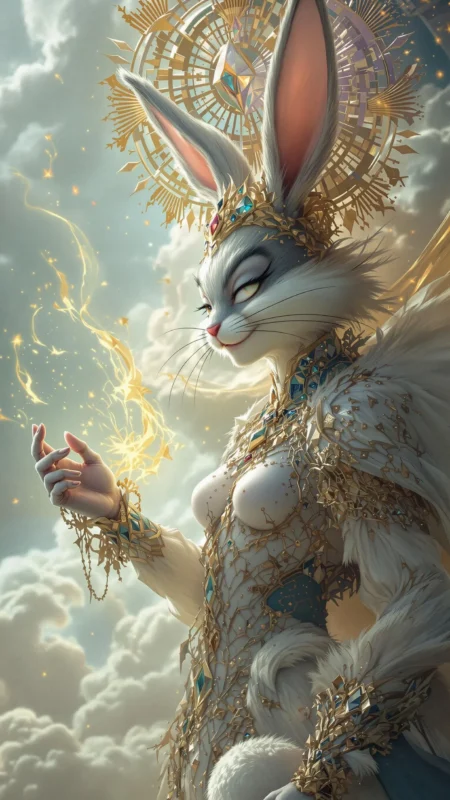
Bugs Bunny

Archetype Meaning & Symbolism

Witty, irreverent, unflappable, clever, trickster, adaptable, audacious, nonchalant, transgressive, charismatic

  • Of course you realize, this means war.

If Bugs Bunny is part of your personal mythology, you may...

Believe

  • You may believe that authority is inherently absurd and that the most appropriate response to it is mockery, not obedience.
  • You may believe that the rules of any system, from social etiquette to the laws of physics, are merely suggestions, open to creative reinterpretation.
  • You may believe that wit is the ultimate survival tool, and that a clever mind will always triumph over brute strength or stacked odds.

Fear

  • You may fear being genuinely outsmarted, being made the butt of the joke, and having your own cleverness turned against you.
  • You may fear true emotional vulnerability, a situation where a wisecrack is not enough and a sincere, unguarded response is required.
  • You may fear an inescapable trap: a humorless, rigid situation with no loopholes, no angles to play, and no escape hatch.

Strength

  • Your strength may be an unshakable composure, the ability to treat a crisis not as a catastrophe but as an interesting puzzle to be solved.
  • Your strength may be a profound creativity, an ability to find solutions by completely subverting the assumptions of the problem.
  • Your strength may be a magnetic and disarming charisma, a way of using humor and nonchalance to defuse tension and win over adversaries.

Weakness

  • Your weakness may be a tendency to escalate conflicts for sport, turning a minor disagreement into a full-blown war of wits just for the fun of it.
  • Your weakness may be a reliance on sarcasm as a shield, making it difficult to express sincere emotions or engage in moments of gravity.
  • Your weakness may be a potential for intellectual arrogance, a dismissiveness toward those you deem less clever that can border on cruelty.

The Symbolism & Meaning of Bugs Bunny

Bugs Bunny may be the quintessential American trickster, a figure whose very existence is a commentary on the absurdity of power. He symbolizes the triumph of the individual mind over brute force, institutional rigidity, and the humorless void of authoritarianism. In one's personal mythology, he is not the hero who slays the dragon, but the one who convinces the dragon it is actually a teapot. His symbolic power lies in his fluidity: he can be an opera diva, a baseball player, a matador. This shapeshifting is a metaphor for a profound psychological adaptability, a refusal to be defined by any single role or expectation. He suggests that identity itself is a costume, to be worn for a scene and discarded when it no longer serves the story.

His nonchalance in the face of annihilation is perhaps his most potent symbol. A shotgun barrel to the face elicits not fear, but a curious, almost academic, inquiry. This could represent a deep spiritual or philosophical stance: that the universe, in all its sound and fury, is ultimately a kind of cosmic slapstick. To internalize this is to find a strange sort of peace. The carrot he chews so casually may be a totem of this self-possession: a simple, earthy pleasure that grounds him, a reminder that even amidst chaos, one can always find a moment for a small, defiant snack. He is the patron saint of the loophole, the footnote, the clever clause in the contract of reality.

Furthermore, Bugs could embody the creative spirit's relationship with its own medium. By speaking to the animator, arguing with the script, or running off the edge of the film reel, he declares his sovereignty over the reality constructed for him. For an individual, this may symbolize the power to rewrite one's own narrative, to question the foundational stories we are told about ourselves and the world. He is the part of the psyche that knows it is in a story and thus feels empowered to grab the pen, to erase the antagonist's gun, and to draw a rabbit hole where a dead end used to be.


Bugs Bunny Relationships With Other Archetypes

The Hunter

The Hunter, in his various guises as a flustered sportsman or a sputtering prospector, may not be an antagonist so much as a dance partner, the necessary friction that lets the Trickster glow. This figure, representing a kind of blunt-force, joyless ambition, could be seen as the potter's wheel upon which the Bugs Bunny archetype is spun into form. The Hunter provides the rigid, predictable patterns of aggression and desire, a flat, grey canvas against which the splash of anarchic color becomes so vibrant. He is perhaps the straight man in a cosmic vaudeville act, his earnest fury the very metronome that gives the Trickster’s nonchalant wit its perfect, devastating timing. Without the sound of the shotgun, the snap of the carrot might just be a rabbit eating its lunch; with it, it becomes the punctuation mark at the end of a profound, karmic joke.

The Fourth Wall

For most characters, the Fourth Wall is an unbreachable, crystalline barrier separating their world from our own. For the Bugs Bunny archetype, it may as well be a beaded curtain in a doorway, something to be breezed through with a knowing wink. This relationship is not one of defiance but of intimacy. He could be seen as a lucid dreamer, aware of the artifice of his own reality and, finding it amusing, invites the audience in on the secret. This direct address, this lean against the proscenium arch, is perhaps his most defining gesture. It transforms him from a mere participant in a narrative to its casual, omniscient curator, a being who treats the very medium of his existence as a co-conspirator, a private telephone line to the architects of fate to whom he might whisper, “Ain’t I a stinker?”

The Carrot

The carrot is a paradox, at once a mundane vegetable and a scepter of absolute power. Its relationship to the Bugs Bunny archetype could be that of a grounding rod, an anchor of profound cool in a sea of hysteria. While anvils fall and dynamite sizzles, the casual crunch of the carrot is a meditative act, a small, orange flag of tranquility planted atop a mountain of chaos. It may function as a conductor’s baton, used not to lead an orchestra but to mock the cacophony of his pursuers with its steady, insouciant rhythm. Perhaps it is the ultimate symbol of self-possession—a reminder that true mastery is not the ability to control the world, but the ability to remain unbothered by it, to find a moment for a leisurely snack while standing on the precipice of cartoon oblivion.

Using Bugs Bunny in Every Day Life

Navigating Bureaucracy:

When faced with an unyielding institutional form or an inflexible clerk, one might channel this archetype not by arguing, but by finding the absurd loophole. You could ask a question so far outside the script that the system short-circuits, creating the very opening you need. It is the art of treating a monolithic department like a slow-witted giant, easily distracted by a carrot on a string.

Handling an Aggressor:

Instead of meeting a bully's force with force, the Bugs Bunny approach is to deflate their power with nonchalant wit. It is the verbal equivalent of painting a tunnel on a rock face. The aggressor, expecting a wall of resistance, instead finds themselves charging full-speed into an illusion, their momentum becoming their own downfall. You do not fight them: you simply hand them the script to their own farcical defeat.

Creative Problem-Solving:

When a project is stalled or a problem seems intractable, this archetype encourages a wrong turn at Albuquerque. It is the permission to ignore the map entirely. You might solve a coding bug by rewriting the premise, or win a negotiation by changing the game being played. The solution is rarely a better version of the existing path, but a rabbit hole to an entirely different reality.

Bugs Bunny is Known For

Outwitting Opponents

His primary mode of existence is the intellectual dismantling of his adversaries, from the hapless Elmer Fudd to the bombastic Yosemite Sam, proving that a quick mind is mightier than any ACME-brand sword.

"What's Up, Doc?":

An iconic catchphrase that is not merely a greeting but a tool of radical disarmament. It is spoken with a casual crunch of a carrot, a cool inquiry that instantly reframes a moment of mortal peril into a casual, almost boring, encounter.

Breaking the Fourth Wall:

His unique awareness of his own medium, directly addressing the audience with a wry glance or a knowing aside. He acknowledges the absurdity of his own reality, inviting us to be co-conspirators in the joke.

How Bugs Bunny Might Affect Your Personal Mythology

How Bugs Bunny Might Affect Your Mythos

To integrate Bugs Bunny into one's personal mythos is to re-script a life story from a heroic epic or a tragedy into a divine comedy. The challenges one faces may cease to be seen as soul-crushing obstacles and could instead be reframed as setups for a brilliant punchline. Your narrative may no longer be about enduring hardship, but about masterfully outwitting it. That time you were fired might become the story of how you cleverly escaped a place that was a cage; a painful breakup transforms into a tale of dodging a cannonball with a well-timed sidestep. Your mythos becomes less a chronicle of suffering and more a highlight reel of your own cleverness.

This archetype shapes a life story that celebrates the perpetual underdog, the soloist who can out-dance the entire chorus line of fate. The narrative arc may not be a steady climb to glory but a series of brilliant, improvisational dodges, weaves, and gambits. Your personal legend is not written in stone by the gods, but sketched in pencil by a trickster who knows that an eraser is the most powerful tool of all. It is a mythos that finds its climax not in a great battle, but in the quiet, satisfied chuckle after the antagonist has, once again, tied himself into a pretzel.

How Bugs Bunny Might Affect Your Sense of Self

Adopting this archetype may profoundly affect one's self-concept, fostering an identity rooted in intellectual agility. The self is not defined by its strength, status, or wealth, but by its wit. You may see yourself as fundamentally unflappable, your core identity a calm, carrot-chewing center in a hurricane of absurdity. This fosters a kind of self-reliance that is deeply internal: your security comes from your mind, a portable toolkit that can dismantle any trap. The self is perceived as fluid, a master of disguise able to adopt any role necessary to navigate a situation without ever losing the essential 'you' underneath.

This may also cultivate a self that is perpetually at play. Seriousness is the enemy, a trap of the ego. A person with this inner archetype could view their own anxieties and fears with a certain ironic distance, as if watching a character in a cartoon. This can be a powerful tool for emotional regulation, creating a buffer between the self and the overwhelming immediacy of an emotion. However, it may also mean the 'true' self, the one without the wisecracks and costumes, remains a carefully guarded secret, perhaps even from oneself.

How Bugs Bunny Might Affect Your Beliefs About The World

A worldview informed by Bugs Bunny is one that sees the structures of society as fundamentally arbitrary and ripe for playful subversion. The world is not a serious, well-ordered machine but a chaotic, poorly written cartoon. Kings, presidents, and CEOs are just Yosemite Sams in different hats: loud, impotent, and easily foiled by a bit of lateral thinking. This perspective pierces the veil of pomposity that cloaks authority, revealing the shaky foundations underneath. It is a worldview that instinctively looks for the loose thread, the logical fallacy, the 'that's all, folks' written at the bottom of a sacred text.

This perspective may also see reality itself as malleable. The laws of physics, social conventions, and even time can be bent if one is clever enough. A 'wrong turn at Albuquerque' isn't a mistake; it's an opportunity to discover a new, more interesting destination. This fosters a deep-seated optimism, not because one believes things will necessarily be good, but because one believes they can always be outsmarted. The world is a game of wits, and for the person aligned with this archetype, it is a game they are confident they can win.

How Bugs Bunny Might Affect Your Relationships

In relationships, the Bugs Bunny archetype might manifest as a charismatic, playful, and endlessly entertaining partner or friend. This person is the master of witty banter, the one who can defuse a tense argument with a perfectly timed, absurd observation. They keep things light, fun, and interesting. They may be drawn to foils: serious, grounded, or even slightly slow-witted partners who serve as the perfect 'Elmer Fudd' for their antics. The dynamic is one of a constant, loving chase, a dance of wits that keeps the relationship from ever growing stale.

However, this same impulse can create a profound barrier to intimacy. The constant performance, the reflexive use of humor as a shield, can make true vulnerability feel impossible. A partner may long for a moment of sincere, unguarded connection, only to be met with another costume change or a clever deflection. The fear of being the fool, of being emotionally 'caught,' can lead the Bugs Bunny type to keep everyone, even those they love, at a safe, ironic distance. They may be masters of the chase, but they can be deeply uncomfortable with what happens after the catch.

How Bugs Bunny Might Affect Your Role in Life

A person embodying the Bugs Bunny archetype may see their role in any group, family, or society as that of the irreverent catalyst. They are not meant to be the king or the soldier, but the court jester, the only one who can speak truth to power without losing their head. Their function is to poke holes in dogma, to question the unquestionable, and to inject chaos into systems that have become too rigid and self-important. They are the necessary irritant that prevents the calcification of thought and behavior in any social structure.

Their role is also that of the great leveler. They humble the arrogant, confuse the powerful, and empower the meek through their example. They demonstrate that one does not need official power or status to have agency. Their role is to be a living reminder that the most elaborate systems can be brought to a standstill by a single, well-placed, absurd question. They are not builders of institutions, but the playful saboteurs who ensure those institutions never forget their own inherent absurdity.

Dream Interpretation of Bugs Bunny

To dream of Bugs Bunny in a positive light, perhaps seeing him casually outwit a menacing figure that has been chasing you, may be a message from the psyche to change your tactics. The dream suggests that confronting this problem with direct force or anxiety is futile. Instead, your subconscious is advising a shift to wit, humor, and creative, unpredictable thinking. Bugs' appearance is an affirmation that you possess the inner resources to be cleverer than your problems. He might hand you a carrot, a symbol of simple, grounded self-possession in the face of the threat.

In a negative context, dreaming of Bugs Bunny could signify a confrontation with your own shadow trickster. Perhaps in the dream, he is tormenting you, or you watch as he plays a cruel, unfunny prank on a vulnerable character. This could indicate that your own cleverness has become a form of cruelty or manipulation in your waking life. It may be a warning that your use of humor and detachment is a defense mechanism that is causing harm to yourself or others by preventing genuine emotional connection. He might represent a part of you that is evasive, refusing to take a serious issue seriously, endlessly taking that 'wrong turn' to avoid a necessary destination.

How Bugs Bunny Archetype Might Affect Your Needs

How Bugs Bunny Might Affect Your Physiological Needs

From the perspective of personal mythology, the Bugs Bunny archetype reshapes one's approach to basic physiological needs. He is never seen hoarding carrots or building a fortified warren. His confidence is not in his supply, but in his ability to acquire. This may translate to a belief that needs like food, water, and shelter are best met through resourcefulness, not accumulation. There is a letting go of the anxiety of 'not having enough,' replaced by a deep trust in one's ability to 'always find a way.' The focus shifts from the material to the mental: a clever mind is the only storehouse you truly need.

This mythos could also suggest a certain asceticism, not of denial, but of simplicity. Bugs' desires are simple: a carrot, a quiet place to sleep. He is not driven by a need for luxury or excess. This might foster a physiological life free from the stress of chasing material status. One learns to be satisfied with the simple carrot, finding greater pleasure in the game of acquiring it than in the consumption itself. It's a fundamental belief that as long as you have your wits, your basic needs will, in one absurd way or another, be met.

How Bugs Bunny Might Affect Your Ideas of Belonging

Bugs Bunny is a supreme individualist, a loner who is rarely, if ever, lonely. For someone with this archetype, the need for belongingness may be satisfied not by assimilation into a group, but by a profound sense of self-possession. They belong to themselves first and foremost. Friendships and romantic partnerships are welcome, but not necessary for a sense of wholeness. The archetype may foster a life where companionship is a delightful bonus, a dance partner for a scene or two, rather than a foundational requirement for identity.

When connection is sought, it is often with a 'foil' or a partner-in-crime who appreciates the performance. Belonging is found in the shared joke, the mutual understanding of the absurdity of it all. This can lead to incredibly fun and dynamic relationships, like his rapport with Lola Bunny or even his frenemy status with Daffy Duck. However, the need to remain the clever individual can keep true, vulnerable belonging at arm's length. The fear is that to truly belong to another or to a group is to lose the freedom of being the unpredictable soloist.

How Bugs Bunny Might Affect Your Feelings of Safety

The Bugs Bunny archetype provides a radical reinterpretation of safety. Safety is not a place, like a fortified bunker or a gated community. It is a state of mind. His mythology suggests that true security lies not in avoiding danger, but in being absolutely certain you can escape it. He feels safest when he is being hunted, because that is the arena where his genius shines brightest. For an individual, this may mean feeling more secure in a chaotic, unpredictable environment where they can rely on their wits than in a stable, predictable one that feels like a cage.

This internal locus of safety can be incredibly empowering. Fear of job loss, social rejection, or physical threat may be diminished, because each threat is perceived as a setup for a clever escape. The mind becomes the ultimate panic room, a place where one can always find a disguise, a witty retort, or a painted-on tunnel. Safety is the unshakeable faith in your own ability to rewrite the end of any dangerous scene. It is the knowledge that no matter the trap, you are the one holding the eraser.

How Bugs Bunny Might Affect Your Views of Esteem

Esteem, within the Bugs Bunny mythos, is earned and validated internally. It is not derived from the applause of the crowd or the accolades of an institution, but from the private, deep satisfaction of a perfectly executed gambit. Esteem is the silent chuckle when your pursuer runs headfirst into the painted tunnel. It is the feeling of being three steps ahead of everyone else in the room. This fosters a powerful, self-contained ego, one that does not require external validation to feel worthy.

Respect is earned from oneself, for oneself. The measure of success is cleverness. Each problem solved, each bully deflated, each trap escaped adds to a deep well of self-respect. This can create a person of immense confidence and self-assurance. Their worth is not tied to their job title, their bank account, or their social standing, but to the keen, sharp, and ever-reliable instrument of their own mind. Their esteem is rooted in the unshakable belief that they are, quite simply, smarter than the problem.

Shadow of Bugs Bunny

When the Bugs Bunny archetype falls into shadow, the playful trickster becomes a malicious saboteur. The charming wit curdles into cruel, manipulative gaslighting. This shadow figure doesn't outsmart aggressors in self-defense; he seeks out the vulnerable and the earnest—the Elmer Fudds of the world who are just trying to do their jobs or live their lives—and torments them for sport. The goal is no longer freedom or survival, but the exertion of intellectual dominance. Humor becomes a weapon not to deflate pomposity, but to inflict deep psychological wounds, all while maintaining plausible deniability: 'Can't you take a joke?'

The shadow's adaptability becomes a radical refusal to take responsibility. Every problem is someone else's fault; every commitment can be escaped through a convenient rabbit hole of excuses. He is the partner who cheats and then masterfully convinces you it was your fault for being too trusting. He is the colleague who sabotages a project and then frames someone else with a dazzling display of misdirection. This shadow is not a lovable scamp; it is a nihilistic force of chaos that uses its intelligence to create suffering, all while wearing a mask of innocent, wide-eyed amusement.

Pros & Cons of Bugs Bunny in Your Mythology

Pros

  • It fosters an incredible psychological resilience, allowing one to face adversity with creativity and a sense of play.
  • It encourages out-of-the-box thinking and the ability to find humor and levity even in the darkest of situations.
  • It builds a powerful sense of self-reliance and confidence, rooted in one's own intellectual and adaptive capabilities.

Cons

  • It can lead to emotional detachment, using wit and sarcasm as a wall that prevents true intimacy and vulnerability.
  • It may foster a flippant or contrarian attitude that can undermine one's ability to engage with serious matters appropriately.
  • It risks developing into intellectual arrogance and a manipulative disposition, where cleverness is used to control or belittle others.