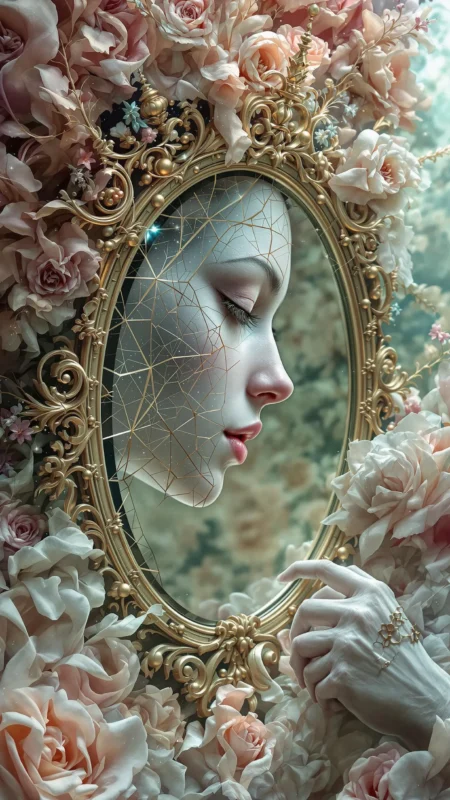


Broken Mirror

Archetype Meaning & Symbolism

fragmented, reflective, sharp, distorted, multifaceted, truthful, dangerous, revealing, shattered, incomplete

  • Do not seek to be whole. Seek to be a beautiful arrangement of your pieces.

If Broken Mirror is part of your personal mythology, you may…

Believe

  • That truth is never singular or simple; it is always a composite of multiple, sometimes conflicting, perspectives.

    That the most beautiful things are those that bear the marks of their history, including scars, cracks, and repairs.

    That a coherent self is not something you are born with, but something you creatively and continuously assemble from the pieces of your experience.

Fear

  • A total psychic shattering, a dissolution from which you can never reassemble yourself.

    That others will only ever see you as ‘broken’ or ‘damaged,’ incapable of seeing the whole pattern your pieces form.

    Inadvertently wounding those you love with your own sharp edges and unresolved fragments.

Strength

  • Profound resilience: having been shattered and survived, you are less afraid of life’s inevitable breaks and collapses.

    A unique perspective: you see the world with a complexity and nuance that allows for great creativity and insight.

    Deep empathy: your own experience of fragmentation allows you to connect with the suffering and complexity of others in a powerful way.

Weakness

  • A persistent feeling of instability or internal chaos, making it difficult to feel grounded or secure.

    Difficulty in presenting a simple, consistent ‘self’ to the world, which can hinder progress in conventional careers or social structures.

    A tendency toward self-sabotage or fatalism, a belief that things are bound to break anyway, so why bother building them carefully.

The Symbolism & Meaning of Broken Mirror

To invite the Broken Mirror into one’s personal mythology is to reject the tyranny of the perfect, singular reflection. It is an acceptance of fracture, not as failure, but as a fundamental state of being. The mirror, once a tool for vanity or simple self-recognition, becomes in its shattered state a complex oracle. Each shard offers a different angle, a new perspective. One piece might reflect your ambition, another your vulnerability, a third your shadow self. To consult the Broken Mirror is to acknowledge that you are not one thing, but many, and that a coherent identity is not found by ignoring the contradictions but by holding them all at once. It symbolizes a post-lapsarian wisdom, the knowledge that comes after the fall, after the break.

This archetype speaks to the beauty of repair, of kintsugi, where the lines of fracture are filled with gold. The personal mythos is no longer about maintaining a pristine surface but about the story told by the scars. The Broken Mirror could represent a pivotal trauma, a psychological break, or a spiritual crisis that, while devastating, created the necessary rupture for a more authentic self to emerge. It suggests that our most interesting qualities live in the cracks, in the places where we are not smooth or easily defined. It is a symbol for the modern psyche, fragmented by a multitude of roles and digital reflections, and it offers a way to find meaning not despite the fragmentation, but because of it.

Ultimately, the Broken Mirror is an emblem of radical self-acceptance. It challenges the cultural mandate for wholeness and healing-as-erasure. Instead, it proposes that wisdom lies in assemblage. Meaning is not discovered; it is constructed from the glittering, sharp-edged pieces of who we have been and what we have endured. It is the patron saint of the survivor, the artist, the bricoleur of the soul. Your life may not be a perfect story, but with the Broken Mirror as a guide, it can become a magnificent mosaic, more profound and resilient for having been broken.


Broken Mirror Relationships With Other Archetypes

The Artist

The Broken Mirror and The Artist have a symbiotic, almost codependent relationship. The mirror provides the raw material: the shards of experience, the fragments of memory, the painful and beautiful pieces of a life. The Artist is the one with the vision and patience to pick up these sharp-edged truths and arrange them into a new form, a collage, a mosaic, a sculpture. The Artist sees not a mess to be discarded but a palette of possibilities. Without The Artist, the Broken Mirror is just a pile of dangerous glass; without the Broken Mirror, The Artist may lack the profound, fractured material from which great work is often born.

The Trickster

The Trickster delights in the Broken Mirror, for it is an instrument of chaos and rearranged truth. While a whole mirror reflects what is, a broken one reflects what could be, what is absurd, what is distorted. The Trickster might hold up a shard to a king and show him a fool, or hold another to a pauper and show him a god. This archetype uses the mirror’s fractured nature to subvert expectations, to poke holes in pomposity, and to reveal that reality is far more slippery and subjective than we believe. The mirror’s distortions are the Trickster’s playground, a place to deconstruct meaning and laugh at the pieces.

The Seeker

For The Seeker, the Broken Mirror presents the ultimate spiritual puzzle. The path to enlightenment or self-knowledge is not a straight line but a scavenger hunt for scattered pieces of the self. The Seeker must painstakingly gather the shards, risking cuts and misinterpretation, to assemble a more complete, albeit complex, picture of truth. Each piece is a clue, a partial revelation. The Seeker’s journey, when influenced by this archetype, is not about finding a single, divine reflection, but about the sacred act of gathering, contemplating, and arranging the fragments into a personal, living mandala.

Using Broken Mirror in Every Day Life

Navigating Identity

When you feel pulled in conflicting directions, a parent and an artist, a professional and a dreamer, the Broken Mirror archetype allows you to hold these identities without demanding they form a single, seamless image. Each facet reflects a different light, a different truth. You are not one thing, but a kaleidoscope of selves, and your personal myth is the story of how these pieces glitter together.

Healing from Trauma

After a shattering event, the pressure to ‘get back to normal’ can be immense. The Broken Mirror suggests a different path. It doesn’t deny the break; it sanctifies it. Your story is now a ‘before’ and ‘after,’ and the crack is a part of your landscape. Healing may not be about gluing the pieces back perfectly, but about learning to live with the new, fractured reflection and the wisdom it offers.

Creative Problem-Solving

When faced with an intractable problem, the Broken Mirror encourages you to shatter your assumptions. It invites you to look at the issue from a dozen different, slightly distorted angles. The solution may not be a single, elegant answer but a composite of partial insights, a bricolage of ideas that, when assembled, reveals a path forward that a ‘whole’ perspective could never see.

Broken Mirror is Known For

A Fractured Reflection

It does not offer a clear, singular image of the self, but rather a multitude of partial, often contradictory, views. It is known for revealing that identity is not a monolith but a mosaic.

An Omen of Rupture

In common superstition, it signals bad luck. In personal mythology, this translates to the recognition of a significant break

a disruption in one’s life story, a point of no return that irrevocably changes the narrative.

A Source of Sharp Truths

The edges of a broken mirror are sharp and can cut. It is known for delivering truths that may be painful, truths that shatter comforting illusions about oneself, others, or the world.

How Broken Mirror Might Affect Your Personal Mythology

How Broken Mirror Might Affect Your Mythos

When the Broken Mirror is a central object in your personal mythos, your life story is likely not a linear progression from ignorance to wisdom, but a narrative of rupture and reconfiguration. There may be a singular, shattering event at its core: the moment the glass broke. This event cleaves your story into a ‘before’ and an ‘after,’ and the central tension of your myth becomes how you navigate the changed landscape. Your quest is not to return to the ‘before’ but to find the meaning hidden within the fractured ‘after.’ The heroes of your story may be those who show you how to find beauty in the shards, and the villains those who demand you pretend the break never happened.

Your personal mythology may also be characterized by a kaleidoscopic quality. The story of your life isn’t one story; it’s a collection of many, sometimes contradictory, narratives that coexist. You might be the hero in one shard’s reflection and the anti-hero in another. This archetype frees your mythos from the need for a single, consistent protagonist. Instead, your life story becomes a testament to the multifaceted nature of the self, a saga that honors complexity over simplicity and finds its resolution not in a neat ending, but in the ever-shifting pattern of the pieces.

How Broken Mirror Might Affect Your Sense of Self

Your view of self, under the influence of the Broken Mirror, may be one of compassionate fragmentation. You might not see a single, unified ‘me’ when you look inward, but rather a committee, a cast of characters, a collection of past selves. This perspective can be liberating. It releases you from the pressure to be consistent. The part of you that is ambitious does not invalidate the part that craves rest; the part that is cynical does not cancel out the part that is hopeful. You may see your psyche as a mosaic, understanding that the grout of self-acceptance is what holds the disparate pieces together.

This can also lead to a perpetual sense of being a work-in-progress, not in the aspirational sense of self-improvement, but in a more fundamental, structural way. You may feel that you are constantly reassembling yourself in response to new experiences. This can foster incredible resilience and adaptability. However, it might also create a feeling of instability, a fear that the pieces could scatter at any moment. Your sense of self is not a static monument but a dynamic, shimmering construction, beautiful but perpetually fragile.

How Broken Mirror Might Affect Your Beliefs About The World

A worldview shaped by the Broken Mirror archetype is one that is inherently suspicious of grand, unified theories and simple binaries. You may see the world itself as a fractured object, where truth is perspectival and absolute certainty is a fiction. Political ideologies, religious doctrines, and social norms may all appear as partial reflections, true from one angle but distorted from another. This does not necessarily lead to cynicism, but rather to a sophisticated form of epistemological humility: an understanding that no single viewpoint can capture the whole picture.

This perspective fosters an appreciation for complexity and nuance. You might be drawn to art, philosophy, and stories that explore ambiguity and contradiction. You may find more truth in a paradox than in a plain statement. Your worldview doesn’t seek to resolve the world’s dissonances into a harmonious whole. Instead, it finds a strange and profound harmony in the dissonance itself. It is a worldview that can hold grief and joy, beauty and horror, meaning and absurdity all at the same time, seeing them as inseparable facets of the same shattered reality.

How Broken Mirror Might Affect Your Relationships

In relationships, the Broken Mirror archetype could manifest as a deep capacity for accepting the imperfections and contradictions of others. You do not need your partners, friends, or family to be perfect, consistent beings. You have room for their flaws, their histories, their ‘broken’ parts, because you recognize your own. This can lead to relationships of profound depth and authenticity, where vulnerability is not a risk but the very foundation of connection. You may be drawn to others who have also known rupture, finding a sense of belonging in a shared understanding of what it means to be pieced together.

Conversely, this same influence can make relationships challenging. Your own feeling of fragmentation might make it difficult to offer a stable, predictable self to another person. You may fear that your sharp edges will inadvertently hurt those you love. Intimacy could be frightening, as it requires allowing someone to see all the shards, even the ones you keep hidden. There could be a tendency to push people away to protect them from your perceived brokenness, or to form relationships that are themselves fragmented and unstable, mirroring your internal landscape.

How Broken Mirror Might Affect Your Role in Life

Your perceived role in life, informed by the Broken Mirror, may be that of the Assembler or the Reflector of hidden truths. You may not see yourself as a Leader in the traditional sense, forging a single path for others to follow. Instead, you might be the one who gathers disparate people, ideas, or resources and helps them find a new, unexpected coherence. You are the curator of fragments, the one who sees the pattern in the chaos. Your role is to build mosaics, whether they are teams, communities, art projects, or intellectual frameworks.

Alternatively, you may feel your role is to be the one who shatters comforting illusions. Like the child in ‘The Emperor’s New Clothes,’ your perspective allows you to see the cracks in the facade that others ignore. You might be the truth-teller in your family or workplace, the one who points out the inconvenient, sharp-edged reality. This is a difficult and often thankless role, as people are rarely grateful to the one who breaks their cherished mirrors. Yet, from your perspective, this is a sacred duty: to break the false reflections so that a more complex, truer picture can emerge.

Dream Interpretation of Broken Mirror

In a positive context, dreaming of a Broken Mirror may symbolize a profound breakthrough in self-acceptance and integration. The dream might involve you calmly gathering the shards, or seeing your reflection beautifully multiplied and multifaceted in the pieces. It could feature the fragments coming together to form a mosaic, a stained-glass window, or a kaleidoscope. Such a dream suggests you are successfully integrating disparate parts of your personality or past. It is a sign that you are moving beyond the desire for a simple, ‘perfect’ self and are finding strength and beauty in your complexity. The break is no longer a wound, but the source of a new, more interesting form of wholeness.

In a negative context, a Broken Mirror in a dream can signal feelings of psychic disintegration, alienation, or a painful, unavoidable truth. You might dream of being cut by the glass shards, symbolizing that your internal conflicts or sharp self-judgments are causing you pain. Seeing a monstrous or terrifyingly distorted image of yourself in the pieces can represent a fear of your own shadow or a part of yourself you refuse to acknowledge. If the mirror shatters in the dream, it may point to a recent or impending psychological blow, a traumatic event, or the collapse of a long-held belief about yourself or the world. It is a distress signal from the psyche, indicating a state of crisis and a desperate need for careful re-assembly.

How Broken Mirror Archetype Might Affect Your Needs

How Broken Mirror Might Affect Your Physiological Needs

From a mythological perspective, the Broken Mirror may affect your relationship with your physical body, your most basic home. You may not perceive your body as a single, integrated organism, but as a collection of parts. There could be a hyper-focus on certain ‘flawed’ elements, a disconnect where you see your hands, your face, your limbs as separate objects rather than extensions of a unified self. This can lead to a feeling of disembodiment, as if the ‘real you’ is a consciousness floating somewhere behind the machinery of a body that feels disjointed or alien.

This archetype could also manifest in your approach to basic needs like food and rest. These might be addressed in a fragmented, inconsistent way. You might swing between periods of intense self-care and periods of neglect, as different ‘shards’ of your psyche take control. There may be a belief that the body is merely a vessel, and its needs are secondary to the more compelling drama of the mind or spirit. The fundamental need for physical integrity may feel less urgent than the need to make sense of the psychological fragments.

How Broken Mirror Might Affect Your Ideas of Belonging

Belonging can be a profound challenge when the Broken Mirror is part of your mythos. You may feel fundamentally different, too complex or ‘damaged’ to fit neatly into any group. The smooth, smiling surfaces of social gatherings can feel alienating. You see the cracks and contradictions in others, and you assume they only see the cracks in you. This can lead to a feeling of deep loneliness, of being a singular, shattered object in a world of seemingly whole people. The search for belonging can feel like looking for a puzzle piece that no longer has its original shape.

However, this archetype can also lead to the most authentic forms of connection. You may find your ‘tribe’ not among the perfect, but among the other mosaics. Belonging is found with those who are not afraid of your sharp edges and who allow you to see theirs. These relationships are not based on shared interests, but on a shared language of survival, resilience, and the beauty of imperfection. Love, in this context, is not about ‘completing’ one another, but about two collections of shards glittering together, creating a pattern more beautiful than either could alone.

How Broken Mirror Might Affect Your Feelings of Safety

The need for safety, under the Broken Mirror’s influence, may be a constant, low-level hum of anxiety. The world can feel as fragile as you do, a place that could shatter at any moment. This may lead to a life structured around avoiding risks, creating rigid routines, and building walls to protect a precarious sense of self. Safety is equated with preventing any further cracks. The fear is one of total dissolution, that one more blow will cause the pieces to scatter beyond any hope of recovery.

Conversely, a different kind of safety can be found in the archetype. One might adopt the philosophy that ‘what is already broken cannot be broken.’ Having survived a shattering, you may develop a paradoxical fearlessness. Conventional threats to security, like job loss or social rejection, may seem less terrifying. Safety is no longer found in external stability, which you know to be an illusion, but in your own proven ability to survive a collapse and reassemble yourself. Your security lies in your resilience, not in your circumstances.

How Broken Mirror Might Affect Your Views of Esteem

Esteem, for one with the Broken Mirror mythos, is not built on a foundation of achievements or external validation. In fact, conventional metrics of success can feel hollow or irrelevant. High self-esteem is not about believing you are perfect, talented, or superior. It is derived from a much deeper, quieter source: the intimate knowledge of your own resilience. Your esteem comes from the fact that you broke and you are still here. It comes from the courage it takes to look at all your pieces, even the ugly ones, and not turn away.

This form of esteem is incredibly robust, as it is not contingent on winning or being flawless. It is the esteem of the survivor, the artist, the alchemist. You may take pride in your unique perspective, in your ability to see the world with a complexity that others miss. Your value is not in your wholeness, but in the wisdom etched into your fracture lines. Esteem is the quiet, fierce love you have for the beautiful, complicated mosaic of your own being, a masterpiece precisely because it was once in pieces.

Shadow of Broken Mirror

The shadow of the Broken Mirror emerges when one becomes fixated on the brokenness to the exclusion of all else. It is the difference between a deliberate mosaic and a meaningless pile of shards. In this shadow state, the individual may perpetually identify as ‘damaged,’ using it as a crutch or an excuse to avoid growth and responsibility. They might reject any form of wholeness or healing as a betrayal of their ‘authentic’ broken self. This leads to a stasis of misery, where the narrative of rupture is the only story they tell, trapping themselves and others in a cycle of acknowledged but un-reconfigured pain.

Another manifestation of the shadow is to weaponize the sharp edges. Instead of using fragmented perception to foster empathy and understanding, the individual uses it to deconstruct and destroy. They become relentlessly critical, using their sharp insights to cut others down, to expose flaws with surgical cruelty, and to shatter the hopes and constructions of those around them. Here, the Broken Mirror is not a tool for complex truth, but an instrument of nihilistic vandalism. It is the cynical belief not just that perfection is an illusion, but that beauty, meaning, and connection are as well, leaving only a wasteland of sharp, glittering debris.

Pros & Cons of Broken Mirror in Your Mythology

Pros

  • You are largely immune to the societal pressure to be perfect, finding freedom and authenticity in your imperfections.

    You possess a profound capacity for empathy, especially for those who are hurting or feel like outsiders.

    Your unique, multifaceted perspective is a wellspring of creativity, allowing you to see connections and solutions others miss.

Cons

  • You may struggle with a chronic sense of instability, making it difficult to build or maintain stable structures in your life.

    Others may perceive you as unreliable, inconsistent, or emotionally dangerous, leading to social and professional challenges.

    There is a risk of becoming trapped in a narrative of brokenness, inhibiting your ability to heal or grow beyond past traumas.