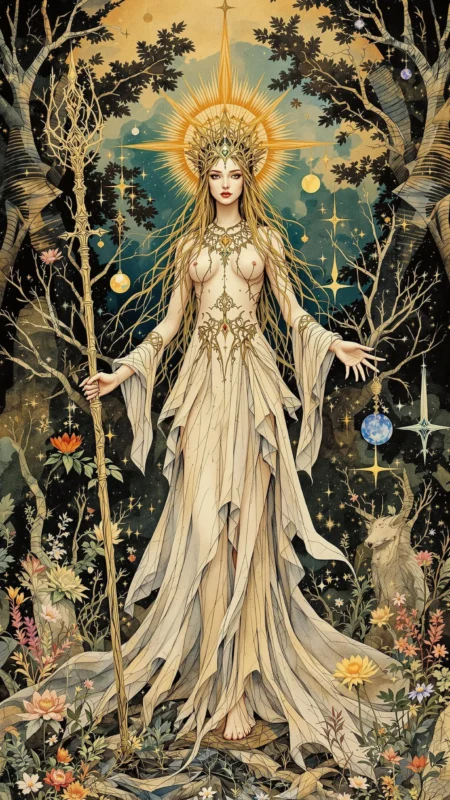
Brigid

Archetype Meaning & Symbolism

Fiery, Creative, Healing, Protective, Poetic, Forging, Maternal, Liminal, Demanding, Luminous

  • Bring me your rust, your silence, your wounds; we will make them sing. All creation is an act of careful burning, and the heart is the truest forge.

If Brigid is part of your personal mythology, you may...

Believe

  • You may believe that inspiration is a sacred duty, and to ignore it is a kind of spiritual negligence.

  • You may believe that everything, from a wound to a societal problem, is raw material for transformation.

  • You may believe that the most profound meaning in life is forged through the skilled labor of one's hands, heart, and mind.

Fear

  • You may fear the extinguishing of your inner fire through burnout, apathy, or despair.

  • You may fear that your well of creativity or healing will one day run dry, leaving you barren and without purpose.

  • You may fear that the fire you wield could be used for destruction, that you might forge a weapon instead of a tool, or that your words could inflict wounds rather than heal them.

Strength

  • Your strength may be a boundless and resilient creativity, allowing you to find innovative solutions and create beauty from unlikely materials.

  • Your strength may be a profound capacity for healing, both for yourself and for others, able to hold space for pain and facilitate restoration.

  • Your strength may be an unwavering sense of purpose and the self-discipline to master your chosen craft, leading to exceptional skill and competence.

Weakness

  • Your weakness may be a relentless perfectionism and a harsh inner critic that never allows you to be satisfied with your work.

  • Your weakness may be a tendency toward burnout, driving yourself and your 'fire' to the point of exhaustion in the service of your craft.

  • Your weakness may be a fiery impatience or intensity that can overwhelm others and strain relationships, especially with those who are more placid or passive.

The Symbolism & Meaning of Brigid

The modern resonance of Brigid is not confined to the pastoral landscapes of her origin; she lives now in the flicker of the cursor on a blank page, the sterile fire of a surgeon's laser, the focused heat of a protestor's righteous anger. She is the archetype of skilled transformation. Brigid represents the point of contact between raw potential and intentional craft. She is the alchemical force that believes no material is without possibility: silence can be woven into a poem, trauma can be forged into resilience, disparate individuals can be melded into a community. In your personal mythology, she may be the patron of your specific craft, the quiet whisper that insists the thing you make, mend, or nurture is a sacred act.

Her dominion over thresholds—dawn, dusk, the shoreline, the cusp of seasons—makes her a profound guide for a life of perpetual becoming. To have Brigid in your mythos is to feel at home in the liminal. You may find significance in the spaces between things: the pause between breaths, the moment before a decision is made, the transition from one life chapter to the next. These are not voids to be rushed through but her sacred territories, where the most potent magic resides. She teaches that transformation is not a single, dramatic event, but a constant, subtle state of being, like a candle flame that is never the same from one moment to the next.

Ultimately, Brigid symbolizes a fierce and intelligent hope. It is not a passive, waiting hope, but an active, hands-on, fire-in-the-belly conviction that what is broken can be mended, what is cold can be warmed, and what is fallow can be brought to life. She is the marriage of the heart and the hands, the belief that compassion without action is a sentiment, but compassion with skill can change the world. She is the patron of the midwife, the activist, the artist, the engineer, the healer: anyone who looks upon the raw stuff of the world and sees not what it is, but what it could become with the application of fire and will.


Brigid Relationships With Other Archetypes

The Forge

The relationship between Brigid and the Forge is perhaps less a partnership and more a state of being; she may not merely preside over the anvil and bellows, but be the very heat that makes transformation possible. The Forge is a crucible of becoming, a thunderous, percussive heart where the raw material of potential is subjected to unbearable pressure, only to emerge tempered and true. This is not a gentle coaxing, but the violent, alchemical marriage of will and fire. One might say the clang of the hammer is the sound of a poem finding its meter, or the sharp, clarifying pain that precedes a profound healing. The Forge, then, could be the physical manifestation of Brigid’s most demanding aspect: the part that understands that to create anything of worth—be it a sword, a self, or a society—one must first be willing to be broken down in the flames.

The Well

If the Forge is the searing exhalation of creative force, the Well is its cool, silent inhalation. Brigid’s connection to the Well suggests a necessary counterbalance, a descent into the quiet, dark, and uterine depths for every ascent into the bright fire of expression. A well is a portal, a liquid eye staring up from the earth, and its water may hold the reflection of what is, but also a distorted glimpse of what could be. This relationship is not one of opposition, but of tidal rhythm. It could be that inspiration, for Brigid, is not a lightning strike but something drawn up slowly, bucket by bucket, from a source far beneath the conscious mind. The Well is where the fever of making is soothed, where stories steep like tea leaves, and where healing begins not with a cauterizing flame, but with a single, clear, and life-giving sip.

The Swan

In the Swan, Brigid may find a creaturely echo of her own liminal grace. The swan exists effortlessly in three worlds—the water of the subconscious, the earth of the manifest, and the air of the spirit—and in its movement, one could see the seamless glide between the roles of healer, poet, and smith. Its elegance seems to belie a formidable strength, a fierce and sudden protectiveness that mirrors the protective fire of the mother or the artist defending their creation. The relationship, perhaps, is one of kinship, a mutual recognition between beings who bridge the worlds. The curve of the swan's neck might be the arch of a new idea reaching from the unseen, its sudden flight the moment of epiphany, and its placid presence on the water a reminder that the most profound power can also be the most serene.

Using Brigid in Every Day Life

Navigating Creative Stagnation

When the wellspring of ideas runs dry, one might invoke Brigid not by waiting for a lightning strike of inspiration, but by tending to the small, necessary fires. This could mean engaging in the mechanics of the craft without expectation: cleaning the brushes, organizing the code repository, re-reading the poets who first lit the way. It is an act of faith in the process, a belief that tending the hearth coaxes the flame back to life. You are not summoning a muse; you are readying the forge for her eventual return.

Healing from Relational Fractures

In the aftermath of conflict or heartbreak, the Brigid archetype offers the symbolism of the sacred well. The work is not to forget or to erase, but to cleanse. This may manifest as a period of deliberate solitude, journaling that feels like drawing water from a deep, internal source, or seeking the therapeutic counsel of one who can hold space for pain without judgment. The goal is to wash the wound, to see the story of it with clarity, and to allow the clear, cold water of truth to begin its slow, healing work.

Embarking on a New Path

When starting a new venture—a business, a family, a life in a new city—one might embody Brigid the Smith. This is the act of gathering raw materials: the research, the funds, the courage. It is the controlled, intense heat of focus and long hours. It is the percussive, repetitive work of hammering out the details, shaping the chaos of a new beginning into a viable, strong structure. Your personal mythos frames this not as a gamble, but as a deliberate act of forging a new reality from the ore of possibility.

Brigid is Known For

The Triple Flame

Brigid's mastery over three domains: the fire of the forge for smithcraft, the fire of inspiration for poetry, and the fire of the hearth for healing and nurturing. This trinity suggests a balance of the practical, the artistic, and the compassionate.

The Sacred Well

A symbol of a gateway to the otherworld, a source of profound healing and wisdom. The waters represent cleansing, intuition, and the deep, often hidden, currents of life that sustain and restore.

The Eve of Spring

Her festival, Imbolc, marks the first stirring of life after the deep of winter. She is the light in the dark, the promise of renewal, the patron of thresholds and new beginnings when the world is still cold but the light is returning.

How Brigid Might Affect Your Personal Mythology

How Brigid Might Affect Your Mythos

When Brigid claims a chapter in your personal mythos, your life story ceases to be a linear progression and becomes a series of alchemical cycles. Your narrative is no longer about just getting from A to B; it is about what you are forging along the way. Periods of depression or inactivity are not seen as failures but as necessary winters, the fallow time before the return of the light at Imbolc. Your greatest challenges are reframed as the unrefined ore that, when subjected to the intense heat of your focus and will, becomes the source of your greatest strength and most beautiful creations. Your story becomes a testament to the power of transformation.

Your personal myth may be marked by a defining 'Imbolc moment'—a point where, after a long darkness, a sudden spark of inspiration or a healing insight changed everything. You might see your life in terms of what you have 'smithed': the family you nurtured, the art you created, the community you built, the wounds you healed. The central tension in your story might be the struggle to keep the fire lit, to balance the three flames of craft, inspiration, and healing without letting one consume the others. You are the keeper of a sacred flame, and your myth is the record of how you tended it.

How Brigid Might Affect Your Sense of Self

With Brigid as an internal compass, you may perceive yourself not as a fixed entity but as a process, a perpetual work-in-progress at the forge. Your identity is tied to your capacity to create, to heal, and to inspire. This can foster a profound sense of competence and purpose. You might possess an inner knowing that you have the resources—the 'fire', the 'water', the 'metal'—to handle whatever life presents. There may be a quiet confidence, the assurance of a skilled artisan who trusts their hands and their tools.

This self-concept, however, could also carry a heavy burden. You may feel a relentless pressure to be productive, to be the healer, to be the source of light for others. A fallow period might trigger a crisis of identity: if you are not creating or mending, who are you? Your sense of self-worth might be inextricably linked to your output, making it difficult to simply rest or to receive care. You may see your own needs as secondary to the demands of the forge, risking a burnout that could extinguish the very flame that defines you.

How Brigid Might Affect Your Beliefs About The World

Your worldview might be one of profound potentiality. You see the world not as a set of immutable facts, but as a vast repository of raw material waiting for a transformative hand. A blighted cityscape is not an endpoint but a canvas; a societal injustice is not a permanent state but a flawed structure to be dismantled and reforged. This perspective breeds a kind of pragmatic optimism, a belief that problems exist to be worked upon, not surrendered to. You might be drawn to solutions that involve skill, craft, and the slow, deliberate application of wisdom.

This view could also foster a certain impatience with passivity or cynicism in others. You may struggle to understand those who accept the world as it is, who seem unwilling to pick up a tool and begin the work of change. Your world, animated by Brigid's fire, is a place of constant making and remaking. You may believe that meaning is not found, but forged. This can make the world feel like a place of infinite possibility, but also one of immense and urgent responsibility.

How Brigid Might Affect Your Relationships

In relationships, you may unconsciously assume the role of the hearth: the provider of warmth, light, and a central gathering point. People may be drawn to your creative energy and your capacity for deep, healing conversations. You likely value relationships that are generative, where both parties are engaged in their own 'craft' and can share in the process of building a shared life. Authenticity is paramount; you want to engage with the true person, the unvarnished metal, not a polished facade.

However, the intensity of the forge can be challenging for others. You might bring a craftsman's perfectionism to your relationships, subtly trying to 'fix' or 'improve' your loved ones. Your desire for depth can feel like an interrogation, and your fire, when uncontrolled, can manifest as a sharp tongue or a volatile temper. There can be a danger of making your relationships another project, another thing to be perfected at the forge, rather than a space of mutual, imperfect being.

How Brigid Might Affect Your Role in Life

You may feel a deep, intrinsic calling to a role of sacred craftsmanship. This is not limited to literal arts; you could feel it as a parent, a teacher, a community organizer, a coder, or a therapist. Your perceived role is active and generative: you are here to build, to mend, to teach, to protect, to illuminate. There is a sense of vocational purpose, a feeling that your work, whatever it is, is a form of service to the larger whole. You are the keeper of a specific flame, tasked with ensuring it is not extinguished.

This can lead to a powerful sense of meaning and direction in life. However, it may also create a rigid definition of your own purpose. You might struggle if circumstances force you into a role that does not feel creative or generative, feeling as though your true self is being stifled. There is also the risk of 'vocational shadow,' where the identity of 'The Healer' or 'The Artist' becomes so consuming that it eclipses all other aspects of your humanity, turning a sacred role into a gilded cage.

Dream Interpretation of Brigid

To dream of Brigid in a positive context is to dream of the forge in full, productive flame. You might see yourself effortlessly smithing a beautiful object, drawing pure, clear water from a well, or hearing a poem that brings tears to your eyes. Such dreams often signify an imminent breakthrough in a creative project, the beginning of a profound healing process, or the successful start of a new venture. The dream is an affirmation from the deep psyche that your inner resources are aligned and potent. It may feel like a blessing on your work, a sign that you are on the right path and the fires of inspiration, healing, and craft are well-tended.

In a negative context, a dream of Brigid can be one of frustration and impotence. The fire in the forge may be sputtering out, leaving you cold and in darkness. The metal on the anvil might refuse to take shape, shattering under your hammer. The sacred well could be choked with mud or debris, or you might find yourself mute, unable to speak a vital truth. These dreams often point to burnout, creative block, or a deep-seated fear that your gifts are failing you. They may be a warning that you are neglecting your own well-being, that your fire is consuming its fuel too quickly, or that an unaddressed wound is poisoning your creative wellspring.

How Brigid Archetype Might Affect Your Needs

How Brigid Might Affect Your Physiological Needs

Your approach to the body's needs may be viewed through the lens of tending a sacred vessel. The need for food, water, and rest is not a mundane chore but the essential act of providing fuel for the inner fire. You might gravitate towards whole foods, seeing them as pure material for the body's alchemy. Water could hold special significance, a physical manifestation of the healing well. The act of cooking may become a ritual: a small, daily act of creation at the hearth for the sake of sustaining the larger craft.

This sacred view can also lead to a disconnect when the body inevitably falters. Sickness or fatigue may be perceived as a personal failure, a sign that you have mismanaged your own forge. There could be a tendency to 'push through' illness or exhaustion, treating the body like a stubborn piece of metal that needs more hammering rather than a sensitive organism requiring rest. The challenge is to see rest not as the absence of fire, but as the necessary period of cooling and tempering that ultimately strengthens the blade.

How Brigid Might Affect Your Ideas of Belonging

Belonging, for you, is likely forged in a crucible of shared purpose or mutual creation. You find your tribe among other 'makers'—artists, thinkers, builders, and healers. Love and friendship may be expressed through acts of service and co-creation: collaborating on a project, offering healing counsel, or building a home and family together. You are the hearth fire that draws people in, and you feel you belong when you are tending that communal flame.

This can create incredibly strong, deep, and loyal bonds. Yet, it might also set the bar for entry into your life quite high. You may have little patience for superficial connections or for people who do not seem to share your intensity or sense of purpose. There's a risk of creating an exclusive guild rather than an open community, where belonging is conditional upon a person's 'usefulness' or creative output. True intimacy may require learning to love the person not just for what they make, but for who they are in their fallow, un-forged moments.

How Brigid Might Affect Your Feelings of Safety

A sense of safety may not come from external reassurances but from internal competence. Security is something you forge with your own hands. This could manifest as a focus on financial independence through your craft, creating a home that is a true sanctuary—a well-defended hearth—or cultivating a set of skills that ensures you are always needed and valuable. Safety is the result of your own labor and foresight. You build your own walls, and you keep your own fire.

This self-reliance, however, can curdle into a refusal to ask for help. The belief that you alone must forge your security can make you vulnerable in situations that truly require communal support. You might over-invest in one area of safety—like career skills—while neglecting others, like emotional support networks. The fortress you build to keep danger out can also become a prison, isolating you from the very community that could offer a different, more resilient kind of safety.

How Brigid Might Affect Your Views of Esteem

Your self-esteem is likely rooted in the tangible evidence of your craft. It is the quiet pride in a well-turned phrase, a mended relationship, a thriving garden, or a finished piece of work. This is esteem built on a foundation of competence, not on external praise. You are the primary judge of your own work, and your standards are high. When you meet them, the resulting sense of self-worth is solid and deeply personal, like the satisfying heft of a well-balanced tool.

This internal validation system is a source of great strength, but it is also a demanding master. A creative failure or a healing that does not take can deliver a devastating blow to your esteem. You may be prone to intense perfectionism, where the gap between your vision and your execution becomes a source of chronic self-criticism. The danger is tying your entire worth to your last success, leaving you in a precarious state of needing to constantly prove your competence to yourself.

Shadow of Brigid

The shadow of Brigid emerges when the sacred fire becomes an inferno. The smith becomes an arsonist. Instead of forging, she melts down. Instead of healing, she wields her knowledge of wounds to inflict precise and terrible pain. This is the artist consumed by envy who seeks to tear down the creations of others, the healer who manipulates the vulnerable, the community leader who uses their warmth to create a cult of personality. The fire of inspiration becomes the fever of fanaticism. The shadow is not the absence of Brigid's gifts, but their curdling into tools of control, destruction, and ego. It is the belief that because you hold the flame, you have the right to decide what is worthy of existence and what must be turned to ash.

Conversely, the shadow can also be the extinguished hearth. It is the smith who lets their forge go cold, their tools rust, their skills atrophy. This is a state of profound apathy, cynicism, and creative nihilism. It is the poet who scoffs at beauty, the healer who has lost all empathy. This shadow archetype actively rejects the call to create or to mend, choosing instead to reside in a cold, stagnant bitterness. It is a state of willed impotence, a deep depression that not only extinguishes one's own flame but also casts a chilling pall on the fires of those nearby, whispering that the effort is pointless and nothing new can ever be truly forged under the sun.

Pros & Cons of Brigid in Your Mythology

Pros

  • Having this archetype in your personal mythos provides a deep and abiding sense of purpose, rooted in the meaningful acts of creation and healing.

  • It fosters incredible resilience, as challenges are reframed as opportunities for transformation and the development of new skills.

  • It endows you with a powerful creative and generative energy that can be applied to any aspect of life, from career to relationships to personal growth.

Cons

  • There is a significant risk of burnout and workaholism, as the internal pressure to create, mend, and improve is relentless.

  • The intensity of the 'forge' can make you demanding and impatient in relationships, potentially alienating those who cannot match your fire.

  • Your self-worth can become perilously tied to your productivity and competence, leading to harsh self-judgment during fallow periods or creative blocks.