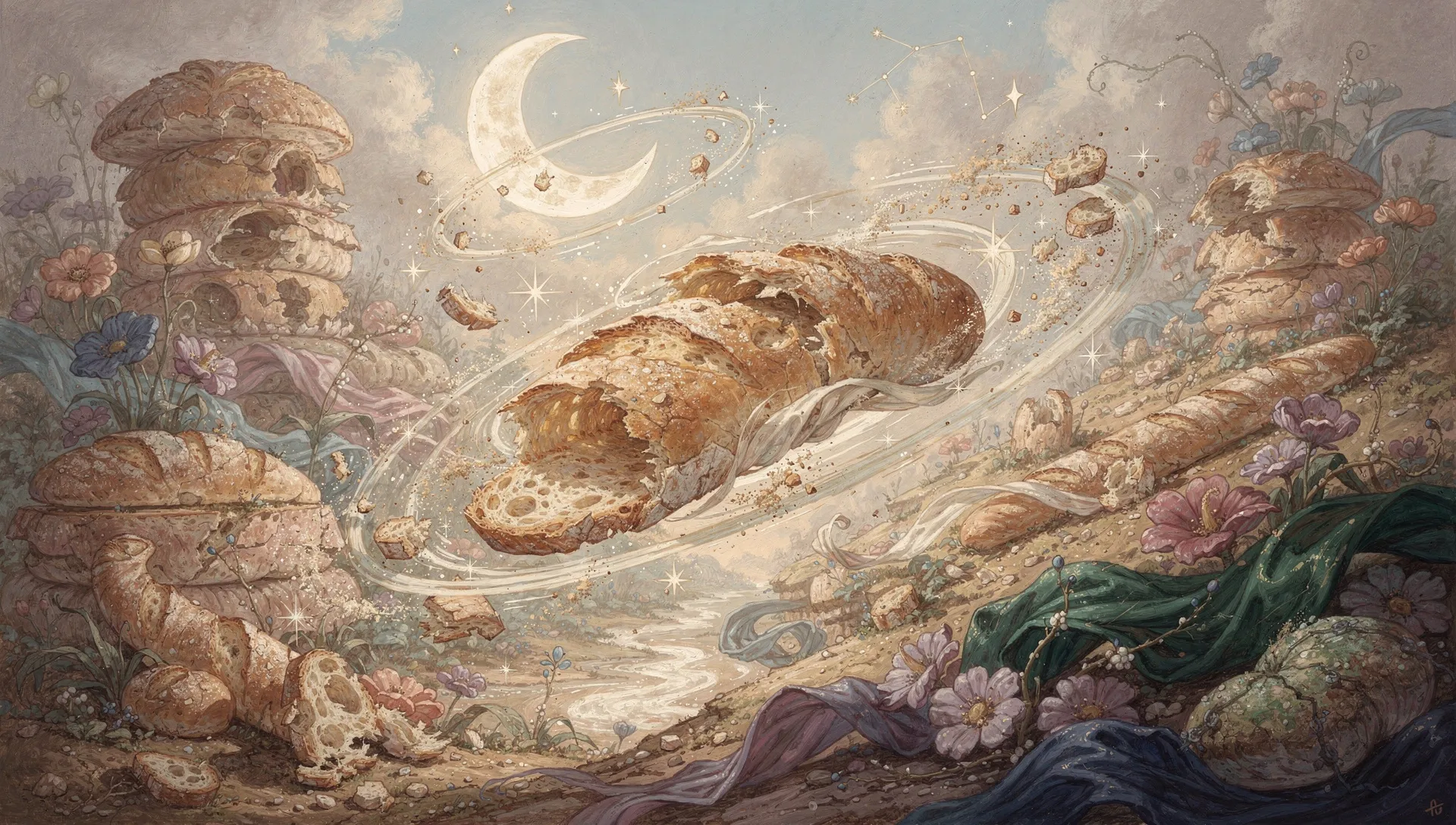


Bread Crust

Archetype Meaning & Symbolism

Protective, overlooked, resilient, tough, flavorful, peripheral, humble, structural, foundational, weathered

  • Do not discard the shell that held the softness; it absorbed the most heat and carries the memory of the fire.

If Bread Crust is part of your personal mythology, you may...

Believe

  • You may believe that hardship is not an obstacle to life, but the very ingredient that gives it substance and flavor.

    You may believe that a protective shell is not a sign of fear, but a testament to what has been successfully survived.

    You may believe that the most essential work is often the least visible, providing the silent structure that holds everything else together.

Fear

  • You may fear being seen as merely functional and disposable, the part that gets cut off and thrown away once its purpose is served.

    You may fear that your tough exterior has become so effective that it prevents anyone from seeing, or believing in, the softer person inside.

    You may fear becoming too brittle, that the next inevitable wave of heat will not toast you, but shatter you completely.

Strength

  • You possess a profound and reliable resilience, an ability to handle external pressures that would overwhelm or undo others.

    You are fiercely protective of those and that which you care about, providing a steadfast shield against the harshness of the world.

    You have a unique capacity to find value, beauty, and meaning in the weathered, overlooked, and hardened aspects of life.

Weakness

  • Your well-honed protective instincts can easily become an isolating fortress, keeping out potential connection as much as potential harm.

    You may habitually neglect your own softer, more vulnerable needs in the service of maintaining a tough and capable facade.

    Your exterior can be perceived by others as abrasive, hard, or unapproachable, leading to misunderstanding and loneliness.

The Symbolism & Meaning of Bread Crust

The Bread Crust archetype speaks to the beauty of the hardened exterior, the part of the self that is formed in direct response to the world’s transformative heat. It is a symbol of resilience, not as an innate quality, but as a developed one. The crust bears the marks of its trial by fire: its color, its texture, its very flavor are the results of that searing interaction. In a personal mythology, this could represent the persona, the protective but also flavorful boundary we present to the world. It is the record of our survival, a textured map of every challenge that has browned and crisped us into who we are.

This archetype is also a potent symbol for the peripheral and the overlooked. The crust is essential, yet it is often the first part to be discarded. A person whose mythos is informed by the Bread Crust may grapple with a sense of being the container rather than the contained, the protector rather than the protected, the structure rather than the star. Theirs is a quiet nobility, the strength that allows softness to exist. They may find profound meaning in this supportive role, or they may feel a quiet sorrow in being valued for their function over their essence.

Ultimately, the Bread Crust symbolizes the complex relationship between our interior and exterior selves. It is the necessary armor that allows our vulnerability to thrive. It can be hard, even bitter, but it is also where the deepest, most complex flavors reside. To embrace this archetype is to understand that our tough, weathered parts are not flaws to be hidden, but are, in fact, the source of our most interesting character and the very definition of our form.


Bread Crust Relationships With Other Archetypes

The Hearth:

The Hearth is the source of the transformative fire, the crucible in which the Bread Crust is born. The relationship is one of origin, of cause and profound effect. The Hearth represents the formative challenge: the difficult upbringing, the demanding career, the crucible of loss. For the Bread Crust, the Hearth is both creator and tormentor, the source of its strength and the memory of its trial. A person with this mythos may have a deeply ambivalent relationship with the institutions or people who “baked” them into being.

The Knife:

The Knife represents discernment, separation, and judgment. It is the force that decides the fate of the crust, whether it is to be honored as part of the whole or severed and discarded. This interaction might symbolize the sharp edge of social judgment, the piercing nature of self-criticism, or the painful but necessary act of cutting ties. For the Bread Crust, the Knife is a constant presence, a reminder that its worth and belonging are perpetually subject to the decisions of others, or even of oneself.

The Soft Interior:

The Bread Crust exists in a symbiotic, codependent relationship with its opposite, the soft and yielding crumb. It is the guardian of vulnerability. A person aligned with the Bread Crust archetype may feel an immense, almost fierce, drive to protect a tender, private inner self, or to shield the softer people in their lives. The two are inseparable, each giving the other meaning. The hardness of the crust has purpose only because of the softness it contains, a dynamic that can define one's most intimate relationships.

Using Bread Crust in Every Day Life

Facing Criticism:

When confronted with harsh judgment or unkind words, you may invoke the Bread Crust. Visualize the words as heat, not something that penetrates, but something that toasts the exterior, adding color and complexity to your character. The protective shell allows your tender core of self-worth to remain untouched, while the outer you develops a more resilient, interesting texture. You learn to let criticism inform your shape without compromising your substance.

Valuing Unseen Labor:

If your contributions feel peripheral or unappreciated, this archetype offers a new perspective. The crust is essential for the bread’s form and its very existence, yet diners often focus on the soft interior. You can reframe your mythos: you are the structure that makes everything else possible. Your role is not one of celebrated glory, but of foundational strength, the unsung container of collective success.

Navigating Hardship:

The Bread Crust sees adversity not as a flaw in the universe, but as a necessary element of creation. When facing a trial, you might see it as the kiln’s fire. This heat is not meant to destroy you, but to transform you from something doughy and undefined into something with character, resilience, and a rich, complex flavor. The hardship is the very process that creates your most durable and interesting qualities.

Bread Crust is Known For

The Maillard Reaction

A complex chemical transformation under heat, it is the alchemical process that turns simple dough into a flavorful, browned, and aromatic crust, symbolizing a character deepened by experience.

Protective Shell:

Its primary function is to shield the soft, vulnerable interior from the direct, harsh heat of the oven, allowing it to cook through without burning. This represents a capacity for shielding the self or others.

Being Discarded:

It is famously, almost ritually, cut off and left on the side of the plate, a symbol for feeling peripheral, unappreciated, or valued only for its temporary utility.

How Bread Crust Might Affect Your Personal Mythology

How Bread Crust Might Affect Your Mythos

If the Bread Crust is part of your personal mythology, your life story may be one of celebrated resilience. You narrate your journey not by what you were born with, but by what you have become through exposure to life’s kiln. Your scars, your tough spots, your weathered exterior are not flaws in your story; they are the plot. Your mythos is one of transformation, where character is not an innate essence but is literally baked into you by experience, giving you a flavor and complexity others may lack.

Your personal narrative may also revolve around being the “necessary husk.” You might see your life as a chronicle of providing structure and safety for a precious idea, a vulnerable person, or a fragile community. Your story might be less about personal glory and more about your vital, often unsung, function. This is the mythos of the quiet guardian, the one whose strength is the precondition for another's flourishing, finding a profound, albeit lonely, purpose in this role.

How Bread Crust Might Affect Your Sense of Self

You may perceive yourself as fundamentally tough, a survivor whose identity is fused with the barriers you've built. This self-image could be a source of immense pride, a quiet acknowledgment of all you have weathered. You might see your guarded nature not as a pathology but as a sensible, hard-won adaptation to a harsh world. Your roughness is not an accident; it is a craft, a carefully maintained shield that you trust more than anything else.

Conversely, you may struggle with a persistent feeling of being the “throwaway” part of a greater whole. This could manifest as a deep-seated fear that your true self is the tough, functional exterior, and that there is nothing of value underneath. You might over-identify with your protective role to the point that you lose touch with the very vulnerability you are protecting, leaving you feeling hollow, hard, and lonely within your own fortress.

How Bread Crust Might Affect Your Beliefs About The World

Your worldview could be predicated on the belief that adversity is the primary agent of character development. You may look out at the world and see it not as a garden but as a great oven: a place of intense, transformative pressure that reveals the true substance of people, ideas, and nations. You may grant respect only to that which has endured, that which shows the beautiful imperfections of having been through the fire.

This archetype may foster a deep suspicion of things that appear too soft, too easy, or too polished. You might operate from a core belief that anything of genuine value must possess a protective layer, a bit of flavorful bitterness. This can lead to a worldview that is profoundly practical, perhaps bordering on cynical, as you are always probing for structural integrity, for the crust that proves something is real and has survived contact with the world.

How Bread Crust Might Affect Your Relationships

In relationships, you may reflexively adopt the role of the protector, the one who absorbs the initial impact and takes the heat for others. You might find yourself drawn to people you perceive as “softer” or more vulnerable, feeling a deep, instinctual need to act as their shield. This can forge bonds of incredible loyalty and devotion, but it also carries the risk of creating an unbalanced dynamic, where you are the permanent shell and they are the permanent, precious interior.

True intimacy may be a significant challenge. The crust is, by its nature, a barrier, and you may equate vulnerability with total annihilation. Letting someone in is not just an emotional risk; it feels like a structural one. A breakthrough in relationships might not look like softness, but like the rare, profound moment when you allow someone to appreciate both the crust and the crumb together, to value your strength and your tenderness not as separate entities, but as an integrated, delicious whole.

How Bread Crust Might Affect Your Role in Life

You may gravitate toward roles that function as a buffer or a shield in a system. This could be the stoic project manager who protects their team from executive whims, the unflappable public relations officer handling a crisis, or the family member who quietly absorbs all the emotional turbulence. Your perceived role is often structural and protective, providing the durable framework within which others can do their more delicate work, safe from the harshest elements.

This can also manifest as a comfort with being the “first draft” or the “first line of defense.” You may be the person who handles the initial cold call, the difficult client, the first round of brutal feedback on a project. You understand that your role is to take the initial, often messy, impact so that the final product can be more refined. You may not always be present for the final celebration, but you find a quiet satisfaction in knowing that the success was built upon the foundation of your initial resilience.

Dream Interpretation of Bread Crust

In a positive context, to dream of a perfect, golden-brown bread crust may symbolize a healthy integration of your own resilience and boundaries. Eating and savoring the crust could suggest that you are learning to love and appreciate the parts of yourself that were hardened by experience, seeing them not as scars but as sources of flavor and strength. The dream might signify a period of feeling secure, well-protected, and confident in your ability to meet the world.

In a negative light, dreaming of a burnt, cracked, or discarded bread crust could reflect deep-seated fears of being brittle, broken, or disposable. A burnt crust may indicate that your defenses have become too rigid, making you bitter and isolated. Seeing a crust being cut off and thrown away could tap into anxieties about being unappreciated or abandoned by those you seek to protect. Such a dream may be a prompt from the subconscious to examine whether your protective shell has become a prison.

How Bread Crust Archetype Might Affect Your Needs

How Bread Crust Might Affect Your Physiological Needs

From a mythological perspective, the Bread Crust archetype ties your physiological needs to the concept of earning and endurance. Sustenance is not a given; it is the end result of a process of trial and transformation. You might operate under a deep-seated belief that to deserve rest, food, or comfort, you must first withstand a certain amount of heat or pressure. This can create a life rhythm where periods of intense effort are seen as the necessary payment for periods of basic replenishment.

This mythos can manifest as a physiological hyper-vigilance around resources. Just as the crust prevents the precious moisture from escaping the loaf, you may feel a primal urge to conserve your own energy, finances, and material comforts. This is not mere thriftiness; it is a bodily felt need to maintain a hardened boundary against a world of potential scarcity. This can result in a baseline level of tension, a body perpetually braced for the heat to be turned up.

How Bread Crust Might Affect Your Ideas of Belonging

Belonging can be a complex and often painful paradox within this archetype. On one hand, the crust is inextricably part of the loaf; it defines the loaf’s very shape. You may find your place within a group by being its protector, its container, or its anchor. You belong because your strength and structure are essential to the group's coherence. Your role, though on the edge, is what allows the community’s soft heart to beat safely.

On the other hand, the crust is, by its very nature, texturally and chemically different from the interior. This can foster a persistent feeling of being *with* a group but never truly *of* it. You may witness the easy, soft bonding of others from a place of loving, lonely separation. This can lead to a quiet, persistent fear of being “cut off,” the ultimate confirmation of your otherness. You may belong by function, but you may constantly question if you belong in essence.

How Bread Crust Might Affect Your Feelings of Safety

Your need for safety is synonymous with the integrity of your personal boundaries. The Bread Crust is the archetypal shield, and you may feel safe only when your emotional, psychic, and physical perimeters are well-defined and unbreached. For you, safety is not a passive state of being but an active, ongoing construction. It is a wall built brick by brick from experience, designed to keep the unpredictable chaos of the world from touching the soft, vital core of your being.

A threat to your safety is therefore perceived as anything that could crack this meticulously built exterior. This might not be a physical threat, but rather the psychic danger of unsolicited intimacy, invasive questions, or criticism that finds a fissure in your defenses. Your quest for safety may become a lifelong project of testing, reinforcing, and sometimes repairing the crust that makes you feel whole and protected from a world you perceive as fundamentally hazardous.

How Bread Crust Might Affect Your Views of Esteem

Your self-esteem may be deeply rooted in your resilience and your capacity to endure. You respect yourself for the pressures you have withstood, for the heat you have taken. Your self-worth is not based on innate purity or talent, but on the hard-won character etched into your surface. You might admire your own tough, complex “flavor,” seeing it as the honorable mark of a life fully engaged with, and not hidden from, its challenges.

However, this basis for esteem can be precarious, especially if it becomes dependent on your protective function being recognized by others. If your strength is taken for granted, or if you are indeed cast aside after serving your purpose, it can trigger a devastating crisis of worth. You may then be forced to confront the shadow belief that your hardened exterior, the very thing you cultivated for survival, is also what makes you fundamentally unlovable or disposable.

Shadow of Bread Crust

The shadow of the Bread Crust archetype manifests as a fortress that has become a tomb. When this aspect takes over, the protective shell becomes impenetrably rigid, brittle, and burnt. The individual may grow relentlessly cynical, viewing all forms of softness in themselves or others as pathetic weaknesses to be scorned. They reject vulnerability entirely, and in doing so, they starve the tender interior that the crust was originally meant to protect. This shadow crust is bitter and isolating, pushing away any chance of warmth or genuine connection. It takes a perverse pride in its own hardness, failing to recognize that it has become inedible, a lifeless husk that can no longer receive or give nourishment.

Conversely, the shadow can appear as a complete and utter lack of a crust. This is the person who is all soft interior, with no boundaries, no resilience, and no capacity to withstand the ambient heat of life. They are doughy and undefined, easily misshapen or destroyed by the slightest pressure or criticism. Fearing the transformative fire, they may seek to have others be their crust, becoming emotionally parasitic and codependent. This shadow aspect is marked by a refusal to develop character through challenge, remaining forever unbaked, formless, and painfully vulnerable to the world.

Pros & Cons of Bread Crust in Your Mythology

Pros

  • You are exceptionally resilient and can be a source of incredible stability and strength in any crisis.

    You provide a profound sense of safety and security for the people you choose to let inside your perimeter.

    Your life experience has given you a unique appreciation for the beauty and character forged by adversity.

Cons

  • You risk being consistently misunderstood or taken for granted, valued for your function rather than your self.

    Your protective nature can curdle into emotional unavailability, making true intimacy a significant challenge.

    You may feel perpetually on the outside of things, fundamentally different from the “softer” people you love and protect.