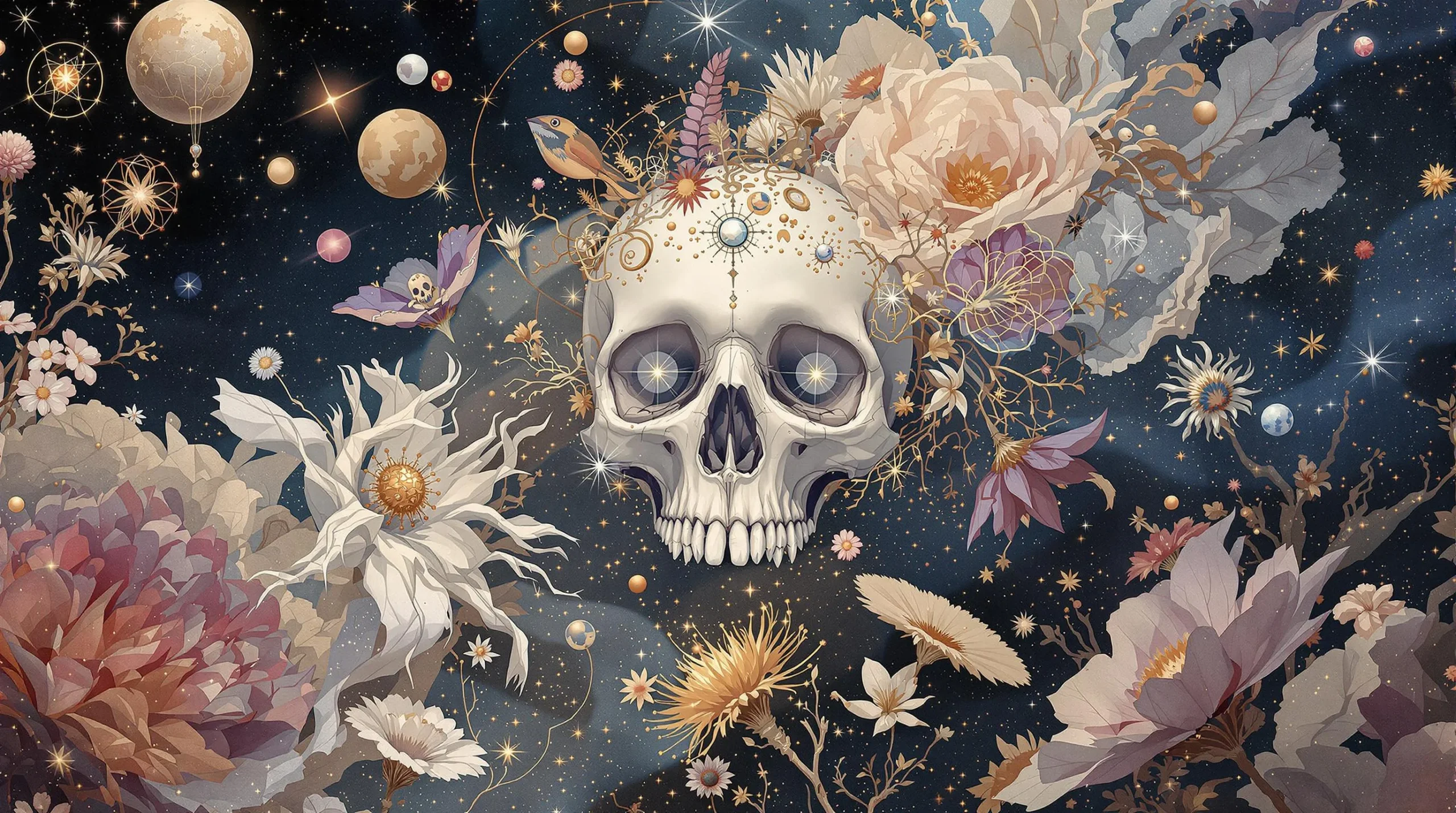


Bone

Archetype Meaning & Symbolism

Structural, Enduring, Essential, Ancestral, Unadorned, Stark, Resilient, Inflexible, Truth, Mortal

  • I am the last, unarguable fact. The framework on which your fleeting story is hung.

If Bone is part of your personal mythology, you may...

Believe

  • You may believe that truth is the highest, and perhaps only, real virtue, and that it must be faced, no matter how stark or uncomfortable.

  • You may believe that what is built to last is inherently more valuable than what is beautiful, popular, or entertaining for a moment.

  • You may believe that your identity is inextricably linked to your lineage, and that the story of your ancestors is a living part of your own architecture.

Fear

  • You may fear dissolution and formlessness, the idea that there is no solid core to the self or to reality, that everything is merely shifting sand.

  • You may fear corruption and decay, not of the body, but of principles, watching as the foundational truths of your world are eroded by convenience or sentimentality.

  • You may fear being fundamentally broken, a structural shatter from which there is no recovery, rendering your entire framework useless.

Strength

  • Your strength is an unshakeable resilience, an ability to weather crisis by holding fast to your essential core when all else is stripped away.

  • Your strength is clarity of thought, an almost X-ray vision that allows you to see the underlying structure of arguments, systems, and situations.

  • Your strength is a profound sense of self-possession, an inner authority that comes from being deeply rooted in your own history and principles.

Weakness

  • Your weakness may be a profound rigidity, an inability to adapt to new information or changing environments that can lead to being left behind or shattered by unforeseen pressures.

  • Your weakness could be a perceived coldness or harshness, a tendency to present the bare truth without the flesh of compassion, which can alienate and wound others.

  • Your weakness may be a slide into pessimism, a habit of seeing only the skull beneath the skin, which robs you of the joy and beauty found in life’s ephemeral moments.

The Symbolism & Meaning of Bone

In the personal mythos, the Bone archetype represents the essential, the unadorned, the truth that persists beneath the skin of things. To have Bone as a guide is to be drawn to the core of any matter, to seek the foundational principles of a life, a relationship, or a belief system. It is an archetype of profound integrity, suggesting a life built not on shifting sands of opinion or emotion, but on a solid, internal framework of what is known to be true. It whispers that substance is more valuable than show, that the strength you cannot see is more potent than the muscle that flexes for an audience. It symbolizes a comfort with stark realities, including the ultimate reality of mortality, seeing it not as an end, but as the final stripping away of all that is not essential.

Bone speaks, too, of resilience. Not the resilience of bending like a reed in the wind, but of enduring. It is the strength of the coral reef built from the skeletons of a billion tiny lives, creating a world. Your mythology may be one of weathering storms, of being reduced by struggle, yet finding that your core structure remains, perhaps even polished and made more visible by the hardship. It is an intimacy with deep time, a sense that your personal story rests upon the much older story of your ancestors, whose literal bones form the bedrock of your existence. This archetype connects you to a strength that is impersonal, ancient, and mineral.

This archetype also carries the weight of what is unchangeable. Bone is the map of your inherited possibilities and limitations. It can symbolize the rigid structures in your life: the unshakeable beliefs, the family dynamics set in stone, the personal dogmas that provide support but also prevent movement. To engage with the Bone archetype is to ask what parts of your life are this foundational frame. Which parts are supporting you, and which are caging you? It is a call to understand your own architecture, to honor its strength while recognizing where its inflexibility may be a liability.


Bone Relationships With Other Archetypes

The Flesh Archetype:

The relationship between Bone and Flesh is the primal dialogue between the permanent and the ephemeral. Flesh is the vibrant, responsive, feeling layer of experience: it is joy, pain, blush, and decay. Bone is the silent, enduring structure beneath. A personal mythos strong in Bone may see Flesh as fleeting, untrustworthy, or merely decorative. Conversely, one dominated by Flesh may find Bone to be rigid, cold, and unfeeling. A healthy integration means understanding that Flesh gives Bone a reason to stand, and Bone gives Flesh a form to inhabit. It is the tension between the unyielding truth and the lived, messy, beautiful reality.

The Earth Archetype:

Bone and Earth share a relationship of origin and return. Bone is mineral drawn from the Earth, structured into life, and destined to crumble back into soil. For a person, this may symbolize a deep, grounding connection to place, to land, to the very substance of the world. Safety and belonging might be felt most profoundly in nature, walking on the ground that is, in essence, the dust of ancient bones. This connection suggests a worldview where life is a temporary loan from the Earth, and one’s body is a sacred vessel to be returned, a story to be absorbed back into the greater planetary narrative.

The Storyteller Archetype:

The Storyteller spins yarns, weaves illusions, and clothes reality in compelling narrative. Bone, in contrast, is the stark fact that precedes the story. Their relationship is one of tension and necessity. The Storyteller may fear Bone, for a single fact can undo the most beautiful tale. Yet, the greatest storytellers know they need a solid skeleton of truth on which to hang their narrative tapestry. In a personal mythos, this relationship might play out as a conflict between your desire to create a romantic, heroic version of your life and the unyielding facts of your history and limitations. Bone challenges the Storyteller to build tales that are not just beautiful, but also true.

Using Bone in Every Day Life

Navigating a Creative Impasse:

When a project becomes overwrought, a tangle of decoration and doubt, the Bone archetype invites you to excavate. It asks: what is the skeleton of this idea? You may be called to strip away the adjectives, the subplots, the flourish, until only the essential, load-bearing structure remains. This is not about destruction but clarification. By finding the project’s bones, you find the one true thing it is trying to say, the form from which all meaningful growth can proceed.

Processing Grief:

In the disorienting landscape of loss, the Bone archetype offers a stark kind of solace. It does not offer warmth, but permanence. It is the recognition of what the relationship was built upon: the core memories, the fundamental lessons, the structural changes a person made to your very being. These are the bones of love that remain in the earth of your psyche. Contemplating them is a way of honoring the indelible, of understanding that what was essential cannot truly be lost, only changed in its form.

Establishing Personal Boundaries:

The Bone archetype can be a powerful tool for defining your non-negotiables. It is the practice of identifying your deepest principles, the very framework of your integrity. When faced with a request that feels compromising, you might ask, “Does this threaten my structure? Does this ask my bones to bend in a way they cannot?” This creates boundaries that are not emotional reactions but architectural facts of the self. They are not walls to keep others out, but the very frame that keeps you standing.

Bone is Known For

Structure

It is the internal scaffolding of being. Bone provides the form, the support, the architecture against which the soft tissues of life play out their dramas. It is the silent, unseen framework that allows for movement and integrity.

Permanence:

Long after the heart has ceased its beating and the mind its chatter, the bone endures. It is the physical record, the last testament. It speaks to geologists and archaeologists, a mineral memory of a life lived, awaiting rediscovery.

Ancestry:

Bone is the unbroken thread of lineage, a physical library of heredity passed down through millennia. To contemplate one's own skeleton is to hold a relic connecting you directly to the first creatures that chose to stand, to walk, to build.

How Bone Might Affect Your Personal Mythology

How Bone Might Affect Your Mythos

When Bone becomes a central pillar of your personal mythos, your life story may be framed not by its dramatic events, but by what endures them. The narrative is less about the fire and more about the foundation that remained after the blaze. Your myth is one of resilience, integrity, and essentialism. You might define your chapters by the principles you discovered or solidified, rather than the relationships or careers that came and went. The defining moments are those of stripping away: the moment you realized a core truth, the moment you shed a false identity, the moment you were reduced to your very essence and found it to be enough.

This narrative arc resists sentimentality. It may be a starker, quieter story, one that finds heroism in consistency and endurance rather than in flashy victories. Your personal mythology might be populated by ancestors, their struggles and strengths seen as the foundational bedrock upon which your own structure is built. You are a continuation of a long, unbroken line, and your purpose may be to uphold that structure, to pass on its strength. The climax of your story might not be achieving a goal, but in becoming, immovably and authentically, yourself.

How Bone Might Affect Your Sense of Self

Your sense of self, if informed by Bone, is likely rooted in something deep and unshakeable. Self-worth may not be tethered to praise, appearance, or achievement, but to a quiet, internal knowledge of your own integrity. You know your own framework. This can grant a profound sense of inner security and independence. You are who you are at your core, and that core is solid. You may feel older than your years, possessed of a stoicism that sees through the fleeting dramas of the social world.

However, this can also lead to a self-concept that is rigid or brittle. If your identity is fused with your principles, you may struggle to adapt or change your mind, seeing it as a structural failure. There could be a coolness to your self-perception, a difficulty in connecting with the softer, messier, more emotional aspects of your being—the Flesh. You might judge your own emotional responses as superficial, failing to see them as vital signals from the living part of your experience. The challenge is to see your bones as a living, adaptable framework, not a static, lifeless monument.

How Bone Might Affect Your Beliefs About The World

A world view shaped by the Bone archetype is one that constantly seeks the underlying structure. You may look at a political argument and instinctively search for the foundational premises, the skeleton of the logic, ignoring the rhetorical flourishes. You see institutions, companies, and social movements in terms of their core principles and structural integrity. This can make you an astute analyst, able to predict which structures will last and which will crumble under pressure. The world may appear as a vast, interconnected architecture of truths, some hidden, some exposed.

This perspective can also veer into cynicism. In seeing the skeleton of all things, you might miss the life that animates them. You may see the inevitability of decay in every beautiful thing, the skull beneath the skin of every smiling face. The world can seem stark, governed by harsh, unfeeling laws of cause and effect. There's a risk of developing a materialist or deterministic outlook that dismisses the unquantifiable aspects of existence: spirit, spontaneous joy, mystery. The challenge is to hold the awareness of the bone without letting it bleach all the color from your perception of the world.

How Bone Might Affect Your Relationships

In relationships, the Bone archetype compels you to seek structural compatibility. You are likely uninterested in superficial attractions or fleeting romances. Instead, you search for a connection that is, for lack of a better word, skeletal. Do you share the same fundamental principles? Is there a bedrock of shared values upon which a life can be built? Friendships and partnerships may be few, but they are deep and built to last. You are the friend who provides unvarnished truth, the partner who offers unwavering support, the solid framework against which others can lean in a crisis.

This need for structural integrity can make you seem cold, demanding, or slow to commit. You may test potential partners and friends, consciously or not, to see if their framework is sound. You could struggle with partners who are more fluid, emotionally expressive, or spontaneous, mistaking their flexibility for a lack of substance. Intimacy for you may be less about shared vulnerability and more about the profound recognition of seeing another’s core structure and finding it resonant with your own. It is the quiet comfort of knowing someone’s bones.

How Bone Might Affect Your Role in Life

Your perceived role in any group—family, work, community—is likely that of the foundation. You may be the person who remembers the family history, who upholds the mission statement of the company, who reminds the community of its founding principles. You provide the structure, the stability, the invisible support that allows others to be more creative, expressive, or daring. Your contribution is often essential but not always visible, and you may be comfortable with that lack of recognition, knowing the importance of your role.

This can also mean you are cast as the rigid traditionalist, the one who resists change, the enforcer of rules. You may struggle to innovate, preferring the proven strength of the old ways. People may come to you for stability but not for inspiration. There is a risk of becoming the skeleton in the closet, the embodiment of a past that the group is trying to move beyond. Your task is to learn how to allow the structure you provide to evolve, to be a living framework that can support new kinds of growth, rather than a cage that confines it.

Dream Interpretation of Bone

In a positive context, dreaming of bones—especially clean, whole, or well-arranged skeletons—can symbolize a powerful connection to your own core strength and integrity. It may suggest you are successfully stripping away illusion and getting to the heart of a matter in your waking life. Finding a fossil or an ancient bone could represent the discovery of a deep, ancestral strength or a forgotten, foundational truth about yourself. Building something with bones in a dream might indicate that you are laying a solid and enduring foundation for a new phase of life, a project, or a relationship.

Conversely, dreaming of broken, scattered, or diseased bones often points to a compromised foundation in your life. It could reflect a fear that your core principles are being shattered, that your integrity is under attack, or that a fundamental structure in your life—your career, your family, your health—is failing. Being pursued by a skeleton could symbolize being haunted by an unchangeable past or a fear of mortality. Gnawed or chewed bones might suggest you feel something is picking you apart, draining you of your essential strength and leaving you depleted.

How Bone Archetype Might Affect Your Needs

How Bone Might Affect Your Physiological Needs

From the standpoint of personal mythology, the Bone archetype connects your physiological needs directly to the concept of structure and essence. You may feel a deep, intrinsic need for foods that build the literal bones: calcium-rich greens, minerals, and broths. There is a rejection of the artificial, a craving for what is substantive and foundational. This extends beyond diet. Your body might crave the structural integrity of good posture, the grounding force of standing on solid earth, the deep rest that allows the frame to knit itself back together.

Beyond the literal, this archetype fosters a need for an environment that is pure and unadulterated. You might be sensitive to metaphorical “toxins” in your life: draining conversations, cluttered spaces, or meaningless obligations. These things are not just unpleasant; they feel like they are compromising your very framework, leaching your essential vitality. Your physiological well-being is tied to a life stripped of filler, leaving only that which provides true, foundational nourishment for body and spirit.

How Bone Might Affect Your Ideas of Belonging

The need for belonging, when filtered through the Bone archetype, is a search for a tribe with a shared skeleton. It is not about finding people you like, but about finding your people, those with whom you share a bone-deep connection. This belonging is often rooted in ancestry and heritage: the family, the clan, the people who share your history. It can also be found in schools of thought or disciplines that share a foundational set of principles. You belong where the core truths are held in common.

This can make finding a sense of belonging a slow and deliberate process. You may feel like an outsider in more casual, fluid social groups, unable to connect on a purely emotional or circumstantial level. There is a longing for a bond that is structural, one that would remain even if all superficialities were stripped away. The pain of loneliness, for you, may be the feeling of being the only one of its kind, a unique skeleton with no matching parts. True belonging is the profound, quiet resonance of finding a structure that mirrors your own.

How Bone Might Affect Your Feelings of Safety

Safety, for one guided by the Bone archetype, is synonymous with structure. You feel most secure when life is built on a solid foundation. This manifests as a need for clear rules, reliable systems, and predictable outcomes. Your sense of safety may be deeply connected to physical structures: a house with good “bones,” a secure shelter, a city with a logical layout. You find comfort in the unshakeable and the permanent. This extends to financial security, where a well-structured plan, a solid investment, provides a feeling of safety that liquid cash cannot.

The corresponding fear is one of structural collapse. Earthquakes, both literal and metaphorical, are terrifying. The idea of betrayal strikes at the very foundation of trust. Chaos, formlessness, and radical uncertainty are not just stressful; they represent a fundamental threat to your being. Your safety depends on the belief that the floor will hold, that the rules will be followed, and that the core principles of your world are sound. When that is shaken, your entire world feels unsafe.

How Bone Might Affect Your Views of Esteem

Esteem is built not from external accolades but from an internal sense of structural integrity. Your self-worth is directly tied to your ability to live in alignment with your core principles. You respect yourself when you are unshakeable, when you stand for something, when you refuse to bend on what is essential. This creates a powerful, self-referential esteem that is not dependent on the whims of others. It is the pride of the ancient oak, rooted deep in the earth, its strength a quiet, undeniable fact.

However, this can also be a brittle source of esteem. If you are forced to compromise, or if you make a mistake that violates one of your core tenets, it can feel like a catastrophic structural failure. You may judge yourself harshly, feeling that your entire being has been compromised. The challenge is to cultivate an esteem that allows for the living nature of bone, which can break and then heal stronger. It is the ability to maintain integrity not through perfect rigidity, but through the resilient process of damage, healing, and continued growth.

Shadow of Bone

When the Bone archetype falls into shadow, its strength becomes its poison. The love for structure calcifies into oppressive, absolute dogma. This is the shadow of the inquisitor, who loves the purity of the rulebook more than the people it governs. It is the unbending patriarch whose traditions choke the life out of his family. Truth is no longer a tool for liberation but a cudgel, used to strip others bare, to expose their flaws with surgical cruelty, devoid of compassion. The shadow Bone has no marrow, no life-giving core: it is just dead, sterile mineral, a monument to its own rightness.

The other face of the shadow is a morbid obsession with decay. A healthy connection to Bone is a sober acceptance of mortality; the shadow is a fearful, constant dwelling on it. It becomes a nihilistic worldview where all is pointless because all eventually turns to dust. This can lead to a paralysis, a refusal to build or love or create because “what’s the use?” It is the brittleness of osteoporosis, a structure that looks solid but is internally weak, ready to shatter at the slightest impact. The shadow Bone is the skeleton in the closet, the unacknowledged truth that poisons the whole household from within.

Pros & Cons of Bone in Your Mythology

Pros

  • You possess an internal compass of integrity that is reliable in times of chaos, providing you and others with a stable point of reference.

  • You build things to last, whether they are relationships, belief systems, or creative works, investing in what is foundational and enduring.

  • Your clear-sightedness makes you difficult to deceive, as you are not easily swayed by emotional manipulation, trends, or superficial rhetoric.

Cons

  • Your preference for structure can make you resistant to change, spontaneity, and improvisation, causing you to miss opportunities that require flexibility.

  • You may be perceived by others as cold, overly critical, or dogmatic, making it difficult to form connections with those who prioritize warmth and emotional expression.

  • Your focus on the essential and the permanent can lead you to devalue the ephemeral, robbing you of the simple joys and transient beauties of everyday life.