The Fawn
The Boa’s relationship with The Fawn may not be one of simple malice, but rather of a profound, all-consuming devotion. It is, perhaps, the inevitable and terrifying gravity that raw, primal power exerts upon a certain kind of sun-dappled innocence. The Fawn exists in a world of fleeting moments and delicate steps, a life that the Boa, in its patient, ancient wisdom, could perceive as tragically incomplete. The final embrace is not merely an act of predation; it could be seen as a form of transfiguration, a sacrament where the Fawn’s fragile beauty is not extinguished but absorbed, integrated into a longer, slower, and more enduring consciousness. In this way, the Boa doesn't just end The Fawn; it preserves it, carrying its memory within the deep, dark, and dreamless cathedral of its own body.
The Uncut Jungle
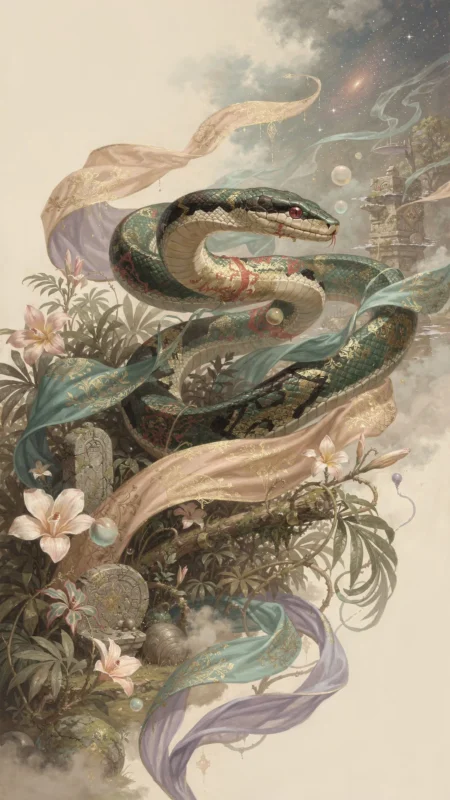
One might say the Boa does not so much live in the Jungle as it is the Jungle’s own musculature, its slow, deliberate digestive system given animate form. It is a symbiotic relationship of perfect, amoral harmony. The Jungle provides the suffocating humidity and the latticework of shadow that serves as the Boa’s cloak and temperament, while the Boa enacts the Jungle’s most fundamental law: that all things are eventually consumed and transformed. To feel the humid press of the air, to see the way the light is strangled by the canopy—this is to feel the latent presence of the Boa. It is the quiet, watchful intelligence of the environment itself, a silent, coiled promise that here, in the heart of the world, nothing truly escapes; it only changes shape.
The Glass Enclosure
Placed within the Glass Enclosure, the Boa becomes a portrait of immense, thwarted potential. The relationship here is one of constant, quiet tension between a primal force and the fragile artifice of its containment. The coil of its body, a universe of power held in check, may represent any great and terrible passion—of the artist, the lover, the revolutionary—that has been named, categorized, and made safe for observation. Its slow, rhythmic pulse against the transparent wall could be a reminder that such containment is always provisional. The Glass Enclosure allows us to witness the sublime without being consumed by it, yet the Boa’s patient gaze suggests it understands, better than we do, that glass is only a temporary idea, and that the wild, magnificent force it holds is eternal.

 Believe
 Fear
Fear Strength
 Weakness