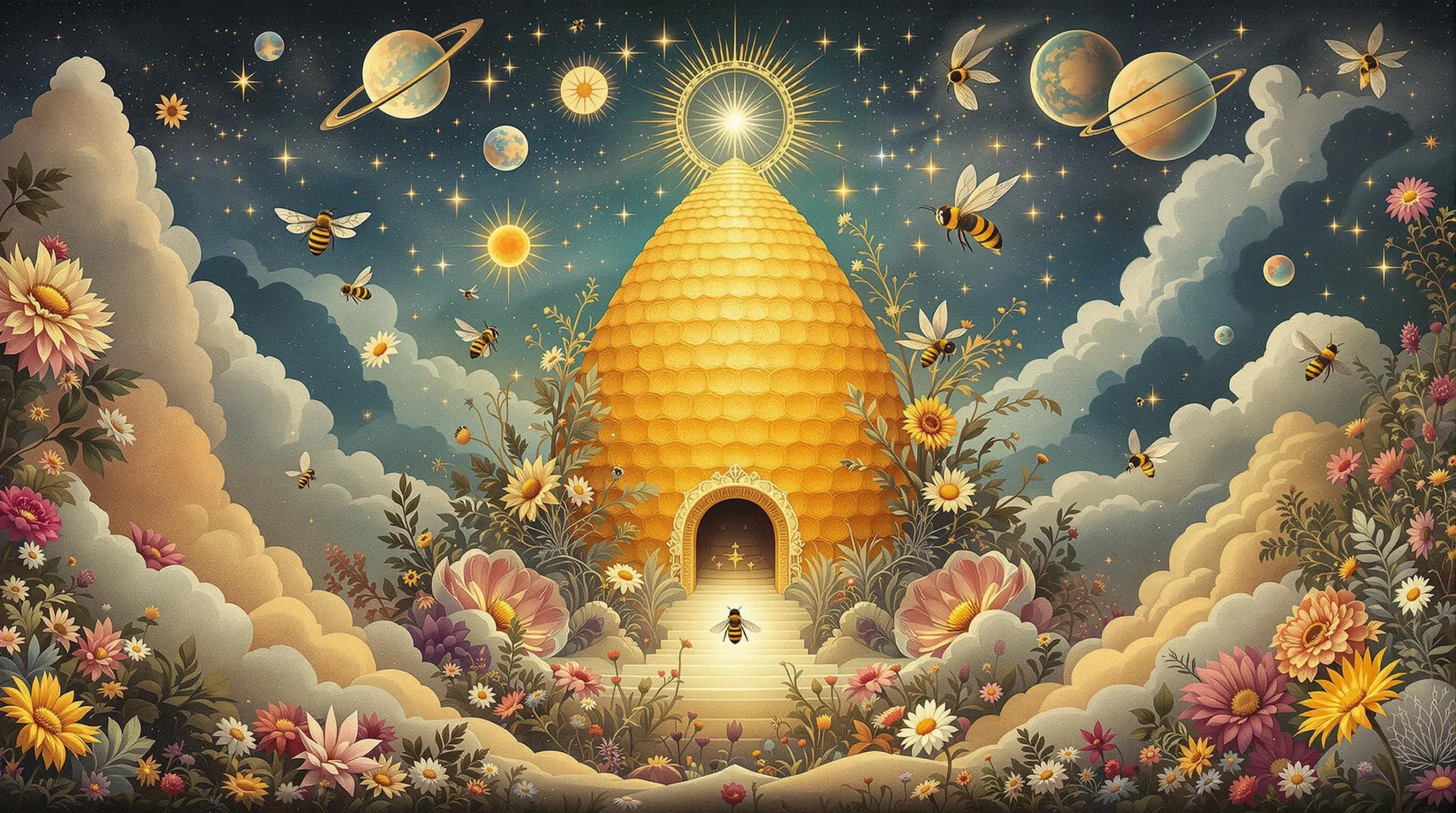


Beehive

Archetype Meaning & Symbolism

Communal, industrious, structured, sweet, defensive, hierarchical, productive, fertile, intricate, purposeful

  • One cell is a home. A thousand, a city. A million, a world. Each begins with a single, perfect intention.

If Beehive is part of your personal mythology, you may...

Believe

  • The work is the worship. A life of purpose is found in diligent service to a cause greater than oneself.

  • Order is beauty. The most elegant solutions, and the most stable societies, are built on clear structure and function.

  • Individuality is secondary to the health of the collective. Personal sacrifice is necessary for the group to thrive.

Fear

  • Uselessness. The idea of being idle, unproductive, or a drain on the resources of your community is a source of deep anxiety.

  • Chaos. A sudden disruption of the systems you rely on—a collapse of order in your home, work, or society—is a primary terror.

  • Exile. Being cast out of the group, deemed unworthy or non-essential, is a fate worse than mere loneliness; it is a loss of purpose and identity.

Strength

  • Incredible focus and diligence. You have the ability to see massive, long-term projects through to completion, one small step at a time.

  • Community building. You are a natural at creating and maintaining strong, supportive, and productive groups united by a common goal.

  • Profound loyalty. You are a fierce protector and provider for your chosen 'hive,' be it your family, company, or friends.

Weakness

  • Rigidity. Your reliance on structure can make you resistant to change, innovation, and spontaneous opportunities.

  • A tendency toward burnout. By tying your self-worth to your productivity, you risk working yourself to the point of collapse, neglecting rest and play.

  • Groupthink. Your belief in the collective can sometimes blind you to the value of dissent and the dangers of conformity.

The Symbolism & Meaning of Beehive

The Beehive in your personal mythology is the architecture of purpose. It speaks to a life built not on grand, solitary gestures, but on the accumulation of small, diligent acts that, together, create a structure of breathtaking complexity and sweetness. It is the understanding that your individual work, the tiny deposits of effort you make each day, fills a cell in a much larger design. This archetype asks you to consider what cathedral you are building with your daily bricks, what honey you are producing with your mundane tasks. It is a symbol of sacred industry, where work is not a curse but a form of devotion to the whole, be that a family, a company, or a cause. The hive is a city, a womb, and a fortress, a place where one’s purpose is clear and one’s contribution essential.

Yet, the Beehive is also a potent symbol of the tension between the individual and the collective. Its perfect, hexagonal order may feel comforting and secure, or it could feel like a beautiful prison of conformity. To have the Beehive in your mythos is to constantly negotiate your own uniqueness against the demands of the group. The hum of the hive can be the sound of harmonious collaboration, or it can be the buzz of anxious groupthink, drowning out the solo voice of intuition. The honey is sweet, but the sting is sharp. The hive offers belonging and safety, but perhaps at the cost of personal freedom and the wild, chaotic detours that define a different kind of life story.

Ultimately, the Beehive may symbolize the creation of a legacy that outlasts the self. The individual bee’s life is short, but the hive and its golden stores can persist for seasons. This archetype could compel you to work on projects whose completion you may not see, to contribute to a body of knowledge that will nourish future generations. It is a commitment to a future beyond your own horizon, a belief in the power of the group to achieve a form of immortality. It is the myth of the great work, the understanding that you are a temporary, yet vital, participant in an eternal, humming project.


Beehive Relationships With Other Archetypes

The Gardener:

The Beehive and The Gardener exist in a state of profound symbiosis. The Gardener cultivates the fields of possibility, providing the raw material of nectar and pollen. The Beehive, in turn, is the agent of fertilization, the force that ensures the Gardener's work bears fruit. In a personal mythos, this relationship might represent the interplay between resources and action. The Gardener in you gathers knowledge, experiences, and opportunities, while the Beehive in you provides the structure and tireless industry to transform those resources into something tangible, ensuring that ideas don't just blossom but lead to a harvest.

The Lone Wolf:

The Beehive stands in stark opposition to the Lone Wolf. Where the Beehive finds strength in the collective and identity in function, the Lone Wolf finds strength in solitude and identity in radical self-reliance. They are oil and water. For someone with the Beehive in their mythos, the Lone Wolf may appear as a tragic, inefficient figure, disconnected from the power of community. Conversely, the Lone Wolf might view the Beehive as a terrifying symbol of surrendered identity, a place where the soul is subsumed by the system. Their dynamic highlights the fundamental human tension between belonging and autonomy.

The Alchemist:

The Beehive is a natural, living embodiment of the Alchemist's quest. It takes a common, fleeting substance, nectar, and through a mysterious, collective process, transmutes it into honey: a golden, incorruptible elixir. The Alchemist archetype might see the Beehive as a sacred blueprint for transformation. This relationship suggests a personal mythology where the focus is on turning the mundane experiences of daily life (the nectar) into wisdom, art, or legacy (the honey). The hive's structure provides the alchemical vessel, the disciplined container required for the Great Work to occur.

Using Beehive in Every Day Life

Navigating a Creative Block:

When inspiration feels distant, the Beehive archetype suggests focusing on structure over spirit. Do not wait for the muse: build the container. Outline the novel, prep the canvases, organize the studio. Create the hexagonal cells of your project, and trust that the nectar will find its way into the waiting structure. The work itself becomes an invocation.

Strengthening Community Bonds:

If a community or family feels fractured, embodying the Beehive means identifying a shared, tangible purpose. It's not about forced conversations, but about a common project: planting a garden, organizing a neighborhood watch, or collaborating on a fundraiser. The shared work of building something, of producing a collective 'honey', may mend the interpersonal structures more effectively than words alone.

Career Advancement:

In a complex corporate environment, the Beehive teaches the wisdom of the niche. Instead of trying to do everything, find your unique function within the larger system. Become undeniably excellent at that one role, whether it's communication, data analysis, or team morale. Your indispensability to the whole becomes your greatest asset, ensuring your place and value within the organizational hive.

Beehive is Known For

Honey Production

The alchemical transformation of ephemeral flower nectar into a golden, stable, and nourishing substance. It represents the sweet, tangible reward that emerges from diligent, collective labor.

The Queen

The singular, fertile center of the hive around which all activity is organized. She may symbolize a central purpose, a matriarchal power, or the core idea that gives a project or family its life and direction.

The Swarm

A mesmerizing and terrifying manifestation of collective consciousness in motion. It represents the hive's capacity for dramatic change, expansion, and the unnerving power of a group united in a single, overwhelming purpose.

How Beehive Might Affect Your Personal Mythology

How Beehive Might Affect Your Mythos

When the Beehive is a cornerstone of your personal mythos, your life story may not follow the arc of a solitary hero's journey, but rather the narrative of a master builder or a vital citizen. The central plot may revolve around the creation and sustenance of a great work: a thriving business, a close-knit family, a social movement, or an artistic legacy. Your personal history might be chronicled not by personal epiphanies, but by collective milestones: the day the foundation was laid, the year the harvest was bountiful, the moment the community successfully defended itself against a threat. Your identity is woven into the tapestry of this larger creation.

Your mythos may be less concerned with 'finding yourself' and more with 'placing yourself' within a system that gives your actions meaning. The key conflicts in your story might arise when the needs of the hive conflict with your personal desires, or when the structure you have so carefully built faces an external threat or internal decay. Your greatest triumphs are not solo victories but shared successes. The narrative of your life becomes the story of the hive you built, protected, and served, a testament to the power of a single, focused life to contribute to a vast and enduring whole.

How Beehive Might Affect Your Sense of Self

Your sense of self may be inextricably linked to your function and your productivity. You could see yourself as a 'worker,' a 'guardian,' a 'nurturer,' or an 'organizer' first, and an individual second. This can provide a powerful sense of clarity and purpose: you know who you are because you know what you do. Self-worth is not an abstract concept but a tangible one, measured by the honey in the pot, the stability of the structure, the well-being of the collective. You may feel most yourself when you are busy, contributing, and operating as a seamless part of a larger machine.

This can, however, lead to a fragile sense of identity. Who are you when you are not working? What is your value when you are not being useful to others? An identity built on function can feel hollow during periods of rest, transition, or failure. There may be a persistent, quiet fear of becoming a 'drone,' losing the unique spark of your personality to the overwhelming hum of the collective. Your journey of self-discovery might involve learning to value your being as much as your doing, and finding a self that exists independent of the hive.

How Beehive Might Affect Your Beliefs About The World

You may view the world as a vast, interconnected system, a macro-hive where every component has a role to play. Society, nature, and even the cosmos might appear as intricate structures of cause and effect, where the actions of one part inevitably ripple through the whole. This perspective fosters a deep appreciation for order, cooperation, and systems thinking. You might look at a complex problem, like climate change or economic inequality, and instinctively search for the systemic solution, the way to get all the 'bees' working in concert for the common good.

This worldview can sometimes lack a tolerance for chaos, randomness, and radical individuality. You might become frustrated with inefficiency, dissent, and those who refuse to 'get with the program.' The world may seem divided into two camps: those who contribute to the structure and those who threaten it. There is a risk of developing a belief that there is one right way for society to function, mirroring the rigid order of the hive, and you may struggle to appreciate the value of disruption, rebellion, and the beautiful messiness of unstructured progress.

How Beehive Might Affect Your Relationships

In relationships, you may seek not just love and companionship, but partnership in a shared enterprise. A romantic partner could be seen as a co-builder, someone with whom you can construct a life, a home, a family—a shared hive. The health of the relationship might be measured by its productivity: how well you manage finances together, how harmoniously you run your household, how you support each other’s work in the world. Intimacy may be forged in the crucible of shared labor and mutual reliance.

Friendships might also be organized around shared goals or activities, forming a 'court' of specialized supporters. You may have friends for specific purposes: the one you collaborate on creative projects with, the one who helps with practical tasks, the one who guards your emotional well-being. This can create powerful, reliable bonds, but it also risks making relationships transactional. You might struggle with connections that are purely for pleasure or leisure, viewing them as inefficient. The challenge is to find space for relationships that are not about building anything, but simply about being together, appreciating the person for who they are, not what they do for the hive.

How Beehive Might Affect Your Role in Life

Your perceived role in life could be one of profound, functional clarity. You are the builder, the provider, the protector, the organizer. The Beehive archetype instills a powerful sense of duty and an understanding that your role is essential to the survival and prosperity of your chosen collective. This can be deeply comforting, eliminating the existential angst of 'what should I do with my life?' The answer is clear: you do your job. You fulfill your function. You serve the hive. This might manifest as being the designated planner in your friend group, the reliable financial pillar of your family, or the systems-thinker at your company.

However, this can also feel like being typecast in the play of your own life. You might feel trapped in a role that you have outgrown or that no longer serves you. The expectations of the collective, and your own internal sense of duty, can make it difficult to change or experiment with new identities. A 'worker bee' who suddenly wants to be an artist, or a 'queen' who longs for solitude, may face immense internal and external resistance. The mythos of the hive suggests roles are fixed for the good of the whole, making personal evolution a potentially disruptive and frightening act.

Dream Interpretation of Beehive

In a positive context, dreaming of a healthy, humming beehive may be a powerful affirmation from your subconscious. It could signify that your hard work is paying off, that you are in harmony with your community, and that a period of great productivity and sweetness is at hand. Tasting honey in a dream could symbolize the enjoyment of the fruits of your labor. Seeing bees diligently working might be a sign that you are on the right path with a project or in your career, and that your efforts are contributing to something beautiful and stable. The dream validates your role within the collective and promises a sweet reward.

Conversely, a dream featuring a disturbed or dying hive, or being attacked by a swarm, could signal deep-seated anxieties. It might represent a fear of social chaos, a feeling that your community or workplace is collapsing. Being swarmed may articulate a feeling of being overwhelmed by the demands of others, losing your individuality, or being attacked by groupthink. A silent, empty hive could be a potent symbol of burnout, loneliness, or a loss of purpose, suggesting that the structure you have built no longer has life in it.

How Beehive Archetype Might Affect Your Needs

How Beehive Might Affect Your Physiological Needs

The Beehive archetype can instill a profound focus on securing the body's foundational needs, viewing physiology through the lens of hive efficiency. Your approach to food may be less about pleasure and more about fuel. The goal is a well-stocked larder, a system of nourishment that ensures the 'workers'—your body's cells—have the energy to perform. You might find comfort in meal prepping, bulk buying, and creating a pantry that could withstand a long winter. The body is the first hive, and its physical resources must be managed with diligence and foresight.

This mythos may also regulate your cycles of energy and rest. You might operate in bursts of intense, focused activity, followed by periods of necessary, functional collapse. Sleep isn't a luxury; it is a vital part of the system for restoring productivity. There may be a subtle anxiety around unstructured rest, a feeling that any time not spent working or actively recuperating is wasted. Your body's rhythms could become deeply entwined with the cycles of production you have established in your life, making it hard to relax without a clear objective.

How Beehive Might Affect Your Ideas of Belonging

Belonging, in the context of the Beehive mythos, may be earned through utility. You feel you belong when you are needed. Your place in a family or a group of friends is secured by your contribution, by the essential function you perform. Love and acceptance are demonstrated through acts of service, both given and received. You may show affection by helping someone with a project or offering practical support, and you may feel most loved when your own hard work is acknowledged and integrated into the group's success.

This can create an incredibly strong and resilient sense of community, a group bound by mutual reliance and a shared purpose. The potential pitfall, however, is a fear that if you cease to be useful, you will cease to belong. This could make it difficult to be vulnerable, to ask for help without offering something in return, or to simply be present in a group without having a specific role to play. True belonging might feel conditional, dependent on your continued ability to produce for the hive.

How Beehive Might Affect Your Feelings of Safety

For you, safety may be synonymous with structure, redundancy, and collective defense. A secure life is an orderly one: finances are budgeted, emergency funds are in place (the stored honey), and the home is a well-maintained fortress. You might find deep psychological comfort in insurance policies, retirement plans, and having a well-defined protocol for emergencies. Safety is a system you build, not something you hope for. The walls of the hive must be thick, and its entrances must be guarded.

The greatest threats to your sense of safety might be chaos and unpredictability. A sudden job loss, a market crash, or an unexpected betrayal can feel like a bear tearing apart the hive. Your response to such a threat might be to retreat, reinforce the walls, and rely on the strength of your inner circle. Safety is also found in numbers; you may feel most secure when you are surrounded by a loyal group you can count on, where everyone understands their role in watching each other's backs.

How Beehive Might Affect Your Views of Esteem

Your self-esteem may be built on the bedrock of your competence and achievements. It is not about who you are, but what you can do and what you have built. You might hold yourself to incredibly high standards of quality and efficiency, and your pride comes from a job well done, a project flawlessly executed, or a system running smoothly. The 'honey' you create—whether it's a successful company, a beautiful piece of art, a well-raised child, or a healthy bank account—is the external validation of your internal worth.

This provides a clear and often attainable path to feeling good about yourself: work hard, be excellent, and see the results. However, it also makes your self-esteem vulnerable to failure and criticism of your work. A failed project may not just be a setback; it could feel like a fundamental indictment of your character. Furthermore, you might struggle to value qualities in yourself and others that are not easily measured by productivity, such as kindness, creativity for its own sake, or the simple ability to be still.

Shadow of Beehive

The shadow of the Beehive manifests as a totalitarian regime of the soul. When its orderly impulse runs rampant, it creates a personal mythology of stifling conformity where any deviation from the norm is seen as a pathology. Creativity is crushed in favor of efficiency. Individuality is sacrificed for the illusion of perfect harmony. In this shadow state, you may become the tyrannical queen of your own life, demanding absolute adherence to rigid routines and punishing any part of yourself—or others—that exhibits spontaneity or dissent. The hive becomes a prison painted gold, and the sweet honey of achievement tastes of bitterness and lost freedom.

The other shadow aspect emerges when the hive structure collapses: the leaderless swarm. This is the Beehive's energy turned to chaos. It is a state of anxious, purposeless activity. You may be incredibly busy but achieve nothing of substance, buzzing from task to task without a central goal. Your community might devolve into infighting and gossip, a collective without a queen, consuming itself. This shadow represents the terror of disorganization, a state of perpetual, unproductive motion that generates only noise and heat, but never the sweet, golden light of honey.

Pros & Cons of Beehive in Your Mythology

Pros

  • You are capable of building extraordinary, lasting legacies through your discipline and collaborative spirit.

  • You foster deep, reliable bonds with others, creating a powerful sense of security and belonging for yourself and your community.

  • Your life has a powerful sense of purpose and direction, anchored in your contribution to a greater whole.

Cons

  • You may struggle to value your own worth outside of your productivity, leading to workaholism and anxiety during periods of rest.

  • Your need for order can make you inflexible and intolerant of differing lifestyles, ideas, or methods.

  • You risk losing your unique voice and personal desires to the will and needs of the collective.