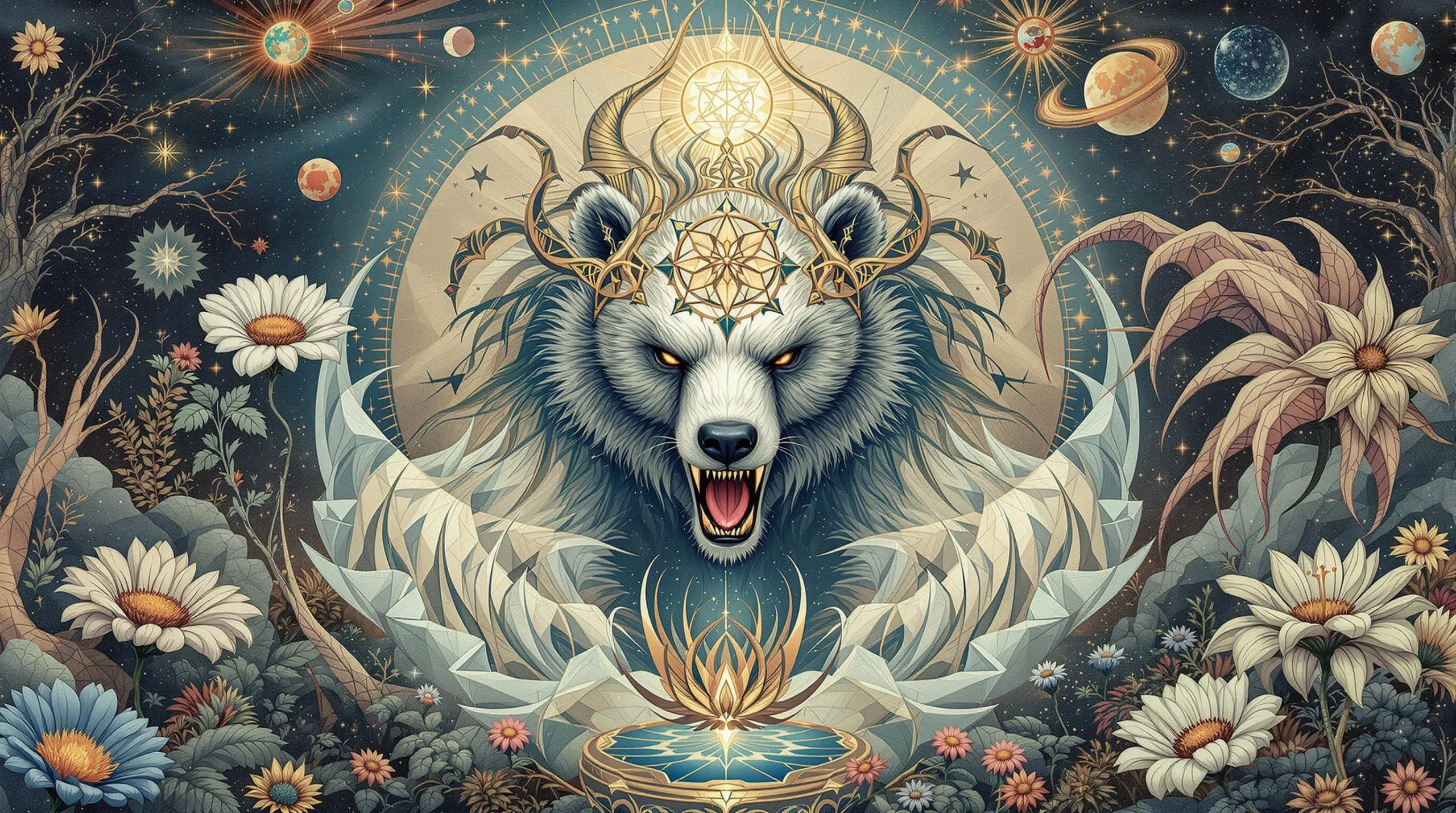


Bear Claw

Archetype Meaning & Symbolism

Protective, grounded, powerful, formidable, primal, enduring, patient, decisive, territorial, nourishing

  • Do not mistake stillness for inaction. The earth remembers every step, every intention. Dig deep, hold fast, and when you strike, let it be with the full weight of your truth.

If Bear Claw is part of your personal mythology, you may...

Believe

  • True strength is not found in the attack, but in the power held patiently in reserve.

    Everything you truly need can be found if you are willing to dig deep enough, within yourself or within the world.

    Your presence alone should be its own boundary; your integrity its own defense.

Fear

  • A deep-seated fear of losing control and unintentionally harming those you mean to protect.

    A terror of being declawed, of being rendered powerless and unable to defend yourself or your loved ones from harm.

    A persistent anxiety that your protective nature will be misinterpreted as aggression or control, leading to profound isolation.

Strength

  • An unwavering ability to protect and provide for your chosen family, creating a profound sense of safety and stability for others.

    A deep resourcefulness and patience, allowing you to unearth solutions, opportunities, and truths that others might miss.

    A grounded, powerful presence that naturally commands respect, often without needing to resort to threats or overt displays of force.

Weakness

  • A tendency towards territoriality or possessiveness in relationships, sometimes mistaking control for care.

    A staunch reluctance to show vulnerability or ask for help, stemming from a core belief that you must be the sole source of strength.

    An inclination to meet nuanced or delicate problems with brute force, overlooking more subtle or diplomatic solutions.

The Symbolism & Meaning of Bear Claw

To have the Bear Claw within your personal mythology is to understand the duality of power. The claw is both a tool of fearsome defense and an instrument of gentle foraging. Its symbolism is not about aggression, but about capacity: the capacity to protect, to provide, to establish a boundary with a single, definitive gesture. It may represent a strength that is so integrated into your being that it requires no announcement. This archetype suggests that true power is held in reserve, its presence felt in your stillness, your groundedness, your unwavering gaze. It is the quiet confidence of knowing you can handle what comes, a confidence born not of ego, but of a deep, instinctual connection to your own capabilities.

The Bear Claw is also a profound symbol of our connection to the earth, to the primal and instinctual self. It is the part of us that knows how to dig for truth, how to unearth the nourishment hidden beneath the surface of daily life. In your own narrative, this might manifest as an uncanny ability to get to the root of a problem, a patience for excavating complex emotional landscapes, or a fundamental need to feel connected to the physical world. It reminds you that you are an animal being, that your survival and well-being are tethered to the tangible: to the ground beneath your feet, the food you eat, the safety of your den.

Finally, the Bear Claw speaks to the mark we leave behind. Like a bear scoring its presence onto a tree, your actions may leave an indelible impression on your world and on the lives of others. This archetype in your mythos could point to a deep-seated desire for your life to have weight, for your presence to mean something. It is about legacy, not in the grand sense of statues and monuments, but in the quiet, profound impact of your protection, your provision, your steadfastness. The story becomes one of leaving a mark of safety and strength, a testament that you were here, and you held your ground.


Bear Claw Relationships With Other Archetypes

The Forest

The Bear Claw's power is contextualized and sustained by The Forest. The Claw digs into the forest floor for sustenance, grips its trees to climb, and marks its bark to define its territory. In return, the foraging of the Claw may aerate the soil and disperse seeds, shaping the ecosystem. In a personal mythos, this relationship suggests that one's power (Claw) is intrinsically linked to one's environment (Forest). Your strength may be most potent when you are in a familiar, grounding place, and you might feel a deep responsibility to cultivate and protect that environment, as it is the very source of your sustenance and identity.

The Heart

The relationship between the Bear Claw and The Heart is one of guardian and ward. The Heart, symbolizing love, vulnerability, and connection, is the precious thing the Claw instinctively moves to protect. The Claw builds the den, establishes the boundaries, and stands ready to defend against any threat to the Heart's safety. However, a disharmony here can be perilous. An overactive Claw, driven by fear, may encase The Heart in a fortress so thick that no love can get in or out. An undefended Heart may feel raw and exposed. The life journey is often about teaching the Claw to be a discerning gatekeeper, not a prison guard, for the tender Heart.

The Key

The Bear Claw and The Key represent two opposing philosophies for overcoming obstacles. The Claw represents primal force: the power to break, to tear down, to remove a barrier through sheer strength. The Key, conversely, symbolizes nuance, intellect, and the search for the specific, subtle solution that bypasses the need for force. A person strong in the Bear Claw archetype might initially try to smash through a locked door, while someone embodying The Key would search for the hidden mechanism. Integrating these two might mean learning that not every problem is a threat to be neutralized; some are puzzles to be lovingly and patiently solved.

Using Bear Claw in Every Day Life

Establishing Boundaries

When faced with a person or situation that consistently oversteps, the Bear Claw archetype informs a response that is not necessarily aggressive, but definitive. It is the psychic equivalent of scoring a deep line in the dirt. This isn't about a shouted argument; it is about a calm, unbreachable statement of fact, a declaration of where your territory begins. It is the quiet power to say “no” with the full weight of your being, communicating that this line will not be crossed again.

Accessing Primal Strength

In a moment of crisis—a sudden loss, a profound challenge—the Bear Claw offers a connection to a power deeper than intellect. It is the feeling of your feet on the ground, the solidness of your own bones, the instinct to protect what is vital. Tapping into this may mean letting go of panic and instead finding the core of your resolve. It is the capacity to act with decisive force, not out of rage, but from a deep, instinctual well of self-preservation and the will to endure.

Cultivating Patient Foraging

The Bear Claw is not only a weapon; it is a tool for sustenance. When you are searching for a new career, a creative solution, or a deeper self-knowledge, this archetype encourages patient digging. It suggests that what you need is not on the surface, easily plucked. You may need to turn over the soil of your own life, to excavate past experiences, to patiently sift through possibilities until you unearth the hidden nourishment. It is a reminder that some of life's greatest rewards require getting your hands dirty.

Bear Claw is Known For

Defense

The claw is a primary tool of protection, a symbol of the ability to hold one's ground and defend what is sacred. It represents formidable power that is often held in reserve, displayed only when necessary.

Foraging

It is an instrument for digging, for unearthing roots, grubs, and hidden sources of nourishment. This points to a capacity for resourcefulness and the ability to find sustenance from the environment.

Marking Territory

Bears rake their claws against trees, leaving a visible and olfactory signature of their presence, power, and boundaries. This act symbolizes leaving one's mark, establishing presence, and communicating identity and limits without confrontation.

How Bear Claw Might Affect Your Personal Mythology

How Bear Claw Might Affect Your Mythos

When the Bear Claw is a central object in your personal mythos, your life story may be framed not by constant conflict, but by the weight of your presence and the significance of your actions. Your narrative is one of contained power. You are not the warrior always seeking a battle, but the guardian whose stillness is a warning. The key moments in your story might be the rare instances when that power must be unleashed: a decisive action to protect a loved one, a foundational choice that secures your family’s future, or the deliberate excavation of a painful truth for the sake of healing. Your myth becomes about the responsibility of strength and the wisdom to know when, and how, to use it.

The mythos may also be one of profound connection to a primal lineage, a sense of being the current embodiment of an ancient, earthy strength. Your story might involve a journey away from the superficial and towards the authentic, a shedding of societal expectations to embrace a more instinctual way of being. This narrative could be about learning to trust the wisdom of your body, the gut feelings that guide you, and the fierce, animalistic love you have for your kin. Your personal legend is written in the ground you till, the homes you make safe, and the boundaries you defend.

How Bear Claw Might Affect Your Sense of Self

Your perception of self may be anchored in a sense of fundamental capability. Deep down, you might believe you can handle whatever life throws at you, not through cleverness, but through sheer endurance and innate strength. This can foster a quiet, grounded self-confidence that is not easily shaken by external opinions. You may see yourself as a provider, a protector, a rock for others to lean on. This identity is deeply embodied; you feel your strength in your hands, in your stance, in the solidness of your own presence. You are the one who remains standing when the storm has passed.

Conversely, you may harbor a quiet fear of your own potency. The knowledge of the claw's sharpness can lead to a constant, careful monitoring of your temper, your words, and your actions. You might see a destructive capacity within yourself that you work diligently to keep sheathed, leading to a gentle, even placid, exterior that belies the power within. This can create an inner tension between your instinctual self and your socialized self, a private struggle to wield your strength with surgical precision so as not to cause unintentional harm. Your inner work may be a lifelong practice of gentle power.

How Bear Claw Might Affect Your Beliefs About The World

You may view the world as a tangible, physical place that requires a degree of practical fortitude. It is a forest, full of both nourishment and danger. This is not a cynical worldview, but a deeply realistic one. It acknowledges that resources must be sought, territory must be defined, and safety must be created, not assumed. You might see society's abstract rules as secondary to the more primal laws of survival, protection, and provision. The world, for you, may operate on a very fundamental level of cause and effect, where decisive action is what truly matters.

This perspective could also imbue you with a profound respect for what is hidden. You may see the world as a place of secrets and sustenance buried just beneath the surface, available only to those with the patience and strength to dig. This fosters a worldview that values depth over superficiality, and substance over appearance. You might be less impressed by loud displays and more by quiet competence. The world is a vast, rich place, but its greatest treasures, you may believe, do not lie in plain sight. They must be unearthed with intention and effort.

How Bear Claw Might Affect Your Relationships

In relationships, you may love fiercely and protectively. Your instinct might be to create a 'den' for your loved ones—a space of profound emotional and physical safety. Love, for you, could be a verb, expressed through acts of service, provision, and unwavering loyalty. Friends and partners may feel incredibly secure in your presence, knowing you are a formidable ally who has their back without question. You are the one they call in a crisis, the steady hand in the chaos. Your love is an anchor.

However, this powerful protective instinct can have a shadow side. The line between protecting and controlling can become blurred. You may struggle with a tendency towards territoriality, viewing your partner's other connections with suspicion, or becoming overly involved in your loved ones' problems under the guise of helping. The Bear Claw's influence may require a conscious effort to trust others to handle their own battles, to understand that smothering someone with safety is not the same as allowing them the freedom to thrive. True partnership, you may need to learn, involves respecting another's own strength and territory.

How Bear Claw Might Affect Your Role in Life

You may naturally gravitate toward the role of The Guardian in your family, community, or workplace. This is the person who ensures the foundations are strong, the resources are managed, and the perimeter is secure. This role could manifest literally, as a parent, a security professional, or a financial planner, but also metaphorically, as the team member who anticipates problems, the friend who provides a stable emotional anchor, or the leader who protects their people fiercely. Your sense of purpose is often derived from being the bedrock upon which others can build their lives.

Beyond guardianship, you might also be drawn to the role of The Excavator. Possessing the tool to dig deep, you may find your purpose in unearthing what is hidden. This could be the role of a therapist, a researcher, a journalist, or an artist who explores uncomfortable truths. You are not afraid of the dark or the dirt. Your role is to go where others are hesitant, to dig into the compacted soil of trauma, history, or complexity, and to bring the roots of the matter into the light for examination and healing. You provide the strength necessary for profound discovery.

Dream Interpretation of Bear Claw

In a positive context, dreaming of a Bear Claw—perhaps finding one, holding it, or observing a bear using it to dig for food—may symbolize the dreamer's connection to their own innate power and resourcefulness. The dream could be a message from the psyche that you possess the strength you need to protect yourself, to establish healthy boundaries, or to provide for your own needs. It can be an affirmation of your resilience and a call to embrace your own authority and instinctual wisdom. Finding a claw might suggest the discovery of a new strength or talent you were unaware you possessed.

In a negative light, a dream featuring a Bear Claw as a weapon of aggression can be unsettling. Being threatened or wounded by a claw may represent a fear of someone else's anger or aggression in your waking life, or more profoundly, a fear of your own. It might indicate that you are using your 'claws'—your words, your power, your anger—destructively or without care. It could also symbolize a feeling of being trapped by a situation or relationship that feels dangerously territorial. Such a dream may be a caution from your subconscious to examine how you are wielding your power, or how you are responding to the power of others.

How Bear Claw Archetype Might Affect Your Needs

How Bear Claw Might Affect Your Physiological Needs

The Bear Claw archetype anchors your personal mythos directly to your physiological needs, particularly the drive for sustenance. It symbolizes the primal, non-negotiable imperative to secure the resources for survival. In modern life, this may translate into a powerful work ethic, a deep-seated need to be a provider, and an almost instinctual ability to find opportunities for material security. There may be a profound discomfort with dependency, as the archetype insists on the ability to forage for oneself. Your body's needs for food, water, and shelter are not abstract concepts; they are the bedrock of your reality.

Furthermore, this archetype may foster a deep connection to the body itself as a source of power and information. You might feel your emotions viscerally and trust your 'gut feelings' as primary data. There could be a fundamental need for physical expression: exercise that tests your strength, work that involves your hands, or simply the act of grounding yourself in nature. Your physiological well-being may be directly tied to feeling strong, capable, and physically present in your own skin. Neglecting the body's needs feels like a denial of your most essential self.

How Bear Claw Might Affect Your Ideas of Belonging

Love and belonging, through the lens of the Bear Claw, are defined by fierce loyalty within a clearly demarcated circle. To be loved by you may be to be brought into the den, to be considered part of your protected territory. For this inner circle, your commitment is absolute. You show love through guardianship, through creating a haven where your chosen few can be vulnerable because you are strong. Belonging is earned through trust and proven loyalty, and once granted, it is rarely revoked.

The challenge this archetype presents to belongingness is in its territorial nature. You may be slow to trust, viewing newcomers with a wary eye. The process of letting someone into your inner circle can be long and full of tests, whether conscious or not. This can make it difficult to form new friendships or to integrate into new communities. Others might perceive you as standoffish or guarded. The work is to learn that a boundary can also be a gate, one that you can choose to open without compromising the safety of what lies within.

How Bear Claw Might Affect Your Feelings of Safety

Your need for safety is foundational, shaped by the Bear Claw's dual role as both a fortress and a weapon. Security is not a passive state for you; it is an active creation. This may manifest in a meticulous attention to practical safety measures: financial savings, a secure home, emergency preparedness plans. You might find a deep sense of peace in knowing you have anticipated threats and have the resources to meet them. This is the den-building instinct, the drive to create a space so secure that you and your loved ones can finally rest.

This drive for security can also forge a powerful self-reliance. The core belief may be that true safety comes only from one's own strength and preparedness. This can make you incredibly resilient and capable in a crisis. However, it may also make you hesitant to trust external systems or other people for your security. The potential downside is a hyper-vigilance or an inability to relax, a constant feeling that you must be the sole protector. The need for safety might, if unchecked, prevent you from experiencing the comfort of shared vulnerability and interdependent support.

How Bear Claw Might Affect Your Views of Esteem

Esteem needs are deeply connected to competence, respect, and the exercise of your strength. You may derive a powerful sense of self-worth from your ability to provide, protect, and solve tangible problems. Your accomplishments are not just feathers in your cap; they are the fortifications of your den, the proof of your ability to impose order and safety onto a chaotic world. Being seen as reliable, strong, and capable is paramount to your self-esteem. You respect yourself when you successfully wield your power in service of your values.

Consequently, your esteem can be particularly vulnerable to disrespect or challenges to your authority. When your boundaries are ignored, your competence is questioned, or your protective efforts are rejected, it can feel like a fundamental attack on your identity. You need others to acknowledge the weight of your presence and the seriousness of your purpose. A feeling of powerlessness or being ineffective may be one of the most significant threats to your sense of self-worth, as it undermines the very foundation of the Bear Claw archetype within you.

Shadow of Bear Claw

When the Bear Claw falls into shadow, its protective instinct curdles into tyranny. Here, the guardian becomes a warden. Healthy boundaries become impenetrable walls, and the safe den becomes an emotional prison for its inhabitants. This shadow self wields its power not for protection but for control, lashing out with disproportionate force at the smallest perceived slight. It uses its capacity to provide as a tool of dependency, ensuring others can never leave its orbit. Love becomes a form of ownership. This is the claw that strikes out of fear, not strength, terrified of being abandoned or seen as weak, and thus it seeks to dominate its entire environment to preempt any possible threat.

In its opposite, passive shadow, the Bear Claw can manifest as a complete abdication of power. This is the archetype declawed by its own fear. Paralyzed by the potential to cause harm, this person refuses to set any boundaries, allowing others to trespass and take at will. They deny their own strength, equating any self-assertion with unforgivable violence. This leads to a life of quiet resentment and victimhood, a simmering anger beneath a veneer of passivity. They starve for the nourishment they refuse to dig for and suffer the wounds they refuse to defend against, a tragic denial of their own potent and essential nature.

Pros & Cons of Bear Claw in Your Mythology

Pros

  • You possess a deep well of inner strength and resilience, making you a pillar of support for others during times of crisis.

    Your fierce protective instinct makes your loved ones feel profoundly safe, cherished, and cared for in a tangible way.

    You are exceptionally resourceful, capable of finding what is needed for survival and creating opportunities for thriving even in difficult circumstances.

Cons

  • Your powerful self-reliance can make it extremely difficult to be vulnerable or accept help, which may lead to emotional exhaustion and isolation.

    You may be perceived by others as intimidating, unapproachable, or overly aggressive, even when your intentions are purely protective.

    Your instinct to establish firm boundaries can sometimes morph into rigid territoriality, pushing away new people and experiences that could be enriching.