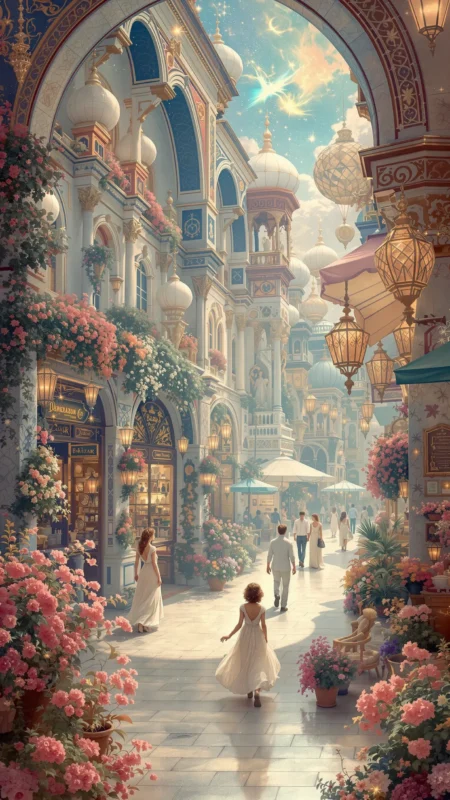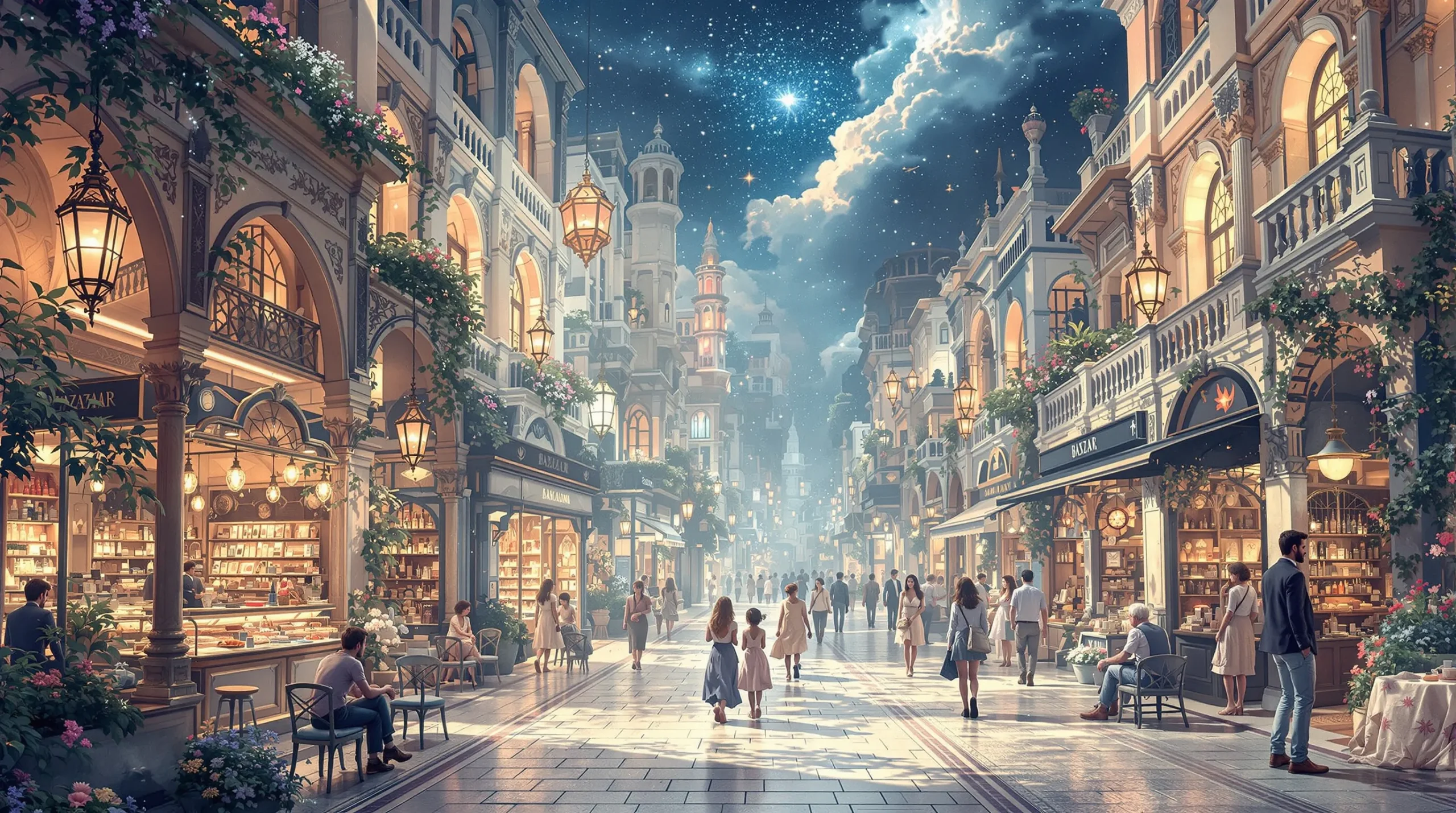


Bazaar

Archetype Meaning & Symbolism

bustling, chaotic, interconnected, transactional, diverse, ephemeral, sensory, opportunistic, cacophonous, emergent

  • Do not seek a map: learn the art of getting beautifully lost. The greatest treasures are found by accident.

If Bazaar is part of your personal mythology, you may...

Believe

  • Every person you meet is a potential trading partner, offering a new perspective, skill, or opportunity in exchange for what you have to offer.

  • True wealth is measured not by what you accumulate, but by the quality and velocity of what flows through you: ideas, resources, and goodwill.

  • The most beautiful order is not planned from above but emerges from the chaotic, voluntary interactions of individuals pursuing their own interests.

Fear

  • Irrelevance: the terror of waking up one day to find that the skills you've honed and the goods you offer are no longer in demand by anyone.

  • Isolation: being cast out of the marketplace, with no one to trade with, left to face the silence beyond the city walls.

  • Deception: the deep fear of discovering that you have been cheated, that the things you've built your life around are counterfeit, and you have traded your soul for smoke.

Strength

  • Adaptability: an almost chameleon-like ability to thrive in any environment by quickly assessing what is valued and how you can contribute.

  • Networking: a natural talent for seeing the hidden threads connecting people and ideas, and weaving them together for mutual benefit.

  • Resourcefulness: an unshakeable belief that a solution to any problem can be found, bartered for, or built from the spare parts available in your immediate environment.

Weakness

  • Transactionalism: a tendency to view even the most intimate relationships through a lens of 'what's in it for me,' potentially cheapening them.

  • Superficiality: in mastering many trades, you may fail to achieve deep mastery in any single one, leading to a life that is broad but lacks profound depth.

  • Restlessness: a constant need for novelty and stimulation that can make it difficult to commit to a single place, person, or project for the long term.

The Symbolism & Meaning of Bazaar

In personal mythology, the Bazaar archetype symbolizes the psyche as a place of infinite exchange. Your mind is not a fortress to be defended but a sprawling, open-air market of competing ideas, memories, and desires. Each thought is a vendor, calling for your attention, offering a different version of reality. To have the Bazaar within you is to be comfortable with this inner cacophony, to understand that a stable self is not a single, monolithic structure but an ever-shifting equilibrium born of constant negotiation between these internal merchants. You might learn to browse your own anxieties and hopes as if they were goods on a blanket, examining them with curiosity rather than judgment, perhaps trading a bit of fear for a measure of courage found in a neighboring stall.

The Bazaar also speaks to a cosmology of interconnectedness and opportunity. It suggests the universe is not a linear path but a labyrinth of potential transactions. Your life’s purpose isn't a destination to be reached, but a trade to be made: your unique talents offered in exchange for meaning, your attention for wisdom, your vulnerability for love. This archetype reframes challenges as negotiations and relationships as partnerships in a grand, cosmic marketplace. It replaces the hero’s lonely quest with the merchant’s journey, a path defined not by battles won but by the quality and richness of the connections forged along the trade routes of life.

Furthermore, the Bazaar is a potent symbol for the value of the ephemeral. Unlike a cathedral or a castle, a bazaar is often a temporary, fluid space. Its magic lies in its impermanence. The same stall may sell different wares tomorrow, or be gone entirely. For the individual whose mythos is shaped by this archetype, there may be a deep understanding that life’s most profound moments are transient exchanges. This fosters an appreciation for the present moment, a talent for seizing fleeting opportunities, and a resilience in the face of change, seeing every ending not as a loss, but simply as the market closing for the day, ready to re-emerge with new possibilities at dawn.


Bazaar Relationships With Other Archetypes

The Trickster

The Trickster is the Bazaar's most vital and volatile patron. This is the space where the Trickster’s arts—misdirection, bargaining with riddles, challenging assumptions of value—are not just tolerated but are the very currency of the realm. The Trickster exposes the foolish merchant who prices his goods based on effort rather than demand, and the naive customer who believes every polished story. For a person with the Bazaar in their mythos, their inner Trickster may be a source of savvy and humor, the voice that reminds them to check the merchandise twice and to understand that the most entertaining part of any deal is the dance of negotiation itself, a game where the rules are wonderfully, maddeningly fluid.

The Caravan

The Caravan is the lifeblood of the Bazaar. It is the archetype of the journey, of bringing the foreign and exotic from the world’s edge into the communal center. Without the Caravan, the Bazaar would be a closed loop, endlessly trading the same familiar items until they lose all value. The Caravan brings new goods, new stories, new faces, new plagues, and new possibilities. In a personal mythos, the relationship between these two archetypes might represent the dynamic between your inner world (the Bazaar) and your experiences in the outer world (the Caravan). You must venture out, gather new perspectives and knowledge, so that your inner marketplace remains vibrant, diverse, and full of valuable things to trade.

The Hermit

The Hermit exists in direct opposition to the Bazaar. Where the Bazaar is noise, the Hermit is silence. Where the Bazaar is endless connection, the Hermit is chosen solitude. They are oil and water, yet they define each other. The chaos of the Bazaar is what gives the Hermit’s silence its profound peace. The deep introspection of the Hermit is what creates the rare, artisanal wisdom that would fetch the highest price in the Bazaar, should the Hermit ever choose to sell. For the Bazaar-minded individual, the Hermit may represent a terrifying void or a necessary retreat. It is the quiet hut you must periodically build in the center of the chaotic market, a place to count your coins and remember what you truly value before plunging back into the glorious fray.

Using Bazaar in Every Day Life

Navigating a Career Crossroads

When your professional life feels like a dead-end street, the Bazaar archetype suggests it’s merely a single quiet stall in a sprawling market. Instead of looking for one “correct” path, you might wander through the metaphorical aisles: dabbling in a new skill, having coffee with people in unrelated fields, bartering your expertise for a chance to learn something new. The solution may not be a new career, but a new combination of wares, a unique stall you build from the unexpected connections you make.

Breaking Creative Stagnation

A creative block can feel like a room with no doors. The Bazaar reminds you that inspiration is a currency exchanged, not a resource mined in isolation. You might consciously place yourself at a nexus of sensory input: a crowded train station, a library’s foreign language section, a fabric store. You are not there to find a specific idea, but to absorb the ambient noise of human endeavor, to overhear a fragment of conversation, to touch a texture that suggests a new narrative. The goal is cross-pollination, not singular genius.

Enriching Your Social Life

If your social circle has become a closed loop, the Bazaar archetype encourages you to become a merchant of experiences. Instead of waiting for invitations, you could offer something: host a skill-swap, a potluck centered on a specific culture’s cuisine, or a discussion group. You become the temporary stall that draws disparate people together. Your value is not just in your presence, but in your capacity to facilitate the exchange of stories, laughter, and connection among others.

Bazaar is Known For

The Nexus of Exchange

The Bazaar is the quintessential place of trade, not just of goods, but of ideas, whispers, cultures, and futures. It is where a farmer’s grain buys a sailor’s story, where a whispered rumor can be worth more than a bag of gold. It represents the very principle that everything has a value to someone, somewhere.

Sensory Overload

It is known for its overwhelming assault on the senses

the call of vendors, the scent of spices and roasting meat, the brilliant flash of silks and hammered metals, the press of the crowd. This sensory flood is not mere decoration; it is the medium of connection, a chaotic symphony that speaks of life at its most vibrant and unfiltered.

Serendipitous Encounters

One does not go to the Bazaar with a precise map. One goes to wander. It is famous for the chance meeting, the unexpected discovery, the connection that changes the trajectory of a life. It is a physical manifestation of chaos theory, where the smallest interaction can ripple outward with profound consequences.

How Bazaar Might Affect Your Personal Mythology

How Bazaar Might Affect Your Mythos

When the Bazaar is a central landscape in your personal mythos, your life story may resist a linear, heroic arc. It is not a tale of slaying a single dragon but a sprawling epic of a thousand small, significant trades. Your defining moments are not grand battles but serendipitous encounters in the crowded laneways of life: the stranger on a bus who recommends a book that changes your career, the failed project that introduces you to a lifelong collaborator, the overheard conversation that sparks a spiritual awakening. Your narrative is an emergent property, a rich tapestry woven from countless threads of interaction, where the supporting characters are as vital as the protagonist.

Your personal myth might also be one of constant reinvention. In the Bazaar, you are what you have to offer today. The potter can become a storyteller, the weaver a musician, if their new wares find an audience. This allows for a mythos of profound adaptability, where your identity is not fixed but is a collection of skills and masks you can trade and adopt as circumstances demand. You are the sum of your exchanges, your story a living ledger of debts and credits, of gifts given and received, its meaning found not in a final destination but in the beautiful, chaotic, and unending process of the market itself.

How Bazaar Might Affect Your Sense of Self

To see yourself through the lens of the Bazaar is to understand that your identity is not a monolith but a mosaic. You are a collection of skills, stories, beliefs, and relationships, each acquired through some form of exchange. This perspective can be liberating: you are not defined by a single job title, family role, or past failure. You are a walking marketplace of potential, with a diverse inventory of talents and experiences. Self-worth, then, may not be an intrinsic state but something that is constantly being negotiated and affirmed through your interactions with the world. Your value is demonstrated in your ability to connect, to facilitate, to create something useful or beautiful for the collective.

This may also foster a self-view that is fundamentally relational. You do not exist in a vacuum. Your sense of self is perhaps forged in the crucible of community and transaction. You are who you are because of the people who have traded with you—the mentors who offered wisdom, the friends who bartered support for vulnerability, the rivals who sharpened your skills through competition. This can lead to a profound sense of humility and interdependence, a recognition that the “self-made” person is a myth, for everyone and everything is assembled from pieces generously or grudgingly traded in the grand Bazaar of existence.

How Bazaar Might Affect Your Beliefs About The World

Your worldview, colored by the Bazaar, might be one of emergent order and radical possibility. You may see society not as a rigid structure of hierarchies and laws, but as a dynamic, self-organizing marketplace of ideas and energies. You trust the “invisible hand” of human connection more than the visible fist of authority. This perspective allows you to find patterns in chaos and opportunity in disruption. A stock market crash, a political upheaval, or a cultural shift is not an apocalypse but a sudden liquidation sale: old values are cleared out, and new, unexpected commodities can rise to prominence. Your world is less a kingdom to be conquered and more a network to be navigated.

This view could also lead to a deep-seated belief in the subjectivity of value. There is no universal gold standard. A simple, well-told story can be worth more than a diamond to a person starved for meaning. This makes you a cultural relativist in the truest sense: you are less likely to judge others’ beliefs or desires and more likely to ask, “What is the currency in their world? What do they trade for, and why?” This fosters a profound curiosity and tolerance, viewing the entire world as an endless, fascinating negotiation of what matters, a cosmic Bazaar with a stall for every conceivable version of truth.

How Bazaar Might Affect Your Relationships

Relationships, within the Bazaar's framework, are understood as a form of exchange. This is not necessarily the cold, calculated transaction of a ledger book, but a dynamic and often beautiful trade of intangible goods: support, laughter, vulnerability, wisdom, and time. You may intuitively understand that a healthy relationship requires a balanced flow of this currency. When one person is always giving and the other only taking, the trade becomes unsustainable. You might see arguments not as battles to be won, but as fierce negotiations to re-establish fair market value for each person’s needs and contributions.

This perspective can also make you a master networker, a natural hub connecting disparate people. You see the potential trades everywhere: your friend the graphic designer should meet your cousin the aspiring novelist. You understand that the health of your own stall depends on the health of the entire market. Consequently, you may invest heavily in your community, knowing that every connection you facilitate strengthens the web that, in turn, supports you. Your relationships are not just a series of isolated pairings but a sprawling, interconnected ecosystem of mutual benefit and shared humanity.

How Bazaar Might Affect Your Role in Life

Your perceived role in the world may shift from that of a hero on a singular quest to that of a merchant, a connector, a facilitator. You might not see yourself as the one destined to save the world, but as the one who knows the person who has the key, the one who can broker the peace deal, the one who can translate between two warring factions. Your power lies not in your individual strength but in your address book, your reputation, and your ability to see the hidden connections between seemingly unrelated things. You are the keeper of a stall at the crossroads, a vital node through which the energy of the world flows.

This can also mean your role is wonderfully fluid. You are not just one thing. One day you are a trader of practical skills, the next a purveyor of wild ideas, and the day after that, a merchant of comfort and listening. This frees you from the tyranny of a single life purpose. Your purpose is to participate, to engage in the great exchange, to keep the flow of commerce and conversation alive. You are a catalyst, your primary role being to ensure the Bazaar never grows silent, that the vibrant, chaotic, life-giving trade continues.

Dream Interpretation of Bazaar

In a positive context, dreaming of a vibrant, bustling Bazaar may signify a period of immense opportunity and personal growth. You are navigating a world rich with possibilities, where new skills, relationships, and ideas are available for the taking. The dream might encourage you to be open, to explore, and to engage with the world around you. Haggling successfully for an item could symbolize your growing confidence in asserting your own value and needs. Discovering a hidden alleyway or a unique stall might point to uncovering a latent talent or a new, unexplored part of your own psyche. The overall feeling is one of excitement, connection, and empowerment within a complex but navigable system.

Conversely, a negative dream of a Bazaar could evoke feelings of being overwhelmed, lost, or cheated. A labyrinthine market where every turn leads you back to the same place might reflect a feeling of being stuck in life, surrounded by choices but unable to make one that leads you forward. Being pickpocketed or sold a fraudulent item could speak to fears of being taken advantage of, or a recent experience where your trust was betrayed. An overwhelmingly loud and chaotic Bazaar where you can't hear yourself think might symbolize sensory overload in your waking life, a mind cluttered with too much information and too many demands, drowning out your own inner voice and intuition.

How Bazaar Archetype Might Affect Your Needs

How Bazaar Might Affect Your Physiological Needs

The physiological needs of food, water, and warmth, when viewed through the Bazaar archetype, are rarely met through solitary effort. They are secured through trade. You may have a profound, embodied understanding that your survival is tied to the community. You don't hunt the beast, fell the tree, and build the shelter alone; you trade your skill as a weaver for the baker's bread, the baker's bread for the woodcutter's fuel. This creates a physiological sense of interdependence. Hunger might not just be a personal lack but a signal of a breakdown in the communal network of exchange, a reminder that your well-being is inseparable from the well-being of the market.

This archetype may also heighten your physiological sensitivity to your environment. The Bazaar is a feast for the senses, and you might experience life in a similar way. Your body is the first point of contact, the instrument that assesses the quality of the goods. You trust your nose to detect deceit, your ears to parse the truth from the noise, your gut to guide your negotiations. Your physical self is not just a vessel but an active participant in the marketplace of life, constantly gathering data, assessing risk, and seeking the sensory richness that signifies a healthy, vibrant exchange of energy.

How Bazaar Might Affect Your Ideas of Belonging

Belonging, in the mythos of the Bazaar, is not about finding a single tribe and assimilating. It is not about shared blood or a common creed. Instead, belonging is earned through participation. You belong because you have a stall, because you have something to offer, because you engage in the daily dance of exchange. Your place in the community is secured by your utility and your reputation. This allows for a more inclusive and fluid sense of community, where people from all walks of life can find a niche as long as they are willing to contribute to the collective vibrancy.

This can also mean that love and intimacy are viewed as the most precious of trades. They are the exchange of vulnerabilities, the bartering of trust for loyalty, the sharing of personal narratives like rare and priceless silks. A deep friendship or partnership is the ultimate fair trade, a market of two where the books are always balanced because the giving and receiving are in constant, generous flow. The feeling of being loved is the feeling of having your most authentic offerings seen, valued, and met with an equally precious gift in return.

How Bazaar Might Affect Your Feelings of Safety

For one who embodies the Bazaar, safety is not found in high walls, isolation, or the hoarding of resources. That is the way of the fortress, not the market. Instead, safety is a dynamic condition, found in the strength and diversity of your network. Security is having a good reputation, knowing who to trust, and possessing skills that are always in demand. It is the web of relationships that will catch you if you fall. Your safety lies in your social and economic agility, your ability to adapt to changing market conditions and to negotiate your way out of trouble rather than fighting it head-on.

The inherent danger of the Bazaar is also part of your understanding of safety. You are aware of the tricksters, the thieves, and the purveyors of false goods. This doesn't necessarily make you paranoid, but it could make you perpetually vigilant, a shrewd judge of character. You accept that risk is the price of admission to the market of opportunity. True peril, from this perspective, is not being cheated, but being cast out of the market altogether—becoming irrelevant, having nothing to trade, and being forced into the silent, dangerous isolation that lies beyond the Bazaar's lively hum.

How Bazaar Might Affect Your Views of Esteem

Esteem, for the Bazaar archetype, is deeply connected to your perceived value within the marketplace of society. It is not a static internal state but is built and reinforced through successful transactions. This doesn't have to be financial; it's about your skills being needed, your advice being sought, your art being appreciated. Self-worth comes from being a good merchant: you are honest, your wares are of high quality (be they ideas, crafts, or emotional support), and you deal fairly with others. Your reputation is your greatest asset, and the respect of your peers is the currency that builds your esteem.

This can be a double-edged sword. While it grounds your esteem in tangible contributions and skills, it can also make it vulnerable to external validation and the fickle nature of the market. A period of unemployment, a creative failure, or a social rejection can feel like a devastating market crash, a declaration of bankruptcy for the self. The challenge for the Bazaar-minded individual is to build an inner sense of value that is not wholly dependent on the last transaction, to know that even when your stall is empty, you yourself are not worthless.

Shadow of Bazaar

The shadow of the Bazaar emerges when the principle of exchange metastasizes, consuming everything. Every interaction becomes a transaction, every relationship a negotiation for advantage. Compassion is replaced by calculation. The shadow Bazaar personality is the ultimate opportunist, the grifter who sees vulnerability not as a call for empathy but as an opening for exploitation. They commodify trust, sell false hope, and believe that everything and everyone has a price. In this shadow realm, the vibrant hum of the market becomes a predatory hiss, and the goal is not mutual benefit but a zero-sum game of profit and loss.

Another facet of the shadow is overwhelming chaos. When one lives too deeply within the Bazaar, the constant noise of external opportunities and demands can completely drown out the quiet inner voice. You become so busy trading that you forget what you were shopping for. This leads to a frantic, scattered existence, a life of endless browsing without ever making a meaningful purchase. The self becomes a collection of miscellaneous, half-used acquisitions, with no coherent core. The shadow is the terror of discovering that in the process of trying to have everything, you have become nothing at all.

Pros & Cons of Bazaar in Your Mythology

Pros

  • Your life is a constant source of novelty and serendipity; boredom is a foreign concept.

  • You develop a sophisticated, nuanced understanding of human nature, motivation, and the subjective nature of value.

  • You are rarely lonely, as your default state is to be enmeshed in a dynamic network of human connection and exchange.

Cons

  • It can be profoundly difficult to find true silence, peace, and the stillness required for deep introspection.

  • You risk becoming cynical or jaded, seeing all of life's beautiful complexities as mere transactions to be optimized.

  • A constant state of flux can inhibit the development of deep roots, long-term commitment, and a stable sense of identity.