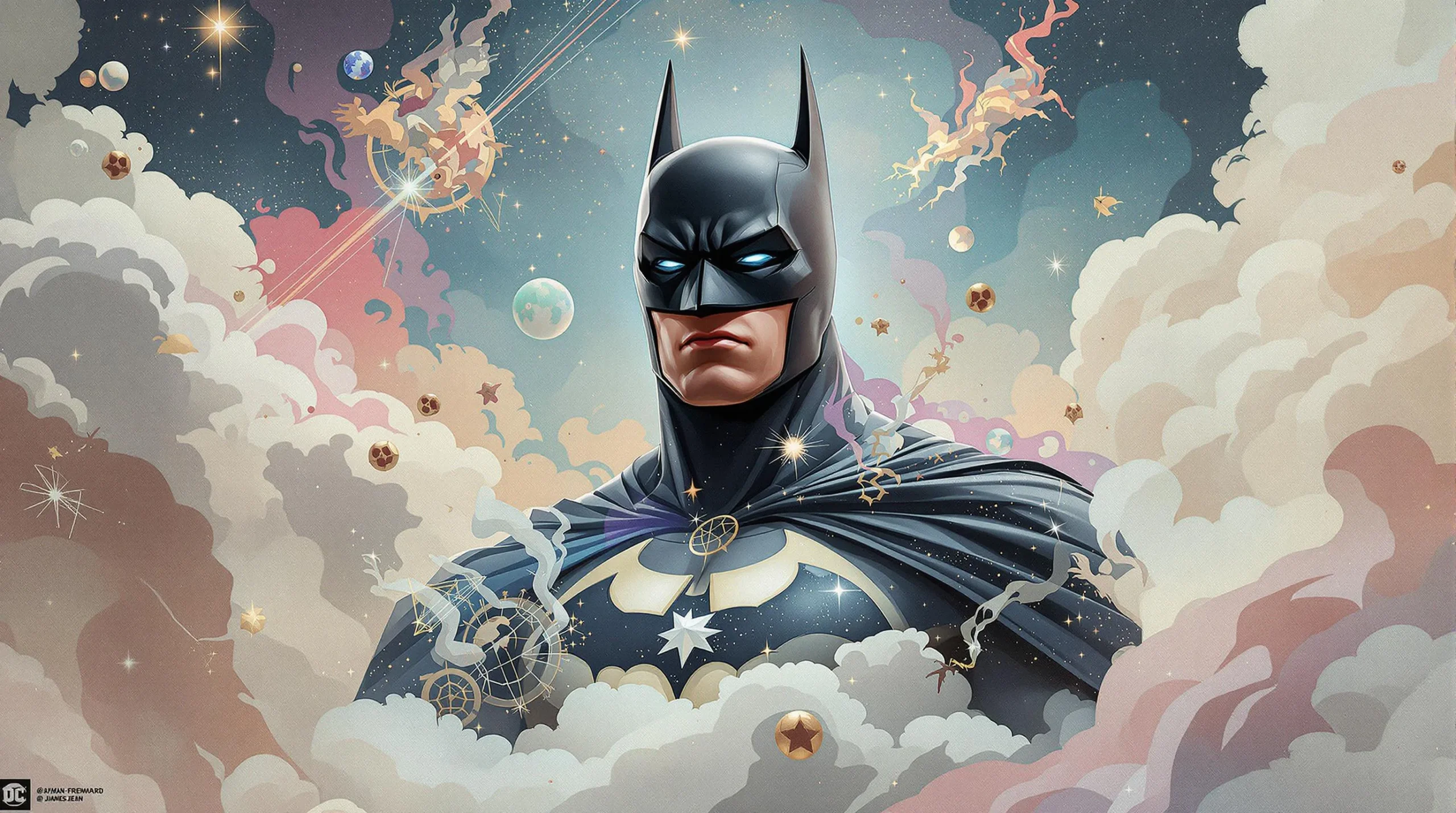


Batman

Archetype Meaning & Symbolism

Vengeful, Just, Disciplined, Obsessive, Resilient, Solitary, Wealthy, Mourning, Prepared, Theatrical

  • It's not who I am underneath, but what I do that defines me.

If Batman is part of your personal mythology, you may...

Believe

  • You may believe that your greatest trauma can be repurposed as your most potent fuel.
  • You may believe that through sheer force of will and discipline, the limits of human potential can be radically expanded.
  • You may believe that justice is not something you are given, but something you must create and enforce yourself.

Fear

  • You may fear that one moment of weakness will lead to a catastrophic failure that harms those you've sworn to protect.
  • You may fear that the line between justice and vengeance is perilously thin, and that you are always in danger of crossing it.
  • You may fear letting anyone truly close, because love is a vulnerability that can be used as a weapon against you.

Strength

  • Your capacity for intense focus and strategic planning is nearly unparalleled.
  • You possess a formidable resilience, an ability to endure physical and psychological hardship that would break most people.
  • You are governed by a powerful, self-defined purpose that gives your actions immense weight and direction.

Weakness

  • You may be emotionally walled-off, making genuine intimacy and vulnerability feel almost impossible.
  • Your relentless drive can easily curdle into a self-destructive obsession, neglecting health, rest, and personal happiness.
  • You may have an ingrained refusal to ask for help, believing that all burdens must be carried alone.

The Symbolism & Meaning of Batman

The Batman archetype is a modern myth written in the ink of trauma. It proposes a radical alchemy: that the thing you fear most, the bat that flew through the window of your youth, can be worn as a cloak of power. To have this figure in your personal mythology is to court the idea that a defining wound need not be a scar you hide, but a symbol you brandish. He represents a conscious choice to descend into the cave of one’s own psyche, to confront the darkness, and to emerge not healed, but weaponized. This is not about therapy, it is about transfiguration. The symbolism is one of perfect, terrifying control, the will imposing its order on the chaos of both the self and the city.

He is also a testament to the power of the vow. In a world of shifting values and situational ethics, the Batman archetype clings to a self-imposed, absolute code. This code, often forged in a moment of profound loss, becomes the central pillar of one's existence. It is a private religion with a congregation of one. This may suggest a personal mythology where your life is governed by a singular, non-negotiable promise you made to a younger version of yourself. Your actions are not defined by societal expectation or external law, but by this sacred, internal contract. The mask, then, is not just a disguise: it is a priestly vestment, a symbol of one's devotion to that vow.

The archetype further explores the permeable membrane between wealth and responsibility, power and justice. He is the specter of inherited privilege turned inside out, where immense resources are not for comfort but for a crusade. This could mean that your personal mythology grapples with the meaning of your own resources, be they financial, intellectual, or emotional. Are they for personal gain, or are they ammunition for a greater cause? The Batman figure suggests that true power lies not in acquisition, but in its disciplined, strategic, and often anonymous application in the service of an ideal, turning the ivory tower into a watchtower.


Batman Relationships With Other Archetypes

The Gothic City

The relationship between The Batman and the City may be the most profound of all—a kind of tormented symbiosis. The City is not merely a stage for his nightly passion play; it could be the very ink from which he is drawn, a labyrinthine projection of his own psyche. It is a sprawling, concrete lung that breathes in corruption and exhales a miasma of fear, and he, perhaps, is a rogue antibody in its diseased system. He haunts its gargoyles and alleyways not as a conqueror, but as a groundskeeper tending to a poisoned garden, forever pruning the weeds that are, in some sense, a part of the soil itself. The City is his crucible, his patient, and his wound, a vast, echoing chamber where the cry that began his quest may never truly fade.

The Agent of Chaos

In the Agent of Chaos—that grinning jester with a nihilist’s punchline—The Batman may find his cruelest mirror. This figure is not a mere adversary but the un-thought of his own rigid philosophy, the chaotic static that proves the signal of justice is arbitrary. Their conflict could be seen less as a battle and more as a dreadful, magnetic orbit, a dance between a fist that seeks to impose order and a laugh that insists there is no order to be found. The Agent of Chaos perhaps represents the ultimate futility of The Batman’s mission, an unraveling thread on the carefully woven tapestry of his vengeance. He is the abyss that does not just stare back, but winks, suggesting that the entire crusade is a joke and The Batman is the only one not in on it.

The Primal Fear

The Batman's totem—the bat itself—is not a creature he commands but a terror he has ingested. His bond with this Primal Fear could be a form of radical alchemy, transmuting the subterranean darkness of a personal trauma into a broadcast signal of dread. He wears the symbol not as a costume but as a second skin grafted over a childhood wound, a constant, whispering reminder of the fragility that birthed his strength. The bat is the echo he has weaponized, a shard of the night sky he has swallowed to make the darkness his own. In doing so, he has perhaps made a covenant not with justice, but with the very thing that men of power and privilege believe themselves to be above: raw, animalistic fear.

Using Batman in Every Day Life

Navigating Personal Trauma

When confronted with a past event that feels like a foundational wound, the Batman archetype offers a script not of mere recovery, but of transformation. It suggests channeling that pain, that memory of the pearls scattering on the pavement, not into forgetting, but into a forge. Your personal 'Crime Alley' may become the origin point of a new, highly disciplined version of yourself, one who uses the intimate knowledge of suffering to build an impenetrable resolve and a purpose that answers the chaos of the past.

Solving Intractable Problems

Faced with a seemingly impossible challenge at work or in life, one might adopt the detective's cowl. This is not about simple problem-solving: it is about total immersion. It is the practice of creating a 'Batcave' of the mind, a space for obsessive data collection, for mapping out networks of causality, for anticipating every move of the opposition. It is the belief that no problem is unsolvable with enough preparation, tactical thinking, and the sheer will to stare into the abyss of the puzzle until it blinks first.

Managing a Dual Existence

Many of us live with a schism between our public and private selves: the competent professional and the secret poet, the sociable friend and the solitary thinker. The Batman mythos provides a dramatic framework for this duality. It acknowledges that the public persona may be a necessary performance, a 'Bruce Wayne' designed to navigate the world. This allows one to protect their true, more vulnerable, or more mission-driven self, giving them the space to operate without compromise, understanding that the mask you show the world may be what allows your true work to be done in the shadows.

Batman is Known For

No Superpowers

A relentless dedication to pushing the limits of human potential

intellect, physical prowess, and willpower, without the aid of superhuman abilities.

The Bat-Family

The creation of a found family, a network of allies and proteges bound not by blood, but by a shared, dangerous mission and a deep, often unspoken, trust.

Gotham City

An almost symbiotic relationship with his environment, representing the belief that one must take ultimate responsibility for the soul of their own city, their own community, their own patch of ground.

How Batman Might Affect Your Personal Mythology

How Batman Might Affect Your Mythos

When the Batman archetype bleeds into your personal mythos, your life story may cease to be a narrative of healing and become one of harnessing. A central trauma is no longer an event to be moved past, but the very crucible in which your purpose was forged. Your myth may be re-written as a story of a 'fall' that was, in fact, the beginning of a deliberate, calculated ascent into a new form of being. Life is not a series of accidents, but a campaign. Every setback is intelligence, every loss is fuel, every relationship is a potential asset or liability to the mission.

Your personal narrative might also become a story of duality, of a carefully curated split. There is the life lived in the light: the social obligations, the career, the persona. Then there is the life of the night: the true work, the private obsession, the adherence to a code that no one else can see. This mythos is not about integration, but about compartmentalization as a survival strategy. It is the story of a self that is intentionally fractured to protect its core, believing that the only way to remain whole is to live as two separate, yet symbiotic, beings.

How Batman Might Affect Your Sense of Self

To see oneself through the lens of the Batman archetype is to view the self as a project of relentless self-improvement and control. The body is not a vessel for experience so much as a tool to be sharpened. The mind is not a garden to be tended but a database to be optimized. This may cultivate a profound sense of competence and self-reliance, a belief that you are equal to any task because you have prepared for every contingency. The self is defined not by feelings or identity, but by capability and function.

This perspective, however, could also foster a deep and abiding loneliness within the self. If the 'true' self is the cowled one, the vigilant operator, then the public self may feel like a hollow performance. Compliments and accolades directed at the unmasked persona may feel meaningless, as they are praise for a fiction. This can lead to a state of internal exile, a feeling of being a stranger in your own life, where the only moments of authentic selfhood are those spent in solitude, planning, or executing the mission.

How Batman Might Affect Your Beliefs About The World

Adopting the Batman archetype may color your perception of the world in shades of Gotham gray. You might see the systems of society, its laws and institutions, as fundamentally flawed, inadequate, and prone to corruption. The world is not a place that can be fixed from within the rules: it is a broken thing that requires the intervention of a dedicated, perhaps even obsessive, individual. This worldview is not optimistic. It does not believe in progress as an inevitable tide, but as a territory to be fought for, inch by bloody inch, every single night.

Consequently, your worldview could become one of hyper-vigilance. You may see potential threats and structural weaknesses everywhere. A delayed train is not an inconvenience: it is a systemic failure. A political scandal is not news: it is proof of the rot. This perspective fosters a deep-seated cynicism about human nature and societal structures, but it is a cynicism paired with a radical sense of personal responsibility. The world is broken, and it is therefore your job, and your job alone, to stand on the parapet and watch over it.

How Batman Might Affect Your Relationships

In the realm of relationships, the Batman archetype might manifest as a profound guardedness. To love someone is to give a hostage to fortune, to create a vulnerability that your enemies can exploit. Therefore, intimacy may be seen as a strategic liability. You may keep others at a distance, not out of malice, but out of a twisted sense of protection. Letting someone in close is the ultimate risk, a breach in the armor that could compromise not only you, but the entire mission. Friendships and romantic partnerships may be held at arm's length, compartmentalized away from your core identity.

Yet, this archetype also provides a model for an alternative form of connection: the found family. It suggests that the most profound bonds are forged in the crucible of a shared purpose. These are not relationships of casual affection, but of deep, tested trust and mutual reliance. This 'Bat-Family' is a clan of fellow outsiders, soldiers in the same private war. Love may be expressed not through gentle words and open vulnerability, but through a shared watch, a timely rescue, or the silent understanding that someone else is out there in the darkness with you.

How Batman Might Affect Your Role in Life

If the Batman is part of your mythos, you may feel compelled to assume the role of the silent protector, the unseen guardian of your domain. In your family, you might be the one who anticipates crises, who has a plan for every disaster, who quietly solves problems before others are even aware they exist. At work, you could be the one who stays late to ensure a project's perfection, who sees the flaws in the plan that everyone else missed, taking on the burden of vigilance so that others can rest easy. This role is rarely assigned: it is assumed, born of a belief that if you do not do it, no one will.

This self-appointed role is also that of the strategist and the moral anchor. You may position yourself as the one who holds the line, who adheres to a strict code when others are tempted by compromise. This can make you an indispensable resource, the person people turn to when things fall apart. But it is also an incredibly isolating role. You are the one who makes the hard decisions, who carries the weight of the consequences alone. You are on the board, but you may also be the one who sees all the pieces, a lonely position that separates you from the other players in the game.

Dream Interpretation of Batman

To dream of the Batman in a positive context may signal an integration of your own shadow. It could suggest you are ready to face a deep-seated fear, the 'bat' in your own psychic cave, and transform it into a source of power and control. His appearance might represent the emergence of your own competence, discipline, and strategic mind. You may be stepping into a new phase of personal power, where you feel prepared and capable of protecting yourself and your values. He is the symbol of your own harnessed potential, your will made manifest.

In a negative light, a dream of Batman could be a warning against obsession and emotional isolation. He may represent a part of you that has become rigid, unforgiving, and cut off from human connection. Dreaming of him might indicate that your vigilance has curdled into paranoia, or that your mission has consumed your humanity. He could be a symbol of burnout, the shadow of a hero who refuses to rest, heal, or ask for help, endlessly replaying a trauma instead of mourning it. His presence could be your psyche's way of telling you that you are losing yourself to the cape.

How Batman Archetype Might Affect Your Needs

How Batman Might Affect Your Physiological Needs

When the Batman archetype informs your mythos, your basic physiological needs might be viewed as inconvenient variables to be managed, not essential requirements to be met. Sleep is not for rest, but for minimal recovery before the next phase of the mission. Food is not for pleasure, but for fuel, precisely calculated for optimal performance. The body itself may be seen as an instrument, a piece of equipment that must be relentlessly trained, pushed, and punished into a state of peak readiness. This can create a disconnect from the body’s natural rhythms, prioritizing will over wellness.

This perspective could lead to a state of perpetual, low-grade physical stress. The body is always on high alert, primed for action in a way that can strain the nervous system and exhaust adrenal reserves. Minor pains may be ignored, injuries worked through, and fatigue treated as a weakness of character rather than a biological signal. The foundational belief is that the body is subservient to the mind and the mission. This can result in a formidable physical presence, but one that is often brittle, scarred, and running on the fumes of sheer willpower, always one step away from a critical system failure.

How Batman Might Affect Your Ideas of Belonging

The need for belongingness, seen through the Batman archetype, becomes a complex and often contradictory drive. On one hand, there is a profound sense of being an outsider, fundamentally separate from the mainstream of humanity. You may feel like an observer, watching the warmth and easy camaraderie of others from a cold distance. Conventional groups, parties, and social gatherings may feel alienating, a charade you must perform. The sense of belonging to the normal world is sacrificed for the sake of the mission, leading to a deep, resonant loneliness.

On the other hand, the archetype allows for a different, more intense form of belonging. It is not found in the crowd, but in a small, select circle of allies who share the code and understand the cost: a 'Bat-Family'. This is belonging forged in shared adversity and unwavering trust. It is the bond between soldiers who have fought in the same trenches. This form of love and connection is not about ease or comfort, but about loyalty and shared purpose. It may be less expressive, but it is, in its own way, fiercely deep and utterly dependable.

How Batman Might Affect Your Feelings of Safety

From a Batman-informed perspective, safety is not a passive state granted by society, but an active, unending project of personal engineering. It is a fortress built of preparation, knowledge, and control. Your need for safety may manifest as a desire to master your environment completely. This could mean physical security measures, but more likely it means intellectual and strategic dominance. Safety is knowing every exit, having contingency plans for your contingency plans, and possessing the skills to neutralize any perceivable threat. The world is seen as inherently chaotic and dangerous, so safety is a bastion you must construct yourself.

This drive for safety could also foster a deep-seated paranoia. If safety must be personally guaranteed, then any unknown variable is a potential threat. A new person in your life is not a friend, but a subject to be vetted. A change in routine is not an opportunity, but a potential disruption to be analyzed. True safety, in this mythos, is an illusion. The best one can hope for is a state of superior readiness. This constant state of alert can be exhausting, making it difficult to ever truly feel at peace or secure, as the watch is a duty that never ends.

How Batman Might Affect Your Views of Esteem

Esteem, in a mythology shaped by Batman, is not sourced from external validation but from internal metrics of competence and adherence to the code. Praise for your public self, your 'Bruce Wayne', may feel hollow and unsatisfying because it is directed at a mask. True self-esteem comes from the quiet, personal knowledge that you have successfully executed a difficult task, that you have honored your vow, that you were prepared when the crisis came. It is the esteem of the master craftsperson who needs no one else to admire their work because they know its quality intimately.

This internal locus of esteem can make you incredibly resilient to criticism and independent of social trends. However, it can also be a brutal taskmaster. Your self-worth may become precariously balanced on a knife's edge of performance. A single failure, a mistake that leads to negative consequences for others, can be catastrophic to your sense of self. Since your esteem is tied to your effectiveness, any lapse can trigger a devastating crisis of identity, proving the fear that you are not, in fact, good enough to carry the weight you have chosen to bear.

Shadow of Batman

When the shadow of the Batman archetype takes hold, the disciplined protector decays into the paranoid tyrant. The vow for justice curdles into a thirst for pure vengeance. The shadow self no longer walks the fine line but erases it entirely, deciding that the criminals he fights do not deserve mercy or the rule of law. He becomes a figure of pure terror, using fear not as a strategic tool, but as his primary mode of interaction with the world. The mission is no longer to save the city, but to punish it. His allies are not partners, but disposable assets, and his relationships are defined by manipulation and suspicion.

In this shadow form, the compartmentalization collapses into a complete dissociation from humanity. There is no 'Bruce Wayne' anymore, only the Bat, a creature of pure, obsessive rage. The refusal to heal becomes a pathology, endlessly picking at the wound of the past until it infects every aspect of the present. This is the Batman who becomes the very thing he swore to destroy: an agent of chaos and fear, ruling his small kingdom of night with an iron fist, utterly alone in a fortress of his own making, having sacrificed his soul for a victory that has lost all meaning.

Pros & Cons of Batman in Your Mythology

Pros

  • The archetype provides a powerful narrative for transforming pain into purpose, offering a path to action rather than despair.
  • It fosters an extraordinary level of personal competence, discipline, and strategic thinking, making one highly effective and resilient.
  • It cultivates a profound sense of responsibility and a drive to protect and serve one's community or family.

Cons

  • The intense focus on mission and control can lead to profound emotional isolation and an inability to sustain healthy, intimate relationships.
  • It can foster a savior complex and a cynical worldview that dismisses collaborative or systemic solutions.
  • The lifestyle of constant vigilance and self-sacrifice is a direct path to burnout, obsession, and physical and mental self-destruction.