Believe
 Fear
Fear Strength
 Weakness
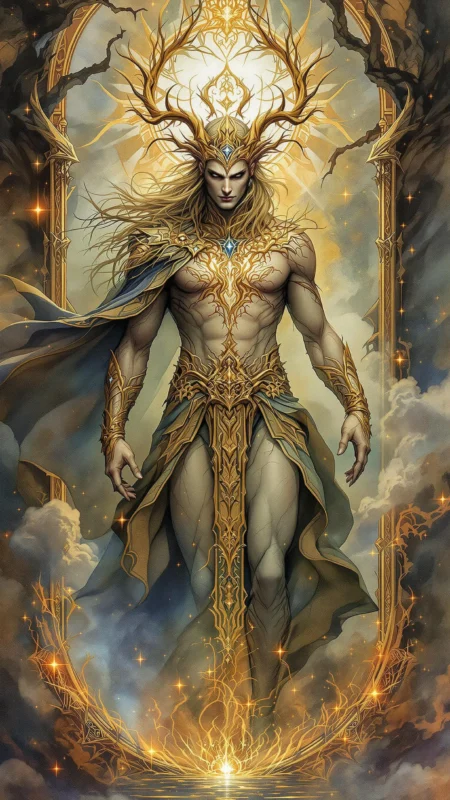
To carry the Baldur archetype in your personal mythology is to be acquainted with the paradox of the beautiful soul. You may be a vessel of light, a source of joy and peace for those in your orbit, someone whose presence alone seems to raise the temperature of a room. This isn't merely about appearance, but a quality of being: an innate goodness, a radiant optimism, a capacity for seeing the world not as it is, but as it could be. This archetype is the golden child, the beloved friend, the artist whose work is suffused with a purity that feels both miraculous and heartbreakingly fragile. It is the story of inherent worth, of a grace that is given, not earned, and the magnetic pull of that grace on others.
Yet, this radiance is intrinsically tied to a profound vulnerability. The myth of Baldur is not a celebration of perfection but a tragedy about it. His invulnerability is a trick of the light, a borrowed armor dependent on the love and protection of others. Within this mythology, your greatest strength, your belovedness, could also be the source of your greatest blind spot. You may come to rely on the oaths sworn by others, forgetting to cultivate your own resilience. The symbolism points to a life where danger comes not from the obvious threats, the roaring lions and sharp-toothed wolves, but from the thing no one thought to ask, the small, seemingly insignificant detail everyone, including you, dismissed as harmless.
The modern meaning, therefore, is a meditation on the relationship between innocence and wisdom. It suggests that a life of pure light, shielded from all harm, may be a life unlived. Baldur’s death is a catalyst, the tragic event that ushers in the twilight of the gods and the promise of a new world born from the ashes. In your own mythos, a 'Baldur moment'—a shattering of innocence, a painful confrontation with your own mistletoe—could be the very event that allows for true growth. It may be the end of the golden summer of youth, but it is also the beginning of a deeper, more resilient self, one who understands that even the sun has shadows and that true strength lies not in being untouchable, but in the ability to rise again after the fall.