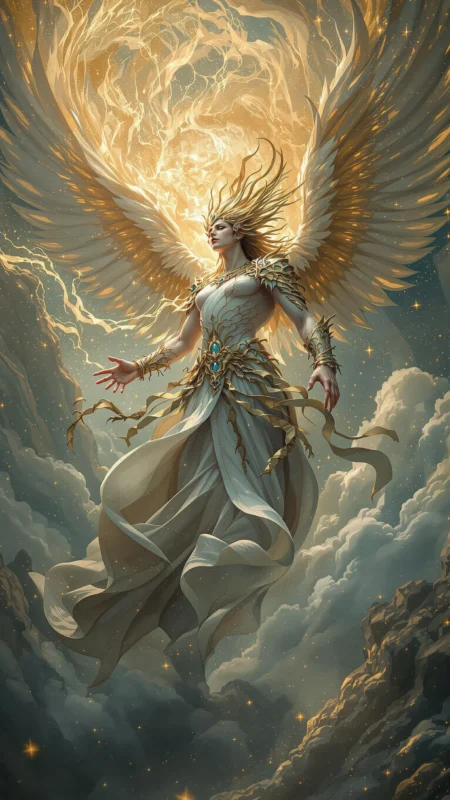


Azrael

Archetype Meaning & Symbolism

Sober, final, transitional, necessary, compassionate, inevitable, silent, impartial, releasing, transformative

  • Say, 'The angel of death will take you who has been entrusted with you. Then to your Lord you will be returned.'

If Azrael is part of your personal mythology, you may...

Believe

  • You may believe that endings are not failures, but sacred and necessary acts of completion that create space for the new.
  • You may believe that the courage to let go is a greater strength than the power to hold on.
  • You may believe that life's preciousness is a direct result of its impermanence, and to deny endings is to deny the beauty of the present.

Fear

  • You may fear that your comfort with endings makes you appear cold, morbid, or unfeeling to others.
  • You may fear that you will become fatalistic, giving up on things prematurely by misinterpreting a difficult phase as a final ending.
  • You may fear becoming a 'harbinger of doom' in your social circles, the person whose presence signals that an uncomfortable truth is about to be spoken.

Strength

  • You may possess an extraordinary calm and clarity in moments of crisis, loss, or transition, providing a grounding presence for others.
  • You may have the ability to make clean, decisive, and compassionate choices about what must end in your life, freeing you from lingering attachments and regrets.
  • You may have a profound capacity for empathy, especially for those experiencing grief, because you are not afraid to sit with the reality of their loss.

Weakness

  • You may have a tendency toward emotional aloofness or premature detachment, cutting yourself off from experiences to avoid the eventual pain of their ending.
  • You may risk fatalism, sometimes failing to fight for a relationship, a project, or a cause that could, with effort, be saved and transformed rather than ended.
  • You may make others deeply uncomfortable with your directness, bypassing their need for denial and speaking truths they are not yet ready to hear.

The Symbolism & Meaning of Azrael

In a modern personal mythology, Azrael is rarely about a literal, physical death. Instead, this archetype emerges as the sovereign of endings, the patron saint of the closed door and the finished chapter. To have Azrael as part of your inner pantheon is to have a profound relationship with finality. It is the recognition that for anything new to be born, something old must pass away. This isn't the chaotic destruction of a trickster or the violent upheaval of a war god: it is the quiet, dignified, and necessary conclusion. Azrael is the energy that allows you to delete the phone number, to burn the old letters, to accept that a certain path has reached its terminus. It is the wisdom of the farmer who knows the harvest is an act of killing the plant to sustain life, the understanding that endings are not a failure but a function of a living system.

The presence of Azrael in one’s life story suggests a capacity for immense courage: the courage to look at what is over and call it by its name. Where others may cling, deny, or bargain, the individual aligned with Azrael may find a strange peace in the truth of an ending. This archetype sanctions grief not as a weakness, but as a ritual. It provides the gravitas for goodbyes, transforming them from painful ruptures into meaningful rites of passage. It is the internal permission to stop fighting a battle that has already been decided, not in defeat, but in wise surrender to the flow of what is. It is the difference between a house falling to ruin and a house being lovingly decommissioned, its materials salvaged for a new structure.

Ultimately, Azrael symbolizes the profound liberation that comes from accepting impermanence. By making peace with the end, you are paradoxically freed to live more fully in the present. The constant, low-grade anxiety about potential loss is replaced by a solemn appreciation for the 'now.' Every conversation, every project, every season of life becomes more precious because it is understood to be finite. This archetype helps you curate your life, not by endlessly accumulating, but by knowing what to release. It is the silent, ever-present cosmic editor, the one who knows that the most powerful stories are not the longest, but those with a perfect, resonant ending.


Azrael Relationships With Other Archetypes

The Gardener

The Azrael may share a profound, earth-stained kinship with The Gardener. Both are custodians of cycles, understanding that endings are not an absence but a necessary cultivation. A gardener’s shears, in their own small way, could be seen as a silver scythe, pruning the dead branch so the rose may bloom, clearing the spent annuals to enrich the soil for spring. Theirs is not a relationship of malice, but of quiet, sober necessity. The Gardener knows the scent of decay is the overture to new life, just as The Azrael might perceive that the closing of one story is what allows the ink to dry, giving it meaning. They both work in the service of a larger, often unseen, design, their hands performing the somber alchemy of turning what-has-been into what-may-yet-be.

The Midwife

Perhaps the most poignant relationship The Azrael has is with The Midwife, for they are perfect, inverse reflections. They are the keepers of the two great, silent thresholds, standing at opposite ends of the same hallway. One presides over the raw, gasping entry into the world, the other over the quiet, sighing exit. Theirs is not a bond of collaboration but of cosmic symmetry, like two celestial poles whose opposition defines the very sphere of existence. They may never meet, yet the work of one validates the other, a silent, antiphonal chant sung across the arc of a lifetime. The Midwife’s hands guide a soul into the light of the known, while Azrael’s presence, one could argue, ushers it into the gentle dark of the great unknown, each performing a sacred and mirrored duty.

The Lighthouse

One might see in The Lighthouse a kind of stationary, stone-and-mortar cousin to The Azrael. Both are solitary figures, posted at the precipice of a vast and formless unknown. The Lighthouse casts its cyclical beam across a chaotic sea, a singular, rational promise in an overwhelming darkness, guiding ships away from ruin or toward a safe harbor. In a similar vein, The Azrael could be perceived not as the storm itself, but as the final, steady beacon that appears when the fog of life grows too thick to navigate. It is a relationship of purpose, if not of kind. While the lighthouse is a guide for the ongoing journey, The Azrael may represent the ultimate, personal waypoint, the last quiet light one sees, signaling that the long, treacherous crossing has, at last, come to its end.

Using Azrael in Every Day Life

Navigating a Career Change

When a long-held professional identity dissolves, the Azrael archetype offers a framework not for failure, but for dignified conclusion. It is the force that allows you to pack up your desk, not with bitterness, but with a quiet reverence for the work that was done. It is the inner permission to turn off the lights in that office for the last time, feeling the finality as a release, a clearing of the slate upon which a new story can be written. This archetype helps you sever the emotional tethers to an old title, allowing the 'death' of the 'former professional you' to be a clean, necessary event, preventing the haunting of what-ifs.

Ending a Relationship

In the delicate, often messy act of parting ways, Azrael provides a model of compassionate finality. It is the courage to speak the last words that need to be spoken, to create a definitive end rather than a slow, ambiguous fade. This archetype discourages ghosting, not from a place of moral prescription, but from an understanding that a clean ending honors the reality of what was. It is the ability to be the gentle, firm hand that closes the door, acknowledging the pain but understanding the necessity of the closure for both individuals to truly move on. It transforms a painful separation into a solemn, respected rite of passage.

Overcoming an Old Belief

Beliefs, especially those about ourselves, can be the hardest things to let die. The Azrael archetype can be the internal agent that performs this necessary act. It is the quiet moment of realization that a long-held story, 'I am not creative' or 'I am not worthy of love', must end. This is not a violent destruction, but a purposeful, conscious act of withdrawing the energy that sustains it. Azrael allows you to see the belief not as an eternal truth, but as a chapter that has reached its final page. You can then officiate its funeral, mourn its passing if necessary, and finally, experience the liberation that comes from its absence.

Azrael is Known For

The Great Transition

Azrael is fundamentally known as the agent of transition, the being that facilitates the separation of the soul from the body at the moment of death. This is not an act of malice, but a necessary, functional role in the cosmic order, ensuring the passage from one state of being to another.

The Cosmic Scribe

In some traditions, Azrael is depicted as a cosmic scribe, holding a vast book or scroll upon which the names of all humanity are written. He is said to know the exact moment of each person's birth and death, carrying out a divine schedule with perfect impartiality.

Compassionate Impartiality

Unlike vengeful spirits or demons, Azrael is typically portrayed as impartial and often compassionate. The archetype's role is not to judge but to serve a fundamental law of existence. This makes Azrael a figure of solemn necessity rather than one to be feared for its own sake.

How Azrael Might Affect Your Personal Mythology

How Azrael Might Affect Your Mythos

When Azrael becomes a key figure in your personal mythos, your life story shifts from a linear narrative of perpetual acquisition and ascent to a cyclical saga of transformation. Your mythos is no longer solely about what you build, but also about what you have the grace to let dismantle. Victories are not just about winning, but also about knowing when the game is over and walking away with dignity. The core plot of your life may revolve around a series of profound endings and subsequent rebirths: the death of a career giving rise to a vocation, the end of one identity allowing a more authentic self to emerge. Your personal legend becomes less of an epic of conquest and more of a sacred text on the art of release.

Your narrative may be punctuated by moments of stillness and quiet reflection, spaces where you consciously take stock and prune what is no longer vital. You may see yourself as a tender of a garden, knowing that pruning and the decay of autumn are as crucial as the blossoms of spring. The villains in your story might not be external foes, but rather the temptation to cling to the past: the ghost of a former love, the echo of an old ambition. The climax of your story might not be a grand battle, but a quiet, internal moment of acceptance where you finally let something, or someone, go. Your mythos becomes a testament to the idea that a well-lived life is measured not by what it holds onto, but by what it has the courage to release.

How Azrael Might Affect Your Sense of Self

Integrating the Azrael archetype may fundamentally alter your perception of self. Your identity might become less fused with external roles, achievements, or relationships. If your job, your social status, or your role as a partner can end, then who are you? Azrael prompts this question, guiding you toward a core self that is resilient to transition. You may begin to see your 'self' not as a static statue to be polished and protected, but as a river: always flowing, ever-changing, its essence defined by its movement, not by any single shape it takes. This can lead to a profound sense of inner security, one that is not dependent on external validation.

You might cultivate a kind of compassionate detachment from your own dramas. When faced with setbacks or losses, you may be able to step back and witness the 'death' of a particular hope or plan without it annihilating your entire sense of worth. This is not apathy, but a form of profound self-compassion. It's the ability to say, 'This part of my story is over, and I will grieve it, but *I* am not over.' You may come to value your own integrity, your grace under pressure, and your wisdom in navigating change far more than any transient success. Your self-esteem becomes rooted in the courage to face endings, which is a source of strength that no external event can take away.

How Azrael Might Affect Your Beliefs About The World

With Azrael as a guide, your worldview may be colored by a deep appreciation for cycles and impermanence. You might look at a thriving forest and see not just life, but also the fallen logs feeding new growth. You see the beauty in ruins, the stories in decay, the necessity of winter. The modern world's obsession with perpetual growth, endless progress, and the denial of aging may seem naive or even dangerous to you. Your perspective could become longer, more patient, more aligned with natural rhythms than with quarterly reports or social media trends. The world is not a problem to be solved or a resource to be exploited, but a great, breathing organism in a constant state of flux.

This perspective might also foster a unique kind of hope. It is not the optimistic hope that things will always get better, but a resilient hope that even after the most devastating endings, something new and unforeseen can emerge. You may find meaning not just in success stories, but in the dignified closure of failed projects, noble efforts that ran their course, and ideas whose time has passed. Your worldview becomes less about achieving a permanent state of happiness or stability, and more about skillfully and soulfully navigating the inevitable waves of creation and dissolution that constitute existence. This is a worldview that can hold sorrow and joy in the same hand, seeing them as inseparable parts of a whole.

How Azrael Might Affect Your Relationships

In relationships, the Azrael archetype may manifest as a profound honesty about their nature. You might understand, on a cellular level, that every connection is temporary in its current form. Paradoxically, this may not lead to detachment, but to a more intense and grateful presence. Knowing that this conversation, this shared meal, this moment is fleeting, you may savor it more completely. You could be a partner who is less likely to make promises of an impossible forever, but more likely to offer an absolute commitment to the present, in all its beauty and imperfection.

You might also become the person others seek out when they are navigating their own endings. You possess the capacity to hold space for grief without offering platitudes or false cheer. You can be a steady, non-judgmental presence for a friend going through a divorce or grieving a loss because you are not afraid of the finality they are facing. However, this same quality could be challenging. Your comfort with endings might be misinterpreted as coldness, and your inability to participate in the collective denial about a relationship's demise could make you an uncomfortable companion for those not ready to face the truth.

How Azrael Might Affect Your Role in Life

Embracing Azrael may shape your perceived role in the world into that of a 'transition specialist' or a 'midwife of endings.' This is rarely a literal job, but a way of being. In groups, in families, in workplaces, you might be the one who senses when an initiative has lost its energy, when a conversation is complete, or when a team needs to be gracefully disbanded. You don't cause these endings, but you may be the one with the clarity to name them and the compassion to help others navigate through them. Your role is not to be the executioner, but the gentle guide who helps souls—be they the souls of people, projects, or dreams—pass peacefully from one state to another.

This role carries a solemn responsibility. You might feel called to create rituals of closure where none exist: a final team dinner that honors the work done, a letter that brings a definitive and kind end to a friendship, a personal ceremony to release an old dream. You may see your purpose as helping your community or your own soul maintain its health by pruning what is dead or dying. It is a quiet, often invisible, but essential role. You are the keeper of the sacred gate between what was and what will be, ensuring that passages are made with awareness and dignity rather than with chaos and regret.

Dream Interpretation of Azrael

To dream of Azrael in a positive context, perhaps as a silent, calm, or even gentle figure, may suggest that your subconscious is ready for a significant release. This dream could be a profound affirmation that you are prepared to let go of something that no longer serves you: a painful memory, a limiting belief, a draining job, or a relationship that has run its course. The dream is not a portent of physical death, but a symbol of psychological readiness for transformation. Seeing Azrael might mean you have reached a state of acceptance about a necessary ending, and your psyche is signaling that it is safe and right to proceed. It can be a dream of immense relief, a spiritual exhalation.

Conversely, if Azrael appears in a dream as a terrifying, menacing, or chasing figure, it likely points to a deep-seated fear of an impending and unavoidable change. You may be desperately clinging to a situation or identity that your deeper self knows is over. This frightening Azrael is the personification of your own resistance to letting go. The dream could be a warning that by denying this necessary 'death,' you are causing yourself more suffering. It might also reflect a shadow aspect, where you feel a part of you is being 'killed off' by external circumstances or by another person, and you feel powerless in the face of this termination.

How Azrael Archetype Might Affect Your Needs

How Azrael Might Affect Your Physiological Needs

From a mythological perspective, integrating Azrael attunes you to the fundamental physiological reality of the body: its finitude. This doesn't necessarily foster hypochondria; instead, it may cultivate a deep, abiding respect for the simple mechanics of being alive. The act of breathing, for instance, could become a conscious meditation on the threshold between life and non-life, a constant, gentle rhythm of intake and release. This awareness can translate into a more intuitive approach to physical needs, a sense of caring for the body not as a machine to be optimized for eternity, but as a precious, temporary vessel to be honored and sustained for its season.

The archetype may also inform how you experience rest and sleep. Sleep itself is a small 'death' of consciousness, a daily surrender. An individual aligned with Azrael might find it easier to yield to the body's need for rest, seeing it not as lost time but as a necessary dissolution that allows for renewal. There may be a deep acceptance of the body's cycles of energy and fatigue, and less of a tendency to push past physical limits in a vain attempt to deny the body's inherent rhythms and ultimate mortality.

How Azrael Might Affect Your Ideas of Belonging

The Azrael archetype may shift the need for belonging from a search for a permanent, unchanging tribe to a sense of profound, universal kinship. The ultimate commonality that connects all of humanity, and indeed all life, is mortality and the experience of loss. By being intimate with this truth, you may feel a quiet, deep empathy for every other person. You see past the superficial divisions of culture, status, and belief, and recognize a fellow traveler on the same finite journey. This creates a feeling of belonging to the whole of the human condition.

In personal relationships, this can lead to a desire for connections that are authentic and tolerant of change. You may feel you belong most with people who can talk about the hard truths, who don't shy away from grief, and who understand that relationships evolve, and sometimes, they conclude. This can make it difficult to feel at home in social circles built on superficiality or a relentless positivity that denies the shadow of life. Your sense of belongingness is fulfilled not by being part of an unassailable group, but by sharing a moment of genuine, vulnerable, and transient connection.

How Azrael Might Affect Your Feelings of Safety

The Azrael archetype fundamentally reframes the need for safety. A conventional view of safety involves building walls, accumulating resources, and eliminating uncertainty to create a fortress against loss. For one whose mythos includes Azrael, this approach seems futile. True safety is not found in the permanence of your surroundings, but in your internal capacity to face their impermanence. Safety becomes a psychological and spiritual resilience, the deep-seated knowledge that you can survive endings. It is the trust that even if the fortress walls crumble, your core self will endure.

This might mean you feel paradoxically safer in the world because you have made peace with its inherent insecurity. Your fear of loss, which is the root of so much anxiety, may be diminished. Safety is therefore not the absence of threat, but the absence of the terror of change. This allows you to take calculated risks, to love deeply without being crippled by the fear of heartbreak, and to commit to ventures without being destroyed if they fail. Your foundation is not built on the shifting sands of external circumstance, but on the bedrock of your ability to gracefully navigate whatever comes, including the end.

How Azrael Might Affect Your Views of Esteem

When Azrael is part of your mythos, the foundations of your self-esteem may undergo a radical shift. Esteem is no longer sourced from accumulating successes, titles, or praise, as these are all recognized as transient. Instead, self-worth is derived from the *how* rather than the *what* of your life. Esteem may be built on the courage with which you face difficult truths, the grace you show in letting go, and the integrity you maintain during periods of dissolution. Your ability to handle an ending with compassion and dignity might become a greater source of pride than the achievement that preceded it.

This fosters a very stable, internal locus of esteem. You are not devastated by criticism or failure because your worth is not contingent on perpetual success. You may even see your 'failures'—the projects that ended, the relationships that concluded—as part of a rich tapestry of experience that has honed your wisdom and character. Respect from others is valued, but self-respect, earned by navigating the full, often painful, spectrum of life with awareness and fortitude, becomes paramount. You value yourself for your resilience, a quality that is forged in the very endings that others fear.

Shadow of Azrael

The shadow of Azrael manifests in two terrifying extremes: ruthless severance or paralytic stagnation. In its hyperactive shadow, the archetype becomes a cold, unfeeling executioner of potential. You might use 'the need for an ending' as a justification for a lack of commitment, cutting off relationships, projects, and opportunities at the first sign of difficulty. Here, Azrael's compassionate sobriety curdles into a brutal, sterile pragmatism. You become the person who fires someone with a shrug, who ends a friendship via text, who disposes of anything inconvenient without ritual, respect, or grief. It is the misuse of the sacred sword of ending, wielded not to prune for health, but to clear-cut for personal convenience, leaving a trail of unresolved pain.

Conversely, the repressed shadow of Azrael is a terror of finality that leads to a living death. This is the refusal to let anything go. Your life becomes a museum of ghosts: you remain in a dead-end job for decades, you haunt the social media of an ex from years ago, your home is cluttered with relics of past identities you cannot release. Here, the fear of the pain of an ending is so great that you choose the slow, chronic suffering of stagnation. Life loses its vitality, becoming a stagnant pond because the natural flow of beginnings and endings has been dammed by fear. In this shadow, Azrael is not a gentle guide but a terrifying spectre you spend your entire life fleeing from, ensuring you are never truly present and alive.

Pros & Cons of Azrael in Your Mythology

Pros

  • You are liberated from the pervasive, low-grade anxiety about change and loss, allowing you to engage with life more fully and courageously.
  • You possess a rare wisdom that can be a profound gift to others, helping them find meaning and peace during life's most difficult transitions.
  • You are capable of curating a life of meaning and purpose by knowing what to keep and, just as importantly, what to release.

Cons

  • You may be perceived by others as pessimistic, detached, or cold, which can lead to feelings of isolation.
  • You run the risk of applying the 'logic of endings' too quickly, sometimes failing to put in the hard work required to save something that is merely struggling, not dying.
  • You might struggle to fully immerse yourself in moments of pure joy or hopeful beginnings, as an awareness of their eventual end is always present.