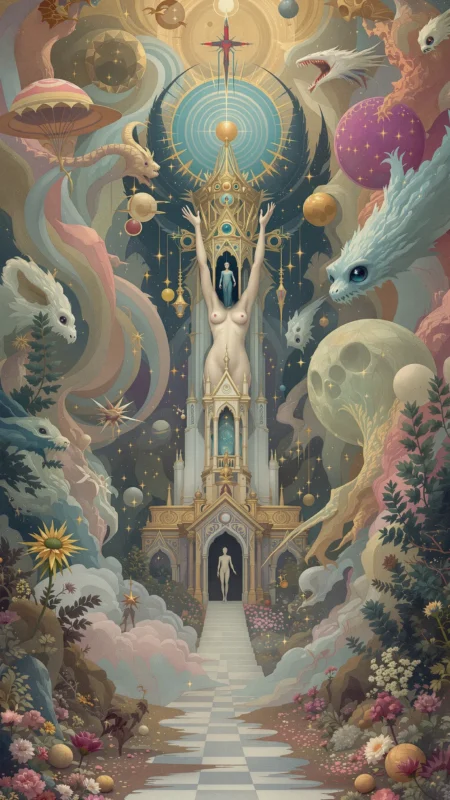


Asylum

Archetype Meaning & Symbolism

Sanctuary, Seclusion, Recovery, Containment, Madness, Solitude, Reprieve, Imprisonment, Quiet, Observation

  • The world is loud: only within these walls can you hear your own thoughts echo back as wisdom.

If Asylum is part of your personal mythology, you may...

Believe

  • True clarity is found not in discussion, but in silence.

  • My personal boundaries are the sacred walls of a temple that houses my soul.

  • The richest experiences are not collected from the world, but cultivated within the self.

Fear

  • The noise of the world will one day breach my defenses and I will lose myself in its chaos.

  • If I retreat for too long, I will be forgotten or become incapable of re-engaging with life.

  • The absolute silence of my sanctuary will reveal a truth about myself that I cannot bear to face.

Strength

  • A profound capacity for self-reflection and deep, focused creative work.

  • An immunity to peer pressure and the superficial dramas of the external world.

  • The ability to create a sense of peace and order for yourself and others, even in chaotic times.

Weakness

  • A tendency towards avoidance, using retreat to escape necessary conflict or challenges.

  • Difficulty functioning in unpredictable or highly stimulating environments, leading to a restricted life.

  • A risk of emotional detachment, valuing the safety of the sanctuary over the messy reality of relationships.

The Symbolism & Meaning of Asylum

In personal mythology, the Asylum is the sacred geography of the interior world made manifest. It is the quiet room at the center of the labyrinthine self, the walled garden where the rarest, most fragile ideas can bloom away from the trampling feet of public opinion. It may represent a necessary chapter in one's life story: a period of intentional withdrawal for the purpose of healing, creation, or profound self-inquiry. This is not the Void’s empty space, but a structured, architectural quiet. It has walls, routines, perhaps a window with a single, curated view. The symbolism here is one of deliberate containment, the understanding that for something new to grow, it first needs a vessel to protect it.

The modern meaning of the Asylum archetype has evolved beyond its clinical, often grim, history. It is now perhaps the silent rebellion against a culture of relentless connectivity and performative extroversion. To have the Asylum in your mythos is to value the unseen work: the mending of a psyche, the slow gestation of a masterpiece, the quiet recalibration of a life’s trajectory. It symbolizes the belief that the most important journeys are often not across landscapes, but through the corridors of one's own mind. It’s the personal library where you are the sole librarian, the observatory where you are the only astronomer charting your inner constellations.

However, the Asylum is eternally haunted by its shadow: the specter of madness and imprisonment. Its symbolism carries a crucial warning. A sanctuary, if inhabited for too long, becomes a prison. The peace it offers can curdle into stagnation. It asks a vital question of your personal myth: are you building a retreat, or are you building a cage? The difference may lie in the door. In a healthy Asylum, you hold the key, and the door can be opened from the inside. In its shadow form, the key is lost, or perhaps it was never yours to begin with.


Asylum Relationships With Other Archetypes

The Wanderer:

The Asylum holds a magnetic, deeply ambivalent relationship with the Wanderer. For the soul defined by movement, maps, and open roads, the Asylum is both a desperately needed harbor and a terrifying paralysis. The Wanderer may seek it out after a long, wearying journey, collapsing into its quiet embrace, but the stillness soon becomes an irritant. The walls, once a comfort, begin to feel like a judgment on the Wanderer’s essential nature. The Asylum offers a fixed point, a place to heal, but it challenges the Wanderer’s identity, asking: who are you when you are not moving towards the next horizon?

The Healer:

The Healer and the Asylum are intrinsically linked, yet distinct. The Healer is the active principle of mending, the practitioner with the tools and wisdom. The Asylum is the passive principle: the environment itself. It is the sterile operating theater, the quiet therapist's office, thesanitarium in the mountains. A Healer may work within an Asylum, but the Asylum itself is a form of medicine. Their relationship suggests that healing is not just an act, but a place. It requires a container, a space set apart from the normal course of life where the delicate work of restoration can proceed, undisturbed.

The Abyss:

The Asylum is often built precariously at the edge of the Abyss. It may be the last bastion of structure and sanity before the plunge into formless chaos, the lighthouse on a cliff above a churning, infinite sea. For some, the Asylum is a fortress to keep the Abyss out, its routines and walls a defense against the terrifying boundlessness of their own subconscious. For others, it is a safe platform from which to study the Abyss, to lower a bucket into its depths and examine what comes up. The relationship is one of proximity to terror, a constant negotiation between structured reality and the vast, unknowable void it borders.

Using Asylum in Every Day Life

Recovering from Emotional Turmoil:

After a significant loss or a period of intense stress, you might consciously invoke the Asylum archetype. This isn’t about wallowing, but about creating a designated period and space for grieving or processing. It could be a weekend retreat where communication is limited, a daily hour dedicated to journaling in a silent room, or a metaphorical ‘gated garden’ in your mind where you can tend to your psychological wounds without interruption from the world’s demands.

Incubating a Creative Project:

For the artist, writer, or innovator, the Asylum is a necessary laboratory of the soul. When a project requires deep, unbroken concentration, you may enter your personal asylum. This could mean turning off your phone for a week, renting a cabin in the woods, or simply transforming a corner of your home into a sacred, single-purpose space. Here, the raw, chaotic materials of inspiration are given the quiet and safety needed to be shaped into something coherent and new.

Establishing Personal Boundaries:

The Asylum serves as a powerful model for setting non-negotiable boundaries. When you feel psychically trespassed upon by demanding relationships or a toxic work environment, visualizing the walls of your asylum can be a potent tool. It teaches that a selective ‘no’ is not a rejection of the world, but an affirmation of your own inner space. It is the act of defining what is allowed in and what must remain outside for your own well-being to flourish.

Asylum is Known For

Sanctuary

It is known as a place of refuge and safety, a haven from the relentless pressures and stimuli of the outside world. It offers a structured quiet where the mind can settle and the soul can convalesce.

Confinement

The Asylum is equally known for its double-edged nature: its protective walls can easily become the bars of a prison. It represents the fine line between healthy solitude and self-imposed isolation, between a temporary retreat and a permanent withdrawal from life.

Transformation

This is a place where profound internal shifts may occur. Whether through healing, deep thought, or confronting one's own shadows, the purpose of entering the Asylum is to emerge changed, with a new perspective or a renewed sense of self.

How Asylum Might Affect Your Personal Mythology

How Asylum Might Affect Your Mythos

When the Asylum is a central feature of your personal mythology, your life story may not be a hero’s journey outward, but a cartographer’s journey inward. The epic moments are not battles with dragons, but breakthroughs in the quiet study. Your mythos is less about what you conquer in the world and more about the internal architectures you build, renovate, and sometimes, tear down. The major chapters of your life might be named not for the cities you lived in or the jobs you held, but for the Asylums you inhabited: The Years of the Silent Apartment, The Season of the Library Carrel, The Era of the Garden Shed.

Your narrative arc may be defined by cycles of engagement and retreat. You venture into the noisy, chaotic world to gather experiences, information, and emotional wounds, then return to the sanctum of your Asylum to process, integrate, and create. This rhythm becomes the engine of your growth. Your personal legend is not one of linear progress up a mountain, but of a spiral, circling ever deeper into a core of understanding. The climax of your story could be the successful creation of a perfect, sustainable Asylum that allows for both profound connection with the self and meaningful engagement with the world.

How Asylum Might Affect Your Sense of Self

Your sense of self may be intricately tied to your need for and ability to create sanctuary. You might see yourself as a creature requiring a specific habitat to thrive, like a rare orchid that needs the controlled environment of a greenhouse. This can foster a deep self-awareness and a commitment to self-care, a recognition that your sensitivity is not a flaw but a trait that requires careful management. You may identify as an observer, a thinker, a curator of your own inner world, valuing depth of experience over breadth.

Conversely, this archetype could foster a self-perception of being inherently fragile or broken, someone who is ‘not built for this world.’ You might see your need for asylum as a weakness, a sign that you are unable to cope with the normal rigors of life. This can lead to a sense of alienation or a self-fulfilling prophecy where you retreat not just to recharge, but to hide from challenges that you believe you are incapable of meeting. The core task is to frame the Asylum as a tool for strength, not a symptom of deficiency.

How Asylum Might Affect Your Beliefs About The World

The world, through the lens of the Asylum archetype, may appear as a beautiful but overwhelmingly chaotic place: a symphony played at a deafening volume. You might view the structures of society—the open-plan offices, the constant social demands, the 24-hour news cycle—as fundamentally inhospitable to the human soul. Your worldview could be one that champions slowness, silence, and depth in an age of speed, noise, and superficiality. You may believe that true progress, both personal and societal, happens in the quiet spaces between the shouting.

This perspective can cultivate a profound appreciation for subtlety, for nuance, for the unseen currents that shape our lives. However, it can also lead to a cynical or fearful view of the world beyond your walls. You might see society as a source of contamination, a place of meaningless strife from which you must perpetually protect yourself. The danger is in seeing the world only as a threat to be managed, rather than a complex, sometimes difficult, but ultimately enriching place to engage with.

How Asylum Might Affect Your Relationships

In relationships, you may operate like a nation with carefully monitored borders. Intimacy is possible, even deeply desired, but it must respect the sovereignty of your inner world. You might require a partner who understands that your need for solitude is not a rejection of them, but a prerequisite for your ability to be present with them. Your ideal connection is not one of constant enmeshment, but one of two self-contained worlds that choose to open their gates to one another in a trusted, intentional way.

This can lead to relationships of immense respect and depth, where both partners have ample room for their individual growth. However, it can also create barriers to intimacy. The walls of the Asylum can be raised too high, its doors barred too quickly at the first sign of conflict or misunderstanding. You may struggle with the inherent messiness of human connection, preferring the clean, controlled environment of your own company. The challenge is to build a gate that swings both ways, allowing for both sacred solitude and genuine, vulnerable connection.

How Asylum Might Affect Your Role in Life

Your perceived role in life may not be that of the frontline warrior or the charismatic leader, but rather the monk in the tower, the keeper of the lighthouse, or the archivist in the vaults. You may see your purpose as providing a calm, stable center for a chaotic world. This could manifest as being the quiet, reliable friend who always has a safe space to offer, or professionally, as a researcher, artist, therapist, or any role that requires deep focus and a tranquil environment. Your contribution is one of depth, not volume.

You might feel your role is to observe, process, and reflect back the world’s madness from a place of remove, creating art or theories that help others make sense of the chaos you so keenly feel. This can be a role of immense value, a source of wisdom for your community. But there is a risk of becoming a permanent spectator in your own life, watching the parade go by from a high window. The archetype asks you to find a balance: to use the wisdom gained in the Asylum to engage with the world meaningfully, not just to comment on it from a safe distance.

Dream Interpretation of Asylum

In a positive context, dreaming of an Asylum—perhaps a clean, well-lit sanatorium with beautiful gardens or a cozy, soundproof library—is often a direct message from the psyche that you are in profound need of rest and retreat. It may be a sign of psychic integration, suggesting you have successfully created a mental space to process difficult experiences. The dream affirms your need for boundaries and self-care. Finding such a place in a dream could symbolize the discovery of a new inner resource, a capacity for self-soothing and reflection you didn't know you possessed. It is an invitation to consciously create such a space in your waking life.

In a negative context, a dream of an Asylum can be terrifying. It may appear as a dilapidated, dark, and confusing institution from which you cannot escape. The staff might be menacing, the other inhabitants lost in their own worlds, and the corridors an endless, repeating loop. Such a dream may point to a feeling of being trapped by your own fears, routines, or isolation. It can symbolize a part of yourself that you have locked away and labeled as 'mad' or unacceptable. This dream is a warning that your sanctuary has become a prison, and your retreat from the world has severed you from a vital part of your own humanity.

How Asylum Archetype Might Affect Your Needs

How Asylum Might Affect Your Physiological Needs

The Asylum archetype in one's mythos often translates into a profound physiological need for control over sensory input. This is not a mere preference but a core requirement for well-being. The body itself may feel like a porous entity, easily overwhelmed by loud noises, bright lights, strong smells, or the psychic 'noise' of crowds. You may find that your nervous system only truly settles in environments of profound quiet and predictability. Your baseline of physiological comfort is a state of low stimulation, a stark contrast to a world that increasingly demands high-intensity engagement.

Consequently, you may structure your life around routines that create a sense of physiological safety. Predictable meal times, sleep schedules, and structured periods of silence are not just habits; they are the very architecture of your well-being. The body is treated as the ultimate asylum, and practices like meditation, gentle yoga, or even just sitting in a quiet room are the methods by which its walls are maintained. A disruption to this routine may feel like a physical violation, a breach in the fortifications that keep somatic chaos at bay.

How Asylum Might Affect Your Ideas of Belonging

Belonging, for the soul with an Asylum mythos, is a nuanced and often paradoxical affair. The roaring hearth of a large tribe or community may feel more like a threatening inferno. True belonging is not found by dissolving into a group, but by being accepted by a select few who understand and honor the need for the drawbridge to be raised. It is the quiet companionship of another who can share your silence without needing to fill it, the unspoken pact of mutual respect for each other's inner worlds.

Love and connection may be experienced most profoundly in the spaces between interactions. The feeling of belonging might arise not during a conversation, but in the comfortable knowledge that a trusted person is nearby, respecting your solitude. Intimacy is the granting of a key to one's private asylum. You may find your 'tribe' not in a physical community but in a lineage of thinkers, artists, and mystics from across history who also understood the sacredness of the inner sanctum. It is a fellowship of the quiet.

How Asylum Might Affect Your Feelings of Safety

For one guided by the Asylum archetype, safety is less about freedom from physical harm and more about freedom from psychic intrusion. The primary threat is not a predator in the shadows, but the overwhelming, incessant demands of the external world. Safety is a psychological state achieved through the creation of impenetrable boundaries. This could be a physical space—a home with the curtains drawn—or an emotional and digital one, with curated social circles and strictly managed notifications. The fundamental need is for a space where one is not perceived, not expected to respond, and not subjected to the opinions of others.

This drive for safety shapes behavior in countless ways. It may lead to an avoidance of large gatherings, a preference for one-on-one interaction, and a deep distrust of anything that threatens one’s autonomy or private mental space. The greatest sense of security comes from the knowledge that you have a place to retreat to, a 'panic room' for the soul. The ultimate fear is a state of being trapped outside, exposed and unable to return to this inner or outer sanctum, a psychic homelessness.

How Asylum Might Affect Your Views of Esteem

Self-esteem may be deeply connected to your ability to be self-sufficient and to cultivate a rich, stable inner world. You might derive a sense of competence and pride from your capacity for introspection, your ability to entertain and soothe yourself, and your independence from external validation. Your worth is not measured by your social standing or public accolades, but by the quality of the internal architecture you have built. Esteem is the quiet satisfaction of knowing you have created a sanctuary within, a place of beauty and order that is yours alone.

However, the esteem needs can also be a source of profound struggle. Society often rewards the outgoing, the loud, and the constantly visible. Your need for retreat might be misinterpreted by others—and by yourself—as weakness, antisocial behavior, or arrogance. This can lead to a pervasive sense of shame, a feeling of being 'wrongly made' for the world. A major life task, then, is to build esteem not in spite of your need for asylum, but because of it: to see your capacity for depth and silence not as a liability, but as a rare and valuable gift.

Shadow of Asylum

The shadow of the Asylum manifests when the sanctuary becomes a prison. The benevolent guardian of the psyche becomes a paranoid jailer, and the goal shifts from recovery to a permanent quarantine from life. This is the difference between a monk’s cell, a place of willed spiritual incubation, and a madman's padded room, a place of involuntary containment. In its shadow, the need for quiet becomes a phobia of noise; the desire for solitude curdles into agoraphobia. Life is viewed not as a dance of engagement and retreat, but as a constant siege where the only rational act is to bolt the doors and never leave. The rich inner world becomes a sterile, echo-filled chamber, devoid of new light or air, where old thoughts and fears circle endlessly.

The shadow can also turn outward, transforming the individual into an enforcer of sterile order. They may become judgmental of those who live loud, messy, expressive lives, seeing them as 'unwell' or 'chaotic.' In relationships and families, they might try to turn their home into a rigid institution, demanding absolute quiet and adherence to strict routines, suffocating the life and spontaneity out of their loved ones. This is the Asylum archetype attempting to 'commit' the world, to force everyone into a quiet, ordered, and lifeless version of its own perceived safety. It is the fear of life masquerading as a prescription for it.

Pros & Cons of Asylum in Your Mythology

Pros

  • Provides an essential and protected space for deep healing, creative incubation, and profound reflection.

  • Fosters a powerful sense of self-reliance and a rich, complex inner life independent of external validation.

  • Acts as a powerful defense against burnout, anxiety, and the psychological damage of a hyper-connected, over-stimulated culture.

Cons

  • Can lead to chronic social isolation, loneliness, and a debilitating fear of engaging with the world.

  • May foster a sense of fragility, victimhood, or specialness that hinders personal growth and resilience.

  • The comfort and safety of the sanctuary can become an addiction, preventing one from taking necessary risks or having experiences essential for a full life.