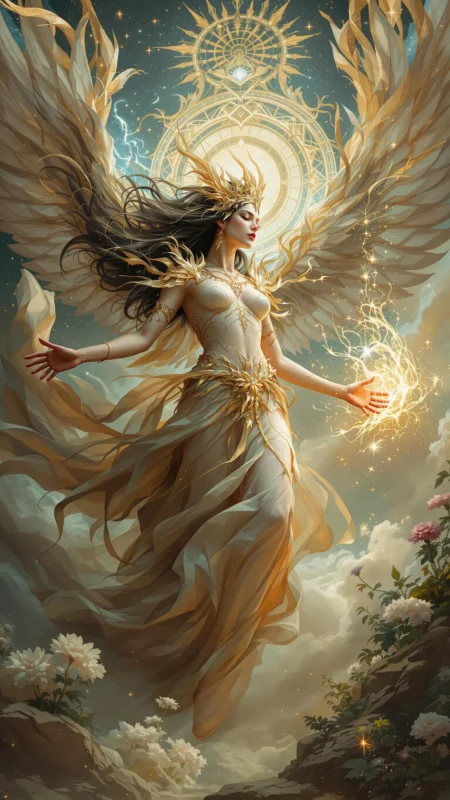


Astarte

Archetype Meaning & Symbolism

sovereign, fertile, warlike, sensual, creative, destructive, cyclical, celestial, defiant, protective

  • Tend your garden with one hand, and sharpen your sword with the other: both are acts of love.

If Astarte is part of your personal mythology, you may...

Believe

  • You may believe that conflict is not the opposite of love, but a tool for its clarification.
  • You may believe that your ambition is a sacred charge, and to diminish it would be a form of sacrilege.
  • You may believe that your body is not an apology, but an oracle.

Fear

  • You may fear that your power, if fully unleashed, could become destructive, consuming the very things and people you wish to protect.
  • You may fear that your fierce independence will ultimately lead to a profound and inescapable loneliness.
  • You may fear that in your drive to build and defend your kingdom, you will lose touch with softness, tenderness, and simple joy.

Strength

  • An unshakeable sense of self-worth that is independent of external validation, allowing you to pursue your vision with singular focus.
  • A capacity for both deep, passionate love and fierce, effective conflict, making you a powerful ally and a formidable protector.
  • The ability to alchemize destruction into creation, seeing endings not as failures but as necessary clearing for new growth.

Weakness

  • A tendency to escalate conflicts where de-escalation or compromise would be the wiser, more strategic path.
  • An impatience with perceived weakness in others, which can lead to a lack of empathy or a difficulty in offering gentle support.
  • A potential for your self-sovereignty to curdle into isolation, making it difficult to ask for help or be truly vulnerable in a partnership.

The Symbolism & Meaning of Astarte

In the modern psyche, Astarte may rise not as a deity of bronze and stone, but as the patroness of radical self-possession. She symbolizes the integration of what our culture often insists on splitting: the lover and the warrior, the creator and the destroyer, the sensual body and the strategic mind. To find her in your personal mythology is perhaps to accept that your gentleness does not negate your ferocity. Her symbolism is a passport to complexity. She is the permission slip to be the artist who is also a CEO, the healer who sets unforgiving boundaries, the parent who teaches both empathy and the art of the fight. She represents a power that is not borrowed or granted, but generated from within, a geothermal force of creativity and will.

Her meaning today could be found in the courage to instigate necessary endings. Astarte understands that fallow fields are a prerequisite for spring’s abundance, that some relationships and identities must be laid to rest with honor, like noble warriors fallen in battle, to make space for new life. She is the archetype of the strategic retreat and the righteous coup. Her presence in one's life story might signal a period where the most loving act is a declaration of war on the status quo, and the most creative impulse is to first clear the canvas, sometimes with fire. She is the queen who knows her own worth, crowns herself, and defends her territory against all intruders, be they external or internal.

Ultimately, Astarte symbolizes a form of sacred audacity. She is the force that chooses, acts, and defines its own terms of engagement with the world. She might represent the journey from seeking validation to embodying authority. Her symbolism is not about peace at any cost, but about a peace that is earned through the establishment of a just and well-defended sovereign state of being. She is the morning star, a piercing light that is both a promise of the coming day and a reminder of the night that precedes it, asking you to honor both the darkness and the dawn within yourself.


Astarte Relationships With Other Archetypes

The Warrior

The Warrior and Astarte may seem to stand at opposite poles, one forged in the clangor of the smithy, the other born of seafoam and starlight. Yet, they are not so much opposites as two faces of the same ancient coin. The Warrior’s shield, one might suggest, is polished to better reflect her light, a devotional act that turns a tool of defense into a mirror for the divine. Her passion could be the very thing that fuels The Warrior’s charge, the cause for which the sword is drawn and the last image that flickers behind the eyes in the crucible of battle. Perhaps every war is, at its heart, a brutal and misguided love affair, and The Warrior is simply the one who acts out the violent passions that Astarte holds in perfect, terrible balance.

The Abyss

With The Abyss, Astarte shares a certain silent language of gravity. While she is the glimmering point of light in the evening sky, The Abyss is the velvet, infinite blackness that makes her visible. Her love, in this context, is not a gentle comfort but a profound, gravitational pull, a call to a depth that is both terrifying and generative. To know her is to stand at the edge of this chasm and feel its pull. It seems her beauty is the luminescence on the surface of waters that have no bottom, a promise that what is most creative may also be what is most consuming. She is, perhaps, the star that marks a beautiful and perilous passage, and The Abyss is the destination itself, the quiet, formless womb from which all forms must eventually emerge.

The Astronomer

The Astronomer’s relationship with her is one of devoted, and perhaps unrequited, observation. Through the cold glass of a lens, The Astronomer charts her movements, transforming her divine passage into the cool, clean language of mathematics and prediction. This act of mapping could be seen as a kind of worship, an attempt to understand a mystery by measuring its shadow. The Astronomer’s charts and calculations are, in a sense, intricate love letters to a celestial body that is utterly indifferent to being known. She, in turn, provides the mystery that gives The Astronomer’s life its purpose—a distant, perfect fire that warms the lonely observer through the long, quiet hours of the night, a constant reminder that the universe’s most beautiful truths may be those we can only witness, never possess.

Using Astarte in Every Day Life

Navigating Creative Stagnation

When the wellspring of inspiration feels like a desert, the Astarte mythos may suggest that creation is not always a gentle coaxing. It can be a battle. It could mean confronting the inner critic with warlike ferocity, demolishing old, safe structures to make way for something radically new. Astarte reminds you that fertility often follows a controlled burn, a clearing of the deadwood with purposeful fire.

Establishing Sovereign Boundaries

In relationships where your space is encroached upon, embodying Astarte is not about building a passive wall, but defining a border and actively patrolling it. It is the calm, unwavering declaration of non-negotiable terms. This archetype could grant the courage to view a necessary confrontation not as a failure of love, but as an act of profound self-love, protecting the kingdom of the self so that it remains a place worth sharing.

Reclaiming Sensual Power

If shame or societal conditioning has created a disconnect from your own body, the Astarte narrative offers a path to reclamation. It suggests that sensuality is a form of divine intelligence, a way of knowing the world that is as valid as logic. It might look like choosing fabrics that feel like a hymn against the skin, or moving in a way that is for your own pleasure first. It is the belief that to be fully embodied is to be fully powerful.

Astarte is Known For

Sovereignty of the Self

Astarte is known for her absolute autonomy. She is not a consort or a secondary figure but a ruling power in her own right, symbolizing the part of the psyche that refuses to be defined or controlled by another.

The Union of Love and War

She famously embodies the paradox of being a goddess of both tender love and brutal conflict. This represents the capacity to nurture and protect with equal, and sometimes simultaneous, ferocity.

Celestial Connection

Her association with the planet Venus, the morning and evening star, marks her as a celestial guide. She is a light in the darkness, symbolizing hope, ambition, and the cyclical nature of disappearance and reappearance, of loss and return.

How Astarte Might Affect Your Personal Mythology

How Astarte Might Affect Your Mythos

When Astarte enters your personal mythos, your life story may cease to be a simple quest for happiness and transform into a saga of sovereignty. The central plot is no longer about finding a place to fit in, but about creating and defending a realm of your own. Your narrative might become punctuated by decisive battles, strategic alliances, and acts of radical creation. Past heartbreaks are not tragic failures, but skirmishes that taught you the art of war. Career changes are not signs of instability, but territorial expansions, the claiming of new lands for your inner kingdom. Your mythos becomes one of building an empire of the self, where you are the ruling monarch, accountable to no higher power for the choices you make within your borders.

Furthermore, the moral arc of your story may bend away from simple notions of 'good' and 'bad'. Astarte’s influence could recast your narrative in shades of complexity. An act of aggression might be reframed as a necessary defense of your most sacred values. A period of isolation could be seen as a strategic retreat to gather strength before a major campaign. Love stories are not about completion, but about alliances between sovereign powers. Your mythos becomes a testament to the idea that wholeness is not about being pure, but about integrating all facets of your nature: the dove and the lion, the diplomat and the general, the lover and the lawgiver.

How Astarte Might Affect Your Sense of Self

With Astarte as a guiding archetype, your perception of self may become unapologetically multifaceted. You might stop trying to sand down your own paradoxes and instead begin to see them as the very source of your power. The part of you that craves solitude and the part that commands a room are not in conflict: they are two departments within the same administration of the self. You may grant yourself permission to be both vulnerable and invincible, sometimes in the same breath. This leads to a profound sense of internal integration, a feeling of being a complete and coherent entity, even if that entity is a coalition of seemingly contradictory forces.

This integration could foster a robust and resilient form of self-esteem. Your worth is no longer a fragile thing, dependent on the weather of external opinion. It becomes a geological feature of your inner landscape. Astarte's presence might quiet the inner critic, not by gentle reassurances, but by staring it down with the unblinking gaze of a predator. You may come to view your ambition not as greed, but as a sacred duty to manifest your potential. Your sensuality is not a liability but a form of intelligence. The self is no longer a project to be fixed, but a territory to be ruled with wisdom, courage, and a fierce, protective love.

How Astarte Might Affect Your Beliefs About The World

To see the world through the eyes of Astarte is to perceive it as a dynamic, often violent, but ultimately fertile field of becoming. You may no longer see conflict as a sign that something is wrong, but as an engine of change, a necessary friction that grinds the new into existence. Systems of power, from global politics to office dynamics, might appear as the temporary territories of competing deities, all vying for influence. This is not a cynical view, but a strategic one. It allows you to navigate the world with a clear-eyed understanding of power, ambition, and the eternal dance between creation and destruction.

This worldview could also cultivate a deep appreciation for beauty in all its forms, especially in its more formidable aspects: the beauty of a thunderstorm, the elegance of a predator, the stark grace of a skyscraper. You might find divinity not just in temples but in boardrooms, on battlefields, and in the passionate arguments of lovers. The world is not a problem to be solved, but a poem of epic scale, full of struggle, passion, and startling moments of grace. Astarte’s lens dissolves the binary between the sacred and the profane, suggesting that the divine is present wherever power, love, and life force are in motion.

How Astarte Might Affect Your Relationships

In the realm of relationships, the Astarte archetype might compel you to seek alliances rather than mergers. The goal of partnership is not to become one, but for two sovereign entities to stand side-by-side, their kingdoms allied but distinct. Love, in this context, is an active and potent force. It involves not just care and affection, but also the fierce defense of the partnership against external threats and the courage to engage in internal conflict to clarify and strengthen the bond. You may find you have little patience for passive-aggression, preferring the clean fire of direct confrontation over the slow rot of unspoken resentment.

This can lead to relationships of extraordinary depth and honesty, built on a foundation of mutual respect for each other’s power. You may attract partners who are themselves self-possessed, who are not intimidated by your strength but are drawn to it. However, it could also mean that relationships that demand you diminish yourself become intolerable. Astarte’s influence is a purifying fire in this regard. It may burn away connections that rely on codependency or inequality, leaving only those partnerships strong enough to withstand the heat of two fully realized individuals.

How Astarte Might Affect Your Role in Life

Embracing Astarte could fundamentally shift your perceived role in life from that of a character in someone else’s story to the author and protagonist of your own. You may feel a pull toward leadership, not necessarily in a formal sense, but as the central, defining force in your own sphere of influence. Your role becomes that of the benevolent, but firm, monarch of your life. This means taking absolute responsibility for your choices, your happiness, and your impact on your corner of the world. You are the lawgiver, the commander, and the chief creative officer of You, Inc.

This sense of role extends to your community and family. You may find yourself becoming the protector, the one who defends the vulnerable within your circle and the one who challenges injustice. Your role is not to keep the peace at all costs, but to create a just peace, one where everyone in your domain can flourish. It is an active, demanding role: it requires the wisdom to nurture, the courage to fight, the vision to build, and the authority to rule. You are not just passing through the world: you are shaping a piece of it in your own image.

Dream Interpretation of Astarte

When Astarte appears in a dream in a positive context, riding a lion or crowned with stars, it may be a powerful affirmation from the psyche. This dream could signal that you are successfully integrating your power with your heart, or that you are on the verge of a significant creative breakthrough. She might appear as you are about to make a bold career move, begin a passionate relationship, or set a crucial boundary. Her presence could be an encouragement to trust your ambition, to honor your body, and to act with sovereign courage. Seeing her might feel like a coronation: a dream-state anointing that confirms your right to rule your own life.

Conversely, a dream of Astarte in a negative light, perhaps as a wrathful, destructive force or a seductive but treacherous figure, may serve as a potent warning. This could point to a shadow manifestation of the archetype within you. Are you using your power to dominate rather than lead? Is your love becoming possessive and controlling? Is your warrior instinct escalating conflicts unnecessarily? A menacing Astarte in a dream might reflect a fear of your own power, or it could be a manifestation of an external relationship where love and aggression have become toxically intertwined. It is a call to examine how you wield your sword and your heart, urging a return to balance before your kingdom turns to ruin.

How Astarte Archetype Might Affect Your Needs

How Astarte Might Affect Your Physiological Needs

The Astarte archetype could anchor you firmly within the wisdom of your own physiology. Your body ceases to be a mere vehicle for the mind and becomes a sacred temple, a primary source of information and pleasure. This might manifest as a deep attunement to your own cycles: not just menstrual, but cycles of energy, hunger, and desire. You may find yourself honoring the need for rest as deeply as the drive for action, seeing sleep not as downtime but as a strategic retreat to consolidate power. Food could become less about fuel and more about ritual, a way to honor the earth’s fertility and your own.

This connection may foster a profound sense of embodiment. Sensual pleasure, in all its forms, is reclaimed as a divine right and a form of knowing. The feeling of sunlight on skin, the taste of a ripe fig, the rhythm of your own heartbeat during exertion: these are communions with the life force that Astarte governs. This perspective treats bodily instincts not as base impulses to be controlled, but as oracular pronouncements from the goddess within. To be tired is a message to rest; to be hungry, a message to feast; to feel desire, a message to connect.

How Astarte Might Affect Your Ideas of Belonging

Belonging, for one with Astarte in their mythos, may be less about finding a tribe and more about founding one. It’s a shift from seeking acceptance to becoming a center of gravity that attracts your own people. You might find yourself curating your social circles with the care of a queen appointing her court. Loyalty, shared values, and mutual empowerment become the criteria for entry. The desire is not to fit in, but to create a space where you and your chosen allies belong completely, on your own terms.

Love and connection are acts of sovereign choice. You may love fiercely, protectively, and passionately, but your identity is not contingent on the relationship. This allows for a healthier form of intimacy, one free from the fear of annihilation that can haunt codependent dynamics. You belong, first and foremost, to yourself. From that place of secure self-possession, you can extend profound love and loyalty to others. Belongingness is the feeling of being the gravitational heart of your own solar system, with planets, moons, and stars held in orbit by the strength of your authentic presence.

How Astarte Might Affect Your Feelings of Safety

From an Astarte perspective, safety is not a passive state but an active creation. It is not found by hiding from the world, but by building a fortress of self and learning to defend its walls. This may translate into a proactive approach to security in all its forms. Financially, it’s not just saving money, but building an empire, creating multiple streams of income that grant you freedom and power. Physically, it could mean learning self-defense or simply cultivating a presence so solid and self-assured that it deters threats. Safety is a function of your own strength and strategic foresight.

This archetype may also redefine emotional safety. It is not about avoiding hurt, which is impossible, but about cultivating the resilience to recover from it. Emotional safety is the knowledge that even if your heart is broken, you are the monarch of that broken kingdom and have the power to rebuild it. It is the deep, internal certainty that you are your own ultimate protector. Boundaries become your front lines, clear and decisively enforced. You understand that the safest position is not one of submission or avoidance, but one of centered, vigilant power.

How Astarte Might Affect Your Views of Esteem

With Astarte as an inner archetype, esteem is not something you seek, but something you embody. It is the natural posture of a sovereign. Your sense of worth could become intrinsic and non-negotiable, decoupled from achievements, relationships, or the opinions of others. It is the quiet, unshakeable knowledge of your own value, complexity, and power. This is not arrogance, but a deep, cellular self-respect. You may find you no longer ask for respect but command it through your presence and actions.

This deep well of esteem fuels ambition and creativity. You may feel entitled to your desires, not in a spoiled sense, but with the conviction that your creative impulses and life goals are valid and worthy of pursuit. Failure is not a reflection on your worth, but simply a strategic setback on the path to inevitable victory. Astarte’s influence fosters an internal monologue that is not one of a supplicant hoping for approval, but of a ruler assessing her domain. The esteem she grants is the bedrock upon which you build your empire of the self.

Shadow of Astarte

When the Astarte archetype falls into shadow, the sovereign becomes a tyrant. The fierce protector turns into a possessive warden, and love becomes a weapon of control. In this dark reflection, boundaries are not defensive walls but offensive barricades, designed to isolate and dominate. The shadow Astarte might use her sensuality to manipulate, her strategic mind to exploit, and her warrior spirit to bully. She creates a kingdom of one, where all others are subjects or enemies, and her need for control suffocates the very life she once sought to nurture. Her mythos becomes a cautionary tale of power without wisdom, a desolate empire where the monarch sits alone on a throne of her own making, fearing betrayal at every turn.

The shadow can also manifest as a collapse of power. The queen abdicates her throne. This may look like becoming a perpetual victim of circumstance, using the language of war to describe minor slights and casting oneself as the noble loser in every battle. It can be a deep-seated fear of one’s own power, leading to a life of self-sabotage where every potential victory is squandered. Instead of wielding the sword, this shadow aspect falls upon it repeatedly. The life force that could have built empires is instead turned inward, becoming a corrosive force of resentment, jealousy, and bitterness against those who dare to claim their own power.

Pros & Cons of Astarte in Your Mythology

Pros

  • You likely possess a powerful sense of self-sovereignty, making you resistant to manipulation and peer pressure.
  • You have the capacity to be both a passionate, nurturing force and a fierce, effective protector in your relationships and community.
  • You are resilient in the face of change and endings, able to see destruction as a necessary catalyst for new creation.

Cons

  • You may have a tendency toward conflict, sometimes seeing battles where diplomacy would be more effective.
  • Your self-reliance can become a fortress, making it difficult for you to show vulnerability or ask for help when you need it.
  • You might struggle with those who operate from a place of passivity or victimhood, leading to a lack of patience or empathy.