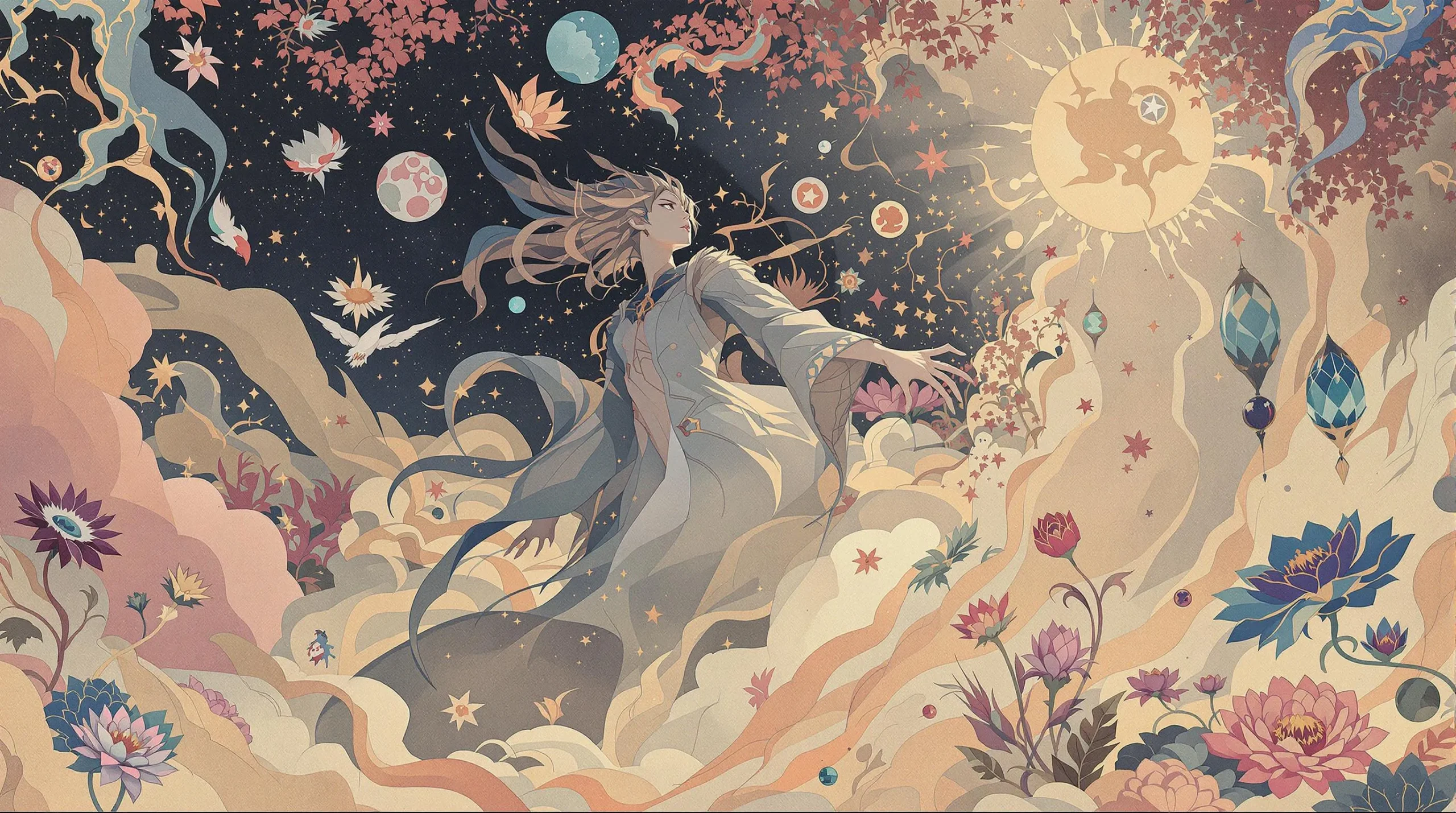


Ashitaka

Archetype Meaning & Symbolism

Diplomatic, burdened, noble, compassionate, determined, outsider, peacemaker, exiled, resilient, weary

  • To see with eyes unclouded by hate.

If Ashitaka is part of your personal mythology, you may...

Believe

  • You may believe that there is no such thing as a true villain, only people acting from a place of pain or fear.
  • You may believe that the greatest strength is not the power to destroy, but the courage to understand and the will to protect.
  • You may believe that a wound, a curse, or a tragedy does not have to be the end of your story, but can be the beginning of your true purpose.

Fear

  • You may fear that the hatred you work so hard to mediate will inevitably infect and consume you, that the curse will one day win.
  • You may fear that you are terminally alone, destined to always be an outsider who belongs nowhere and to no one.
  • You may fear that peace is an illusion and that all your sacrifices and efforts will ultimately change nothing.

Strength

  • Your capacity for empathy is profound and unwavering, allowing you to see the humanity in those whom others have demonized.
  • You possess a rare mental and emotional agility, an ability to hold conflicting truths and navigate complex situations without resorting to simple judgments.
  • You have an immense resilience, a quiet strength that allows you to endure suffering, loss, and isolation without losing your core integrity.

Weakness

  • You have a tendency to carry the weight of the world on your shoulders, absorbing conflicts and burdens that are not yours to solve.
  • Your position as an outsider, while a source of perspective, can lead to a chronic and debilitating loneliness.
  • You may neglect your own needs and desires, always prioritizing the well-being of the collective or the pursuit of peace over your own health and happiness.

The Symbolism & Meaning of Ashitaka

To have Ashitaka in your personal mythology is to be the living bridge. It is to accept the weight of being the connection point between irreconcilable worlds: nature and industry, faith and reason, the past and the future. You may feel a profound responsibility to hold these tensions within yourself, not as a theoretical exercise, but as a lived reality. This archetype symbolizes the courage to stand in the crossfire, armed not with a weapon of your own, but with a radical empathy. It is the understanding that every monster was once something beautiful and every pioneer carves their progress from something sacred. The Ashitaka is the patron saint of nuance in an age of shouting, a quiet insistence that the story is always more complicated than the slogans.

This archetype also speaks to the nature of burdens. The curse on Ashitaka's arm is both a poison and a power. It is a physical manifestation of the world's rage that threatens to consume him, yet it also gives him the strength to intervene, to protect, to act. For the individual, this could be a metaphor for a personal trauma, a chronic illness, or a difficult past. The Ashitaka path doesn't promise a cure. Instead, it offers a way to live with the wound, to integrate it, to understand that the very thing that brings you pain may also be the source of your greatest insight and strength. It is the acceptance of a fate that marks you as different, and the quest to find meaning not in spite of the scar, but because of it.

The Ashitaka figure is ultimately a symbol of active, difficult hope. It is not a passive belief that things will get better, but an active participation in the messy, often thankless work of building peace. It is the choice to love both the feral girl raised by wolves and the pragmatic leader of an industrial town. This archetype suggests that hope is found not in a final victory for one side, but in the small, persistent acts of understanding, in the refusal to hate, and in the enduring belief that even when consumed by rage and sorrow, life is worth living, and worth fighting for.


Ashitaka Relationships With Other Archetypes

The Sovereign

The Ashitaka’s dance with The Sovereign is perhaps that of a river meeting a dam. There is no inherent malice, but a fundamental opposition of purpose. Where The Sovereign seeks to impose order, to chart the wilderness into parcels of progress and security, The Ashitaka moves as a current of consequence, a quiet but persistent reminder that every foundation is laid upon something that was once alive. He is not a revolutionary storm seeking to tear the structure down, but rather a still point of conscience in the hurricane of ambition. To The Sovereign, he may appear as a flaw in the glass of their perfect vision, a troubling variable in the otherwise elegant calculus of survival. Theirs is a relationship of uneasy détente, a dialogue between the blueprint and the soil, where each, in seeing the other, is forced to recognize the limits of its own world.

The Wild Child

In the presence of The Wild Child, The Ashitaka may be seen as a translator for a language made of fang and shadow. This is not a relationship of equals, for they stand on opposite shores of what it means to be human. He is a bridge offered to a spirit that may have no interest in crossing; his hand, extended in peace, reaches across a chasm of instinct and grievance. The connection, if it can be called that, could be a shared glance across a battlefield—an ephemeral recognition that flickers and is gone. For The Wild Child, he might represent a ghost of a possibility, a memory of a world she has forsaken. For him, she is perhaps the untamable truth, the righteous fury that civilization seeks to pave over. Their bond is the sound of a name spoken into a gale, an attempt at meaning in a world that prefers the clarity of silence or a scream.

The Curse

The most intimate of these relationships is, of course, with The Curse. It is a dark star around which his own fate orbits, a corrupting sacrament that grants him power at the price of his own substance. This is not an external foe to be vanquished but a collaborator coiled around his own bones. The Curse could be understood as the world’s accumulated pain made manifest in a single body, a physical ledger of every broken treaty between humanity and nature. Each act of impossible strength it affords him is an advance on a debt that will consume him entirely. It is, perhaps, a bitter honey, the venom that allows him to see the world with a terrible, penetrating clarity. The Curse is his engine and his eulogy, the serpent on his arm whispering prophecies of both power and dust.

Using Ashitaka in Every Day Life

Navigating a Divided Family

When family arguments become trenches of ideology, the Ashitaka archetype offers a path not of choosing sides but of bearing witness. It may mean being the one who listens to both your staunchly conservative uncle and your radical progressive cousin, not to change their minds, but to hold the space for their shared humanity. You might become the keeper of the family’s fragile peace, absorbing the anger of both factions without letting it curdle into your own, a quiet diplomat at the holiday dinner table.

Mediating Workplace Disagreements

In a project torn between the ambitious vision of a creative department and the budgetary constraints of finance, you may find yourself acting as the Ashitaka. You don’t simply relay messages. You translate needs. You might articulate the creative’s yearning for excellence in the language of long-term value for the financier, and you explain the fiscal realities to the artist not as a rejection, but as a parameter for ingenuity. Your role is not to win for one side, but to help them co-create a solution that neither could see on their own.

Finding Purpose After a Personal Tragedy

A personal crisis, like a sudden illness or a profound loss, can feel like a curse, a mark that exiles you from your former life. The Ashitaka archetype suggests this wound need not be a mere ending. It could be a new beginning, a journey west to understand its meaning. This path may involve channeling the pain of your experience into advocacy, helping others navigate similar darkness, or creating art that transforms the scar into a story. The curse becomes the very thing that gives your life a new, deeper purpose: to live with the wound, and still find a way to love the world.

Ashitaka is Known For

The Demonic Curse

A scar on his right arm, inflicted by a maddened boar god, that grants him superhuman strength at the cost of his life force. It is a physical manifestation of hatred, a burden he must carry and control.

The Mediator

He is an outsider who positions himself between the warring factions of Irontown, representing human industry, and the gods of the forest, representing the natural world. He refuses to join either side, seeking a third way.

The Exile

The curse marks him as unclean, forcing his exile from his hidden Emishi village. This act severs his ties to a community and sends him on a quest into the unknown world to understand his fate.

How Ashitaka Might Affect Your Personal Mythology

How Ashitaka Might Affect Your Mythos

When Ashitaka walks into your personal mythos, your life story may cease to be a simple hero's journey toward a treasure or a throne. Instead, your narrative may become a pilgrimage, a journey away from a home you can no longer return to, toward an unknown horizon. The central plot point is not conquest, but understanding. The inciting incident is perhaps a wound, a loss, a 'curse' that sets you apart and gives you a terrible clarity. Your myth is no longer about finding your tribe, but about learning to live between all tribes, belonging to none of them completely. You are the protagonist who arrives after the conflict has already begun, tasked not with winning the war, but with seeing the humanity on every side.

Your personal mythology might be populated by figures who embody extremes: benevolent destroyers, noble savages, pragmatic visionaries who are also tyrants. Your story arc may not curve toward a happy ending, but toward a fragile truce, a moment of quiet understanding before the inevitable next struggle. Victories are not marked by parades but by the silent nod of a former enemy, the brief calming of a forest's rage, the choice to rebuild rather than abandon. Your legend is a quiet one: the tale of the one who saw, who listened, and who, despite being torn, refused to break.

How Ashitaka Might Affect Your Sense of Self

To see yourself through the Ashitaka lens is to accept a certain loneliness as fundamental to your being. You may perceive yourself as an eternal observer, a diplomat whose very nature keeps you at arm's length from the passionate certainties of others. This could foster a sense of profound isolation, a feeling that no one quite understands the world as you do, fractured and beautiful. You might feel older than your years, burdened by knowledge or empathy that others seem to shed easily. The self is a vessel for conflicting truths, and this can feel less like a strength and more like being perpetually torn.

However, this archetype may also instill a deep, quiet sense of integrity. Your self-worth is perhaps not tethered to group identity or external praise, but to your internal moral compass and your commitment to seeing with unclouded eyes. You might see your sensitivity not as a weakness, but as a tool. You are the one who can absorb the pain of others without being consumed, who can hold onto hope when all seems lost. The self is not a fortress to be defended, but a crossroads to be tended, a place where impossible meetings can occur.

How Ashitaka Might Affect Your Beliefs About The World

An Ashitaka worldview is one stripped of villains. It does not mean a world without harm, destruction, or rage, but one where these things are understood as symptoms of a deeper imbalance. You may see the industrialist clear-cutting a forest not as evil, but as a desperate attempt to provide for a community of outcasts. You may see the vengeful god not as monstrous, but as a tragic figure lashing out in pain. This perspective dismantles simple narratives of good versus evil, replacing them with a complex, often heartbreaking ecosystem of competing needs and histories. The world is a place of profound tragedy, where good people are often pitted against each other by circumstance.

This view could lead to a rejection of grand, sweeping ideologies that promise simple solutions. Your political and social beliefs may be fluid, contextual, and deeply personal. You might be more interested in restorative justice than punitive action, in dialogue than in debate. The world is not a problem to be solved, but a dynamic, living system to be navigated with compassion and care. It’s a perspective that offers little comfort in certainty, but immense richness in its depth of understanding. It is the belief that every part of the raging, beautiful, terrible world deserves to be seen and, if possible, understood.

How Ashitaka Might Affect Your Relationships

In relationships, the Ashitaka archetype may manifest as a profound, almost burdensome patience. You might be the partner who always seeks to understand the other's perspective, even when it is hurtful or seems irrational. This can create relationships of incredible depth and resilience, as you are willing to weather storms that would shatter more rigid bonds. You are not afraid of the other's darkness or rage; you see it as part of a larger story. You may be drawn to partners who are themselves outsiders, 'wild' souls like San, people who challenge conventional norms and live by their own fierce codes.

This same quality, however, can create a subtle distance. Your refusal to fully condemn or condone, your constant search for the middle ground, can be maddening for a partner who wants an ally, a champion for their cause. They may feel that you are not truly on their side, but on the side of a theoretical 'peace' that leaves them feeling unseen in their immediate pain. There is a risk of becoming a peacemaker rather than a partner, a mediator in your own intimacy. The challenge is to offer your gift of unclouded sight without sacrificing the fierce, biased, beautiful loyalty that true partnership demands.

How Ashitaka Might Affect Your Role in Life

If Ashitaka is your archetype, you may feel that your role in any group, family, or society is that of the mediator. You are not destined to be the king, the warrior, or the prophet, but the quiet ambassador who travels between them. This is often a thankless position. You carry messages that no one wants to hear, and you plead for a peace that no one believes is possible. Your work is invisible, happening in the spaces between shouts, in the quiet conversations after the battle. You may feel your purpose is to absorb tension, to de-escalate conflict, and to remind each side of the other's humanity.

This role inherently places you on the outside. To be an effective bridge, you cannot be fully anchored to either shore. This could mean you are never fully part of the inner circle, never completely trusted by any faction. Your loyalty is to the whole, to the ecosystem of the community, rather than to any single part of it. Your life's work may not be to build something of your own, but to prevent the destruction of what others have built, a thankless but vital guardian of the fragile connections that hold the world together.

Dream Interpretation of Ashitaka

To dream of Ashitaka in a positive context is to receive a call for profound empathy and diplomacy. His appearance may suggest that you have the inner resources to navigate a conflict in your waking life—be it at work, in your family, or within yourself—with grace and wisdom. He might appear to offer you his bow, symbolizing the ability to act with precision and purpose from a distance, or show you his unscarred arm, indicating that you have the strength to handle a difficult situation without being consumed by its 'curse' or bitterness. Dreaming of riding Yakul through a forest could symbolize a journey toward understanding a 'wild' or untamed part of your own psyche or a relationship, guided by loyalty and a calm heart.

In a negative context, Ashitaka's appearance in a dream can signal a profound sense of being overwhelmed and torn apart. You may dream of his cursed arm writhing with demonic worms, a potent symbol of a rage or bitterness inside you that feels uncontrollable and toxic. This could represent the fear that you are being consumed by the very conflicts you are trying to mediate. Being exiled from his village in a dream could reflect a powerful feeling of isolation and rejection in your own life. A dream of being caught between a charging boar god and the guns of Irontown might articulate a waking feeling of being trapped in a no-win situation, where any action you take will cause harm and where your efforts at peace are futile.

How Ashitaka Archetype Might Affect Your Needs

How Ashitaka Might Affect Your Physiological Needs

From a mythological perspective, the Ashitaka archetype may connect your physical well-being to your moral and emotional state. The curse is a prime example: hatred and violence in the world manifest as a physical ailment in the self, a literal embodiment of the phrase 'it makes me sick.' You may find that periods of intense conflict or emotional turmoil in your life correspond with physical exhaustion, illness, or the flare-up of chronic conditions. Your body is not a separate machine; it is the ground on which the battles of your life are fought. Sustenance and rest are not just practical needs; they are acts of resistance against the consuming nature of your burden.

The drive to mediate and to journey for a cure may also lead to a noble neglect of your own body. Like Ashitaka pushing himself to the brink, you may ignore hunger, exhaustion, and pain in service of your quest. This can be a source of incredible resilience, but it is a finite resource. This archetype teaches that caring for the self, for the physical vessel carrying the curse, is not selfish. It is a necessary part of the journey, the essential maintenance required to continue the work of seeking peace, both internally and externally.

How Ashitaka Might Affect Your Ideas of Belonging

Belonging is the central wound and quest of the Ashitaka archetype. You are defined by your exile, by the community you can no longer claim. This may manifest as a persistent feeling of being an outsider, never quite fitting in, no matter where you go. You may drift between social groups, valued for your perspective but never fully integrated. You see the flaws and virtues too clearly on all sides to offer the kind of blind loyalty that true membership often requires. This can lead to a profound and enduring loneliness, a feeling that your only home is the road itself.

And yet, this archetype offers a different kind of belonging. It is not the comfort of a tribe, but the intense, earned connection with other individuals across enemy lines. Ashitaka forges bonds with San, the wolf princess, and Lady Eboshi, the iron master—two people who should be his mortal enemies. Your sense of love and belonging may be found in these unlikely alliances, in the recognition of a shared humanity with those who are radically different. Belonging is not a place you arrive at, but a connection you build, piece by piece, in the most desolate of landscapes.

How Ashitaka Might Affect Your Feelings of Safety

The concept of safety, for one with the Ashitaka archetype, is radically redefined. Safety is not found behind walls, within a tribe, or through the accumulation of power. In fact, these things are often the source of the conflict you are drawn to. Your sense of security may be found in your ability to navigate danger, not in its absence. It lies in your skill as a rider and archer—metaphors for your agility of mind and precision of purpose. You feel safest when you are moving, when you are in the liminal spaces between fortified camps, relying on your own wits and moral clarity.

This redefinition comes at a cost. You may consciously place yourself in physical and emotional peril, believing it is necessary to protect a greater good or to broker a necessary peace. The safety of the collective outweighs your own. This can look like recklessness to others, a foolish disregard for your own well-being. But for you, it may be the only authentic way to live. True danger is not the arrow or the sword, but the possibility of succumbing to the hatred that fuels them. Safety, therefore, is maintaining a clear heart in the midst of chaos.

How Ashitaka Might Affect Your Views of Esteem

Self-esteem within the Ashitaka mythos is not derived from victory, status, or the approval of others. In fact, you may receive very little positive reinforcement from the outside world. Your actions are likely to be misunderstood by all sides. Lady Eboshi sees you as naive; San sees you as a meddling human. Esteem, therefore, must be an internal construct, built on the bedrock of your own integrity. It is the quiet pride that comes from knowing you did not succumb to hate, that you chose the harder path of empathy, that you acted in accordance with your own deeply held principles.

This can be a fragile foundation for self-worth. In moments of doubt, the lack of external validation can be crushing. You may ask yourself if your efforts matter, if your lonely stance is noble or simply foolish. The esteem of the Ashitaka is the esteem of the stoic: it is measured by effort, not by outcome. It is the knowledge that you looked upon a world full of rage and sorrow, and you chose to meet it with an open heart. It is the simple, profound respect you hold for the person who continues to try, even when faced with impossible odds.

Shadow of Ashitaka

The shadow of Ashitaka emerges when the burden becomes too great, or the path is followed with too much pride. One shadow form is the martyr with a messianic complex. Here, the desire to mediate becomes a belief that only you can solve the conflict, that you are the sole arbiter of what is right. This can lead to a subtle manipulation of others 'for their own good,' a paternalistic approach that robs them of their agency. The unclouded eyes become clouded by self-importance. The curse is no longer a shared burden but a special mark of your importance, a justification for your interference in all matters. You don't just absorb hate, you begin to traffic in it, believing your cause is just enough to warrant any action.

Conversely, the shadow can manifest as a complete collapse into cynicism. This is the Ashitaka who gives up. After seeing too much conflict and too little change, the heart doesn't just become clear, it becomes empty. Empathy curdles into apathy. The belief in a third way dies, replaced by the grim conviction that all sides are equally corrupt and nothing is worth saving. This shadow figure retreats from the world, not as a noble exile on a quest, but as a bitter hermit who has declared the world bankrupt. The cursed arm is no longer a source of struggle, but is allowed to wither, a symbol of a purpose abandoned and a hope extinguished.

Pros & Cons of Ashitaka in Your Mythology

Pros

  • You develop a rare and powerful ability to see situations and people with extraordinary clarity and compassion.
  • You can act as a stabilizing and healing force in families, communities, and workplaces that are torn by conflict.
  • You live with a profound sense of purpose, guided by a strong internal moral compass that remains steady in the face of chaos.

Cons

  • You are prone to a deep and persistent sense of loneliness and isolation, feeling that you never truly belong.
  • You risk emotional, spiritual, and even physical burnout from taking on the emotional burdens of others.
  • You may struggle to form simple, loyal allegiances, as your complex perspective can be alienating to those who seek a straightforward ally.