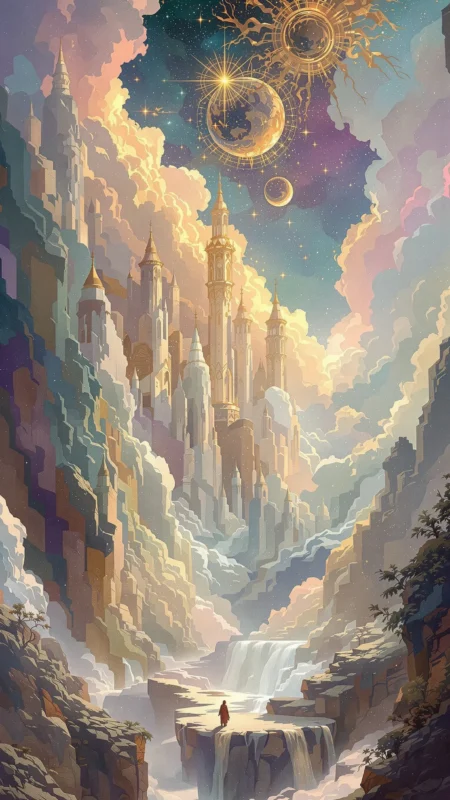


Asgard

Archetype Meaning & Symbolism

Majestic, embattled, orderly, hierarchical, glorious, fated, paranoid, aspirational, fortified, insular

  • Build your walls high, but ensure the gates open to those who prove their worth: a fortress without purpose is just a prison.

If Asgard is part of your personal mythology, you may...

Believe

  • A life without a grand purpose or a code of honor is a life adrift in chaos.

  • Order, structure, and strong boundaries are the only true bulwarks against the meaningless void.

  • What you build and successfully defend in this life is the ultimate measure of your worth.

Fear

  • The slow, inevitable decay of everything you have built, the coming of your personal Ragnarök.

  • Betrayal from within your own walls; that the agent of your downfall is someone you trust implicitly.

  • That the chaos you fight so hard to keep out is, in fact, an essential and untamable part of your own nature.

Strength

  • An extraordinary capacity for vision and execution, allowing you to build lasting structures in your life, career, or family.

  • Unwavering resilience and a powerful sense of duty that allows you to defend your principles against immense pressure.

  • The ability to inspire deep loyalty and create a strong sense of community and shared purpose among those you let inside your walls.

Weakness

  • A dogmatic rigidity and a deep-seated fear of change, which can lead to stagnation and an inability to adapt to new realities.

  • A tendency towards elitism and exclusion, making it difficult to connect with or learn from those who are different from you.

  • A proneness to burnout and anxiety, stemming from the immense, self-imposed pressure of constant vigilance and the need for control.

The Symbolism & Meaning of Asgard

In the personal mythos, Asgard is not a place in the sky but a construct of the psyche: the fortified kingdom of the self. It is the carefully built structure of your beliefs, your ambitions, your values, and your highest ideals. It is the part of you that seeks to impose order on the wild chaos of inner and outer experience. To have Asgard in your mythology is to be a builder of internal citadels, a curator of a personal pantheon of principles. This realm’s golden halls might be your achievements, its high towers your aspirations. Living in this inner Asgard means holding oneself to a higher, almost divine standard, and viewing one's life as a saga worthy of being told.

This archetype also carries the hum of cosmic electricity, the constant tension between creation and destruction. Asgard is defined by its enemies: the giants of chaos, doubt, and entropy are always at the gates. Its existence is not one of peaceful bliss but of glorious, vigilant struggle. Therefore, a personal Asgard is never static. It must be constantly maintained, defended, and expanded. The Bifrost bridge suggests that this realm is not entirely isolated: it must have a connection to the everyday world, a risky but necessary bridge between your highest self and your human experience.

Perhaps most profoundly, Asgard is a realm haunted by its own prophesied doom: Ragnarök. This infuses the archetype with a tragic, beautiful impermanence. Building your inner Asgard is not an attempt to achieve immortality, but to create something of worth within a finite existence. It is the understanding that all great structures eventually fall. The goal, then, is not to avoid the end, but to build a realm so glorious and to live a life so honorably within it that its fall is an epic of its own, a twilight of the gods that gives meaning to everything that came before.


Asgard Relationships With Other Archetypes

The Wilderness (Jötunheimr)

Asgard's relationship with the Wilderness, its mythological counterpart Jötunheimr, is one of antagonistic necessity. Asgard is order, law, and consciousness; the Wilderness is chaos, impulse, and the untamed subconscious. The high walls exist precisely because the Wilderness exists. In a personal mythos, this archetype represents the parts of the self that are feared and suppressed: raw emotion, primal instincts, the formless anxieties that threaten the carefully constructed ego. Yet, the gods of Asgard are constantly venturing into Jötunheimr, seeking wisdom, wives, or magical artifacts. This suggests that the ordered self must periodically engage with its own chaotic depths to gain power and knowledge, even if the journey is perilous.

The Trickster (Loki)

The Trickster is the chaos that lives inside the walls, the flaw in the otherwise perfect system of Asgard. Asgard wants absolute order, but the Trickster reveals the absurdity and fragility of that desire. He is both the catalyst for disaster and the unlikely source of the gods' greatest treasures. For someone with Asgard in their mythos, the Trickster archetype may personify their own inconvenient truths, their capacity for self-sabotage, or the rebellious, cynical voice that questions the nobility of their grand project. The Trickster's presence is a constant reminder that no wall is high enough to keep out the unpredictable nature of life and the self.

The World Tree (Yggdrasil)

If Asgard is the kingdom of the ego, the World Tree is the deep, universal structure of existence upon which that kingdom is built. Asgard is but one of nine realms held within the Tree's branches and roots. This relationship serves to humble the Asgardian impulse toward self-importance. It reminds the individual that their personal, constructed reality is part of a much larger, interconnected cosmos. One may be a god in one's own realm, but one is still subject to the health of the tree. This could manifest as the understanding that personal success is dependent on the well-being of the larger community, the environment, and the mysterious currents of life that flow beyond one's control.

Using Asgard in Every Day Life

Navigating Career Ambition

You might frame your career path as the construction of Asgard. Each project completed is a new golden hall raised, each skill acquired a rune carved into its gates. Your team becomes your own cohort of Æsir, each with a role in defending the realm from the 'giants' of market volatility and corporate entropy. This perspective transforms a mere job into a heroic undertaking: the establishment of a lasting, ordered kingdom of professional excellence, with the Bifrost bridge representing the risky but necessary connections to other departments or industries.

Establishing Family Identity

One could use the archetype to build a strong family culture, a personal Asgard against the buffeting winds of the external world. Family dinners become the feasts in Valhalla, a place to honor the day's small victories. Traditions are the high walls, defining and protecting the family's unique values. The stories told of ancestors are the sagas of the gods. This framework may help create a powerful sense of belonging and shared destiny, a celestial home where each member is a vital deity in a collective pantheon.

Managing a Creative Vision

A large-scale creative endeavor, like writing a novel or launching a startup, could be envisioned as your personal Asgard. The initial concept is the gleaming city on a hill. Each chapter written or feature coded is another bastion against the encroaching chaos of doubt and procrastination. The structure of the work is the realm’s architecture, meticulously planned and defended. This view may provide the epic motivation needed to persist through the long twilight struggle of creation, seeing yourself not just as an artist, but as the divine architect of a world.

Asgard is Known For

The Bifrost Bridge

The shimmering, precarious rainbow bridge connecting Asgard to Midgard, the realm of mortals. It symbolizes the fragile yet beautiful link between the divine and the mundane, the ideal and the real: a path of communication that requires a vigilant guardian.

Valhalla

The majestic hall of the honored dead, where slain heroes feast and train for the final battle of Ragnarök. It represents a belief in a purposeful end, where sacrifice is not a loss but a transformation into a glorious, eternal readiness. It is the ultimate honor club, membership earned by courage.

The Great Walls

The impenetrable fortifications built to protect the gods from the giants of Jötunheimr. These walls symbolize the power of order, structure, and defined boundaries to hold back chaos. They are the tangible manifestation of a defended identity, but also a marker of exclusion.

How Asgard Might Affect Your Personal Mythology

How Asgard Might Affect Your Mythos

When Asgard forms a central geography of your personal mythos, your life story ceases to be a simple sequence of events and becomes an epic saga: the founding and defense of a sacred realm. Your childhood might be re-imagined not as a time of simple growth, but as the primordial age when the land was cleared and the first foundations were laid. Your education and early career become the age of construction, the raising of the great walls of competence and the golden halls of achievement. Alliances are forged, great oaths are sworn, and every significant choice contributes to the architecture of this inner world.

Furthermore, this archetype transforms your struggles into cosmic conflicts. A professional setback is not merely a failure; it is a raid by frost giants, a test of your realm's defenses. A personal betrayal is the work of a Loki, a disruption from within that reveals systemic weaknesses. Your narrative is imbued with high stakes and a sense of fated importance. The central theme of your mythos becomes the heroic struggle to maintain a state of divine order—your personal integrity, your family's honor, your creative vision—against the inevitable forces of chaos and decay that threaten to bring about Ragnarök.

How Asgard Might Affect Your Sense of Self

An identity informed by Asgard may be one of immense strength, purpose, and responsibility. You might perceive yourself not as a mere individual, but as a sovereign or guardian of a precious domain. This could foster a powerful sense of self-respect and a refusal to compromise on core principles, which are the very laws of your kingdom. There is a weight to this identity, a sense of duty to be more than just human, to be a reflection of the divine ideals your Asgard represents. Your self-concept is inextricably linked to what you have built and what you protect.

This may also lead to a certain psychological rigidity. The self becomes identified with the walls of its own making. Challenges to your beliefs might feel like existential threats, assaults on the city itself. There can be a loneliness to this perspective, the isolation of a monarch who stands apart from their subjects. You may feel a constant pressure to be infallible, to be the all-seeing Odin or the ever-strong Thor, making it difficult to admit weakness or ask for help, for fear that it would show a crack in the fortifications.

How Asgard Might Affect Your Beliefs About The World

Viewing the world through the lens of Asgard could lead to a perception of reality as a grand, cosmic struggle between order and chaos. You might see societies, institutions, and even ideologies as different realms, each with its own pantheon and principles. Your 'Midgard' is the everyday world of human affairs, which you, from your elevated perspective, are sworn to protect or influence. This worldview is inherently hierarchical and values-driven; some ways of living are seen as more 'divine' or 'noble' than others.

This perspective may also foster a kind of heroic pessimism. The world is a battlefield, and while glorious victories are possible, the final outcome—Ragnarök—is always on the horizon. This doesn't lead to nihilism, but to a profound sense of purpose. If the end is inevitable, then the only thing that matters is how one fights the battle. It is a worldview that finds meaning not in final victory, but in the honor and courage displayed during the long, twilight struggle against entropy and dissolution.

How Asgard Might Affect Your Relationships

Relationships may be sorted according to the geography of Asgard. The innermost circle, the Æsir, are those who share your code and fight alongside you in the defense of your shared values. These are relationships of profound loyalty, built on oaths and mutual respect. These are your shield-brothers and shield-sisters, and the bond with them is sacred. To be 'inside the walls' with someone is to grant them the highest trust and to share with them the feasts in your great hall.

Consequently, there can be a sharp distinction between insiders and outsiders. Those who do not understand or subscribe to the values of your realm may be perceived as 'giants' or, at best, inconsequential mortals from Midgard. This can make it difficult to form connections based on simple affection or common interest, as relationships are often vetted for their strategic value or alignment with your kingdom's principles. Love itself may be seen as a grand alliance, a merging of two pantheons, requiring oaths and duties as much as affection.

How Asgard Might Affect Your Role in Life

Your perceived role in life might shift from that of a participant to that of a creator and a guardian. You are the architect of your destiny, the lawgiver of your personal cosmos. Whether in your family, your community, or your profession, you may naturally assume the role of the leader, the protector, the one who sets the standard and maintains the boundaries. This role carries with it a deep sense of responsibility for the well-being of the 'realm' and its inhabitants.

This can also be a heavy mantle to bear. The role of 'god' or 'king' demands constant vigilance and a certain emotional distance. You may feel that you are the one who must always be strong, who must have the answers, who must watch on the battlements while others sleep. This can lead to a sense of isolation and the feeling that the fate of your entire world rests solely on your shoulders, for who else can be trusted to guard the gate?

Dream Interpretation of Asgard

In a positive context, dreaming of Asgard—seeing its golden halls gleaming in an eternal sunset, walking across a steady Bifrost, or feasting with noble companions—could signify a powerful alignment of the self. It may suggest that you are living in accordance with your highest values, that your life's structures are sound, and that you feel a sense of mastery and honor in your waking life. Such a dream could be an affirmation from the subconscious, a message that the kingdom you are building is worthy and strong.

Conversely, dreaming of a besieged Asgard might indicate a deep-seated anxiety about the stability of your life. Crumbling walls could symbolize failing personal boundaries or a career in jeopardy. A broken Bifrost may point to a feeling of disconnection from others or from your own purpose. Seeing giants pour over the ramparts might represent overwhelming external pressures or internal chaotic impulses breaking through your defenses. A dream of a silent, empty Asgard could be the most chilling of all, suggesting a loss of faith in the very ideals your realm was built upon.

How Asgard Archetype Might Affect Your Needs

How Asgard Might Affect Your Physiological Needs

The Asgard archetype might translate physiologically into a disciplined, almost martial, approach to the body. Your body is the first fortress, the temple that houses the divine spark. This could manifest as a rigorous commitment to diet and exercise, not for vanity, but for strength and readiness. Sleep schedules might be regimented, seen as a necessary process for restoring the realm's defenses. The goal is an optimized physical form, a body capable of withstanding the long siege of life.

This perspective could also create a disconnect from the body's more chaotic, vulnerable aspects. Illness or physical limitation might be experienced as a betrayal, a weakness in the walls that must be quickly and ruthlessly patched. There may be an impatience with the body's needs for simple, unstructured rest, viewing it as laziness rather than essential maintenance. The body is not a source of pleasure so much as a vehicle for the will, an instrument in a grander campaign.

How Asgard Might Affect Your Ideas of Belonging

Belongingness in an Asgardian context is deep, tribal, and earned. One belongs in the great hall by demonstrating loyalty, courage, and a commitment to the realm's shared purpose. It is the belonging of a soldier in a shield wall, an intense bond forged in common struggle. Love and friendship are not casual affairs; they are sacred oaths, alliances between sovereigns. To be loved is to be granted citizenship in another's sacred realm.

This creates a powerful in-group, but it also creates, by necessity, an out-group. The criteria for belonging can be stringent, and those who do not meet them may be kept at a distance. This may make it difficult to form bonds with people who are different, or to enjoy relationships that are not defined by a grand, shared purpose. There is a risk of seeing the world as populated only by allies and enemies, with little room for the neutral stranger.

How Asgard Might Affect Your Feelings of Safety

Safety, within the Asgardian mythos, is synonymous with structure and control. It is achieved by building formidable walls against the unpredictable. This can translate into a meticulous pursuit of financial security, creating a fortress of assets to weather any economic storm. It might mean cultivating intellectual certainty, constructing an ideological framework so robust it feels unassailable. Emotional safety is found in clearly defined boundaries, relational rules of engagement that are strictly enforced.

The perpetual threat of Ragnarök, however, means that a sense of absolute safety is forever elusive. This can lead to a state of hyper-vigilance, a constant scanning of the horizon for threats. The need for safety becomes a consuming quest for control over every variable, which can be exhausting. The paradox of the Asgardian approach is that the very walls built for protection can also become a source of anxiety, as their potential for being breached is always a primary concern.

How Asgard Might Affect Your Views of Esteem

Esteem is rooted in honor, achievement, and the successful fulfillment of one's sacred duty. Self-worth is not inherent; it is constructed, like the walls of Asgard themselves. It is measured by the grandeur of one's deeds, the integrity of one's word, and the resilience of one's creations. Esteem comes from the quiet satisfaction of looking out from the highest tower of the self and seeing a realm that is well-ordered, well-defended, and worthy of its divine status.

This can be a powerful engine for ambition, but it can also be a precarious foundation for self-worth. If esteem is tied entirely to the state of the realm, then any failure, any breach in the walls, can trigger a catastrophic crisis of identity. There is little room for grace or self-forgiveness. One is either the glorious guardian of a shining city or the failed king of a ruin, with the chasm between these two states being a constant source of existential dread.

Shadow of Asgard

The shadow of Asgard manifests as tyranny. When the need for order becomes an obsession, the benevolent king becomes a paranoid despot. The walls, once protective, become prison bars. Every external challenge is seen as an existential threat, and every internal dissent is heresy. The leader, consumed by the fear of losing control, begins to crush the very life and creativity that made the realm worth defending in the first place. The pursuit of a perfect, unassailable order ironically creates a brittle, stagnant kingdom ripe for collapse. This is the Asgard that, in its fear of Loki, creates the very conditions for his betrayal.

The other shadow is that of the Ruin. This occurs when an individual's Asgard has already fallen, when their grand project has failed, their walls have been breached, and their ideals lie in ashes. This person lives in the wreckage of their own mythos. They may become deeply cynical, believing that nothing is worth building, that all order is an illusion, and that chaos always wins. They are the king surveying a battlefield after Ragnarök, surrounded by the ghosts of a glorious past, with no purpose left but to mourn what was lost and rage against the futility of it all.

Pros & Cons of Asgard in Your Mythology

Pros

  • Provides a powerful internal framework for discipline, ambition, and long-term achievement.

  • Fosters an incredibly strong sense of identity, purpose, and personal honor.

  • Creates stability, safety, and psychological security in a world that often feels chaotic and unpredictable.

Cons

  • Can lead to emotional and intellectual rigidity, making it difficult to adapt to change or accept different points of view.

  • The constant pressure to maintain the ideal can be psychologically exhausting and a source of chronic anxiety.

  • Promotes an 'us versus them' mentality that can lead to isolation, loneliness, and a judgment of others.