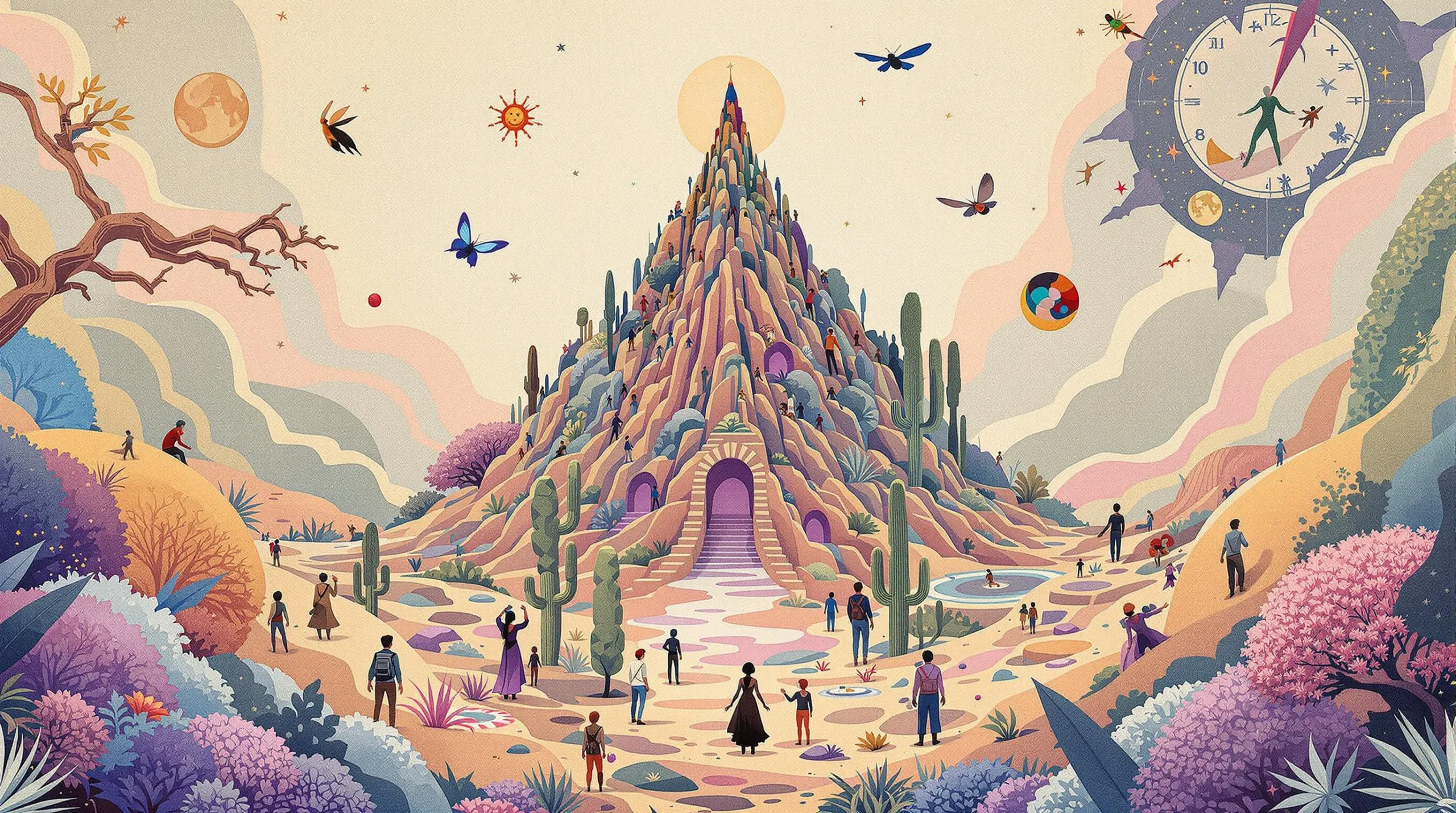


Ant Hill

Archetype Meaning & Symbolism

industrious, communal, structured, emergent, selfless, complex, subterranean, resilient, anonymous, systemic

  • Do not seek your name in stone. Seek your purpose in the million grains of sand we move together.

If Ant Hill is part of your personal mythology, you may...

Believe

  • The work of many anonymous hands builds what a single hero cannot.
  • My ultimate value is defined by my contribution to the whole system.
  • True strength lies not in the individual part, but in the integrity of the entire structure.

Fear

  • Exile: being cast out from the group and losing my function.
  • The collapse of the systems I rely upon for safety and meaning.
  • Losing my individual identity entirely, becoming a faceless drone in the collective.

Strength

  • An unwavering dedication to a shared goal and the patience to see it through.
  • An innate talent for organizing complex systems and fostering collaboration.
  • Deep resilience born from the support and structure of a strong community.

Weakness

  • A tendency to disregard individual needs or dissenting opinions for the sake of group harmony.
  • A fear of standing out, taking individual risks, or challenging the status quo.
  • A vulnerability to groupthink or following the collective will even when it is misguided.

The Symbolism & Meaning of Ant Hill

To have the Ant Hill as a cornerstone of your personal mythology is to find meaning not in the spotlight but in the structural integrity of the whole. Your story may be one of quiet, persistent contribution, a life built on the premise that the most profound acts are often anonymous and cumulative. It suggests a belief in systems, in the intricate and often invisible web of actions and reactions that constitutes reality. You might see your own consciousness less as a solitary peak and more as the emergent property of your relationships, your work, your community: a hum of collective activity that generates a singular, cohesive self.

The Ant Hill is a monument to process. It symbolizes a deep trust in the power of incremental effort, the faith that a million small, seemingly insignificant acts of labor will eventually constitute a mountain. In this mythos, progress is not a leap but a slow accretion of soil and saliva, of showing up day after day. This archetype could challenge the modern obsession with disruptive innovation and heroic individualism, offering instead a grounding in diligence, patience, and the profound beauty of a task well done, for its own sake and for the sake of the collective it supports.

Furthermore, the Ant Hill speaks to the architecture of society and the self. It suggests that our foundations are subterranean, built in the dark, composed of instinct, duty, and a primal urge to connect and build. It represents the part of us that is inherently social, that understands its survival is inextricably linked to the survival of the tribe. To claim this archetype is to honor the part of your psyche dedicated to logistics, to maintenance, to the unglamorous work of holding things together, recognizing that without this foundation, no great spire of individual achievement can stand for long.


Ant Hill Relationships With Other Archetypes

The Lone Wolf:

The Ant Hill exists in stark opposition to The Lone Wolf archetype. Where the Wolf finds strength in solitude, self-reliance, and individual prowess, the Ant Hill finds it in radical interdependence and the dissolution of the individual into the collective function. A person navigating these two archetypes might feel a constant tension between a deep need for community and a fierce, primal pull toward autonomy. Their life story could be a search for a way to be a vital part of a system without being consumed by it, to maintain a sliver of wilderness within the highly structured walls of the colony.

The Architect:

The Ant Hill and The Architect share a love for structure, but their methods are worlds apart. The Architect works from a blueprint, a top-down vision imposed upon the material. The Ant Hill is the architect of emergence; its design arises from the bottom-up, from a million simple interactions without a master plan. In a personal mythos, this relationship might represent the conflict between a desire for conscious control and a trust in intuitive, organic processes. One may grapple with whether to design their life with meticulous intention or to cultivate the right inner conditions and let their life's structure emerge naturally.

The Flood:

The Flood is a primal antagonist to the Ant Hill. It represents the overwhelming, chaotic force of nature or emotion that can dissolve structure in an instant. The Ant Hill's existence is a constant, diligent effort against this eventuality. For someone with the Ant Hill in their mythos, The Flood may symbolize a profound fear of emotional overwhelm, societal collapse, or any force that threatens the carefully constructed systems of their life. Their relationship with The Flood is not one of battle, but of constant, patient rebuilding, a testament to resilience in the face of inevitable chaos.

Using Ant Hill in Every Day Life

Navigating Career Stagnation:

When your professional life feels like a cul-de-sac, the Ant Hill archetype may suggest a shift in perspective. Instead of focusing on a singular, heroic promotion, it encourages examining your role within the larger corporate or creative ecosystem. It asks: what small, consistent, perhaps unnoticed task can you perfect that shores up the entire structure? This could mean meticulously organizing a chaotic digital filing system or becoming the unofficial mentor for new hires. The goal is not immediate visibility but becoming an indispensable, load-bearing column within the whole, from which new, unexpected pathways may emerge.

Healing Community Rifts:

In a fractured family or community, the Ant Hill offers a model for repair that bypasses grand apologies or singular peacemakers. It suggests focusing on the reconstruction of shared, functional life. This might look like organizing a simple, recurring potluck, starting a tool-sharing library, or creating a neighborhood watch. These are not attempts to solve the core ideological divide but to rebuild the subterranean tunnels of daily reliance and interaction. Trust is rebuilt not through words, but through the shared, rhythmic work of maintaining the collective structure.

Building a Creative Practice:

For the artist facing the terror of the blank page, the Ant Hill whispers of incrementalism. It refutes the myth of the single, divine flash of inspiration. Instead, it advocates for the daily moving of a single grain of sand: writing one sentence, drawing one line, coding one function. The focus is on the tireless, anonymous labor of building the mound. The final, impressive structure is not the goal of any single day; it is the emergent property of a thousand small, faithful efforts.

Ant Hill is Known For

Collective Construction

The Ant Hill is known for its creation through the coordinated effort of countless individuals. It's a structure no single ant could conceive of, let alone build, symbolizing the power of collaboration to achieve results far beyond the scope of any one person.

Subterranean Complexity:

Beneath the simple mound lies a labyrinth of tunnels, chambers, and galleries. This represents the hidden depths and intricate systems that support a seemingly simple surface, a metaphor for the complex inner workings of a person, a society, or a project.

Emergent Behavior:

There is no blueprint or central command. The intricate architecture of the Ant Hill arises from simple rules followed by each individual. This is emergence: complex, intelligent, system-level behavior from simple, local interactions. It symbolizes a wisdom that is bottom-up, not top-down.

How Ant Hill Might Affect Your Personal Mythology

How Ant Hill Might Affect Your Mythos

When the Ant Hill shapes your personal mythos, your life story may cease to be a linear, heroic quest. Instead, it becomes a sprawling, subterranean epic of construction. You are not the sole protagonist; you are a vital participant in a much larger project, one whose ultimate shape and purpose may not even be clear to you. Your key moments of triumph might not be dramatic victories, but quiet moments of successful integration: finding the perfect role, completing a task that allows the whole system to function more smoothly, or contributing a piece to a puzzle far bigger than yourself. Your narrative is less about becoming and more about belonging.

The trajectory of this mythos is not upward, toward the sun of recognition, but outward and downward, into the foundations of community and work. It values depth over height. Your personal legend could be written in the language of systems, logistics, and quiet competence. It's the story of the librarian who builds a catalog that lasts for a century, the coder who writes a piece of elegant, stable legacy code, the parent who creates a family culture of mutual support. The ultimate accomplishment in this mythos is not to have your name remembered, but to have your work endure as a functional part of the world.

How Ant Hill Might Affect Your Sense of Self

Your sense of self may be fundamentally relational and functional. Identity is not a static, internal essence you discover, but something that arises from what you do and who you do it with. You might feel most yourself when you are deeply engaged in a task that serves a collective purpose. Self-worth is not tied to individual praise, but to your reliability and effectiveness within the system. This can lead to a profound sense of purpose and a stable, resilient ego, one not easily swayed by the winds of public opinion.

However, this can also create a diffused sense of self, a feeling of being a cog in a machine. The question “Who am I, outside of my function?” could be a central, recurring koan in your life. You may struggle to identify personal desires that are separate from the needs of the group. The journey of self-discovery, then, might involve learning to cultivate a private, inner chamber within the bustling ant hill of your life, a space where your individuality is honored not for its utility, but for its intrinsic existence.

How Ant Hill Might Affect Your Beliefs About The World

You may perceive the world as a single, massively complex, interconnected organism. You see the systems behind the events, the hidden structures that dictate the flow of politics, economies, and social trends. Your worldview could be one of emergent properties: the idea that consciousness, culture, and life itself are not handed down from on high but bubble up from the countless interactions of simple agents. This perspective can foster a deep sense of awe for the intricate clockwork of reality and a profound patience for change, understanding that it happens at a systemic, not individual, level.

This systems-thinking approach can also lead to a kind of fatalism. If everything is the result of a complex, self-organizing system, the power of individual agency can feel diminished. You might see individual heroes or villains as mere symptoms of a deeper systemic function or dysfunction. This can breed a certain detachment, a sense that one’s best course of action is not to fight the system, but to find one’s most effective place within it and perform that role with diligence, trusting that small, local actions are the only real way to influence the whole.

How Ant Hill Might Affect Your Relationships

In your relationships, you may prioritize function, loyalty, and shared purpose over grand passion or romantic ideals. A partnership might be seen as a small, efficient colony of two, built on mutual support, clear roles, and the collaborative project of building a life. You might express love through acts of service: doing the dishes, managing the finances, fixing the leaky faucet. These are the foundational tasks that maintain the structure of the relationship, and for you, they may be the most profound declarations of commitment.

This functional view could make you an incredibly reliable and supportive partner, friend, and family member. You are the one people can count on to help them move, to organize the meal train, to build the spreadsheet. The potential pitfall is a difficulty with the less functional aspects of relationship: spontaneous play, unproductive leisure, or the expression of messy, inefficient emotions. You might struggle when a relationship’s purpose becomes unclear, or when a loved one prioritizes individual emotional expression over the stability of the collective unit.

How Ant Hill Might Affect Your Role in Life

Your perceived role in life might be that of a specialist, a functionary, a vital component of a larger whole. You may not seek to be the queen, but the head of the nursery, the master of the food stores, or the engineer of a critical tunnel. There is great dignity and purpose in this perspective. It frees you from the pressure of being all things to all people and allows for the deep satisfaction of mastering a specific, necessary craft. Your identity is your role, and your purpose is to perform it with excellence.

This can lead to a profound sense of place and belonging. You know your job, you know its importance, and you know who depends on you. The shadow of this is the danger of over-identification with your role. If the company downsizes, if the children grow up, if the community dissolves, your sense of self can be shattered. The life-long challenge may be to understand that while you perform a role, you are not only the role. You are the conscious ant that performs it, and that consciousness has a value and existence independent of any one task.

Dream Interpretation of Ant Hill

In a positive context, dreaming of an Ant Hill might be a powerful affirmation from your subconscious. It could suggest that your efforts at work, in your family, or on a personal project are succeeding. The dream affirms that your small, consistent actions are building something significant and stable. Seeing a bustling, healthy Ant Hill can symbolize a feeling of profound belonging, of having found your tribe and your purpose within it. It may be a sign that you are successfully integrated into a supportive community and that you are contributing in a meaningful way.

Conversely, a dream of a disturbed or chaotic Ant Hill can signal deep-seated anxieties. It might represent a feeling of being overwhelmed by countless, frantic tasks with no clear purpose. You may feel like a faceless drone, your individuality lost in a swarm of collective anxiety. Dreaming of the hill being kicked over or flooded could symbolize a fear of your carefully constructed life falling apart, or a feeling that your safety net is not as secure as you believed. It may also point to a loss of meaning within your community or job, a sense that the collective is churning mindlessly, without direction.

How Ant Hill Archetype Might Affect Your Needs

How Ant Hill Might Affect Your Physiological Needs

The Ant Hill archetype anchors your sense of physical well-being in the collective. The satisfaction of your body's needs: food, water, shelter, rest: is not seen as a purely individual pursuit but as a function of the group's health. You may be someone who naturally organizes community gardens, meal-sharing plans, or cooperative housing projects. There's a primal understanding that a full pantry for the community means a full belly for you. The physiological drive is channeled into building systems that provide for everyone.

The body itself may be viewed as a tool for the collective. Staying healthy and strong is not just for personal benefit, but a duty to the group, ensuring you can continue to perform your function. This can lead to a disciplined, pragmatic approach to health. However, it could also lead to ignoring personal signals of burnout or unique physical needs if they interfere with the perceived needs of the collective. The body's whispers for rest might be ignored in favor of the colony's demand for work.

How Ant Hill Might Affect Your Ideas of Belonging

For you, belonging is not a feeling, it is a function. You belong because you are needed, because you have a role that is integral to the survival and prosperity of the group. Love and connection are demonstrated through acts of mutual service and shared labor. The most profound intimacy may be found not in a candlelit dinner, but in the silent, synchronized rhythm of working alongside someone toward a common goal. You feel most loved when your contribution is recognized and utilized.

This creates a powerful and resilient form of community, one built on tangible interdependence. The risk is that belonging becomes conditional on your utility. You may struggle to feel a sense of unconditional love or acceptance, fearing that if you cease to be useful, you will cease to belong. The deeper journey may be to find a sense of belonging that exists prior to your function, to feel loved for who you are, not just for what you do for the colony.

How Ant Hill Might Affect Your Feelings of Safety

Safety, in this mythos, is synonymous with structure and community. The Ant Hill itself is a fortress, a testament to security achieved through collective engineering and vigilance. You may seek safety by creating highly organized, predictable environments. This could manifest as meticulous financial planning, building strong neighborhood ties, or having clear emergency protocols for your family. The unknown is the primary threat, and the antidote is a well-maintained system.

The greatest danger is not the external predator, but exile. Being cast out of the group, losing your function, or having the social structure collapse is the ultimate threat to safety. This can create a deep-seated fear of non-conformity or rocking the boat. You might prioritize group cohesion and stability over speaking a difficult truth, as your nervous system equates social belonging with physical survival. Security is found in being a predictable and valuable part of the whole.

How Ant Hill Might Affect Your Views of Esteem

Esteem needs are met through the quiet satisfaction of a job well done and the smooth functioning of the whole. Your self-worth is not derived from individual accolades or being in the spotlight, but from the humble pride of being a reliable, essential component. You might feel a surge of esteem when a complex project your team worked on is successful, or when your family navigates a crisis with seamless cooperation. It is the esteem of the master craftsman, not the celebrated king.

This can create a stable, internally-referenced sense of worth that is immune to fleeting praise or criticism. The challenge, however, is that your accomplishments may be invisible to the outside world. You may struggle to advocate for yourself or to feel a sense of personal achievement, as all success is mentally attributed to the collective. Learning to privately acknowledge and value your individual contribution, without needing external validation, may be a key developmental task.

Shadow of Ant Hill

The shadow of the Ant Hill emerges when the collective calcifies into a tyranny of the majority. It is the world of soul-crushing bureaucracy, where adherence to the process becomes more important than the purpose it was meant to serve. In this shadow state, individuality is not just ignored; it is seen as a threat, a virus to be neutralized. Dissent is crushed, and creativity is suffocated in favor of mindless, repetitive efficiency. The colony becomes a machine that has forgotten its function, churning for the sake of churning, its members sacrificing themselves for a hollow cause.

Another manifestation of the shadow is the ruthless logic of pure utilitarianism. The weak, the different, or the unproductive may be cast out or sacrificed for the perceived good of the whole. Compassion is replaced by a cold calculus of collective benefit. The Ant Hill's shadow is the society that purges its artists and its elders, the corporation that lays off thousands to minimally increase shareholder value, the family that shuns a member who deviates from the established norms. It is the chilling silence of a perfectly ordered system with no heart.

Pros & Cons of Ant Hill in Your Mythology

Pros

  • You may possess a powerful and enduring sense of belonging and shared purpose.
  • You have the capacity to contribute to massive, complex goals that are unachievable alone.
  • Your life is supported by an inherent resilience and security provided by a strong community structure.

Cons

  • You may be at risk of suppressing your own individuality, creativity, and personal desires.
  • You might find it difficult to adapt or change course when the collective mindset is flawed or outdated.
  • The emphasis on anonymity and function could bleed into a persistent feeling of being personally insignificant or replaceable.