

Ancient Map

Archetype Meaning & Symbolism

Guiding, Cryptic, Unfolding, Ancestral, Fragile, Incomplete, Prescriptive, Overlooked, Mysterious, Essential

  • Do not search for the destination. Learn the pattern of the terrain, and the destination will find you.

If Ancient Map is part of your personal mythology, you may…

Believe

  • That every life has an intrinsic, though often hidden, pattern and purpose.
  • That the wisdom needed for the future is encoded in the experiences of the past, both personal and ancestral.
  • That intuition is the most reliable compass, and that the universe provides signs to those who know how to look for them.

Fear

  • That the map you have been following is fundamentally flawed or, worse, a deliberate deception leading you nowhere.
  • That you lack the wisdom or clarity to interpret the map correctly, and will therefore miss your one true path.
  • That there is no map at all, that life is utterly random, and that your search for meaning is a pointless delusion.

Strength

  • A powerful and resilient sense of purpose, even in the face of ambiguity and hardship.
  • The ability to perceive deep patterns and make intuitive connections that elude others.
  • A patient, long-term perspective that allows you to weather difficult phases with the trust that they are part of a larger journey.

Weakness

  • A tendency toward fatalism, becoming so attached to the perceived path that you resist necessary and healthy deviations.
  • Analysis paralysis: becoming so engrossed in studying and interpreting the map that you fail to ever begin the journey.
  • A difficulty with true spontaneity, as you may struggle to accept experiences or people that do not seem to ‘fit’ on your map.

The Symbolism & Meaning of Ancient Map

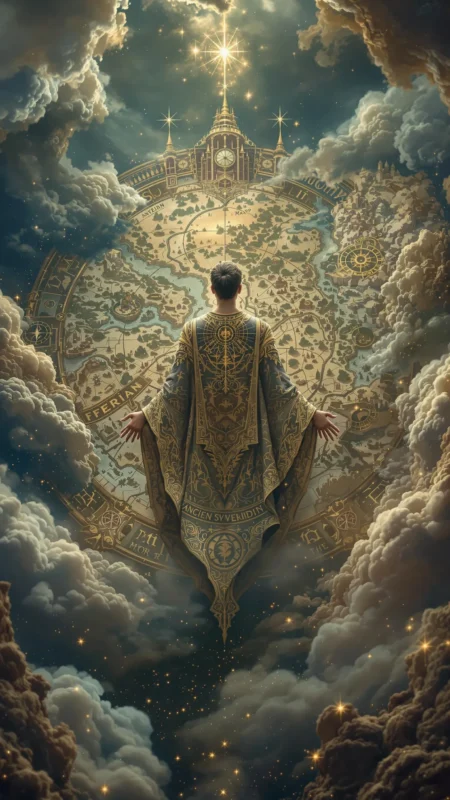
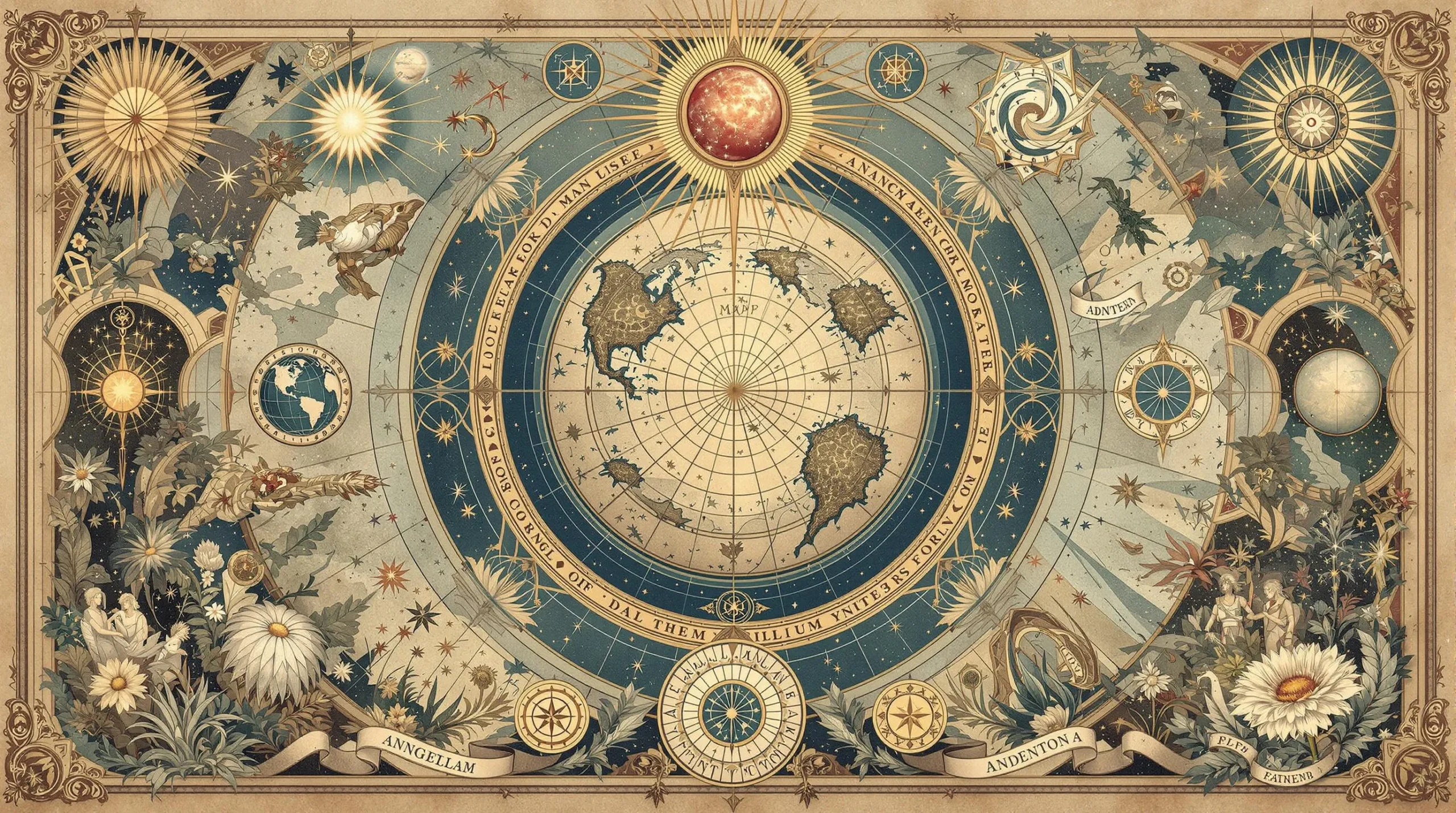
The Ancient Map is not a guide to the outer world but a schematic of the soul. It suggests that your life, with its triumphs and tragedies, follows an innate, albeit esoteric, logic. It is a palimpsest, written over by experience, yet the original markings of your essential self remain. To engage with this archetype is to become an archaeologist of your own psyche, brushing away the dust of daily life to reveal the deeper coastlines and continents within. The paths it shows are not prescriptive mandates but lines of potential, currents of psychic energy that are easier to follow than to resist. It symbolizes a destiny that is not fixed, but is rather a pre-existing landscape upon which you have considerable freedom to roam.

The map’s state of decay is, perhaps, its most profound feature. The torn edges and missing pieces are not flaws; they are the spaces left for you to fill in. It is ancient, but it is not finished. Your experiences, your choices, your loves and your losses are the ink with which you chart the Terra Incognita. This archetype suggests a partnership with fate: you are given a terrain, but you must be the one to survey it, to name its features, to decide which paths to fortify and which to let overgrow. It speaks to a life where meaning is found not in arrival, but in the courageous act of cartography.

The very substance of the map—the brittle vellum, the faded sepia ink, the creases that threaten to tear—is symbolic of the body and the passage of time. The folds are the habits and patterns ingrained through repetition. The water stains may be the marks left by past sorrows. To hold the map is to hold a tangible record of an intangible journey, a reminder that the spiritual quest is embodied, lived through flesh and bone. It refutes the notion of a purely abstract existence, grounding your personal myth in the beautiful, fragile material of your own life.


Ancient Map Relationships With Other Archetypes

The Explorer

The Explorer is the map’s most obvious partner, yet their relationship is one of dynamic tension. The Explorer requires the map for direction and context, relying on its ancient wisdom to avoid known perils. Yet, the Explorer’s very essence is to push beyond the known, to step off the map’s edge into the blank spaces. The map provides the foundation, but the Explorer must ultimately betray its completeness to fulfill their own purpose. This dance symbolizes the balance between honoring tradition and forging new paths, between inherited knowledge and direct experience.

The Librarian

The Librarian archetype acts as the guardian and interpreter of the Ancient Map. Their role is to preserve its fragile form, to study its lore, and to understand its every symbol. The Librarian finds safety and meaning in the careful curation of this knowledge. However, the risk is that the map becomes a revered artifact rather than a living tool. The Librarian may protect the map so fiercely that it is never used by the Explorer, its purpose unfulfilled. This relationship highlights the conflict between knowledge and action, between preservation and application.

The Abyss

The Ancient Map often points toward the Abyss, whether it is marked as a great chasm, an endless sea, or simply ‘Terra Incognita.’ The map’s final function may be to lead you to the edge of what is understandable and structured, and to stop. The Abyss is everything the map is not: formless, chaotic, and unknown. The relationship is one of confrontation. The map provides the structure and courage needed to approach the void, but to truly grow, one must be willing to let go of the map and step into the un-mappable mystery it delineates.

Using Ancient Map in Every Day Life

Navigating Career Transitions

When faced with a professional crossroads, the Ancient Map does not offer a simple X-marks-the-spot for the perfect job. Instead, it encourages a survey of your inner landscape. The mountains may represent your core, unchangeable values; the rivers, your natural talents and emotional currents. A career change, then, is not about leaping to a new point, but about finding a path that follows the contours of your own geography, even if it leads through an unfamiliar forest or a challenging mountain pass.

Understanding Family History

The Ancient Map can serve as a metaphor for the psychic inheritance of your lineage. The faded lines are the stories no one tells; the stains are the traumas passed down through generations. To study this map is to trace the journeys of your ancestors not on a globe, but within your own impulses and anxieties. You may find you are subconsciously avoiding a river where a relative metaphorically drowned, or seeking a mountain peak you were told was your family’s destiny to summit.

Overcoming Creative Block

For the artist or writer, the blank page is not empty but is merely an uncharted section of the map. Creative block may be seen as standing before an impassable chasm or a dense, dark wood on the chart. The archetype encourages you not to force a way through, but to consult the map again. Perhaps there is a forgotten trail nearby, an annotation in the margin from a past self, or a different mode of travel required: to fly over the chasm instead of building a bridge.

Ancient Map is Known For

Terra Incognita

The map is as famous for what it doesn’t show as for what it does. These blank spaces, often labeled ‘Here be dragons,’ represent the vast, unexplored regions of the self and the world. They are a direct invitation to adventure, symbolizing the potential for growth that lies beyond the edges of your current understanding and experience.

The Compass Rose

More than a simple directional tool, the compass rose on an ancient map symbolizes one’s core orienting principles. It is the anchor of personal values, the true north of integrity that helps you navigate even when the topographical details of life are confusing or contradictory. To lose sight of the compass rose is to become truly lost, regardless of what the rest of the map says.

Cryptic Annotations

The small, handwritten notes in the margins or the nearly invisible symbols over certain landmarks are central to the map’s character. These may represent ancestral wisdom, flashes of intuition, or the residue of past experiences. They suggest that the direct path is rarely the whole story and that true guidance often lies in the subtleties we are prone to overlook.

How Ancient Map Might Affect Your Personal Mythology

How Ancient Map Might Affect Your Mythos

When the Ancient Map is a central object in your personal mythos, your life story ceases to be a linear progression from A to B. Instead, it becomes a grand expedition across a complex and meaningful landscape. Pivotal life events are not random occurrences but significant landmarks: the ‘Mountain of First Heartbreak,’ the ‘Forest of Doubt,’ the ‘River of Career Change.’ Your personal narrative is framed as a quest for understanding, a journey to chart the entirety of your own inner world. The plot of your life is driven by the pull of the unseen, the desire to discover what lies over the next hill or to find the source of a mysterious river that flows through your consciousness.

This mythos could also be deeply colored by a sense of legacy and inheritance. You may feel that the map was not created by you, but passed down, perhaps by ancestors, perhaps by a spiritual source. Your role is not just to travel, but to be a custodian of this sacred document. You might see your struggles as attempts to decipher a cryptic clue left by a forebear, or your triumphs as finally reaching a place they could only mark with a hopeful ‘X.’ Your story becomes part of a much larger, multi-generational saga of exploration and discovery.

How Ancient Map Might Affect Your Sense of Self

Your perception of self may shift from that of a fixed personality to that of a vast and varied territory. Self-discovery is not an act of invention but of exploration. You are not building a self; you are uncovering one. This can instill a profound sense of depth and mystery to your own being. You may learn to treat your moods and impulses not as flaws to be corrected, but as weather patterns or geographical features to be navigated. There is a sense that everything within you, even the dark and frightening parts, belongs on the map and has a place in the overall geography.

This can also foster a complex relationship with your own potential. On one hand, the map suggests that your gifts and destiny are already encoded within you, waiting to be found. This can be empowering, a source of quiet confidence. On the other hand, it may create a pressure to find the ‘right’ path or a fear that you are misreading the signs. The self can feel less like a free agent and more like a traveler bound by the contours of a pre-existing terrain, creating a subtle tension between free will and destiny.

How Ancient Map Might Affect Your Beliefs About The World

The world, seen through the lens of the Ancient Map, is not a collection of random objects and events but a place saturated with significance. A chance encounter, a line from a book, the pattern of cracks in a sidewalk—all may be interpreted as symbols on a larger, cosmic map. You might develop a profound attentiveness, a habit of looking for the hidden patterns and secret passages that lie just beneath the surface of the mundane. Reality itself becomes a text to be deciphered, a landscape rich with clues about your own journey.

This perspective may cultivate a belief in an underlying order or intelligence in the universe. Chaos is simply a region of the map that has not yet been charted. This can provide immense comfort in times of turmoil, fostering a trust that even painful events are part of a larger, meaningful topography. However, it can also lead to a worldview where everything must be a sign, potentially diminishing the value of simple, un-symbolic experience and the beauty of pure, uninterpreted reality.

How Ancient Map Might Affect Your Relationships

In the realm of relationships, you might view other people as unique territories, each with their own secret maps. Forging a connection is like the slow, careful process of laying your maps side-by-side, learning to read the other’s symbols, and discovering where your landscapes overlap to create shared worlds. You may be drawn to the mystery in others, to the uncharted regions of their personalities, seeing relationship as a joint expedition into the unknown parts of each other.

You may place a great deal of weight on fateful encounters, seeing them as points where your predestined paths were meant to intersect. This can lead to deep, soulful connections that feel mythic in scope. The danger, however, is a tendency to idealize this fatedness, perhaps staying in a difficult connection because the ‘map’ seems to indicate you should, or dismissing a promising one because it doesn’t fit your preconceived notion of the ‘path.’ Relationships can become less about co-creation and more about following a script you believe has already been written.

How Ancient Map Might Affect Your Role in Life

Your perceived role in life might be that of the Navigator or the Cartographer. You feel a responsibility not just to follow the path, but to understand it, interpret it for others, and perhaps even add to it for future generations. There is a sense of purpose that comes from this role: to bring consciousness to the journey, to make sense of the wilderness. You are the one who holds the long view, who reminds others to trust the process when they are lost in the woods.

Alternatively, you could adopt the role of the Treasure Hunter, with the map as your guide to a specific prize. Your life becomes a focused quest for a singular goal you believe is your destiny: enlightenment, the perfect partner, a world-changing innovation. This provides immense drive and focus. The risk is that the journey itself becomes secondary to the destination. You may traverse beautiful, life-giving landscapes without ever noticing them, your eyes fixed only on the ‘X’ that marks the spot, potentially missing the true treasure of the experience itself.

Dream Interpretation of Ancient Map

In a positive context, to dream of an Ancient Map is to be visited by your own deep intuition. If the map is clear, unfurling easily before you, it may signify a dawning clarity in your waking life. You might be on the verge of understanding your purpose, or a solution to a complex problem is revealing itself. Tracing a path on the map with your finger could suggest that you have subconsciously made a decision and your dreaming mind is affirming it. Finding a new part of the map you’ve never seen before can indicate the emergence of a hidden talent or a new, promising opportunity on the horizon.

Conversely, a dream featuring a damaged or inscrutable map often points to feelings of confusion and being lost. A map that is torn, burned, or written in an unreadable language may reflect a sense of profound uncertainty about your life’s direction. It could symbolize conflicting advice from others or a disconnect from your own inner guidance system. Dreaming that you have lost the map entirely can be a particularly stressful symbol of feeling unmoored, without purpose, or that you have taken a wrong turn so significant that you can no longer find your way back to your essential path.

How Ancient Map Archetype Might Affect Your Needs

How Ancient Map Might Affect Your Physiological Needs

When the Ancient Map informs your mythology, physiological needs are not just biological imperatives; they are instructions from the journey’s guide. The body itself becomes the primary map. Hunger might not just be a need for calories, but a signal that you lack a specific type of ‘fuel’ for the next emotional or spiritual leg of the journey. A particular craving might be a cryptic clue. Fatigue is not just tiredness, but a sign that you have reached a designated resting point on the map, a place to make camp before a strenuous mountain climb ahead.

This can lead to a highly ritualized and intuitive approach to self-care. You might choose foods, exercises, or sleep schedules based on what the ‘terrain’ of your life seems to demand. Rest is not laziness; it is poring over the map. Exercise is not a chore; it is preparing the vessel for the expedition. This view sanctifies the body’s messages, treating them as essential navigational data rather than inconveniences to be ignored or suppressed in the pursuit of a goal.

How Ancient Map Might Affect Your Ideas of Belonging

Belonging, in this mythos, is the profound experience of finding another traveler whose map shares a similar geography to your own. It is not about finding someone identical, but someone whose rivers flow into yours, whose mountains you can see from your valleys. You feel a sense of kinship with those who are on a similar quest, even if their destinations differ. Love and friendship are seen as the act of creating a shared atlas, where you help each other read the difficult passages and celebrate the discovery of beautiful, hidden groves together.

Conversely, a deep sense of alienation can arise when your map feels utterly foreign to everyone you meet. You may feel that your internal landscape is too strange, too complex, or too archaic for anyone else to understand. This can lead to a solitary journey, not by choice, but from a feeling of being fundamentally illegible to others. The search for belonging becomes a quest to find the one or two rare souls who can look at your crumpled, stained, and cryptic map and see not a mess, but a beautiful and familiar world.

How Ancient Map Might Affect Your Feelings of Safety

From the perspective of the Ancient Map, safety is equated with knowledge of the terrain. True security lies in understanding your own inner landscape: your triggers (the treacherous cliffs), your resilience (the sturdy highlands), and your sources of replenishment (the clear rivers). When you know your map well, you can navigate challenges with a sense of preparedness. The feeling of safety comes from having a reliable compass of intuition and a chart, however incomplete, of the world you must traverse. Danger is represented by being forced off your map or into a region where your compass spins wildly.

However, this reliance on the map for safety can become a gilded cage. The desire to stay within the known, charted territories can lead to a profound fear of the unknown. You might avoid risks, opportunities, or relationships simply because they lie in the ‘Terra Incognita’ sections of your chart. Paradoxically, a life lived entirely within the safe zone of the map is a life of stagnation. True, dynamic safety might require the courage to venture into the very places marked ‘Here be dragons,’ trusting that you have the skills to chart them as you go.

How Ancient Map Might Affect Your Views of Esteem

Esteem is directly tied to your progress as a cartographer of the self. Your sense of worth is not derived from external validation, but from the quiet, internal satisfaction of having successfully navigated a difficult passage or having charted a new area of your inner world. Each insight gained, each fear faced, each pattern understood is like adding a new, detailed feature to your map. Esteem grows as your map becomes more complete, more detailed, and more true. It is the pride of the craftsman in their ever-expanding, unique, and masterful work.

Low esteem, therefore, often manifests as the feeling of being hopelessly lost. It is the panic of not being able to read the symbols, of walking in circles, of feeling that your map is blank or, worse, a meaningless scrawl. You might compare your seemingly convoluted and difficult map to the apparently simple, direct roadmaps of others, feeling inadequate and directionless. The pressure to ‘arrive’ at a destination depicted on the map can be immense, and the feeling of falling short can be a significant blow to one’s sense of competence and value.

Shadow of Ancient Map

When the Ancient Map’s influence becomes excessive, it casts a shadow of rigidity and dogma. The map ceases to be a guide and becomes a tyrant. Life is no longer an exploration but a grim exercise in forcing reality to conform to the lines on the parchment. You may become intolerant of anything that represents a detour: a spontaneous opportunity is dismissed as a distraction; a person who challenges your worldview is seen as a hostile force. The joy of discovery is replaced by the grim satisfaction of being ‘on track,’ and you may navigate your life with ruthless efficiency, arriving at your destination only to find you have missed the entire world along the way.

Conversely, the shadow can manifest in the map’s absence or deliberate misreading. Here, the map’s cryptic nature is used as an excuse for perpetual aimlessness. You might claim the path is ‘too hidden’ or the signs ‘too confusing,’ thus absolving yourself of the responsibility to choose a direction. This is not the joyful wandering of the curious explorer, but the fearful drifting of the fugitive. You use the idea of a mystifying destiny as a shield against the anxiety of making a choice, ultimately charting nothing and arriving nowhere, your map remaining a blank and accusing page.

Pros & Cons of Ancient Map in Your Mythology

Pros

  • It provides a profound framework for finding meaning in the chaos of life, turning struggles into navigable terrain.
  • It encourages deep introspection and a connection to personal history, intuition, and ancestral wisdom.
  • It fosters patience and a long-term perspective, helping you to see setbacks as mere features on a much larger journey.

Cons

  • It can lead to a dangerous over-reliance on signs and omens, potentially disconnecting you from the tangible present.
  • It may create a burdensome pressure to find and fulfill a ‘destiny,’ leading to anxiety about being on the ‘wrong path.’
  • It can make it difficult to accept life’s inherent randomness, leading to a frustrating search for meaning where none exists.