Believe
 Fear
Fear Strength
 Weakness
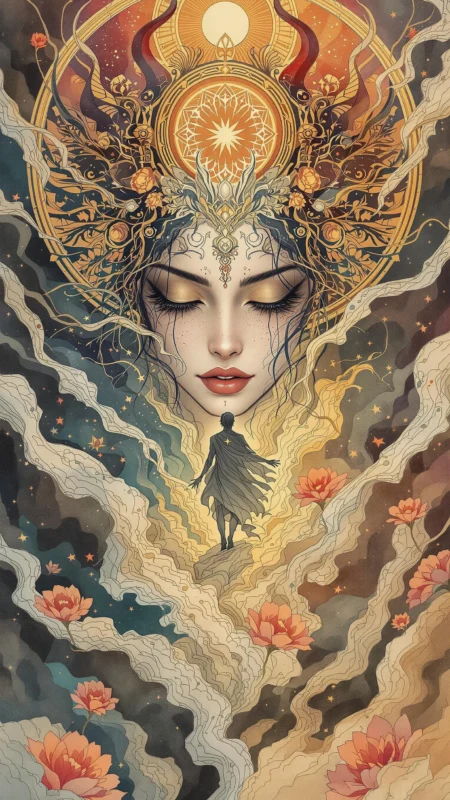
In the modern psyche, Amaterasu speaks to the profound tension between our public-facing radiance and our private, vulnerable self. She is the archetype of the creator, the leader, the vibrant center of a family or community who, by their very nature, provides warmth and light. Yet, this is not a story of tireless, godlike performance. Its most crucial chapter is about the retreat. Her mythos sanctifies the act of withdrawal, not as weakness, but as a necessary response to violation, chaos, or exhaustion. To have Amaterasu in one's personal mythology is to understand that the cave of solitude—be it a studio, a quiet room, or a period of social hibernation—is a sacred space, essential for the eventual return of one's own generative light.
Her story is also a parable about the nature of influence. Amaterasu does not re-emerge through force or argument. She is lured out by a spectacle of beauty, artistry, and joy: the goddess Ame-no-Uzume’s ecstatic dance. This suggests that the deepest parts of ourselves, the brilliant and wounded aspects we have hidden away, are not coaxed out by logic or duty, but by beauty, play, and authentic celebration. Your personal mythology might reflect this truth: that your greatest contributions do not come from a place of grim determination, but from allowing your own light to be drawn forth by that which you find genuinely delightful and compelling.
The mirror, Yata no Kagami, which finally tempts her from the cave, is a symbol of shattering power. When she sees her own reflection, she is captivated by her own brilliance. This is the archetype's lesson on self-worth. For the one who gives so much light to others, the final step is often the recognition of their own radiance. The personal myth becomes a journey toward seeing oneself clearly, not through the eyes of others or the lens of one's responsibilities, but by encountering the startling and undeniable fact of one's own brilliant existence.