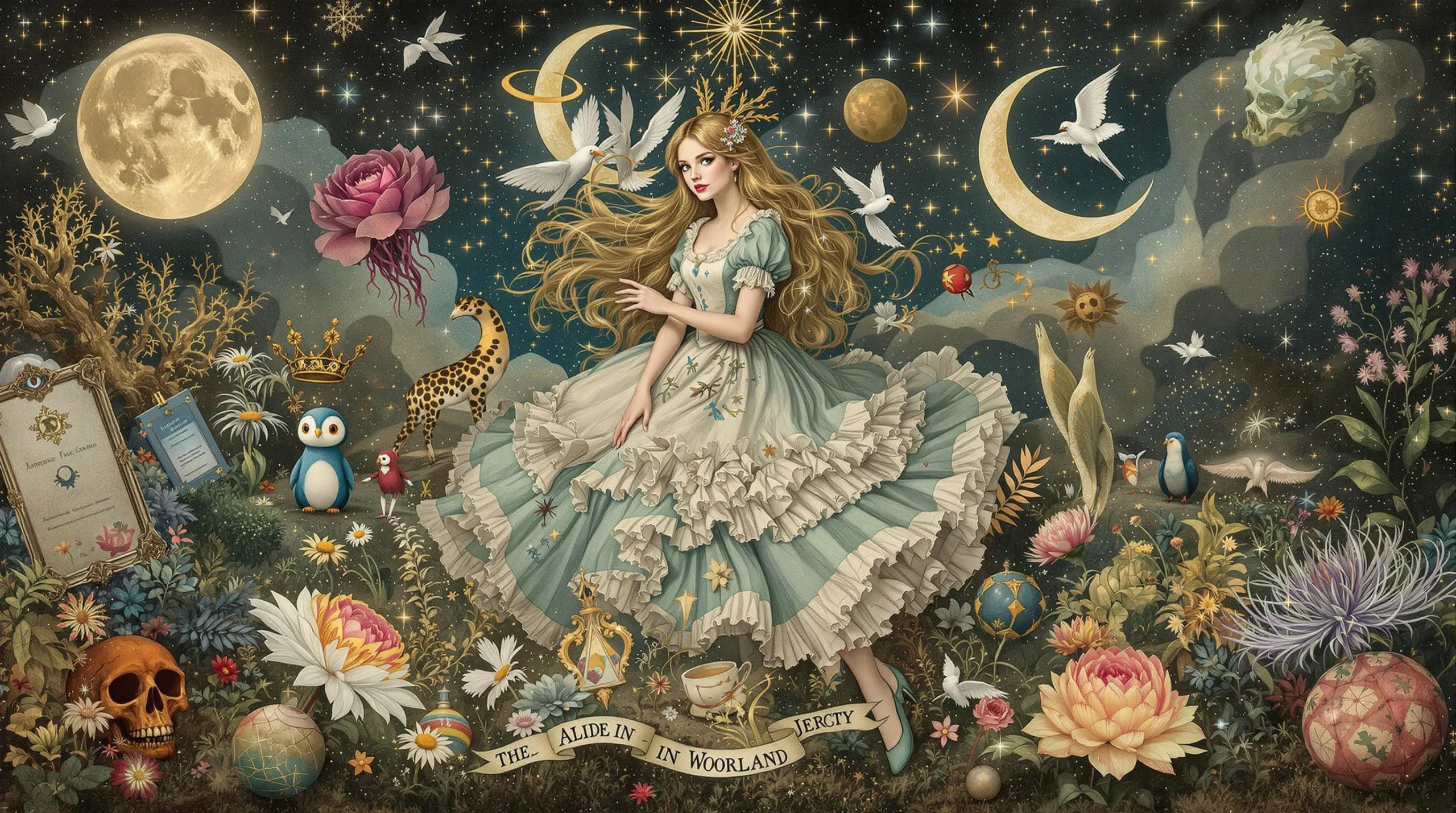


Alice (Alice in Wonderland)

Archetype Meaning & Symbolism

Curious, logical, polite, imaginative, frustrated, brave, observant, stubborn, proper, questioning

  • It’s no use going back to yesterday, because I was a different person then.

If Alice (Alice in Wonderland) is part of your personal mythology, you may…

Believe

  • You may believe that curiosity is the highest virtue, and that asking ‘why?’ is the most important action one can take.
  • You may believe that the world’s proclaimed rules and hierarchies are a collective fiction, and that true reality is far stranger and more fluid than most people are willing to admit.
  • You may believe that politeness and a strong command of language are a form of armor, a way to maintain your composure and create order when surrounded by chaos.

Fear

  • You may fear losing your mind, that one day you will stop being able to distinguish between logic and nonsense and become just another mad guest at the tea party.
  • You may fear being permanently trapped in a situation governed by arbitrary rules and illogical people, with no hope of escape back to a world that makes sense.
  • You may fear that your identity is not stable, that it can be changed, distorted, or erased by external forces beyond your control.

Strength

  • You possess a formidable ability to stay calm and think logically in the midst of utter chaos, making you a stable anchor in any crisis.
  • You have an unshakeable sense of curiosity that allows you to see wonder, novelty, and learning opportunities where others see only confusion.
  • You are unafraid to question authority and challenge assumptions, often cutting through complexity to a simple, unvarnished truth.

Weakness

  • You can become easily frustrated or pedantically condescending toward people who do not operate with the same level of logic as you do.
  • You may feel a persistent sense of alienation or loneliness, as if you are the only sane person in an insane world.
  • You might fall into ‘analysis paralysis,’ trying to logically deconstruct a situation that is fundamentally emotional or irrational, thus missing the point entirely.

The Symbolism & Meaning of Alice (Alice in Wonderland)

Alice is the patron saint of the sensible soul adrift in a sea of nonsense. She is not a hero who quests for a magical sword, but an explorer who quests for simple coherence. Her journey downward, into the earth, is a descent into the subconscious, into a realm where the ego’s rules of logic and propriety are suspended. To claim Alice in your personal mythology is to acknowledge that life, at its core, may be governed by a dream-logic that rational thought alone cannot penetrate. Her constant refrain, ‘curiouser and curiouser,’ becomes a mantra for embracing the perplexity of existence rather than fighting it. She symbolizes the transition from the structured world of childhood, where rules are taught, to the chaotic reality of adulthood, where rules are revealed to be arbitrary and often self-serving.

Her journey is a powerful metaphor for the process of individuation. Alice begins as a proper Victorian girl, a product of her conditioning. Wonderland systematically dismantles this conditioning. The Mad Hatter’s tea party demolishes the concept of polite social order; the Queen of Hearts’ court demolishes the concept of justice. Stripped of these external frameworks, Alice must construct her own identity from the inside out. Her physical transformations, the sudden shrinking and growing, are perhaps the most direct symbol of this internal turmoil: the feeling of being too small and powerless one moment, and too large and conspicuous the next. This is the very rhythm of finding one’s place in the world.

The archetype also speaks to a particular kind of intelligence: not the accumulation of facts, but the steadfast application of reason in unreasonable circumstances. Alice is a philosopher in a pinafore. She is constantly trying to establish first principles, to find the underlying axioms of a world that has none. This may make her a symbol for the scientist, the artist, or anyone who feels like an outsider for simply insisting that things should add up. She represents the courage it takes to remain sane and centered when everyone around you is, by your estimation, quite mad.


Alice (Alice in Wonderland) Relationships With Other Archetypes

The Rabbit Hole

The relationship between the Alice and the Rabbit Hole is perhaps less one of action than of magnetic, fateful sympathy. The Hole is not merely a passageway but a pupil dilating in the eye of the mundane world, an invitation to a deeper, more vertiginous grammar of existence. It could be seen as the universe whispering a secret it can’t quite articulate, a sudden, silent rupture in the fabric of the expected. For Alice, the descent is not so much a fall as a slow, deliberate unspooling of the self, a surrender to the gravitational pull of her own nascent curiosity. The Hole may be the question, and she, in her tumbling, curious passage, becomes the living, breathing answer.

The Mad Hatter

In the company of the Mad Hatter, the Alice archetype may find its most peculiar and profound dialogue. He is not a guide but a fellow traveler lost in the same beautiful, illogical wilderness. Their connection is forged not in shared understanding but in a shared bewilderment, a pact to honor the sanctity of the absurd. The Hatter could be a fractured mirror, reflecting back a delightful distortion of a world already suspected of being mad. He offers a kind of liberation—the freedom that comes from accepting that the teacups will never be clean, the clocks will forever be stopped at teatime, and the most sensible response to an unsolvable riddle is simply to keep pouring.

The Queen of Hearts

The Queen of Hearts could be viewed as the embodiment of rigid, brittle power, the ultimate expression of a world where rules exist without reason. Her relationship with the Alice archetype is the classic confrontation between innocent inquiry and furious, fragile authority. The Queen is not a shadow; she is a tantrum given a crown, a shrieking, crimson-faced insistence on a logic that serves only itself. Alice’s presence in her court is like a drop of clear water in a vat of boiling oil. Her simple, persistent “why?” is not an act of rebellion so much as a fundamental force of nature, and in this collision, the Queen’s tyranny is perhaps revealed for what it is: a fortress of playing cards, magnificent in its construction but susceptible to the slightest breath of common sense.

Using Alice (Alice in Wonderland) in Every Day Life

Navigating a New Environment

When starting a new job or moving to a new city, the rules and culture can feel as nonsensical as a Mad Tea Party. Embodying the Alice archetype allows you to observe with curious detachment, to question the ‘why’ behind bizarre corporate rituals or social norms, and to use your own internal logic as a compass when the external world offers none. You might not immediately fit in, but you will understand the system on your own terms.

Confronting Bureaucracy

Facing an illogical system, like a government agency or a labyrinthine customer service protocol, can feel like playing croquet with a flamingo. Alice teaches one to persist with polite, relentless questioning. She does not accept ‘because I said so’ as an answer from a Queen or a clerk. This archetype encourages you to point out the absurdity of the rules, not with anger, but with the unassailable clarity of a child asking why the emperor has no clothes.

Finding Your Voice

Throughout her journey, Alice is belittled, ignored, and told she makes no sense. Her ultimate triumph is finding her voice in the courtroom and declaring, ‘You’re nothing but a pack of cards!’ For someone who feels their perspective is constantly dismissed, the Alice archetype provides a script for self-actualization. It is the journey of growing into your own authority and realizing that the intimidating figures around you may only have power if you grant it to them.

Alice (Alice in Wonderland) is Known For

Falling Down the Rabbit Hole

This iconic moment represents an unexpected, disorienting plunge into a new and unknown reality, a sudden departure from the familiar world into the subconscious or the absurd.

Growing and Shrinking

By consuming magical cakes and potions, Alice’s body changes size dramatically. This symbolizes fluctuating feelings of power and helplessness, shifting self-esteem, and the confusing physical and psychological changes of maturation.

Conversing with Nonsense

Her interactions with characters like the Cheshire Cat, the Mad Hatter, and the Caterpillar are famous for their circular logic and paradoxical wisdom. These conversations highlight the clash between rigid, conventional thinking and a more fluid, imaginative reality.

How Alice (Alice in Wonderland) Might Affect Your Personal Mythology

How Alice (Alice in Wonderland) Might Affect Your Mythos

When Alice becomes a guide in one’s personal mythos, the life story ceases to be a linear progression and instead becomes a series of rabbit holes. Major life transitions—a new career, a sudden move, a transformative relationship—are not just chapters, but descents into entirely new worlds with their own bizarre rules and inhabitants. The narrative of your life may be punctuated by these moments of profound disorientation, where the skills and knowledge from the ‘world above’ are suddenly useless. Your myth is not one of climbing a ladder but of navigating a Wonderland, learning to drink the potion that makes you small enough to fit through the door, or eat the cake that lets you see over the garden walls.

This archetype shapes a mythos of the ‘accidental adventurer.’ You may not see yourself as a hero who chooses their quest, but as a curious wanderer who stumbles upon it. Your life story is less about achieving predetermined goals and more about the quality of your attention and wit during the unexpected journey. The central conflict in your myth might be the tension between your innate desire for order and a life that persistently delivers chaos. The triumphs are not victories over external foes, but moments of profound clarity: when you finally understand the logic of the Cheshire Cat, or when you find the courage to talk back to the Queen of Hearts in your own life.

How Alice (Alice in Wonderland) Might Affect Your Sense of Self

To see yourself through the lens of Alice is to see a person defined by their relationship with the absurd. You may feel like a perennial outsider, a spectator at the mad tea party of life, armed with a polite curiosity that separates you from the other guests. Your sense of self may be founded on your ability to remain logical and observant while the world spins in nonsensical circles. This can foster a strong, independent identity, one that doesn’t rely on external validation because, in Wonderland, validation is handed out by mad queens and hookah-smoking caterpillars; it’s worthless.

However, this archetype could also color self-perception with a persistent feeling of being out of step. The constant growing and shrinking might resonate as a metaphor for a fluctuating sense of self-worth. One day you may feel competent and powerful, able to see the whole ridiculous game for what it is. The next, you might feel small, helpless, and lost in a sea of your own tears. Your identity might feel fluid, a thing that must be constantly reasserted and redefined in response to the bewildering circumstances you find yourself in. Self-knowledge comes not from quiet introspection, but from the trial of navigating a world that constantly questions who you are.

How Alice (Alice in Wonderland) Might Affect Your Beliefs About The World

An Alice-informed worldview is one that is fundamentally skeptical of surfaces. It presumes that beneath the veneer of societal norms, corporate structures, and political rhetoric lies a realm of profound absurdity. You may view the world as a grand, theatrical performance where most people have forgotten they are actors playing arbitrary roles. This doesn’t necessarily lead to cynicism, but to a kind of amused detachment. You might see the ‘rules’ of the world not as inviolable laws of physics, but as the croquet rules of the Queen of Hearts: invented on the spot and designed to favor the house.

This perspective fosters a deep-seated suspicion of authority and tradition for tradition’s sake. The world is not a serious, well-ordered place, but a chaotic, often hilarious, and sometimes dangerous playground of the illogical. This could lead to a worldview that values flexibility, creativity, and a sense of humor above all else. You may believe that the only rational response to an irrational world is to embrace its strangeness, to follow your curiosity, and to trust your own judgment over the pronouncements of any self-proclaimed kings or queens. Truth is not something to be received, but something to be stumbled upon in the most unlikely of conversations.

How Alice (Alice in Wonderland) Might Affect Your Relationships

In relationships, the Alice archetype might manifest as a pattern of engaging with fascinating, yet bewildering, characters. Your social life could feel like a series of encounters with Mad Hatters, Cheshire Cats, and White Rabbits: people who are captivating but operate on a logic entirely different from your own. You may be drawn to enigmatic individuals, finding beauty in their unique madness, but you might also struggle to find stable, predictable ground for a deep connection. Every tea party is interesting, but none may feel like home.

This can create a dynamic where you are the ‘straight man’ in your relationships, the one who provides the calm, logical counterpoint to a partner’s or friend’s chaotic energy. While this can be a stabilizing role, it may also lead to a sense of loneliness, the feeling that no one truly understands your perspective. You might fear that genuine intimacy requires you to abandon your own logic and surrender to the madness, a terrifying prospect. Alternatively, you may excel at short, transformative encounters, acting as the catalyst who asks the penetrating question that changes someone’s perspective before you both move on, like two ships passing in a dream.

How Alice (Alice in Wonderland) Might Affect Your Role in Life

If Alice is part of your mythology, your perceived role in life may be that of the ‘Witness’ or the ‘Questioner.’ You are not necessarily here to lead the revolution, but to point out that the empress is, in fact, a shrieking tyrant who changes the rules at will. Your function is to maintain your own sense of reason and, by doing so, expose the unreason of the systems you move through. You may find yourself inadvertently becoming a focal point of change, not through intention, but because your simple, logical presence is inherently disruptive to a dysfunctional status quo.

This role is often one of an outsider, and you may accept this as your natural position. You are the eternal visitor, the tourist in strange lands, whether that land is your family, your workplace, or your country. This can be liberating, as it frees you from the pressure to conform. However, it can also be isolating. Your role is not to belong, but to observe and understand. You might feel your purpose is to journey through many different worlds, collecting insights and experiences, and to eventually find your way back to yourself, changed by the journey but fundamentally, unbreakably, you.

Dream Interpretation of Alice (Alice in Wonderland)

To dream of Alice or of being Alice in a positive context is an invitation from your subconscious to embrace curiosity and explore the unknown territories of your own mind. It may suggest you are entering a period of rapid personal growth and transformation, and that the old rules no longer apply. The dream could be encouraging you to question authority, to think outside the box, and to find the playful, creative solution to a waking-life problem. Seeing Wonderland in a dream may be a sign that you need to loosen your grip on rigid control and allow for more magic, spontaneity, and dream-logic in your life.

In a negative context, an Alice dream can symbolize feelings of being lost, powerless, and overwhelmed. It might reflect a situation in your life that feels nonsensical, unjust, and frightening, where you feel your identity is being threatened or erased. Growing too large or too small could represent anxieties about your place in the world, feeling either claustrophobically trapped or insignificantly small. Being pursued by the Queen of Hearts or trapped at the Mad Tea Party might signify a feeling of being stuck in a toxic situation with irrational people, with no logical way out. The dream is a warning that your reliance on reason is failing you, and you are losing your footing.

How Alice (Alice in Wonderland) Archetype Might Affect Your Needs

How Alice (Alice in Wonderland) Might Affect Your Physiological Needs

The Alice archetype suggests a precarious relationship with the most basic of physiological needs. For Alice, the simple acts of eating and drinking are fraught with peril and unpredictable consequences; a sip of a drink or a bite of a cake can upend her entire reality. In one’s personal mythos, this may translate to a deep-seated mistrust of what one takes into the body. It could manifest as highly specific, almost ritualistic eating habits, or a constant anxiety about food, nourishment, and their effects. The body is not a reliable constant but a variable, a thing whose very substance can be altered by the outside world.

This mythos could also frame the fulfillment of basic needs as a puzzle to be solved. Shelter, rest, food, and water are not givens; they are clues in a larger game. Finding a safe place to rest or the right thing to consume requires wit and observation, not just instinct. This can lead to a state of hyper-vigilance regarding one’s physical well-being, or conversely, a kind of surrender to the chaos, a belief that one’s physical state is largely outside of one’s control and subject to the whims of a Wonderland-like world.

How Alice (Alice in Wonderland) Might Affect Your Ideas of Belonging

Alice is the quintessential outsider; her entire journey is a failed attempt to belong. She is too logical for the Mad Hatter, too big for the White Rabbit’s house, too human for the talking flowers. To carry this archetype is to perhaps carry a deep and abiding sense of not quite fitting in, anywhere. The need for love and belonging becomes a quest for a tribe that speaks your language of reason and curiosity, a search that can often feel fruitless in a world that prefers convention.

This might foster a mythology of lonely exceptionalism, the belief that you are simply too different to ever truly be part of a group. Relationships may be seen as temporary alliances or curious encounters rather than permanent ports in a storm. On the other hand, it can lead to a radical redefinition of belonging. Instead of seeking a group to merge with, you might find belonging in your very independence, creating your own community of fellow outsiders, or finding a sense of connection with the universal human struggle to make sense of the world. Love may be found not with someone who is the same, but with someone who appreciates your unique, logical view of their own beautiful madness.

How Alice (Alice in Wonderland) Might Affect Your Feelings of Safety

In Alice’s world, safety is an illusion. The rule of law is personified by a Queen who screams ‘Off with their heads!’ for any and all infractions. Security is not found in structures, institutions, or authority figures; these are, in fact, the primary sources of danger. When this archetype informs your personal mythos, your need for safety is met not by external assurances, but by internal resources. Safety is your own wit, your ability to adapt, your courage to speak truth to nonsensical power. You may feel that the only truly safe space is within your own logical mind.

This can lead to a profound self-reliance, a belief that you are your own best protector in a world that is fundamentally unpredictable and hazardous. However, it can also breed a pervasive sense of anxiety, a feeling that the ground could give way at any moment, plunging you into another rabbit hole. You might struggle to trust institutions designed to provide safety—governments, corporations, even social contracts—viewing them as arbitrary and potentially malevolent. Safety is not a static state to be achieved, but a dynamic process of moment-to-moment navigation through chaos.

How Alice (Alice in Wonderland) Might Affect Your Views of Esteem

Esteem, in the Wonderland mythos, is a battle. Alice is constantly belittled, her intelligence questioned, her very identity challenged by nearly every character she meets. If this is your story, your self-esteem is not built on the praise or validation of others, as this is revealed to be fickle, nonsensical, and untrustworthy. Instead, your esteem is forged in the fires of this very invalidation. It comes from the moments you hold your ground, trust your own senses, and talk back to the absurdity.

This archetype suggests that self-worth is an internal construct, built on the foundation of your own integrity and intellectual honesty. The pivotal moment for Alice, and for the person who embodies her, is the courtroom scene: the realization that the terrifying figures judging you are ‘nothing but a pack of cards.’ Esteem is the result of this profound shift in perspective. It is the quiet confidence that comes from knowing you can navigate chaos with your mind intact, and that your own clear-headed assessment of reality is more valuable than the confusing consensus of the crowd.

Shadow of Alice (Alice in Wonderland)

The shadow of Alice emerges when curiosity curdles into a complete detachment from reality. This is the individual who has not just visited Wonderland but has taken up permanent residence there, using ‘the world is absurd’ as an excuse to abdicate all responsibility. They may retreat into a private world of elaborate fantasy, rejecting societal norms not out of thoughtful critique, but out of a spiteful refusal to participate. They become a professional contrarian, their identity wholly dependent on being against whatever the mainstream accepts. They are not exploring nonsense for the sake of wisdom, but wallowing in it to avoid the difficult work of living.

Conversely, the shadow can manifest as a brittle and fearful hyper-rationality. This is the Alice who never learns the lesson of the rabbit hole, but instead becomes obsessed with enforcing her logic on a world that will not comply. She becomes rigid, intolerant of ambiguity, and dismissive of anything that cannot be measured or proven: emotion, intuition, art, spirituality. In her terror of the absurd, she becomes a tyrant of the literal, a walking rulebook who scolds the world for its poetry. She becomes the very sort of closed-minded, unimaginative figure that Wonderland itself was a rebellion against.

Pros & Cons of Alice (Alice in Wonderland) in Your Mythology

Pros

  • You are exceptionally resilient in the face of unexpected change and can adapt to new rules and environments with remarkable speed.
  • You have a gift for seeing the absurdity in systems of power, which prevents you from being easily intimidated or manipulated.
  • Your constant questioning and unique perspective make you a catalyst for innovation and creative problem-solving.

Cons

  • You may struggle to form deep, lasting bonds, as you often perceive others through a lens of analytical curiosity rather than empathetic connection.
  • Your insistence on logic can be perceived by others as cold, unemotional, or dismissive, particularly in situations that require tact and sensitivity.
  • You may live with a baseline level of anxiety or dissatisfaction, feeling perpetually out of sync with the world around you.