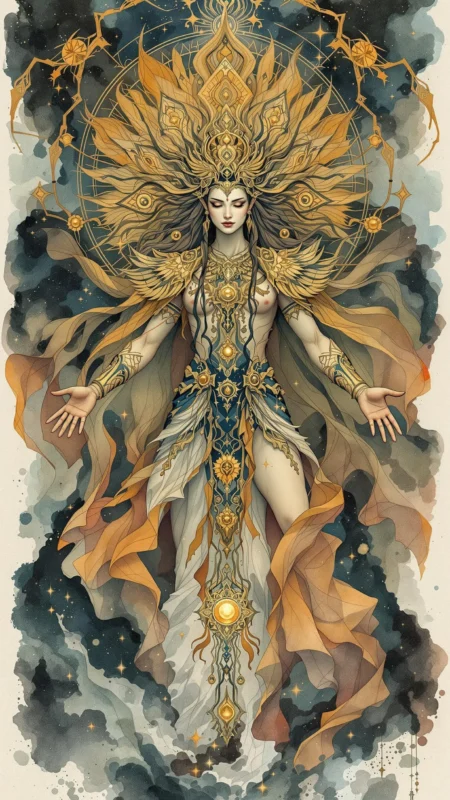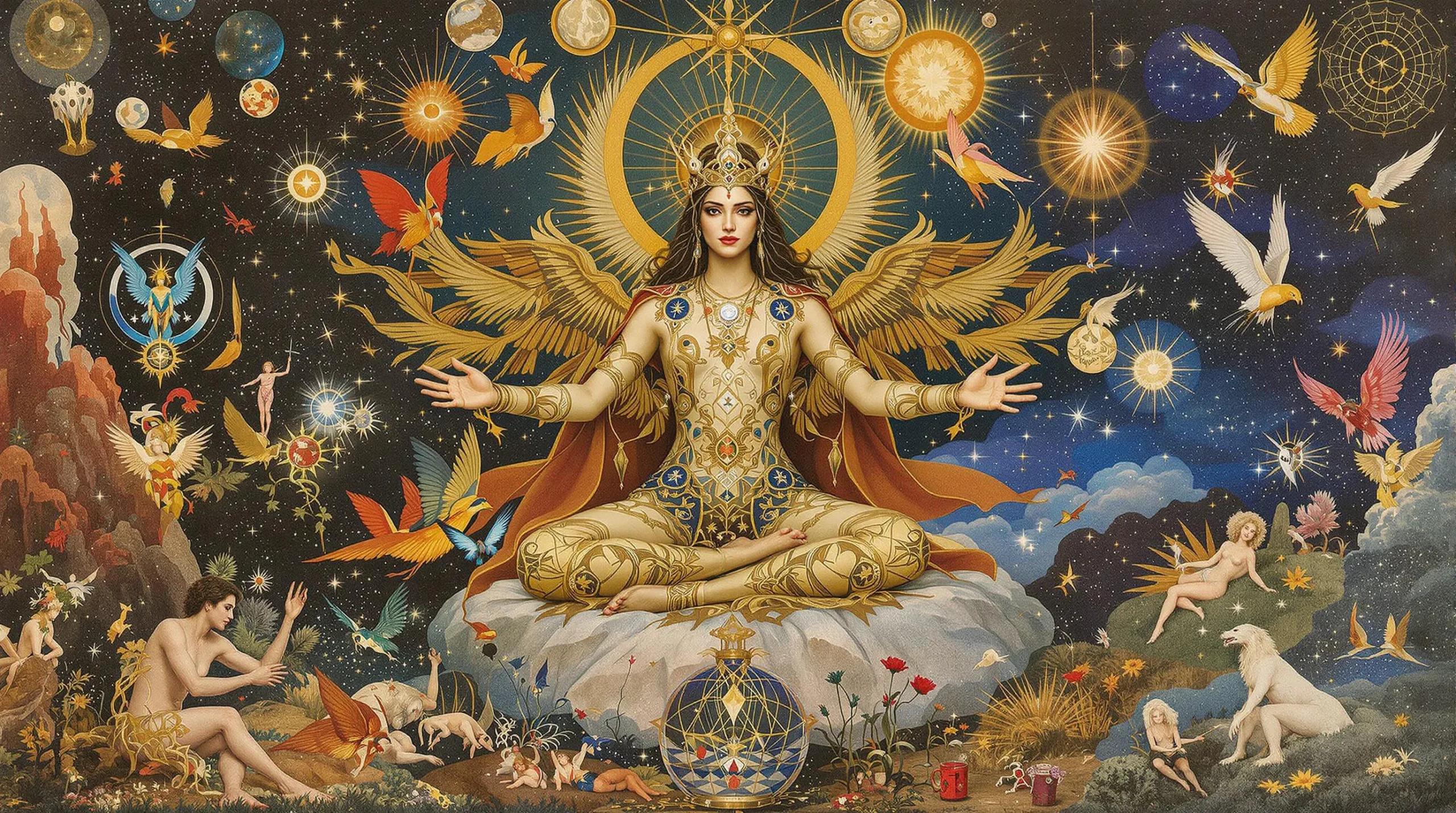


Ahura Mazda

Archetype Meaning & Symbolism

Luminous, Orderly, Wise, Unyielding, Creative, Generous, Dualistic, Demanding, Abstract, Paternal

  • The truth I offer is a fire: it illuminates the path but requires you to choose which shadows to cast.

If Ahura Mazda is part of your personal mythology, you may...

Believe

  • You may believe that free will is the ultimate human gift and that every choice is a creative act that defines reality.
  • You may believe that there is an objective, discernible truth, and that it is your highest purpose to seek it, embody it, and defend it.
  • You may believe that your life is a microcosm of a cosmic struggle between order and chaos, and that you are an active soldier on the side of light.

Fear

  • You may fear succumbing to your own inner 'adversary,' making a choice that leads you down a path of self-betrayal and moral chaos.
  • You may fear that your unwavering principles will inevitably lead to loneliness, isolating you from a world that seems to thrive on compromise and ambiguity.
  • You may harbor a secret fear that the grand, ordered design you perceive is an illusion, and that the universe is fundamentally chaotic and meaningless.

Strength

  • You may possess an unwavering moral compass, which provides immense clarity and purpose in a confusing world.
  • You may have a powerful ability to create order, structure, and functional systems, whether in your work, your home, or your own mind.
  • You may demonstrate profound personal integrity and self-reliance, earning trust and respect through your consistent adherence to your principles.

Weakness

  • You may have a tendency towards rigidity and dogmatism, making it difficult to appreciate nuance or tolerate differing viewpoints.
  • You may be susceptible to burnout, caused by the relentless pressure of constant moral vigilance and the pursuit of perfection.
  • You may struggle with intimacy, as your high ideals can translate into judgment or a lack of acceptance for the imperfections of others.

The Symbolism & Meaning of Ahura Mazda

In the modern psyche, Ahura Mazda may no longer be a deity throned in the heavens but an architect residing in the self. This archetype symbolizes the profound, often terrifying, human capacity for conscious choice. It is the part of us that looks upon the raw chaos of potential and feels an overwhelming urge to build, to order, to illuminate. It represents the belief that morality is not a social construct but a cosmic law, and that our free will is the tool by which we align ourselves with that law. To have Ahura Mazda in one's personal mythology is to feel the weight and glory of being a co-creator of reality, where every decision either weaves a thread of light into the tapestry or invites a strand of darkness.

The archetype speaks to a fundamental dualism, not of a simplistic good versus evil, but of order versus entropy, of truth versus the lie (druj). It is the internal legislator, the tireless judge, the part of the mind that insists on integrity when corner-cutting would be easier. This internal dynamic could manifest as a life structured around principles, a narrative of constant self-improvement, and a relentless pursuit of clarity. It is the inner voice that whispers of a higher purpose, a grand design that your life is meant to serve. This isn't about blind faith: it is about a faith in the power of discerning choice.

Ahura Mazda's presence may also introduce the powerful metaphor of light. Your purpose could be seen as tending to an inner flame, guarding it against the winds of nihilism and the damp of apathy. Knowledge is not merely data; it is illumination. Truth is not a concept; it is a radiance that clarifies and purifies. This symbolism can shape a life path dedicated to education, to art, to justice: any field where one can act as a lens, focusing the light of wisdom onto the shadowed corners of the world. It is the deep-seated belief that to exist is to have a responsibility to shine.


Ahura Mazda Relationships With Other Archetypes

The Shadow

The relationship with the Shadow, that primeval twin known to the Zoroastrians as Angra Mainyu, is perhaps not one of simple opposition but of a terrible, cosmic necessity. The light of Ahura Mazda may not exist to banish the dark, but rather to cast it in sharp relief, to give it form and definition. The Shadow is the silence that gives the divine word its resonance, the uncarved block of marble from which the form of truth is painstakingly chiseled. This archetype could be seen as the ultimate existential question to which Ahura Mazda is the unending, unfolding answer. Theirs is not a war destined for a final, static victory, but a perpetual, dynamic dance—the tension between them may be the very engine of creation, the force that propels the universe through its narrative of choice, consequence, and the slow, arduous dawning of consciousness.

The Weaver

Ahura Mazda could be understood not as a sovereign issuing decrees from a celestial throne, but as the master Weaver at a cosmic loom. In this telling, the archetype’s central principle, Asha—truth, order, the very rightness of things—is the pattern being meticulously woven into the fabric of reality. Each soul, each choice, each moment is a thread, and while the Weaver does not perhaps dictate the color or texture of every fiber, it is their wisdom that guides the shuttle, aligning disparate strands into a tapestry that strives for meaning and coherence against the fraying pull of entropy. This relationship suggests that creation is not a singular event but a continuous, patient artistry, an act of imposing a beautiful, intricate order upon the raw, tangled threads of potential chaos.

The Lighthouse Keeper

On a more terrestrial, human scale, the Lighthouse Keeper may be seen as a humble incarnation of the Ahura Mazda principle. This solitary figure stands at the very edge of the known world, facing the formless, churning chaos of the sea, and performs a simple, yet profound, duty: to maintain a light. Their struggle is not an epic battle, but a quiet, constant vigil against the overwhelming dark. The Keeper’s work—the trimming of the wick, the polishing of the great lens—is a testament to the idea that the grand cosmic struggle for order is mirrored, and perhaps sustained, by individual acts of steadfast responsibility. The lighthouse does not conquer the ocean, but it offers a single, unwavering point of reference, a spark of lucid hope by which others may navigate the immense and treacherous waters of existence.

Using Ahura Mazda in Every Day Life

Navigating a Moral Crossroads

When faced with a decision that pits personal gain against a communal good, one might invoke this archetype not for an easy answer, but for the clarity to see the choice for what it is: a defining act. The question ceases to be 'what do I want?' and becomes 'what reality do I wish to create?'. This reframing could make the more difficult, principled path feel not like a sacrifice, but an act of profound self-creation, of aligning the inner world with a cosmic order.

Finding Purpose in the Mundane

In a career that feels soul-crushing or meaningless, the Ahura Mazda archetype could offer a lens of radical responsibility. The task is no longer just a task; it may be an opportunity to introduce a small measure of order, truth, or excellence into a chaotic system. Filing a report with perfect accuracy, speaking a difficult truth in a meeting, or mentoring a junior colleague with genuine care: these small acts become battles won in the larger war against entropy and falsehood.

Confronting Inner Turmoil

When wrestling with self-destructive habits or negative thought patterns, this archetype frames the struggle not as a personal failing but as a confrontation with an essential adversary, an inner Angra Mainyu. This perspective may strip the shame away, replacing it with a sense of heroic duty. The discipline required to overcome the habit becomes a form of spiritual warfare, a sacred effort to expand the territory of light within one's own consciousness.

Ahura Mazda is Known For

Divine Wisdom

Known as Spenta Mainyu, the holy or creative spirit. This represents the force of creation, order, light, and truth that emanates from the supreme being, a force you may feel compelled to channel in your own life.

The Adversary

Angra Mainyu is the antithesis

the destructive spirit of chaos, darkness, and the lie. This archetype provides a name and a form for the negative forces one battles, both internally and externally, framing life as a stark choice between these two poles.

Cosmic Order (Asha)

This is the fundamental principle of truth, order, and righteousness that governs the universe. To live in accordance with Asha is the highest goal, a state of harmony with the divine plan that you may strive for in every action.

How Ahura Mazda Might Affect Your Personal Mythology

How Ahura Mazda Might Affect Your Mythos

When Ahura Mazda takes a seat at the council of your inner archetypes, your personal mythos may transform from a meandering tale into a grand epic. Life is no longer a series of disconnected events; it becomes a coherent narrative of moral struggle, a Zoroastrian saga in miniature. Each challenge, from a difficult conversation to a career change, is imbued with cosmic significance. It is a chapter in the great war between the light of your highest potential and the shadow of your most profound compromises. Your personal story becomes a testament to the power of choice, with you as the protagonist, defined not by fate, but by the relentless, moment-to-moment decision to align with truth and order.

This reframing of your mythos could grant you an immense sense of purpose. You may see yourself as a warrior of light, an agent of Spenta Mainyu, the creative spirit. Your quest is to bring more 'Asha'—truth, order, righteousness—into your small patch of existence. Your past mistakes are not sources of shame but battles lost to the adversary, Angra Mainyu, providing crucial intelligence for future campaigns. This narrative structure can be incredibly motivating, turning life's inherent suffering into a meaningful trial and its joys into evidence of divine harmony.

How Ahura Mazda Might Affect Your Sense of Self

With this archetype active, your conception of 'self' may shift from a passive experiencer to an active creator. You are the sovereign of your inner kingdom, and your primary duty is to govern it wisely. This can cultivate a profound sense of personal responsibility and integrity. Your self-worth becomes intrinsically linked not to external validation, but to the quality of your choices and the clarity of your conscience. You might see yourself as a vessel for a higher principle, a conduit for wisdom and order. This can lead to a quiet, unshakable self-respect, a sense that your core being is aligned with something eternal and true.

However, this elevated self-concept can also be isolating. You might feel a certain distance from the messy, contradictory, and often irrational nature of humanity. The self can become a fortress of principle, fiercely guarded against the chaos of compromise and emotional flux. There may be a risk of spiritual pride, a subtle belief that you possess a clearer vision than others. The 'self' becomes less of a fluid, evolving entity and more of a static, perfected ideal that you are constantly, and exhaustingly, striving to embody.

How Ahura Mazda Might Affect Your Beliefs About The World

Your worldview may become sharply, beautifully, and perhaps dangerously dualistic. The world is a stage for a cosmic drama, a battleground between the forces of creation and destruction, truth and falsehood. You might interpret global events, social trends, and even interpersonal dynamics through this lens. A political movement is not just a political movement: it is an expression of either order or chaos. A new technology is not just a tool: it is a potential instrument for either liberation or deception. This view can provide a powerful framework for making sense of a confusing world, offering clarity where others see only noise.

This lens may also filter out nuance. The world, in this view, could lose its shades of gray, its delightful paradoxes, its essential ambiguity. Reality is sorted into clean, binary categories. This can foster a worldview that is coherent and morally unambiguous, but it may also struggle to accommodate complexity. People and ideas that do not fit neatly into the categories of 'light' or 'dark' can be a source of frustration or suspicion. The world becomes a problem to be solved, a system to be perfected, rather than a mystery to be inhabited.

How Ahura Mazda Might Affect Your Relationships

In relationships, you may seek not just companionship, but an alliance. You are drawn to partners, friends, and colleagues who share your fundamental commitment to truth and purpose. The primary currency in your relationships could be integrity. A shared moral compass and a mutual dedication to growth might be more important than shared hobbies or simple chemistry. You might see your close relationships as a sacred space, a micro-society built on the principles of 'Asha,' where honesty is absolute and mutual betterment is the goal.

This can lead to relationships of incredible depth and loyalty, but it can also set an impossibly high bar. There may be a tendency to become a teacher or a judge within your relationships, constantly evaluating others against your internal code. You might struggle with the imperfections and moral ambiguities of the people you love, seeing their compromises as a betrayal of the shared ideal. This can create a subtle pressure on others to live up to your standards, potentially stifling their freedom and making love feel conditional upon righteous behavior.

How Ahura Mazda Might Affect Your Role in Life

Your perceived role in life might crystallize into that of a builder, a judge, or a guardian of the flame. Whether you are a parent, an artist, a CEO, or a craftsman, you may feel a deep-seated calling to bring order from chaos, to establish just systems, and to defend what is true. You are not here merely to participate; you are here to shape, to define, to build the temple. This can manifest as a powerful work ethic and a commitment to excellence in your chosen field. You are the one who writes the code of conduct, who designs the blueprint, who clarifies the mission.

This role carries an immense weight. The pressure to be the moral center, the unwavering pillar of principle, can be exhausting. You might find it difficult to delegate, to trust the processes of others, or to accept 'good enough'. The burden of being the 'wise one' can also be lonely, creating a distance between you and those you seek to serve or lead. There is a risk of becoming a benevolent dictator in your own domain, so convinced of your righteous vision that you fail to listen to the very people you aim to help.

Dream Interpretation of Ahura Mazda

In a positive context, dreaming of Ahura Mazda, or symbols associated with him, could be a powerful affirmation from your subconscious. You might dream of a winged, radiant figure bestowing a scepter or a book, symbolizing an acceptance of your life's purpose and a readiness to wield your authority wisely. Dreams of building a structure of pure light, of successfully navigating a labyrinth to reach a central flame, or of winning a debate against a shadowy figure could all suggest you are in alignment with your core principles. Such dreams may leave you feeling centered, purposeful, and clear upon waking, as if your inner compass has been recalibrated by a divine hand.

Conversely, a nightmare involving this archetype can be deeply disturbing. You might dream that the radiant figure is cold, judgmental, and tyrannical, its light casting harsh, terrifying shadows. Or perhaps you dream of being the adversary yourself, actively choosing darkness and chaos, and feeling a perverse thrill in destruction. A dream of a sacred flame sputtering out, or of a carefully constructed temple crumbling to dust, could signify a crisis of faith in your own principles. These dreams may point to the shadow side of the archetype: a rigidity that has become life-denying, or a fear that your entire moral framework is built on a fragile, illusory foundation.

How Ahura Mazda Archetype Might Affect Your Needs

How Ahura Mazda Might Affect Your Physiological Needs

When this archetype shapes your mythos, your physiological needs may be viewed through a lens of sacred duty. The body is not simply a source of pleasure or pain; it is the primary instrument for enacting your purpose in the world. This could lead to highly disciplined physical regimens: a diet not for vanity but for clarity of mind, an exercise routine not for strength but for the endurance to carry out your work. The body becomes a temple to be kept pure and functional, a well-oiled machine in service of a higher calling. Basic needs like food, water, and rest are met with methodical precision, as they are the fuel for the great work.

Alternatively, the intense focus on the metaphysical battle could lead to a neglect of the body. The physical self may be seen as a distraction, a lesser, chaotic vessel that impedes the pursuit of truth and spiritual order. In this case, sleep may be sacrificed for work, meals skipped in the heat of a project, and physical ailments ignored as mere annoyances. The body's signals are overridden by the will, viewed as the whisperings of the adversary tempting you away from your true purpose. This path risks burnout, treating the physiological self not as an ally, but as an obstacle to be subdued.

How Ahura Mazda Might Affect Your Ideas of Belonging

The need for love and belonging, when seen through the Ahura Mazda lens, is a search for a communion of the righteous. You may feel a sense of belonging not with a family or a nation in the traditional sense, but with a tribe of fellow thinkers, creators, and truth-seekers, even if you have never met them. True intimacy is found in a shared understanding of life's grand purpose and a mutual commitment to living by a higher code. Love is not just an emotion; it is a pact to help one another stay on the path of light.

This can result in incredibly strong, loyal, and purpose-driven relationships. Yet, it may also lead to a profound sense of alienation from mainstream society. Casual friendships, lighthearted socializing, and relationships without a 'higher purpose' can feel empty or even corrupting. There is a danger of creating an exclusive in-group, viewing outsiders with suspicion or pity. The desire for belonging becomes a search for ideological purity, which can be a lonely and unforgiving quest, as few people can consistently meet such exacting standards.

How Ahura Mazda Might Affect Your Feelings of Safety

Your need for safety may be transformed from a physical concern to a metaphysical one. The greatest danger is not injury or loss, but moral compromise. True safety is found in the unassailable fortress of one's own integrity. You may construct your life around a set of unwavering principles that act as walls against the chaos of the world. Financial security, physical well-being, and social stability are important, but only insofar as they support the primary objective: to live a life free from falsehood and moral corruption. The ultimate threat is the internal betrayal, the moment you knowingly choose the lie over the truth.

This can lead to a life of great moral courage, where you are willing to risk conventional safety for the sake of your principles. However, it can also create a state of constant, low-level anxiety. The world is seen as rife with moral traps and temptations, requiring perpetual vigilance. You might become excessively cautious, analyzing every situation for its potential to corrupt or compromise your ideals. This quest for perfect moral safety can make it difficult to be spontaneous, to take risks, or to trust situations and people that are not clearly defined.

How Ahura Mazda Might Affect Your Views of Esteem

Your esteem needs are likely fulfilled from an internal, rather than external, source. Self-worth is generated by the act of living in accordance with 'Asha': truth and cosmic order. The quiet satisfaction of making a difficult, ethical choice might bring a deeper sense of value than any public award or accolade. Your esteem is built on a foundation of self-respect, born from the knowledge that you are striving, moment by moment, to be a force for good. You become your own ultimate judge, and when you meet your own high standards, your self-esteem can be exceptionally resilient and stable.

However, this also means that your esteem can be incredibly fragile in the face of perceived moral failure. A single compromise, a lie told, or a duty shirked can cause a catastrophic collapse in self-worth. You may be prone to harsh self-criticism and debilitating guilt, as any deviation from the path of righteousness is seen as a victory for the adversary within. This system of esteem allows for very little grace or self-forgiveness, tying your value not to your inherent being, but to your flawless performance in the perpetual moral drama.

Shadow of Ahura Mazda

When the Ahura Mazda archetype falls into shadow, the bringer of light becomes a blinding tyrant. The pursuit of order curdles into a totalitarian impulse, first within the self and then projected onto the world. Every impulse that is not 'good' must be ruthlessly suppressed. Every person who does not conform to the 'truth' is seen not as different, but as an agent of darkness. The shadow of the cosmic judge is the inquisitor. It is the part of you that can justify any cruelty in the name of a higher good, the part that sanctifies its own rigidity as holy discipline. This shadow aspect is incapable of seeing its own darkness because it is so utterly convinced of its own light.

In this state, you may become a benevolent dictator in your own life and relationships. Your 'wisdom' becomes a weapon to control others, your 'truth' a cudgel to beat down dissent. The dualistic worldview becomes absolute, with no room for paradox, forgiveness, or grace. You cast the longest shadows, demonizing those who represent the complexity and ambiguity you have rejected in yourself. It is the tragic irony of this archetype's shadow: in the fanatical quest to vanquish the adversary, you become its perfect mirror, a force of destruction cloaked in the radiant robes of righteousness.

Pros & Cons of Ahura Mazda in Your Mythology

Pros

  • You likely experience an exceptional sense of clarity and purpose, feeling as though your life has a meaningful, directed narrative.
  • You are probably driven by a powerful impulse to create, improve, and contribute positively, making you a force for constructive change in your sphere of influence.
  • You tend to cultivate high personal standards, which foster deep-seated integrity, self-respect, and trustworthiness.

Cons

  • You may be prone to severe self-criticism and guilt, as any perceived moral failure feels like a cosmic betrayal.
  • You might find it difficult to connect with people who live by different or more flexible value systems, leading to a sense of isolation.
  • Your life may feel like a relentless, exhausting internal battle, leaving little room for spontaneity, rest, or simple, uncomplicated joy.