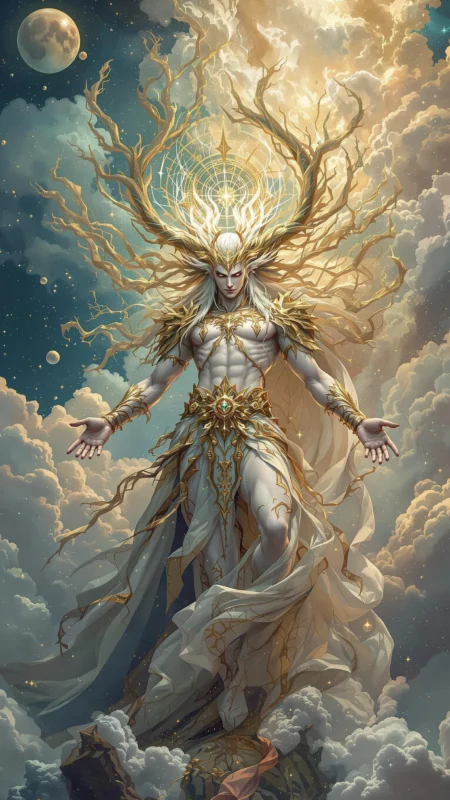
Aesir

Archetype Meaning & Symbolism

Ambitious, honorable, fated, stoic, strategic, boisterous, wise, fallible, martial, creative

  • Cattle die, and kinsmen die, And so one dies one's self; But a noble name will never die, If good renown one gets.

If Aesir is part of your personal mythology, you may...

Believe

  • You may believe that meaning is not found, but forged in the crucible of honorable struggle.
  • You may believe that your word is the bedrock of your reality, and an oath once given is an unbreakable, sacred bond.
  • You may believe that a life of purpose, even one that ends in glorious failure, is infinitely preferable to a long life of quiet insignificance.

Fear

  • You may fear being forgotten, of dying a 'straw death' in bed, leaving no story, no legacy, no saga worth telling.
  • You may fear betrayal from within your inner circle more than any external enemy, as it threatens the very foundation of your world.
  • You may fear the inevitable twilight, the coming Ragnarök, when the great works of your life will crumble to dust.

Strength

  • Your capacity for resilience is immense; you can withstand storms that would shatter others, seeing hardship as a necessary forge for character.
  • You possess a profound and motivating sense of duty, allowing you to lead and protect your chosen clan with unwavering loyalty.
  • You have the ability to think strategically and act decisively, to build order and structure out of the raw material of chaos.

Weakness

  • A tendency toward fatalism can become a self-fulfilling prophecy, causing you to give up on a cause because you perceive its failure as inevitable.
  • Your martial instinct can lead you to approach every problem as a battle to be won, using a hammer where a key is needed.
  • You may find it exceedingly difficult to forgive or show mercy, especially in the face of betrayal, creating a rigid and unforgiving inner world.

The Symbolism & Meaning of Aesir

To find the Aesir within your personal mythology is to hear a horn sounding in the far distance, a call to a life of consequence. It is the recognition that the universe is not a gentle, nurturing garden but a wild, storm-tossed sea, and your task is not to calm the waves but to build a worthy ship. This archetype is the architect of the self as a bulwark against chaos, the chieftain of one’s own inner war-band. It finds meaning not in a promised paradise but in the mettle of the journey, in the quality of the struggle itself. The gods of Asgard are not remote and perfect; they are flawed, they bleed, they scheme, and they face a known, unavoidable doom. Their power lies in their choice to act nobly, to create, to defend, and to seek wisdom in spite of it all.

In the modern soul, the Aesir archetype may manifest as a powerful drive to create a legacy. This is not about mere ambition; it is about forging a name that will outlast the self, as the Hávamál suggests. It could be a body of work, a thriving family, a code of ethics passed down, or a community built and fortified through one’s efforts. It is the psychology of the builder on the frontier, acutely aware of the wolves circling in the woods. This bestows a certain gravity, a sense of purpose that can anchor a life, transforming everyday challenges from mere annoyances into tests of worth, chapters in a personal saga.

This archetype also carries a profound relationship with fate and time. Unlike deities who promise eternity, the Aesir model a life lived under the shadow of a final chapter. This doesn't necessarily breed pessimism; instead, it can be a potent catalyst for action. If the winter is coming, then the hall must be built now. If the battle is inevitable, one must train today. It fosters a perspective where time is a finite, precious resource for the forging of glory and meaning. It is an understanding that the most beautiful things are often the most transient, and their value is magnified, not diminished, by their impermanence.


Aesir Relationships With Other Archetypes

The World Tree

The Aesir may reside in the highest halls of power, but their gleaming citadel is, in fact, a tenant in the boughs of a far older and more profound entity: The World Tree. Their relationship is not one of mastery, but of a deep, perhaps grudging, symbiosis. The tree is the silent, living architecture of their reality, the cosmic spine whose health dictates their own. One might suggest that for The Aesir to gain true sovereignty—the wisdom of the runes—they must sacrifice themselves to this very structure, as Odin did, acknowledging that power is not a conquest of the system but an agonizing alignment with its deep, mystical grammar. They are its guardians and its fruit, and when its leaves begin to wither and its trunk begins to tremble, it may signal that the very constitution of their world is coming undone.

The Trickster

In the stately, golden-lit halls of The Aesir, The Trickster moves like a crack in a perfect mirror, a necessary and unnerving flaw. He is not merely an adversary but a kind of cosmic critic, whose mischief and betrayals often serve to expose the rigidity or hypocrisy of established order. The Aesir’s volatile tolerance for him could be seen as a tacit admission of their own incompleteness; they may require his amoral cunning to solve the very problems their honor-bound strength creates. This reliance, however, is a dance with the serpent that will eventually bite. The Trickster is the laughter at the feast that carries a note of future weeping, a constant reminder that the most stable structures are often rotted from within by the truths they refuse to speak aloud.

The Unforgiving Winter

The Aesir’s ultimate relationship is perhaps not with a rival god or a monstrous beast, but with a coming season, The Unforgiving Winter. It represents a force beyond battle, an atmospheric inevitability that promises to silence the boisterous war-songs and bury the gilded halls in a profound and final stillness. This is not an enemy to be met on the field, but a diagnosis to be grimly accepted. It could symbolize the entropy that shadows all great works, the cosmic cooling that follows an age of fire and force. The Aesir’s foreknowledge of this winter imbues their every triumph with a tragic resonance, a sense that they are holding a grand feast on the eve of a famine, their power defined not by its permanence but by the sheer, magnificent defiance they show in the face of its certain end.

Using Aesir in Every Day Life

Navigating a Professional Setback

When a long-sought promotion is given to another, or a cherished project is cancelled, the Aesir archetype does not counsel despair. It suggests a stoic acknowledgment of the blow, a kind of internal gathering of the clan. You may retreat not to lick wounds but to consult the runes of your own experience, to sacrifice a small vanity for a larger wisdom. The response is not to rail against the injustice, but to begin building the next hall, a better strategy, a stronger alliance, understanding that even the gods face setbacks on the road to their fated hour.

Facing a Personal Betrayal

The sting of betrayal, the Loki in your midst, is a core theme in the Norse sagas. To channel the Aesir here is not necessarily to turn the other cheek. It is to recognize the fracture in the shield-wall. It may mean a swift and final severing of the bond, a clear demarcation of boundaries to protect the rest of the clan. There is a sorrow, a profound one, for what was lost, but the primary duty is to the integrity of the whole. The focus shifts from the wound to the fortification of what remains, a grim but necessary act of self-preservation and communal duty.

Embarking on a Great, Temporary Project

You may be called to pour your soul into something you know is not meant to last: a temporary art installation, a start-up with a high risk of failure, a political campaign. The Aesir mythos provides a framework for this. It is the act of building Asgard itself, a glorious realm destined to fall at Ragnarök. The meaning is not in the permanence of the structure, but in the nobility of its creation, the courage it took to build it, and the glory of its existence, however brief. It is a profound rebellion against nihilism: to create beauty in the face of oblivion.

Aesir is Known For

The War with the Vanir

An ancient conflict with another tribe of gods, the Vanir, which ended not in annihilation but in a truce, the exchange of hostages, and the merging of pantheons. It speaks to the possibility of integrating rival forces to create a stronger, more complex whole.

Odin's Sacrifices for Wisdom

The All-Father famously sacrificed his eye for a drink from the Well of Mimir to gain cosmic knowledge, and hung himself from the world tree, Yggdrasil, for nine nights to discover the runes. This represents the idea that true wisdom demands a significant price.

Ragnarök

The prophesied “doom of the gods,” an apocalyptic final battle where the major figures of the Aesir are destined to perish. It is not simply an end, but a violent, transformative clearing that allows for a new world to be born from the ashes. This imbues all their actions with a sense of tragic grandeur and urgency.

How Aesir Might Affect Your Personal Mythology

How Aesir Might Affect Your Mythos

When the Aesir become a central pillar of your personal mythos, your life story ceases to be a gentle stroll and becomes a saga. The narrative is reframed around themes of honorable struggle, the forging of a worthy clan, and the building of a personal Asgard—a realm of meaning, order, and principle that you must defend against the encroaching chaos. Setbacks are not plot holes; they are the inciting incidents, the wounds that bestow wisdom. Your mythos may be defined by a series of great labors, of oaths taken and kept, and of battles fought, whether in a boardroom, a studio, or the quiet chambers of the heart. There is an epic quality to it all, a sense that your choices have weight and resonance.

Furthermore, your personal mythos may be profoundly shaped by the concept of a personal Ragnarök. This isn't necessarily a literal doomsday, but an understanding that your current world—your career, your primary relationship, your core identity—has a life cycle and will one day end, perhaps violently, to make way for something new. This shapes your narrative into one of cycles rather than linear progress. You might see yourself as the steward of a particular era of your own life, tasked with guiding it to a noble conclusion to set the stage for the next. Your story becomes one of not just building, but of preparing for honorable and transformative endings.

How Aesir Might Affect Your Sense of Self

To see yourself through the eyes of the Aesir is to view the self as a sovereign, a chieftain responsible for the realm of your own being. There is a cultivation of inner authority, a sense that you are the ultimate arbiter of your own code of honor. You might hold yourself to high standards of courage, resilience, and integrity, seeing these not as moral abstractions but as the essential tools for survival and the creation of meaning. This can foster immense self-reliance and a stoic acceptance of your own flaws and limitations, just as the Aesir themselves were fallible. You are the protagonist, yes, but a flawed, human one, whose greatness is measured by your conduct in the face of those flaws.

This self-perception is also deeply tied to action and reputation. Your identity is not something you have, but something you forge through deeds. Self-worth may be inextricably linked to your competence, your reliability, and the legacy you are building. You may feel a deep, abiding need to be a person of your word, to be a source of strength for others, and to face hardship without flinching. This can create a powerful, stable sense of self, one that is less dependent on external validation and more on an internal appraisal of one's own honor and effectiveness in the world.

How Aesir Might Affect Your Beliefs About The World

Adopting an Aesir worldview means seeing the world as a grand, contested space, a field of dynamic tension between creation and destruction, order and chaos. It is not a fundamentally safe or just place, but it is a place ripe with opportunity for glory, wisdom, and the forging of meaning. You may view society not as a finished product but as a collection of competing halls and fortresses, each with its own chieftain and code. This is a world where strength—of character, of will, of community—is the ultimate currency, and where challenges are the raw material of growth.

This perspective fosters a kind of pragmatic realism. It dispenses with the illusion that life should be easy or fair, and instead focuses on what can be built and defended in the world as it is. There is an appreciation for structures, laws, and traditions as necessary bulwarks against the entropic pull of chaos. Yet, there is also the keen awareness that all structures are temporary. This leads to a worldview that values both the act of building and the courage to face the inevitable moment when what has been built must fall, evolve, or be reborn.

How Aesir Might Affect Your Relationships

In the realm of relationships, the Aesir archetype prioritizes the clan, the sworn shield-brother or shield-maiden, the inner circle bound by oaths of loyalty. Relationships are not casual affiliations; they are alliances. There may be a sharp, clear distinction between those inside your shield-wall and those outside it. For those within, your love is a fierce, protective, and demanding force. You may feel a profound sense of duty to your chosen family, willing to go to great lengths to defend and provide for them. Love is an action, a commitment, a shared watch on the battlements.

This focus on loyalty and the clan can have its sharp edges. It may lead to an intolerance of betrayal that makes forgiveness difficult, if not impossible. The breaking of an oath is the most profound sin. Friendships and partnerships are measured by their resilience under pressure, their ability to withstand the sieges of life. There is a deep need for reliability and shared purpose. The ideal relationship is a partnership of sovereigns, two chieftains building a shared hall, each respecting the other's strength and holding the other to a high standard of honor.

How Aesir Might Affect Your Role in Life

If the Aesir archetype informs your life, you may feel a powerful pull toward a role of leadership, stewardship, or guardianship. This need not be a formal position; it is more a state of being. You are the one who takes responsibility, who organizes the defense, who plans for the coming winter. Whether in your family, your workplace, or your community, you might naturally assume the role of the center-pole, the one who provides structure and direction. Your purpose is found in creating and maintaining a space where others can thrive: a business, a family, a creative project.

This role is also that of the wisdom-seeker, the one who understands that power and leadership require sacrifice. Like Odin, you may feel compelled to give up something of value—comfort, leisure, a simple life—in exchange for the knowledge or experience needed to lead effectively. Your role is not just to wield authority but to earn it, continually, through difficult choices and a commitment to the well-being of your realm. It is a heavy mantle, one defined by duty and the constant, forward-looking gaze toward the horizon of what is to come.

Dream Interpretation of Aesir

In a positive context, dreaming of the Aesir may be a potent affirmation of your own strength and agency. You might dream of feasting in a great hall like Valhalla, symbolizing a deep sense of belonging and achievement among peers you respect. A dream of standing with Thor as a storm gathers could represent your readiness to confront a major challenge with courage and power. Seeing Odin on his throne might suggest you are connecting with your own inner wisdom and strategic capabilities. These dreams are messages from the mythos that you are aligned with your purpose, secure in your clan, and prepared for the struggles ahead.

Conversely, when the Aesir appear in a negative or frightening dream context, it often points to a fear of your personal Ragnarök. Dreaming of the Bifröst bridge shattering could signify a fear that your connection between worlds—perhaps between your public and private self—is breaking. A dream of the great wolf Fenrir breaking his chains may be a manifestation of an anxiety that a chaos you thought contained is about to be unleashed. Being betrayed by a figure who resembles Loki could reflect a deep-seated fear of treachery from within your trusted circle. These dreams are warnings from the shadow, pointing to anxieties about fate, powerlessness, and the collapse of the world you have so carefully built.

How Aesir Archetype Might Affect Your Needs

How Aesir Might Affect Your Physiological Needs

From a mythological perspective, the Aesir archetype shapes the relationship with the body as an instrument of will. Physiological needs are not for pleasure's sake, but for purpose. Food is fuel for the coming task. Sleep is recovery for the next day's battle. The body is a vessel to be honed, disciplined, and sometimes pushed beyond its perceived limits to forge resilience. There may be a certain stoicism toward pain or discomfort, viewing it as a test of mettle rather than something to be avoided at all costs. The body is your earthly longship, and its maintenance is a matter of practical readiness.

This can lead to a state of high physical readiness and discipline, a body treated with respect for its function. However, it can also lead to a disconnect from the body's softer needs, for simple rest, for pleasure without purpose, for gentleness. There's a risk of seeing the body as a machine that can be run into the ground in service of a higher goal, ignoring the whispers of exhaustion until they become a roar. The challenge is to honor the body not just as a weapon or a tool, but as the very earth of the realm you are sworn to protect.

How Aesir Might Affect Your Ideas of Belonging

Belonging, for one who resonates with the Aesir, is found in the close-ranked solidarity of the shield-wall. It is not the universal, come-one-come-all embrace of some other archetypes. It is a deep, fierce, and exclusive bond forged with a chosen few. Love and belonging are synonymous with loyalty, shared struggle, and sworn oaths. Your people are your clan, your war-band, and your love for them is a powerful, protective force. Belonging is earned through demonstrated trustworthiness and a shared commitment to the group's survival and honor. You know you belong when someone would stand back-to-back with you against overwhelming odds.

This creates incredibly strong, resilient, and meaningful relationships within the inner circle. The love is profound because it has been tested. However, the shadow side is a sharp demarcation between 'us' and 'them'. It can be difficult to let new people in, as the vetting process is intense. There is a suspicion of outsiders and a potential for clannishness that can isolate the group. The need for belonging is met through quality and depth, not breadth, creating a small, intensely bright constellation of relationships in the vast, dark sky.

How Aesir Might Affect Your Feelings of Safety

The need for safety, through the Aesir lens, is transformed into the imperative to build a fortress. Safety is not a passive state of being but an active, ongoing project of construction and defense. This can manifest in meticulously building financial security, creating a strong and defensible career niche, or cultivating a fiercely loyal network of allies who can be counted on in a crisis. The goal is to create a personal Asgard: a well-ordered, well-defended space that can withstand the inevitable shocks from the outside world of chaos, the realm of giants and monsters.

This constant posture of defense carries the undercurrent of Ragnarök: the knowledge that no fortress is eternal and no wall is truly impregnable. This doesn't render the effort meaningless; it makes it heroic. The feeling of safety is therefore never absolute. It is a temporary peace won through vigilance and strength. This can be a source of incredible motivation, driving one to be prepared and resilient. But it can also foster a low-level, persistent anxiety, a sense of being perpetually besieged, unable to ever fully lower the drawbridge and simply rest.

How Aesir Might Affect Your Views of Esteem

Esteem, in the Aesir framework, is reputation. It is the saga that will be told of you after you are gone. Self-worth is not derived from gentle self-talk or inherent being-ness; it is forged and measured by your deeds, your courage, your integrity, and the quality of what you build. Esteem comes from being known as someone whose word is their bond, who is competent and reliable under pressure, and who leads with honor. It is the quiet pride of the master craftsperson, the steadfast general, the wise chieftain. It is Odin's sacrifice for wisdom, and Tyr's sacrifice for order: esteem is what you gain when you give up something lesser for something greater.

This external, action-based source of esteem can be a powerful motivator for excellence and ethical behavior. It pushes one to live a life of consequence. However, it can also create a relentless pressure to perform, to constantly prove one's worth through action. A period of rest or failure can feel like a devastating blow to one's very identity. The challenge lies in integrating this drive for a noble reputation with an understanding that one's worth is not solely dependent on the last victory, but also on the grace with which one bears the inevitable defeats.

Shadow of Aesir

The shadow of the Aesir is the tyrant chieftain, the Odin who sacrifices not himself, but others, for his obsessive quest for power and knowledge. It is the paranoia that sees a potential Loki in every friend and a looming giant in every stranger, making the world a grim and lonely fortress. When this archetype falls into shadow, the honorable struggle for meaning becomes a ruthless, unending war for dominance. The code of honor warps into a rigid, cruel set of laws imposed on others, and the pursuit of a legacy becomes a hollow hunger for glory at any cost.

In its shadow, the Aesir mythos breeds a deep, crushing fatalism. The awareness of Ragnarök ceases to be a motivator for heroic action and becomes an excuse for nihilism or destructive abandon. 'If it all ends anyway, why build? Why not just take?' The noble warrior becomes a brutish reaver, the wise king a scheming despot. Strength is no longer used to protect the clan but to control it, and the shield-wall becomes a prison, its purpose twisted from defense to confinement. It is the leader who, fearing the prophesied doom, brings it about through their own desperate, tyrannical actions.

Pros & Cons of Aesir in Your Mythology

Pros

  • Living this archetype cultivates an extraordinary inner strength and the capacity to endure profound hardship with stoic grace.
  • It fosters the creation of deeply loyal, meaningful, and resilient relationships, a chosen family bound by shared purpose and trust.
  • It provides a powerful framework for living a life of consequence, motivating the creation of a lasting and honorable legacy.

Cons

  • The constant awareness of struggle and fate can lead to a pessimistic or fatalistic worldview that makes it difficult to experience simple, unburdened joy.
  • The intense focus on the 'clan' can create a rigid 'us versus them' mentality, fostering suspicion and alienation toward those outside the inner circle.
  • The relentless drive for achievement and the weight of responsibility can lead to chronic stress, burnout, and an inability to be gentle with oneself or others.