Believe
 Fear
Fear Strength
 Weakness
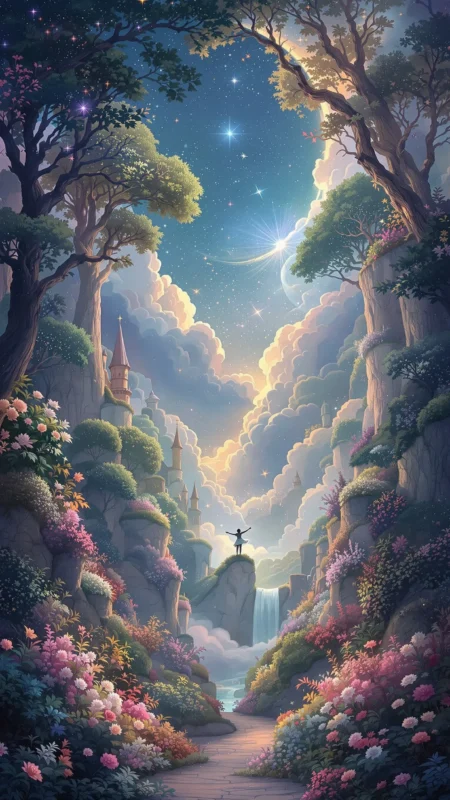
In the modern psyche, Neverland is the cartography of the inner child’s domain. It represents a sovereign territory within the self, a preserve where the imagination remains untamed and the spirit is not yet yoked to the relentless machinery of linear time and productivity. To have Neverland in your personal mythology is to possess a secret country, a mental landscape you can retreat to when the world of deadlines and social contracts becomes a monochrome prison. It is the source code of your creativity, the place where your most original ideas roam free like wild things. This inner realm is not a memory of childhood but an active, living state of being: a place of pure potentiality where you are forever on the cusp of becoming.
The archipelago, however, is shadowed by perilous waters. Neverland also symbolizes the seductive danger of arrested development. It is the siren song of escapism, a beautiful, verdant trap that promises freedom from responsibility but delivers a gilded cage of emotional immaturity. When this landscape dominates the personal mythos, it can foster a refusal to face the necessary deaths and rebirths of a full life. It becomes the place we go not to rejuvenate, but to hide. The refusal to grow up ceases to be a charming quirk and becomes a profound inability to form lasting bonds, to build a meaningful life, or to accept the solemn beauty of mortality.
More recently, Neverland has come to symbolize the act of world-building itself. It is the artist’s studio, the entrepreneur’s garage startup, the dissident’s underground movement: any self-created reality that operates by its own internal logic, defiantly separate from the mainstream. It is a testament to the human capacity to construct meaning and culture on a small scale, to form a tribe of “Lost Boys” united by a shared vision. In this sense, Neverland is not about escaping the world but about creating a new one, a prototype of a different way to live, which may be perilous and isolated but is authentically one’s own.