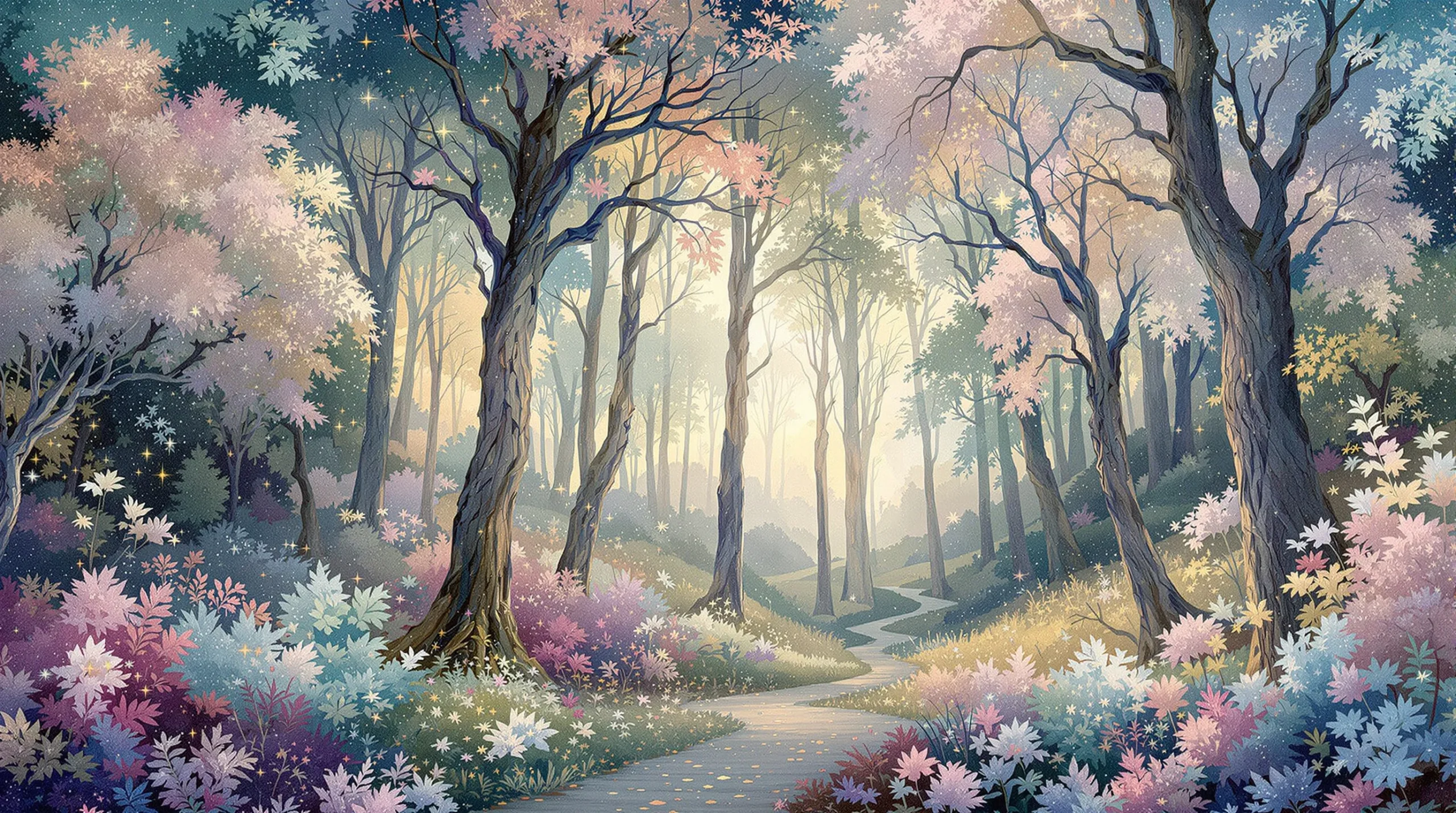


Deciduous Forest

Archetype Meaning & Symbolism

Cyclical, transformative, patient, decaying, renewing, communal, layered, vulnerable, resilient, temporal

  • Do not mistake my winter silence for death: it is the patient, radical act of gathering strength for a spring you cannot yet imagine.

If Deciduous Forest is part of your personal mythology, you may...

Believe

  • That endings are not failures, but beautiful, necessary compost for future growth.

  • That vulnerability, like a tree's bare branches in winter, is a form of profound strength and trust.

  • That life's most important work is often done in the quiet, fallow periods of apparent inactivity.

Fear

  • A secret terror that a particular winter will be the last, that spring will not return, and you will remain stuck in a state of dormancy forever.

  • Being misunderstood as inconsistent, unreliable, or uncommitted because you honor your own changing seasons rather than a constant, linear trajectory.

  • That in letting something go, you will not be able to regenerate, and the loss will create a permanent, barren patch in your soul.

Strength

  • An extraordinary capacity for resilience, allowing you to gracefully navigate profound loss and change.

  • A deep, intuitive wisdom about timing, knowing when to act, when to hold on, and when to release.

  • The ability to perceive and appreciate the beauty in all phases of a cycle, including decline and decay.

Weakness

  • A potential for passivity, sometimes waiting for a season to change on its own rather than taking the action needed to initiate a new phase.

  • Difficulty with projects or goals that require sustained, unwavering, year-round effort without natural breaks or cyclical shifts in focus.

  • A susceptibility to melancholy or a sense of stagnation during the 'winter' phases of your life, which may be misinterpreted by yourself or others as depression.

The Symbolism & Meaning of Deciduous Forest

In personal mythology, the Deciduous Forest represents the profound acceptance of cycles. It is the inner landscape where you understand that life is not a linear ascent but a spiral of growth, release, dormancy, and renewal. To have this forest within your mythos is to possess an innate understanding that endings are not just survivable, but generative. You may find yourself less afraid of loss, seeing it not as an absence but as a clearing, a necessary space for new light to filter down to the forest floor of your soul. This archetype doesn't offer the promise of permanence, but something more resilient: the promise of return. It whispers that even after the most brilliant autumn of success, a winter of stillness is required.

The forest also symbolizes a complex, layered self. You are not just the visible tree but the entire ecosystem. There is your canopy-self, the one that reaches for the light and is seen by the world. Then there is the understory, the quieter, more intimate aspects of your being. And deepest of all, the root system and the dark soil of the unconscious, where things decay and transform in unseen ways. This symbolism invites a holistic self-view, one that honors the hidden processes as much as the visible achievements. It suggests that true strength comes from this integration of all layers, from the highest leaf to the deepest root.

Finally, the Deciduous Forest speaks to a specific kind of vulnerability that is also a form of strength. The bare branches of winter are an act of radical trust. The tree relinquishes its foliage, its primary means of gathering energy, and stands exposed to the elements, trusting in its deep roots and the eventual return of the sun. For an individual, this may manifest as the courage to be seen in moments of transition or uncertainty, to shed old identities without a new one immediately available. It is the quiet power of knowing that one's essence is not in the leaves of accomplishment but in the resilient, enduring core of one's being.


Deciduous Forest Relationships With Other Archetypes

The River

The River is both a life source and a boundary to the Deciduous Forest. It is a constant, flowing presence against which the forest's cyclical nature is measured. The River may carve new paths through the woods, an agent of slow, inexorable change, while the forest drops its leaves into the water, feeding and altering its course. In a personal mythos, this relationship could symbolize the interplay between your own cyclical, emotional nature (the Forest) and the steady, forward-moving narrative of your life's path (the River). They are partners in a landscape, neither one fully in control, each shaping the other over time.

The Fire

Fire is the forest's great terror and its periodic collaborator. An uncontrolled blaze represents sudden, traumatic change that disrupts the patient, seasonal rhythm. It is chaos against a backdrop of order. Yet, some forest ecosystems depend on fire to clear out undergrowth and trigger the germination of certain seeds. In one's inner world, The Fire archetype may represent those sudden, often painful events—a shocking loss, a sudden revelation—that feel destructive but ultimately clear the way for a new, more vigorous kind of growth that would have otherwise been impossible. The Forest fears The Fire, but perhaps knows, on some deep, cellular level, that it is sometimes necessary.

The Hermit

The Deciduous Forest is the natural cathedral for The Hermit. It offers solitude without loneliness, a quiet filled with the subtle sounds of life. The forest provides a sanctuary, a place where the external world's demands fall away like shed leaves, allowing for deep introspection. Within this relationship, the forest is not merely a setting but an active participant in The Hermit's journey. It teaches through its cycles, offering metaphors for The Hermit's own inner processes of shedding, stillness, and renewal. It is a place to get lost in order to find oneself.

Using Deciduous Forest in Every Day Life

Navigating a Career Transition:

When facing the end of a job, you may not see it as a failure but as an autumn. It is a time for shedding a professional identity that has run its course. This archetype encourages you to release old responsibilities and skills, allowing them to compost into wisdom that will fertilize the next phase of your work, even if the ground seems barren for a season.

Ending a Significant Relationship:

The Deciduous Forest archetype suggests a way to comprehend the end of a partnership not as a sudden catastrophe but as a slow, natural turning of seasons. The relationship, like a leaf, may have provided vibrant color and nourishment for a time. Its falling is a moment of profound vulnerability and sadness, yes, but also a necessary release that allows both individuals to move into their own 'winter' of reflection before new growth can occur.

Overcoming Creative Blocks:

For the artist or creator, this archetype reframes the fallow period. A creative block is not a void; it is a wintering phase. It is the forest floor, seemingly dormant, but teeming with the quiet work of decomposition and renewal. Instead of forcing growth, you might learn to honor the need for rest, trusting that the ideas and inspirations are breaking down beneath the surface, preparing for a future, unexpected bloom.

Deciduous Forest is Known For

Seasonal Transformation

The dramatic and total shift in appearance from the full, green canopy of summer to the stark, skeletal branches of winter. This is its most potent metaphor: a complete cycle of vibrant life, graceful release, vulnerable stillness, and explosive rebirth.

Decomposition and Renewal

The forest floor is a testament to life-from-death. Fallen leaves, branches, and entire trees are not waste but a crucial offering, broken down by fungi and bacteria into rich humus that nourishes the next generation. It is a slow, quiet alchemy of turning loss into life.

Layered Ecosystem

From the sun-drenched canopy to the deep shade of the understory and the dark, rich soil, the forest is a complex, multi-level society. It is a model of interdependence, where vastly different forms of life coexist and contribute to the health of the whole.

How Deciduous Forest Might Affect Your Personal Mythology

How Deciduous Forest Might Affect Your Mythos

Your personal mythos, if shaped by the Deciduous Forest, is likely a story of seasons rather than a linear hero's journey. Your life narrative may not be about conquering a series of external foes, but about gracefully navigating a series of internal transformations. Key moments in your story might be defined not by what you gained, but by what you had the courage to release. Victories are measured by resilience, by the ability to survive a harsh winter and put forth new leaves in the spring. Your mythos is less a straight line and more a spiral, revisiting similar themes at different stages of life, each time with a new layer of understanding, like the rings of a tree.

You may find that your story is one that honors the fallow periods. Where another's mythos might skip over the times of confusion, grief, or inaction, yours might see them as the most crucial chapters. These are the winters where the deep, unseen work happens. Your personal legend is one of patience and trust in natural timing. It's a quieter epic, focused on the power of endurance, the beauty of decay as a precursor to life, and the profound wisdom that comes from standing bare and vulnerable, waiting for the inevitable return of light.

How Deciduous Forest Might Affect Your Sense of Self

Your sense of self may be fluid and cyclical. You might not identify with a single, static persona, but see yourself as an ever-changing being, constantly shedding old layers of identity. This can be profoundly liberating, releasing you from the pressure to be consistent at all costs. You may understand that your quiet, introspective winter-self is just as valid and essential as your vibrant, expressive summer-self. Your self-worth is not tied to a particular leaf or branch of achievement but to the entire, enduring tree of your existence.

This archetype could also foster a deep comfort with your own vulnerability. You may see the periods where you feel exposed, stripped of your defenses like a tree in winter, not as moments of weakness but as displays of profound trust and strength. It is the courage to be seen without adornment. This perspective can lead to a quiet confidence, one that isn't dependent on external validation but on the internal knowledge that you have weathered storms before and that you possess the deep-rooted resources to do so again. You know that letting go is the prerequisite for growth.

How Deciduous Forest Might Affect Your Beliefs About The World

Your worldview could be one that embraces impermanence as the fundamental law of nature. You might look at societies, cultures, and institutions not as permanent structures but as forests in various seasons of their existence. This perspective may grant you a long-term, patient view of progress and decline, making you less prone to despair over temporary setbacks or irrational exuberance over fleeting successes. You see the world as a complex, interconnected ecosystem where decay is as vital as growth, and you may find beauty in processes others find frightening or morbid.

Furthermore, you might reject the modern obsession with constant productivity and perpetual growth. Your philosophy could be that true health, for an individual or a society, requires periods of rest, reflection, and even managed decline. You might value slowness, subtlety, and the unseen forces that shape our world. Your worldview is likely grounded and realistic, yet deeply hopeful, because it is rooted in the certainty that even the longest winter eventually gives way to spring. It's a faith not in miracles, but in cycles.

How Deciduous Forest Might Affect Your Relationships

In relationships, you may operate on seasonal rhythms. You might understand that connections, like the forest canopy, have periods of lush growth, vibrant expression, graceful fading, and quiet dormancy. This allows you to navigate the natural ebb and flow of intimacy with less anxiety. You may be more accepting of a friend needing a period of withdrawal, seeing it as their personal winter rather than a rejection. You create space for relationships to breathe and change, trusting that the deep roots of connection remain even when the visible signs of interaction diminish.

However, this also means you may be more inclined to let certain relationships go entirely. If a connection has become a dead branch, draining resources without offering life, you may see the wisdom in pruning it. This isn't done out of malice, but from an ecological understanding that the health of the whole system requires releasing what is no longer viable. You seek relationships that feel like a healthy forest: diverse, interdependent, and honoring of each individual's necessary cycles of growth and rest.

How Deciduous Forest Might Affect Your Role in Life

Your role in your family, community, or workplace may be that of the transition-tender or the cycle-seer. You are the one people might turn to when they are facing an ending—a job loss, a breakup, a crisis of faith—because you possess an intuitive calm in the face of change. You don't offer false promises that things will stay the same; instead, you offer the deeper wisdom that change is natural and that renewal follows release. You are the person who reminds others to rest, who champions the fallow period as a time of sacred, unseen work.

Your contribution may not always be the most visible or dramatic. You are perhaps not the one who builds the permanent stone monument, but the one who plants the grove that will change with the seasons for a hundred years. Your role is to embody a different kind of strength: not the strength of resistance, but the strength of resilience. You teach by example that it is possible to let go gracefully, to stand firm in one's vulnerability, and to trust in the eventual return of life.

Dream Interpretation of Deciduous Forest

To dream of a Deciduous Forest in a positive context, such as walking through a vibrant autumn wood with sunlight dappling through the canopy, may signal a readiness for a significant life transition. The dream could be affirming your acceptance of an ending, suggesting you are letting go with grace and wisdom. A dream of a forest in early spring, with buds just beginning to appear on bare branches, might symbolize the emergence of hope after a long period of dormancy or grief. It is the psyche's way of saying that new life is beginning, and it is time to re-engage with the world.

A dream of a Deciduous Forest in a negative light could involve feeling lost within a dark, tangled wood where the season never changes. A perpetually frozen winter forest might symbolize a state of emotional numbness or being stuck in a past trauma, unable to move forward into the 'spring' of recovery. Dreaming of a rotting, stagnant forest floor where nothing grows could represent a fear of decay, a refusal to let go of old patterns or relationships that have become toxic. It may be a warning from the unconscious that by clinging to what is dead, you are preventing new life from taking root.

How Deciduous Forest Archetype Might Affect Your Needs

How Deciduous Forest Might Affect Your Physiological Needs

Your physiological needs may be deeply attuned to natural cycles. When the Deciduous Forest is a part of your mythos, you may feel a pull to align your body's rhythms with the seasons. This could manifest as a natural desire for more sleep, rest, and calorie-dense foods in the winter, mirroring the forest's dormancy. In summer, you might feel a surge of physical energy, a need for movement, activity, and lighter foods. You honor your body's need for rest not as a weakness, but as a vital part of its energy-management system.

This archetype encourages a profound listening to the body's subtle signals. Thirst, hunger, and fatigue are not inconveniences to be overridden, but messages from your own inner ecosystem. Just as the forest floor needs rain and the canopy needs sun, you understand that your physical being has non-negotiable requirements. Fulfilling these basic needs is the foundational act of self-care, the rich soil from which all other aspects of your life can grow. Ignoring them is to invite drought or blight into your personal landscape.

How Deciduous Forest Might Affect Your Ideas of Belonging

Your need for belongingness may be fulfilled through a sense of being part of a complex, interdependent community, much like a forest ecosystem. You may seek connections that are multifaceted and mutually supportive, where each person's unique nature contributes to the health of the whole. Belonging isn't about conforming or being identical; it's about finding your niche, your place in the canopy or the understory, and linking your roots with others. Love and connection are like the mycelial network, the unseen web that nourishes the entire forest community.

This archetype can also foster a profound sense of belonging to the natural world itself. You may feel a kinship with the land, the trees, the seasons. This connection can be a powerful antidote to loneliness, a feeling that you are part of a vast, ancient, and living system. Love, in this context, expands beyond the human realm. It is a love for the cycle of life itself, finding beauty and companionship in the patient, silent wisdom of the trees and the quiet processes of growth and decay.

How Deciduous Forest Might Affect Your Feelings of Safety

Safety, in the context of the Deciduous Forest, is not found in building impenetrable walls but in cultivating adaptability. You may feel most secure when you know you have the inner resources to handle change. True safety is the resilience of the tree that bends in the wind and sheds its leaves to reduce the burden of snow. It is a dynamic, responsive state rather than a static, rigid one. Your sense of security could be rooted in your trust in process, your faith that you can navigate any 'season' of life because you have done so before.

This archetype may also teach that safety involves a degree of surrender. There is a safety in letting go of the desperate need to control everything. The forest does not fight the coming of winter; it prepares for it. Similarly, you may find security in preparing for life's challenges—building financial reserves, nurturing strong relationships, developing emotional regulation skills—and then trusting in those preparations when the inevitable storms arrive. Safety is not the absence of threat, but the deep-rooted confidence in your ability to endure and renew.

How Deciduous Forest Might Affect Your Views of Esteem

Your self-esteem may be derived from your resilience rather than your achievements. You hold yourself in high regard not for the successes you accumulate, but for the winters you have survived. Esteem is rooted in the quiet dignity of your own endurance. It's the knowledge that even when you are stripped bare of your external markers of identity—your job, your role, your relationships—your core self remains, strong and deeply rooted. You respect yourself for your ability to let go, which you recognize as a profound act of courage.

This archetype also decouples esteem from the need for constant performance. You can value your periods of rest and inactivity as much as your periods of productivity. You understand that the dormant tree is not a 'lazy' tree; it is doing the essential, unseen work of survival and preparation. Therefore, you can grant yourself permission to be unproductive without a loss of self-worth. Your value is inherent, like that of the forest itself, present and worthy in every season, whether in full leaf, ablaze with color, or starkly bare against a winter sky.

Shadow of Deciduous Forest

The shadow of the Deciduous Forest emerges when its natural cycles become distorted or resisted. One manifestation is a refusal to let go, a desperate clinging to dead leaves. This is the person who cannot leave a finished relationship, a defunct job, or an old identity. Their inner landscape becomes choked with rotting foliage, preventing any new light from reaching the ground. The energy of renewal stagnates, and the promise of spring becomes a bitter mockery. Life becomes a grim, musty autumn that never gives way to the clarifying stillness of winter. It is a fear of vulnerability so great that one would rather suffocate under the weight of the dead than stand bare and await rebirth.

Conversely, the shadow can manifest as a premature or compulsive shedding. This is the individual who gives up at the first sign of difficulty, mistaking a temporary autumn for a terminal decline. They drop their leaves before the colors have even peaked, abandoning projects, relationships, and commitments out of a cynical belief that all things must end, so why wait? This constant, restless cycle of starting and shedding prevents any deep roots from taking hold. Their forest is a perpetual, chaotic flurry of falling leaves, with no season of full, stable growth, no quiet winter of consolidation. It is the wisdom of cycles twisted into an excuse for faithlessness and an inability to endure.

Pros & Cons of Deciduous Forest in Your Mythology

Pros

  • You possess a natural ability to adapt to the unpredictable changes and transitions of life.

  • You have a deep capacity for self-renewal, allowing you to recover from setbacks and begin anew.

  • You cultivate a patient and profound perspective, finding meaning and beauty in both growth and loss.

Cons

  • Your cyclical nature may be perceived by others as a lack of consistency or reliability.

  • Your necessary periods of dormancy and withdrawal can be mistaken for depression, laziness, or a lack of ambition.

  • A deep comfort with endings might make it challenging to fully invest in endeavors or relationships that demand a promise of permanence.