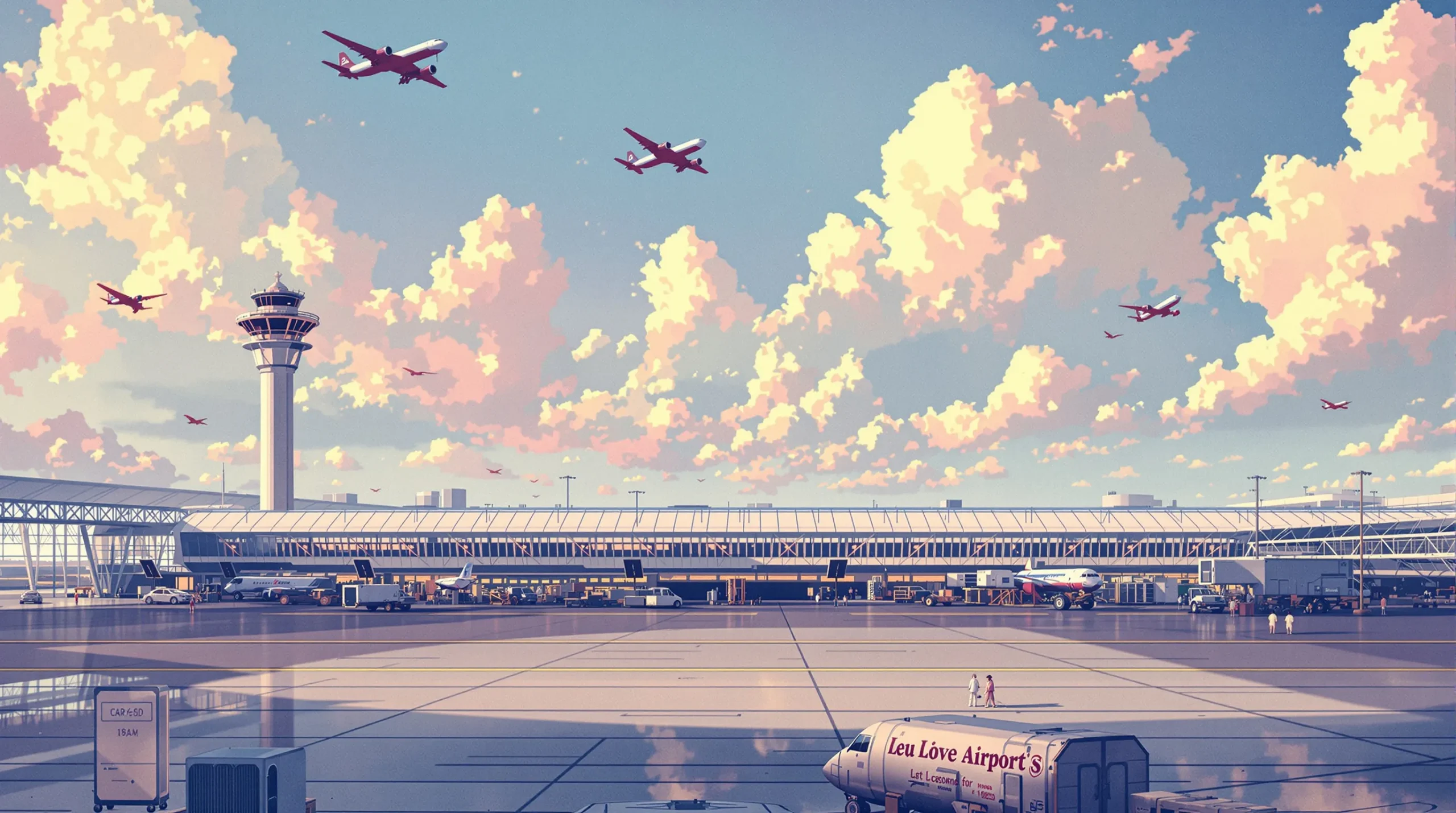


Airport

Archetype Meaning & Symbolism

Transitional, liminal, anonymous, potential, sterile, hurried, suspended, connected, impersonal, expectant

  • Everyone arrives with a story and leaves with a destination. I am merely the space between the chapters. Do not linger in the margins.

If Airport is part of your personal mythology, you may...

Believe

  • The journey itself holds more meaning than the destination.

  • True freedom is the untethered ability to leave at any moment.

  • A fixed identity is a limitation; the self should be as fluid as a travel plan.

Fear

  • Being permanently grounded, stuck in one place with no possibility of departure.

  • Missing the final boarding call for the most important journey of your life.

  • Losing your essential self, your psychic 'luggage,' somewhere in transit.

Strength

  • An exceptional adaptability to new environments, cultures, and sudden changes.

  • A rare grace and competence in managing difficult transitions and goodbyes.

  • The ability to see the bigger picture, to comprehend the entire map of possibilities rather than getting stuck on a single path.

Weakness

  • A deep-seated reluctance to put down roots or make long-term commitments.

  • A tendency towards emotional impersonality and keeping others at a safe distance.

  • A chronic restlessness that prevents you from finding peace or satisfaction in the present moment.

The Symbolism & Meaning of Airport

In personal mythology, the Airport may symbolize a state of pure potential. It is a modern temple to the god of Maybe, a concrete and glass cathedral where futures are decided. Every gate is a portal to an alternate life, every boarding pass a ticket to a different version of your own story. To have the Airport as a central feature of your mythos is to live with a constant awareness of these branching paths. Your life may be structured not by what is, but by what could be. The moments of greatest significance are not the arrivals, but the quiet, suspended hours in the terminal, gazing out at the tarmac, contemplating the vast map of your own possibilities.

The Airport archetype also holds the deep paradox of modern existence: immense connection and profound isolation. You are a node in a global network, physically capable of reaching nearly any point on earth, surrounded by a river of humanity. Yet, you may feel intensely alone. This space could represent a worldview where connections are wide but shallow, where intimacy is fleeting and circumstantial, like a brief conversation struck up while waiting to board. It is the feeling of being one of seven billion, hyper-aware of the crowd but ultimately enclosed in the private bubble of your own journey, your own thoughts, your own destination.

Furthermore, this archetype fundamentally alters one's relationship with time. The Airport exists in a kind of temporal suspension, a zone of 'hurry up and wait.' Time is both compressed into frantic dashes to the gate and stretched into agonizingly long layovers. If this is your realm, you might perceive your own life this way: periods of intense, frantic activity followed by states of forced stillness and reflection. Your personal narrative may not flow like a river but jump like a time-lapse, from one significant departure to the next, with the intervening periods feeling like a sterile, timeless waiting room.


Airport Relationships With Other Archetypes

The Crossroads:

The Airport is the sanitized, bureaucratic descendant of the Crossroads. Where the Crossroads was a place of mythic, often perilous choice—a deal with the devil, a path chosen that alters fate—the Airport presents choice as a consumer option on a departures board. The stakes feel lower, managed by ticketing agents and security protocols. Yet, the essential function remains: it is a place where one path ends and a multitude of new ones begin. The Airport's relationship with the Crossroads is one of modernization, trading mythic resonance for global efficiency and the illusion of control.

The Wanderer:

The Airport is both the temple and the necessary burden of the Wanderer. For the soul who is always in motion, the Airport is a place of temporary sanctuary: a place to rest, refuel, and reorient before the next journey. It understands the Wanderer's nature and asks for nothing but a ticket. However, it also imposes its own structure—schedules, security, gates—on the Wanderer’s freedom. The Wanderer may chafe under these constraints, seeing the Airport not as a gateway to freedom but as a series of bureaucratic hoops to jump through before true wandering can resume.

The Home:

The Airport exists as the absolute antithesis of Home. Home is specific, known, and saturated with personal history and comfort. The Airport is generic, anonymous, and sterile, designed to be interchangeable with any other airport in the world. Its very existence highlights what Home is by showing what it is not. In a personal mythos, the Airport may be the vast, empty space one must traverse to find or return to Home, or it may be the place one flees to escape a Home that has become a prison. The journey through the Airport sanctifies the act of arrival at a place of true belonging.

Using Airport in Every Day Life

Navigating a Career Change

When you find yourself between professions, you may inhabit the Airport archetype. The long period of uncertainty is the waiting lounge, filled with the low hum of anxiety and possibility. The departure board, with its flickering destinations, represents the job listings you scroll through. Each application is a form of check-in. In this liminal space, you are not your old professional self, nor are you your next one. You are simply a passenger, and embracing this temporary, anonymous state could allow you to assess your 'luggage' and decide what is truly essential for the next leg of your journey.

Processing the End of a Relationship

The final, sterile conversation with a partner can feel like it takes place in an airport terminal. It is a non-place, devoid of the shared warmth of the 'home' you once built. The decision to part is the security gate: a point of no return. You may see the emotional baggage being checked, perhaps for the last time. Inhabiting the Airport archetype here provides a strange comfort: a neutral territory designed for goodbyes, allowing you the psychic space to process the departure before you must step into a new world, alone.

Cultivating Personal Reinvention

To become someone new, you might need to pass through your internal Airport. This is the space where you can be anonymous, where the roles and expectations of your past life fall away. Like a traveler in a foreign hub, no one knows your story. This anonymity is a powerful tool. It allows you to try on new identities, to observe others, to move without the weight of your history. The Airport is the necessary void you cross to shed one self and arrive, fresh and unwritten, at the customs gate of a new life chapter.

Airport is Known For

Transitions

It is the quintessential space of comings and goings, a physical manifestation of the beginning of one journey and the end of another. It exists solely to facilitate movement between disparate points.

Liminality:

An airport is a 'non-place,' a threshold between worlds. It is neither the origin nor the destination but the suspended, sterile reality in between, operating on its own time and by its own rules.

Anonymity:

It is a realm of profound anonymity where thousands of individual stories intersect without truly touching, a temporary city of strangers united only by their shared state of transit.

How Airport Might Affect Your Personal Mythology

How Airport Might Affect Your Mythos

When the Airport is a cornerstone of your personal mythos, your life story may not be a linear progression but a series of flights, layovers, and connections. You may not mark time by years, but by cities lived in, by departures mourned and arrivals celebrated. Your narrative's most pivotal scenes might take place not in homes or offices, but in the sterile, transitional spaces of Gate C-27 or the international arrivals hall. Your central heroic journey might not be about slaying a dragon, but about navigating the complexities of a life in motion, of constantly packing and unpacking your sense of self.

Your mythos could also be defined by a sense of 'in-betweenness.' The most formative moments are perhaps not the events themselves, but the suspended periods leading up to them. The long flight over the ocean becomes more significant than the vacation. The silent hours in the terminal before a move to a new city hold more weight than the first few weeks there. Your story privileges the threshold, believing that true transformation occurs not when you arrive, but when you are fully untethered from both origin and destination, existing only in transit.

How Airport Might Affect Your Sense of Self

Your sense of self may be remarkably fluid and adaptable. You might not define yourself by a single place, job, or community, but by your capacity for movement between them. You could feel most authentic when you are in a state of becoming, unburdened by a fixed identity. This can manifest as a chameleon-like ability to fit in anywhere, to strike up conversations with strangers, and to be comfortable with the temporary. Your identity is not a statue, but a passport, its value derived from the stamps collected within.

Conversely, this archetype could foster a nagging sense of being perpetually undefined, or even hollow. If you are always in transit, you may struggle to feel truly present or rooted in your own skin. The self can begin to feel like a collection of superficial check-ins rather than a deeply inhabited space. There may be a quiet fear that if you stopped moving, you might find that there is no 'there' there: just a passenger waiting for the next boarding call, unsure of who they are without a destination.

How Airport Might Affect Your Beliefs About The World

You may view the world as a vast, interconnected network, a map of routes and hubs. Borders might seem more like suggestions than hard realities, and distance a matter of time and logistics rather than a true barrier. This can cultivate a sophisticated, cosmopolitan perspective, an understanding that people and cultures are far more similar than they are different. The world is not a set of isolated fortresses but a series of terminals, all speaking the universal languages of departure and arrival.

This perspective, however, might also be impersonal and systemic. You could see life as a grand, intricate piece of machinery in which you are a single passenger being processed. You follow the signs, stand in the designated lines, and trust in the unseen pilots and air traffic controllers of fate. This can lead to a sense of passivity, a belief that your path is largely predetermined by schedules and systems far beyond your individual control, diminishing your sense of personal agency.

How Airport Might Affect Your Relationships

Your relationships may be characterized by a unique intensity and a perceived impermanence. You may excel at forming quick, meaningful connections in temporary situations: the 'terminal friendship.' These bonds are understood, often implicitly, to be for a specific time and place. You might treasure these transient connections, seeing them as beautiful and complete in their brevity, free from the weight of long-term expectation. Goodbyes are not necessarily failures, but the natural conclusion of a shared journey leg.

The shadow of this relational style is a potential difficulty with deep, lasting intimacy. The constant motion of the Airport in your soul may create a fear of being grounded. You might unconsciously sabotage relationships as they approach permanence, mistaking the stability of a 'home' for the stagnation of a delayed flight. The muscle for 'hello' and 'goodbye' is well-toned, but the muscle for 'staying' may have atrophied, leading to a life of emotional rootlessness.

How Airport Might Affect Your Role in Life

You may perceive your role in the world as that of a facilitator, a connector, a transitional figure. You are the one who helps others get where they need to go, whether literally or metaphorically. You are the friend who helps someone pack for a big move, the colleague who onboards the new hire, the family member who bridges divides. You are comfortable in the role of the guide through liminal spaces because you understand their architecture intimately. Your purpose is not to be a destination, but to be a reliable part of the journey for others.

Alternatively, you could feel that your primary role is simply that of the Passenger. Life is something that happens to you, and your agency is limited to choosing between pre-approved destinations. You may see yourself as being perpetually subject to the whims of larger forces: the company, the economy, fate. This can lead to a sense of detachment from your own life's trajectory, a feeling that you are not the pilot but are merely waiting for instructions on where to go next.

Dream Interpretation of Airport

In a positive context, dreaming of an airport can signal a readiness for significant change and the dawn of new possibilities. A dream where you navigate the airport with ease, find your gate effortlessly, and board your flight on time may suggest a deep, subconscious alignment with a major life transition you are undertaking. It speaks of competence, excitement, and a trust in the journey ahead. The dream airport is a symbol of your own potential, clean, bright, and ready to take you anywhere you wish to go.

In a negative context, an airport dream can be a vessel for profound anxiety. Dreaming of being lost in endless corridors, of your flight being perpetually delayed or cancelled, or of losing your passport or luggage, often points to a fear of missing out on life's opportunities. It may indicate feelings of powerlessness, a lack of direction, or a sense that you are not prepared for an imminent change. This nightmare airport is a bureaucratic labyrinth, reflecting a waking life where you feel stuck, overwhelmed, and left behind.

How Airport Archetype Might Affect Your Needs

How Airport Might Affect Your Physiological Needs

When the Airport governs your mythos, your relationship with your body's basic needs may become functional and detached. Sustenance is not about savoring a meal; it is about grabbing a pre-packaged sandwich to refuel. Rest is not about deep comfort; it is about finding a semi-private corner to doze in an uncomfortable chair. Your physiological baseline might be one of low-grade jet lag, a state of perpetual slight discomfort that you have learned to ignore in the service of movement. You may treat your body like carry-on luggage: essential, but ultimately a thing to be managed and transported.

This approach could instill a remarkable physical resilience and adaptability. You might be able to function on little sleep, eat at odd hours, and ignore the aches and pains of travel. However, it can also create a deep disconnect from your body's signals. The chronic stress of being 'in transit' can manifest physically over time, as the needs that have been deprioritized for the sake of the journey eventually demand to be heard. You may forget how to simply be in your body, rather than using it as a vehicle to get somewhere else.

How Airport Might Affect Your Ideas of Belonging

A sense of belonging, for you, might be temporary and context-specific. It is the fleeting camaraderie found in the boarding line for a delayed flight, a tribe of circumstance formed for a few hours. You may find it easy to connect with these temporary communities, sharing stories with strangers you will never see again. Love and intimacy could be seen through this lens: profound, meaningful connections that are not diminished by the fact that they have an endpoint. Belonging is not about permanence, but about the quality of the shared transit.

The challenge here is the ache of rootlessness. While you may excel at forming these temporary bonds, you might struggle to cultivate a lasting sense of community. The very concept of putting down roots can feel alien or suffocating. This can lead to a deep, often unspoken loneliness, a feeling of being a perpetual visitor in the lives of others. The search for a 'home terminal,' a place or person where you can finally unpack your bags for good, may become a central, and perhaps elusive, quest in your personal mythology.

How Airport Might Affect Your Feelings of Safety

Your need for safety may be met through adherence to systems, rules, and procedures. There is a strange comfort in the security line: the ritual of removing shoes, the x-raying of bags, the quiet authority of the uniformed agent. It creates an illusion of control in an inherently chaotic world. You may feel safest when your life has clear protocols and designated checkpoints, when personal trust is replaced by systemic verification. Safety is not a feeling, but a process you successfully complete.

This reliance on external systems for safety can, however, cultivate a pervasive, low-level anxiety. The Airport is a space of constant alerts, of controlled paranoia. You might develop a worldview where threats are always possible and must be managed by constant vigilance and a willingness to surrender privacy and autonomy. True safety—a deep, internal sense of peace—may feel elusive. You may be safe from external threats, but you are a captive of the very system designed to protect you, always being watched, always being scanned.

How Airport Might Affect Your Views of Esteem

Esteem may be derived from your mobility and your reach. Your self-worth could be quietly tied to the number of stamps in your passport, the elite status on your airline of choice, or your ability to navigate any foreign city with ease. You are a citizen of the world, and your value comes from this global perspective and your capacity to transcend geographical and cultural boundaries. You are a 'Premier 1K' member in the story of your own life, and this status gives you a sense of importance and accomplishment.

Alternatively, the Airport archetype can erode esteem by its very nature of anonymity. In the terminal, you are no one special; you are a seat number, a confirmation code, a body to be processed. This can foster a deep-seated feeling of being interchangeable and insignificant. No matter your accomplishments, in the airport, you are just another face in the crowd. This may translate into a fear that without your destinations and your motion, you lack intrinsic value, that your worth is not inherent but is granted only by your itinerary.

Shadow of Airport

The shadow of the Airport archetype is a purgatorial existence of perpetual, aimless transit. It is not the freedom of the journey, but the prison of the layover. In this shadow state, you are always on your way to somewhere else, using the motion to avoid the difficult work of being somewhere, of building a life. Every relationship is a connection you have to catch, every job a temporary stop. You may become a connoisseur of departures, skilled at the art of leaving, but terrified and inept at the art of arriving and staying. The potential the Airport represents curdles into a life of unrealized possibilities.

This shadow manifests as a profound and inescapable rootlessness. The self becomes as sterile and generic as the terminal itself. You may adopt a cynical, detached persona, a defense against the pain of constant goodbyes. The hum of the jet engines drowns out the quiet whisper of your own soul asking for a place to rest. The freedom to go anywhere becomes the inability to belong anywhere, leaving you a permanent passenger in a world of homes, forever circling, never cleared to land.

Pros & Cons of Airport in Your Mythology

Pros

  • Your life is rich with new experiences, people, and perspectives that others may never encounter.

  • You develop a high degree of self-reliance and the ability to navigate uncertainty with confidence.

  • Change and upheaval, which can be terrifying to others, may feel natural and even energizing to you.

Cons

  • You may sacrifice depth for breadth, having many experiences but few that are deeply rooted.

  • A constant sense of restlessness can make it difficult to appreciate the simple, quiet joys of a stable life.

  • Others may perceive you as unreliable or emotionally distant, making it hard to build trust in relationships.