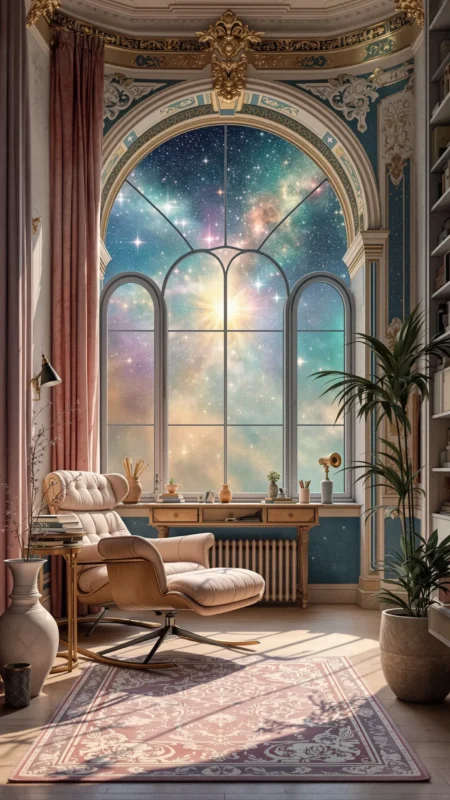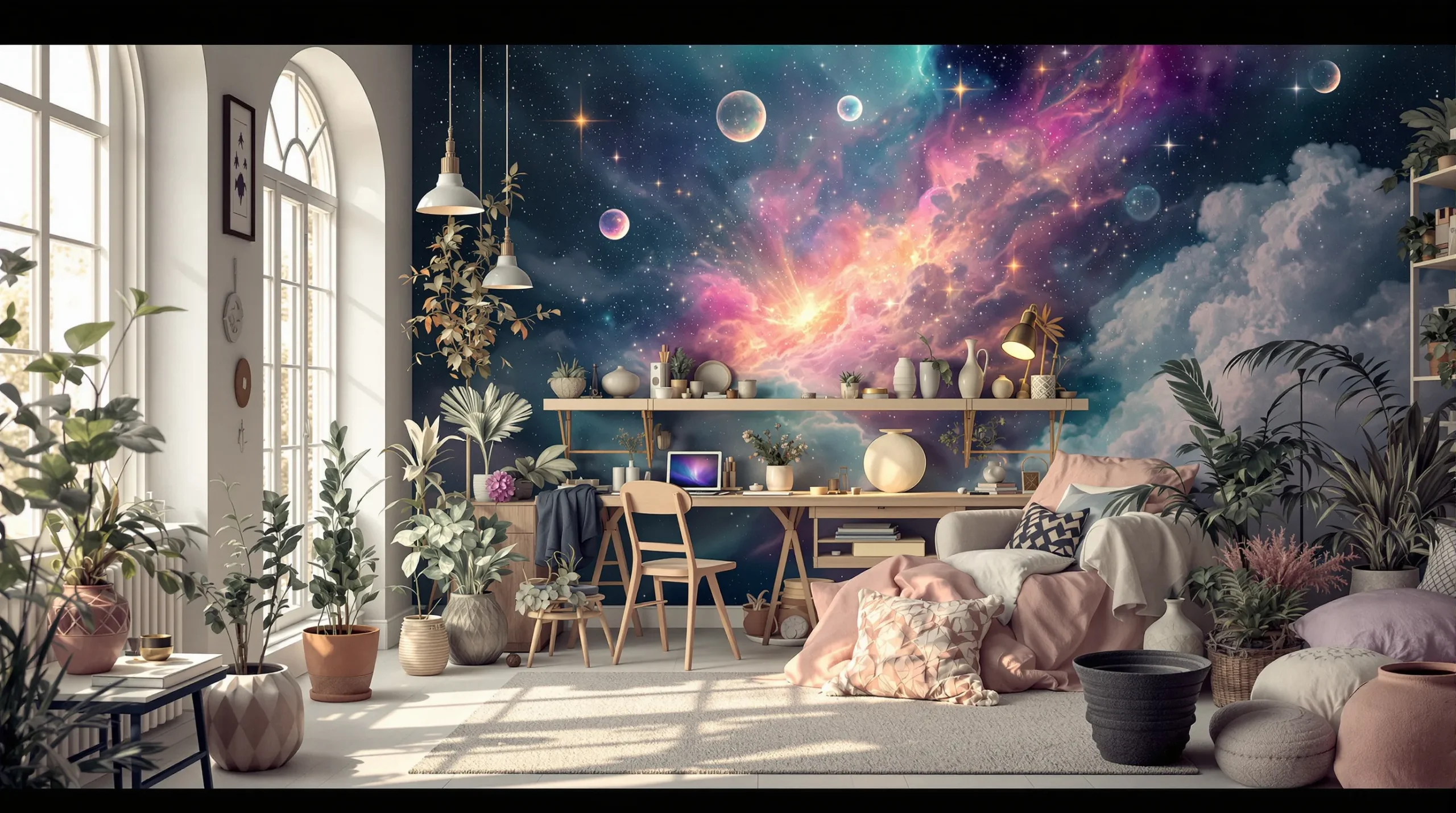


Studio

Archetype Meaning & Symbolism

Contained, generative, chaotic, focused, solitary, experimental, sacred, messy, alchemical, private

  • Chaos is merely raw material. The real work is in the arrangement.

If Studio is part of your personal mythology, you may...

Believe

  • The process is its own reward, and the final product is merely a souvenir of the journey.

  • True freedom is not found in boundless choice, but within the discipline of a self-imposed frame.

  • The most profound realities are the ones that are intentionally constructed, not passively accepted.

Fear

  • That the inspiration will cease, leaving the studio as an empty, echoing monument to past creativity.

  • That the work will never be perfect enough to survive contact with the outside world, and is therefore better left unfinished and private.

  • That you will become so lost in the world you are building that you forget how to live in the one that already exists.

Strength

  • An immense capacity for deep focus and the ability to enter a state of 'flow' by shutting out external distractions.

  • Resilience in the face of setbacks, viewing failure as a valuable data point rather than a final judgment.

  • A powerful sense of agency and the belief that you have the tools to shape your reality and create meaning.

Weakness

  • A tendency toward isolation that can morph into an unhealthy withdrawal from relationships and community.

  • Crippling perfectionism that prevents projects from ever being completed or shared with the world.

  • A potential disconnect from the practical demands of daily life, seeing them as interruptions to the 'real work'.

The Symbolism & Meaning of Studio

In personal mythology, the Studio may symbolize the inner world made manifest: a physical representation of the psyche. Its state of order or chaos could directly mirror one's internal landscape. A cluttered studio might not signify a cluttered mind, but rather a mind actively engaged with a multitude of rich, interconnected ideas, a sign of fertile chaos before the harvest of insight. To have a Studio in your mythos is to possess a place where you are the sole arbiter of reality, where you can deconstruct the world and reassemble it according to your own private logic. It is the command center of the self, the place where the narrative of your life is not just lived, but actively authored.

The archetype also speaks to the profound power of containment. The Studio’s four walls create a limit, and within that limit, infinite possibility might emerge. It suggests that freedom is not found in boundless space but in a focused frame. This is the paradox of creativity: discipline births liberation. In one's life story, the Studio could represent a specific period of intense focus—a graduate program, a period of grieving, a new parenthood—where the world shrinks to a single room, and within that concentration, a whole new self or project is forged. It is a testament to the idea that to build something grand, you must first build a small room to build it in.

Furthermore, the Studio is a liminal space, a bridge between the unseen and the seen, the conceptual and the tangible. It is where ghosts of ideas are given flesh and bone. This archetype in your personal mythology may point to a role as a translator, someone who channels abstract energy into concrete form. Whether you are a coder, a chef, a parent, or a manager, the presence of the Studio suggests a deep-seated need to make things real. It is a place of alchemy, where the lead of raw experience, messy emotion, and disjointed thoughts is transmuted into the gold of meaning, art, and understanding.


Studio Relationships With Other Archetypes

The Muse

The Muse is a visitor to the Studio, never a resident. She is the wild, unpredictable gust of wind; the Studio is the carefully constructed kite designed to catch it. A mythos containing the Studio understands that inspiration is not a passive event but an active invitation. The Studio must be kept, the tools must be ready, the door must be unlocked. The relationship is one of respect and preparation: the Studio honors the Muse’s ephemeral nature by providing a dedicated, disciplined space for her to land. Without the Studio, the Muse’s whispers might dissipate into the ether; without the Muse, the Studio could become a sterile, silent tomb of unrealized potential.

The Marketplace

The Studio exists in a tense, symbiotic relationship with the Marketplace. The Marketplace is the external world of commerce, critique, and public opinion. It is where the creations born in the Studio’s privacy are tested for their value and resonance. For one whose mythos is centered in the Studio, the Marketplace may be a place of profound anxiety or thrilling validation. The journey from the studio door to the market stall is a heroic one, fraught with the peril of misunderstanding and rejection. The Studio provides the private conviction, but the Marketplace provides the public context, and navigating the path between them is a central plot point in the creator’s story.

The Wilderness

If the Studio is the space of refinement, the Wilderness is the source of raw material. The Wilderness is the untamed world of nature, of raw data, of unfiltered human experience. An individual with the Studio archetype must make regular pilgrimages into the Wilderness—be it a literal forest, a bustling city street, or a deep dive into research—to gather the strange stones, twisted branches, and potent herbs of inspiration. These are then brought back across the threshold into the controlled environment of the Studio to be examined, understood, and integrated into a new creation. The Studio tames the wild, but it cannot generate its own substance; it relies entirely on what is brought in from the outside.

Using Studio in Every Day Life

Navigating Creative Block

When inspiration feels like a distant country, embodying the Studio archetype might mean physically clearing a space: a desk, a corner, a digital folder. This act is not about waiting for the muse but building her a place to sit. You might treat your thoughts like clay on a table, something to be molded and reshaped without judgment, reminding yourself that the studio is a place for drafts, not final masterpieces. This could reframe the block not as an absence of ideas, but as a necessary, messy phase of gathering materials.

Processing Life Transitions

A major life change, such as a career shift or the end of a relationship, could be mythologized as entering a personal studio. The uncertainty and mess are not signs of failure but are inherent to the creative process. This perspective allows for experimentation: trying on new identities, new routines, new beliefs like preliminary sketches. It frames this liminal period as a deliberate, private workshop phase where the next version of the self is being designed, revised, and prepared for its eventual unveiling.

Complex Problem-Solving

Faced with an intractable problem at work or in life, you might invoke the Studio. This could mean creating a contained 'problem space': a whiteboard, a journal, a specific hour of the day. Within this container, the problem is not a monolithic threat but a set of components to be disassembled, analyzed, and reconfigured. You could prototype solutions, test them on a small scale, and embrace 'happy accidents'—the unexpected breakthroughs that happen when materials are simply being played with, free from the pressure of an immediate, perfect answer.

Studio is Known For

Sanctuary

The Studio is a refuge from the clamor of the outside world. It is a sealed vessel, a place where the noise of external expectation is muted, allowing the faint signal of an inner voice to become clear. This is its function as a sacred space, defined by a threshold that, once crossed, alters the rules of engagement with reality.

Laboratory

This is a realm of sanctioned failure. The Studio is known for being a place where experimentation is the primary mode of operation. Hypotheses are tested, materials are pushed to their limits, and explosions, both literal and metaphorical, are considered data points. It is a space designed for the process, not just the product.

Womb

It is a generative, nurturing environment where nascent ideas are protected until they are strong enough to survive exposure. Like a womb, it provides the essential conditions for development, a dark, warm, private place where the delicate work of becoming can happen, shielded from premature critique or the harsh light of public opinion.

How Studio Might Affect Your Personal Mythology

How Studio Might Affect Your Mythos

When the Studio is a key landmark in your personal mythos, your life story may be structured not by linear time, but by projects. Your narrative is perhaps an anthology of distinct creative eras: 'the year I built the table,' 'the period we were renovating the house,' 'the season I finally wrote the code.' Each chapter is a contained world, a problem to be solved within the walls of a metaphorical studio. Your personal history becomes a gallery of finished works and fascinating failures, each piece telling the story of who you were at that specific moment of creation. The central heroic journey is the act of making, the epic struggle to bring an idea from the ether into reality, a battle fought in solitude.

This archetype could also cast you as the 'World-Builder' of your own story. Your mythos isn't something that happens to you; it's something you consciously construct. You may feel a deep, intrinsic responsibility for the design of your own life. This transforms mundane choices into artistic ones: crafting a career is like sculpting, building a family is like composing a symphony. This perspective lends a sense of agency and intention to your narrative, but it can also be a heavy burden. The myth becomes one of perpetual labor, of never-ending revision, where you are both the creator and the raw material, endlessly shaping yourself inside the private studio of your consciousness.

How Studio Might Affect Your Sense of Self

A view of the self, seen through the lens of the Studio, may be one of a perpetual work-in-progress. You might perceive your identity not as a fixed state but as a living draft, subject to constant revision, editing, and refinement. This can be profoundly liberating, freeing you from the tyranny of consistency and allowing for evolution and growth. Your 'self' is your ultimate creation, and you are the artist, patiently adding layers, scraping away what doesn't work, and stepping back to see the whole composition. This perspective fosters a patient, compassionate relationship with your own imperfections, seeing them not as flaws but as part of the messy, necessary process.

However, this could also lead to a feeling of being perpetually unfinished. The self might feel like an endless project that is never ready for public viewing. There may be a reluctance to commit to a single identity, a fear that any definitive statement of 'who I am' will be a premature crystallization, limiting future possibilities. This can manifest as a kind of psychic hoarding, an accumulation of potential selves and un-started projects within the inner studio. The self is a space of infinite potential, which can be exhilarating but also paralyzing, a masterpiece that is always in progress but never complete.

How Studio Might Affect Your Beliefs About The World

The world, from the perspective of the Studio, may appear not as a solid, immutable reality, but as a vast collection of raw materials waiting to be assembled. A tree is not just a tree; it is lumber, it is shade, it is a pattern of light and shadow. A conversation is not just an exchange of words; it is data, it is narrative, it is the source code for a new understanding. This worldview is fundamentally creative and generative. It resists passive consumption and instead promotes an active engagement with reality, constantly asking, 'What can be made of this?' Problems become design challenges, and the fabric of the world seems permeable, ready to be re-woven into new patterns.

This perspective could also cultivate a certain detachment from the world as it is. By constantly seeing the world in terms of its potential, of what it could be, there may be a dissatisfaction with what it currently is. The person with a Studio mythos might feel like a perpetual outsider, an observer standing at the window, taking notes on a world they are analyzing rather than fully inhabiting. The world becomes a fascinating object of study, a source of inspiration to be brought back into the studio, but perhaps not a home in which to simply and un-analytically live. This can lead to a profound sense of vision, but also a subtle yet persistent layer of alienation from the flow of ordinary life.

How Studio Might Affect Your Relationships

Relationships may be understood as collaborative projects, requiring a shared studio space to build something meaningful together. This 'space' could be a repository of shared memories, a common goal, or a set of mutual values. The health of the relationship might be measured by the quality of the work being done within it: are we creating kindness, are we building trust, are we composing a life of shared beauty? This view encourages active participation and conscious design in partnerships, treating love not as a state of being to fall into, but as a practice to be honed and a structure to be intentionally built, brick by brick.

Conversely, the Studio archetype might insist on firm boundaries, on the sanctity of private, individual space even within the most intimate connections. There may be a fundamental belief that each person needs their own studio—a place of psychic solitude—to do their own internal work, and that the best relationships honor and protect this separateness. This could lead to a dynamic of healthy autonomy, where partners come together to share what they have created in their own time. It could, however, also manifest as a barrier to true intimacy, a fear that allowing another person fully into one's inner studio would disrupt the delicate process, contaminate the materials, and ultimately compromise the work of the self.

How Studio Might Affect Your Role in Life

Your perceived role in life could be that of the Artisan or the Alchemist. You may not see yourself as a passive participant in a predetermined system, but as an active maker, a shaper of realities. This role extends beyond a profession; it is a fundamental stance toward existence. As a parent, you are not just raising a child, you are crafting a human being. As an employee, you are not just doing a job, you are building a system, refining a process. This imbues life with a sense of purpose and craft, a belief that even the smallest actions contribute to the construction of a larger, meaningful whole. Your role is defined by what you make, not by what you are given.

This can also lead to a role of intense responsibility and potential isolation. As the primary architect of your world, the successes are yours, but so are the failures. There might be a reluctance to collaborate or delegate, a belief that your vision is singular and can only be executed by your own hands. This can place you in a position of the lonely creator, the solitary genius in the attic, admired for your work but disconnected from the community you are ostensibly serving. The role of the maker can sometimes eclipse the role of the friend, the partner, or the citizen, as the demands of the Studio override the demands of the world outside its walls.

Dream Interpretation of Studio

To dream of a Studio in a positive context—perhaps it is flooded with natural light, the tools are perfectly organized, and a sense of calm, focused energy pervades—may symbolize a period of profound integration and creative readiness in your waking life. It could suggest that your subconscious and conscious minds are in alignment, that you have gathered the necessary emotional and intellectual materials, and that you are on the cusp of a significant breakthrough or the birth of a new project. The dream is an affirmation from your psyche: the space is prepared, the conditions are right, and it is time to begin the work.

Conversely, dreaming of a negative Studio experience—it is dark, impossibly cluttered, the tools are broken or missing, or you cannot find the door to get in or out—might point to a state of creative block, frustration, or a lost sense of purpose. This dream could be a metaphor for feeling overwhelmed by too many unformed ideas, or a deep-seated fear that you lack the skills (the 'tools') to manifest your vision. An inaccessible studio may symbolize a disconnection from your own inner world, a feeling that your sacred space of creation has been contaminated, abandoned, or has become a prison rather than a sanctuary.

How Studio Archetype Might Affect Your Needs

How Studio Might Affect Your Physiological Needs

The Studio archetype may translate the physiological need for shelter into a more refined need for a specific kind of sanctuary: a dedicated space for the 'work' of the self. This isn't just about having a roof over your head; it's about having a place with a door that closes, a container that separates the mundane world from the creative one. Without this dedicated physical or mental space, you might feel a kind of physiological restlessness, an unease akin to hunger or thirst. Your body and mind may crave a specific environment to process, create, and make sense of the world, and the absence of this space could feel like a genuine deprivation.

The archetype could also influence how you interact with your physical body and its rhythms. The work of the studio often demands a disregard for normal cycles: long nights fueled by coffee, skipped meals in the heat of inspiration, a monk-like focus that renders the body a secondary concern. This may mean that basic physiological needs are seen as interruptions to the more important work at hand. There could be a tendency to treat the body as a machine or a tool in service of the creative project, something to be maintained just enough to keep it running, rather than an integral part of the creative process itself.

How Studio Might Affect Your Ideas of Belonging

Belongingness may be a carefully curated affair. Instead of seeking it in large tribes or communities, you might create it by selectively inviting others into the 'studio' of your life. True intimacy and belonging are reserved for those who understand and respect the creative process, who can sit comfortably in the presence of a work-in-progress, and who are collaborators rather than just spectators. Belonging is not found; it is built. It is a shared project with a few trusted partners, creating a small, intensely connected world together.

On the other hand, the solitary nature of the Studio can be a powerful force against belonging. The work often requires isolation, a deliberate withdrawal from social life. This can foster a profound sense of loneliness, a feeling of being fundamentally separate from others. You may feel that no one can truly understand the world inside your studio, creating a gulf that intimacy cannot bridge. The price of a unique vision, you might believe, is a certain exile. This can lead to a mythos of the misunderstood genius, where belonging is sacrificed at the altar of creation.

How Studio Might Affect Your Feelings of Safety

Safety, through the lens of the Studio, is primarily psychological. The Studio is a fortress of the mind, a controlled environment where one is safe from the unpredictable intrusions of the outside world: judgment, criticism, unwanted opinions, and the chaos of others' demands. Its safety lies in its predictability and in the sovereignty of its occupant. Within these walls, you set the rules. This allows for the vulnerability required for true experimentation, as failure has no external consequences. The need for safety is a need for a place where the tender, nascent parts of the self can exist without threat of premature exposure.

However, this focus on creating a safe, controlled bubble can lead to a heightened fear of the world outside it. The outside world, with its lack of rules and its random events, might seem inherently unsafe and threatening to the delicate work being done within. This can foster a kind of agoraphobia of the soul, a reluctance to leave the safety of the known and venture into the uncontrolled wilderness of public life. The very walls that provide safety can become the walls of a prison, shielding you not just from harm but from the necessary risks and unexpected encounters that lead to growth and connection.

How Studio Might Affect Your Views of Esteem

Esteem is directly tied to the act of making and the evidence of one's competence. It is not derived from external praise or social status, but from the quiet, internal satisfaction of solving a difficult problem or bringing something of quality into existence. You might feel that 'you are what you make.' Self-worth is built, layer by layer, with every completed project, every mastered skill. This creates a resilient, self-reliant form of esteem, as it depends on your own efforts and standards rather than the fickle opinions of others. It is the esteem of the craftsperson, rooted in the tangible work of their hands and mind.

This foundation for esteem, however, can be brittle. If self-worth is tethered to productivity, then periods of rest, fallowness, or creative block can trigger a crisis of identity and value. There may be a relentless internal pressure to always be producing, to justify your existence through tangible output. This can lead to burnout and an inability to simply 'be' without 'doing.' The risk is a kind of conditional self-esteem, where you are only as good as your last creation, making your inner peace precariously dependent on the constant hum of the workshop.

Shadow of Studio

The shadow of the Studio is when the sanctuary becomes a prison. It manifests as a hermetic retreat from the demands and joys of life, a place where the creator is no longer creating but hiding. The work becomes an obsessive, joyless tinkering, a way to avoid engagement with relationships, responsibilities, or the messy unpredictability of the human heart. The studio is no longer a womb for new life, but a tomb where potential goes to die, endlessly refined and never born. It is the hoarder's den, piled high with the detritus of half-started projects and dusty inspirations, a physical manifestation of a psyche paralyzed by fear of failure and judgment.

In its other shadow form, the Studio becomes a sterile laboratory, devoid of soul. It is a place of cold, technical perfection, where the work is technically brilliant but emotionally vacant. This shadow emerges when the focus on craft and control squeezes out all room for spontaneity, for happy accidents, for the breath of life. It is the over-designed life, the relationship managed like a project plan, the art made by algorithm. The creator becomes a technician, and the sacred space of alchemy becomes a factory for producing perfect, lifeless replicas of what was once a vibrant, authentic vision.

Pros & Cons of Studio in Your Mythology

Pros

  • Fosters a unique, personal vision and the discipline to bring that vision into reality.

  • Provides a powerful container for deep, meaningful work and the development of mastery.

  • Cultivates a strong sense of self-reliance and internal validation, independent of external opinion.

Cons

  • Can lead to significant social and emotional isolation, sacrificing connection for creation.

  • Risks a perfectionistic paralysis where the fear of not meeting impossibly high standards prevents completion.

  • May create a disconnect from the 'real world,' leading to a lack of practicality or relatability.