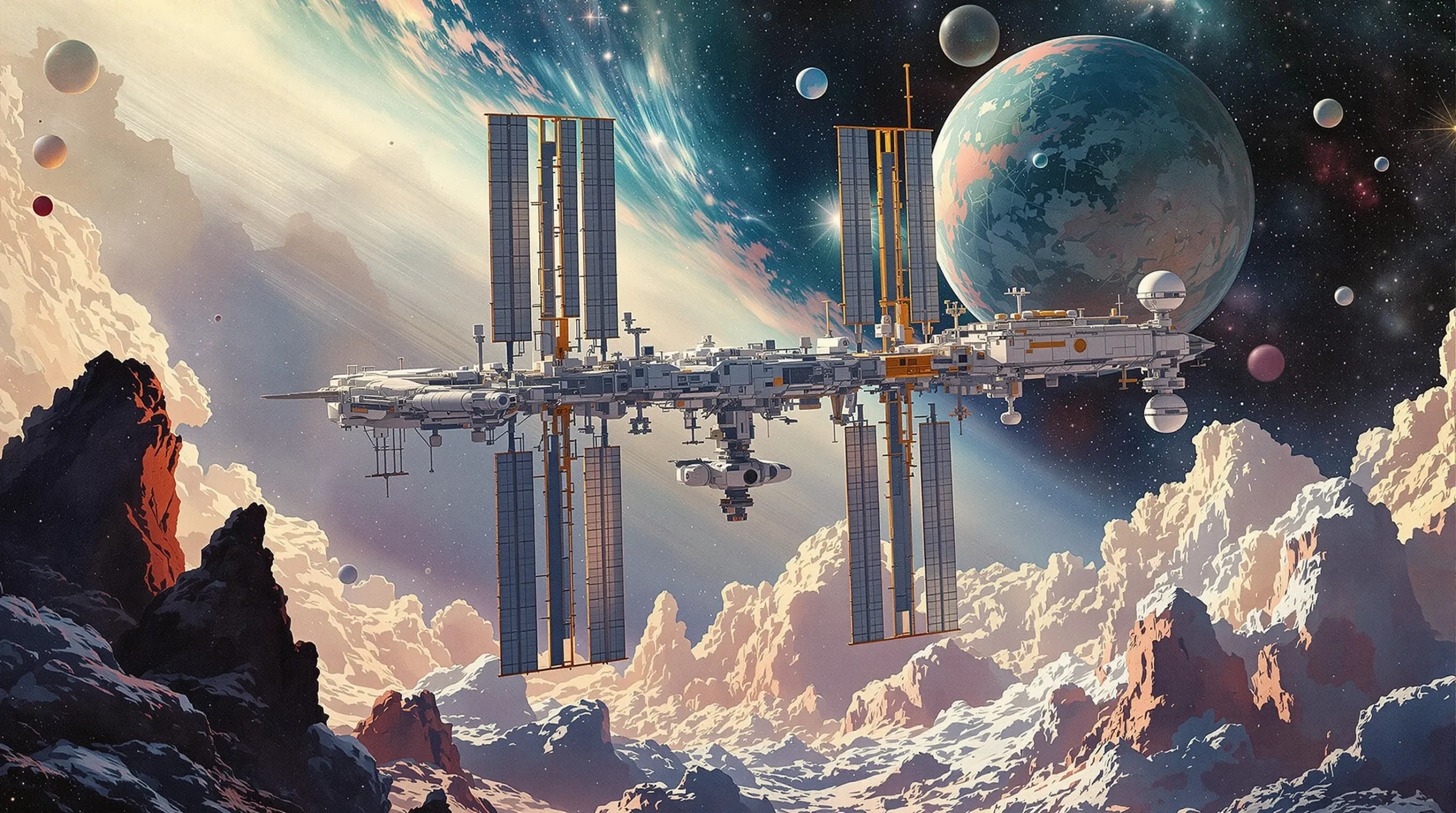


Space Station

Archetype Meaning & Symbolism

Observational, Systemic, Isolated, Collaborative, Fragile, Technological, Liminal, Expansive, Artificial, Precarious

  • From here, borders are only stories, and the only real weather is the solar wind.

If Space Station is part of your personal mythology, you may...

Believe

  • You may believe that with enough distance, every problem reveals itself as a system, and every system can be understood.
  • You may believe that we are all crew members on a fragile vessel, and our primary responsibility is to the integrity of the ship and the well-being of the crew.
  • You may believe that true progress is not a solitary act but the successful collaboration of specialists focused on a singular, transcendent goal.

Fear

  • You may fear a catastrophic, unrecoverable system failure: a glitch in the code of your life that leads to a complete breakdown.
  • You may fear becoming untethered, losing the signal from 'mission control' and drifting alone into the infinite, silent void.
  • You may fear the 'messiness' of terrestrial life, a chaotic, emotional gravity that could pull your carefully constructed world out of its stable orbit.

Strength

  • You may possess an extraordinary ability for systems thinking, allowing you to see the hidden connections and overarching patterns that others miss.
  • You may have a capacity for detached, calm observation, enabling you to analyze high-pressure situations without being overwhelmed by emotion.
  • You may be a natural facilitator of collaboration, skilled at bringing together diverse talents and creating an environment where they can work in harmony toward a common purpose.

Weakness

  • You may have a tendency toward emotional detachment, intellectualizing feelings and keeping others at a safe, analytical distance.
  • You may have an over-reliance on protocols and plans, leaving you feeling lost or anxious when faced with situations that require spontaneous improvisation.
  • You may struggle with a persistent sense of alienation, a feeling of being fundamentally different from and separate to the everyday world of human affairs.

The Symbolism & Meaning of Space Station

In the personal mythos, the Space Station may symbolize the pinnacle of human intellect and collaboration, a place constructed piece by piece in the void. It is the conscious mind building a habitat for itself outside the chaotic pull of the terrestrial, emotional world. It represents a willed existence, one that requires constant maintenance, careful planning, and a deep understanding of systems. To carry this archetype is to feel, perhaps, that your own consciousness or your life's project is a similar feat of engineering: a carefully assembled structure of beliefs, routines, and relationships designed to keep you alive and purposeful in the vast emptiness of the unknown. It is the part of you that observes, analyzes, and connects disparate points of data from a privileged, if lonely, vantage point.

Furthermore, the Space Station is a potent symbol of liminality. It is neither Earth nor the heavens, but a way station between them. It exists in a perpetual state of falling, a continuous, controlled orbit that is a triumph of physics over gravity. For an individual, this may represent a life lived in transition, or a psyche comfortable in the spaces between firm definitions: between career and calling, between one identity and the next, between the internal world of thought and the external world of action. This archetype suggests a personality that thrives not on arrival, but in the journey itself, finding a strange stability in constant motion and a unique perspective from the threshold.

Finally, this archetype speaks to a profound paradox of connection and isolation. The inhabitants are tethered to Earth by a constant stream of data, communication, and vital supplies; they are never truly alone. Yet, they are physically separated by an impassable gulf. A person whose mythos includes the Space Station might experience this in their own life: feeling deeply connected to humanity through digital means or intellectual pursuits, while simultaneously feeling a sense of profound separateness or alienation in their day-to-day existence. It is the scholar in the library, the remote worker in their home office, the thinker whose ideas orbit the globe while their body remains still: a node in a network, yet an island unto themselves.


Space Station Relationships With Other Archetypes

The Earth:

Earth is the Space Station's origin, its anchor, and its constant, silent observer. The relationship is one of profound longing and umbilical connection. From the station's viewport, Earth is a sublime, living jewel, a source of aesthetic and emotional nourishment. This dynamic might play out in a personal mythos as a tension between the abstract, intellectual, or spiritual life (the Station) and the grounded, embodied, instinctual one (the Earth). The individual may feel a constant pull toward the raw, messy vitality of 'terrestrial' life, even as they cultivate a life of observation and intellectual distance from it.

The Explorer:

The Explorer is the transient inhabitant, the very reason for the Space Station's existence. The Station is the basecamp, the laboratory, the safe harbor; the Explorer is the one who ventures out from it. In a person's inner world, this could represent the relationship between one's stable, systematic self and one's curious, risk-taking self. The Space Station aspect of the psyche builds the secure platform, the routines, and the knowledge base, while the Explorer aspect uses that platform to make forays into new emotional territories, creative projects, or intellectual frontiers. They are symbiotic: without the Station, the Explorer is lost in the void; without the Explorer, the Station is a purposeless monument.

The Network:

The Space Station is not just a physical object; it is a node in a vast, invisible Network of information, communication, and control systems. Its lifeblood is data. This archetype's relationship with the Network is one of total dependence. In a personal narrative, this could symbolize a deep integration with or reliance on digital worlds, social networks, or intellectual communities. The person may see their own mind as a terminal connected to a greater consciousness, processing information and contributing to a collective project. Their identity might be less about their physical presence and more about their position and function within this intangible web of connection.

Using Space Station in Every Day Life

Gaining Perspective on Interpersonal Conflict

When mired in a dispute that feels all-consuming, invoking the Space Station allows one to float above the fray. You might visualize the argument as a weather pattern on the globe below: a temporary storm, geographically contained, with its own energy and lifecycle. From this vantage point, the emotional charge lessens, and the larger landscape of the relationship becomes visible again, allowing for a more systemic, less reactive approach to resolution.

Cultivating a Creative Sanctuary

For the artist or innovator, the Space Station represents the ultimate controlled environment. It is a personal mythos for building a studio, an office, or a mental space free from external contamination. This means consciously deciding what 'life support' systems are needed: what information is allowed in, which routines maintain creative oxygen, and how to seal the airlocks against distraction. It’s about curating a habitat where a specific, delicate project can thrive.

Navigating Bureaucracy

Complex social or corporate structures can feel like the intricate, sometimes bewildering, schematics of a space station. By adopting this archetype, you may begin to see the flows of power, communication, and resources as literal conduits and systems. You become an astronaut navigating the modules, understanding that each has a specific function and protocol. This perspective shifts the experience from frustrating maze to a complex machine that can be understood, maintained, and even repaired.

Space Station is Known For

The Overview Effect

A cognitive shift reported by some astronauts during spaceflight, a feeling of awe for the planet as a whole, a tiny, fragile ball of life. It fosters a sense of unity and a renewed sense of responsibility for our world.

A Hub of Collaboration:

A symbol of international cooperation, where individuals from rival nations must work in perfect synchronicity for mutual survival. It is a testament to shared goals transcending political divides.

A Fragile Ecosystem:

A self-contained biome, a delicate bubble of life sustained by technology in the most hostile environment imaginable. It highlights the precariousness of existence and our dependence on complex, reliable systems.

How Space Station Might Affect Your Personal Mythology

How Space Station Might Affect Your Mythos

When the Space Station orbits the landscape of your personal mythos, your life story may cease to be a linear journey and become one of systems and perspectives. Your narrative is less about a hero conquering challenges on the ground and more about an observer piecing together the whole picture from above. Key life events may be seen not as isolated incidents but as interconnected nodes in a complex system, like weather patterns or city lights blooming on the dark side of a planet. You might frame your own development as the slow, deliberate assembly of a complex habitat in the void of your own potential, each new skill, relationship, and insight another module carefully docked into place.

The central theme of your story may become one of balance: the balance between grand vision and meticulous detail, between isolation and connection, between the artificial world you construct and the natural world you long for. Your mythos could be that of a Watcher, a Connector, or a Steward of a fragile, important project. It is a story not of dramatic battles, but of quiet, constant maintenance against the entropy of the void. The great challenge is not slaying the dragon, but ensuring the integrity of the hull and the purity of the air, day in and day out.

How Space Station Might Affect Your Sense of Self

Your view of self may be that of a complex, self-contained system. You might perceive your own mind and body as a marvel of engineering, a habitat that requires precise inputs—the right food, information, sleep, social contact—to function optimally. There could be a sense of being both incredibly powerful and extraordinarily fragile. You are capable of operating in an environment hostile to life, yet a single system failure, a tiny breach, could be catastrophic. This can lead to a highly analytical and self-monitoring approach to life, where emotions, thoughts, and physical states are tracked like data points on a control panel.

This archetype might also instill a dual sense of self: the 'crew member' and the 'station' itself. The crew member is the conscious, active part of you, performing tasks, running diagnostics, and conducting experiments. The station is the larger, unconscious structure of your being: your body, your habits, your foundational beliefs. This perspective can foster a sense of compassionate detachment. When something goes wrong, it is not a personal failing but a system malfunction that needs to be diagnosed and addressed. You are not your anxiety; you are the astronaut managing a faulty atmospheric scrubber.

How Space Station Might Affect Your Beliefs About The World

To see the world through the viewport of the Space Station is to be gifted with the overview effect. You may naturally gravitate towards a global, systemic perspective, seeing humanity as a single, interconnected crew aboard a shared vessel. National borders, political squabbles, and cultural conflicts may seem trivial, like temporary lines drawn on a map that are invisible from orbit. Your worldview could be defined by a profound awareness of the planet's fragility and the interconnectedness of its ecosystems, both natural and social.

This perspective could also foster a deep appreciation for technology and human ingenuity as forces that allow us to transcend our limitations. You might view progress not as a linear path but as the assembly of ever-more-complex systems that create new possibilities. However, this view is not naively utopian. From the station, one also sees the storms, the deserts, the nighttime explosions of conflict. It is a view that holds both the beauty and the peril of our world in a single, silent gaze, fostering a perspective that is at once vast, impersonal, and deeply concerned.

How Space Station Might Affect Your Relationships

In the realm of relationships, the Space Station archetype may manifest as a need for carefully managed connections that function like life-support systems. Relationships are not casual affairs; they are vital tethers to 'Earth,' providing emotional nourishment, stability, and a sense of shared purpose. You might choose your 'crew' with extreme care, valuing competence, reliability, and clear communication above all else. The ideal is a small, highly functional team working together on a grand project, whether that project is a family, a business, or a shared creative endeavor.

However, this archetype also carries the paradox of intimacy and distance. You may require significant periods of isolation to maintain your own systems, to recharge in your own 'module.' This can be confusing for partners who desire constant, grounded contact. You might communicate with profound depth and clarity from a distance—through texts, letters, or scheduled calls—but find sustained, unstructured physical presence to be draining. The challenge is to build an airlock between your world and theirs: a reliable interface that allows for true connection without compromising the integrity of your own inner habitat.

How Space Station Might Affect Your Role in Life

Your perceived role in life might be that of the Observer, the Systems Analyst, or the Bridge-Builder. You may not feel called to be on the front lines of every battle, but rather to occupy a position from which you can see the entire field. Your purpose could be to watch, to gather data, to understand the intricate connections between disparate parts, and to communicate that higher-level perspective to those on the ground. You are the one who reminds the team of the mission's ultimate objective when they are lost in the details of a single task.

This role is also one of a steward or a caretaker of a complex entity. You might feel responsible for maintaining the health of a family, a community, or an organization. Your contribution is not necessarily through charismatic leadership but through quiet, persistent maintenance: ensuring the communication channels are open, the resources are allocated correctly, and the structure remains sound. It is a role defined by foresight and diligence, a commitment to keeping the delicate enterprise of life itself in a stable, life-sustaining orbit.

Dream Interpretation of Space Station

In a positive context, dreaming of a space station can signify the achievement of a new, higher perspective. You may have successfully integrated disparate parts of your life or personality into a functional, cohesive whole. The dream could be a reflection of your ability to rise above emotional turmoil and view your problems with objective clarity. Being inside a well-functioning station suggests a sense of safety and mastery over your own complex inner world. It can be a sign that a major project or life phase is successfully 'in orbit,' sustained by the systems you have painstakingly built.

Conversely, a dream of a malfunctioning or deserted space station could signal profound feelings of isolation, alienation, and precariousness. You may feel untethered from reality, disconnected from your emotional 'Earth.' The dream might highlight a life that has become too sterile, too technological, or too detached from genuine human warmth and spontaneity. A breach in the hull or a life-support failure could symbolize a looming crisis in your health, finances, or relationships, a warning that the systems you rely on are about to fail. It is the anxiety of being trapped in a beautiful, but sterile, prison of your own making.

How Space Station Archetype Might Affect Your Needs

How Space Station Might Affect Your Physiological Needs

When the Space Station is a part of your mythology, your physiological needs may be approached with the precision of a mission director. You might become acutely aware that your body is a biological machine requiring specific, measured inputs to survive. Food is not just for pleasure; it is fuel, calculated for its nutritional value. Sleep is not a luxury but a critical system-reboot cycle, perhaps tracked and optimized. Exercise is the necessary protocol to counteract the atrophy of a sedentary or cerebral lifestyle.

This may lead to a life governed by routines and data. You might use apps to track calories, sleep cycles, and heart rate, treating your own well-being as a complex system to be managed. There could be a disconnect from the instinctual, animal self, replaced by a more clinical, observational relationship with your own body. It is a constant, conscious effort to maintain the fragile ecosystem within the 'hull' of your skin, a never-ending checklist to ensure the mission—your life—continues.

How Space Station Might Affect Your Ideas of Belonging

Belongingness is a matter of profound and paradoxical dimensions for this archetype. On one hand, connection is everything. Love and friendship are the essential tethers to the living world, the voices from mission control that remind you of your humanity. Belonging is found in a small, elite 'crew' where every member is vital and interdependent. The bonds forged in such a high-stakes, isolated environment are intensely powerful and based on mutual trust and competence.

On the other hand, a pervasive sense of separation from the larger 'planet' of humanity is always present. You might feel like an outsider, an observer looking down at the swirling patterns of society without ever feeling fully part of them. You belong *to* the mission, but you are not *of* the world. This can make large social gatherings feel alienating and casual relationships seem pointless. Love is not a gentle landing; it is a complex and risky docking procedure, requiring perfect alignment and absolute trust.

How Space Station Might Affect Your Feelings of Safety

Safety, within the Space Station mythos, is not a given state but an active, ongoing process of maintenance and vigilance. The default state of the universe is hostile, and security is a thin wall of technology and procedure separating you from chaos. This might translate into a personal life where safety is engineered, not assumed. You may build redundant financial systems, have backup plans for your backup plans, and approach new situations with a thorough risk assessment.

Your home may be a fortress of order and preparedness, and your emotional life might be governed by protocols designed to prevent destabilizing breaches. This can create a profound sense of security and competence: you are prepared for anything. However, it can also lead to a state of hyper-vigilance, an inability to relax and trust in the unpredictable flow of life. Safety becomes a complex equation to be solved, rather than a feeling to be inhabited.

How Space Station Might Affect Your Views of Esteem

For the Space Station archetype, esteem is derived not from external praise but from internal metrics of competence and functionality. Your self-worth may be deeply tied to your ability to understand, build, and maintain complex systems, whether they are intellectual frameworks, technological projects, or your own life's intricate routines. You feel valuable when you are a critical component of a larger, meaningful mission. Being reliable, knowledgeable, and capable of performing under pressure are the highest virtues.

This creates a resilient form of self-esteem, as it is based on demonstrable skill and contribution rather than the fickle opinions of others. However, it can also be brittle. A significant failure, a system crash that you were responsible for, could be devastating to your sense of self. Esteem is contingent on performance. When the systems are running smoothly, your self-worth is high. When they fail, you may feel like nothing more than a broken piece of equipment adrift in the void.

Shadow of Space Station

The shadow of the Space Station emerges in the extremes of isolation and control. In its most potent form, it becomes a cold, sterile prison of the mind. Life is reduced to a series of technical procedures and data points, devoid of spontaneity, joy, or messy, human warmth. Relationships are valued only for their utility, and emotions are seen as dangerous system errors to be suppressed. This shadow manifests as a god-complex, the detached observer looking down on the 'primitive' struggles of the world with contempt rather than compassion. It is the intellect completely divorced from the heart, orbiting in a perfect, airless, and meaningless void.

Another manifestation of the shadow is a crippling fear of system failure. This leads to a brittle and obsessive need for control over every aspect of life. The individual becomes a prisoner of their own routines and backup plans, unable to tolerate any deviation or imperfection. Instead of providing a platform for exploration, the station becomes a gilded cage. The fear of the void outside becomes so all-consuming that the airlocks are permanently sealed, not to keep danger out, but to keep the self trapped within a predictable, but ultimately lifeless, environment.

Pros & Cons of Space Station in Your Mythology

Pros

  • You may cultivate a truly unique and expansive perspective, allowing you to find elegant solutions to complex problems.
  • You may develop a profound appreciation for the invisible structures and systems that support our lives, fostering a sense of gratitude and responsibility.
  • You may have the ability to create highly specialized, functional, and safe environments, whether physical or psychological, that allow for focused growth and creation.

Cons

  • You may be prone to a deep-seated loneliness and a feeling of being fundamentally disconnected from the warmth of community and the grounding energy of the natural world.
  • You may be at risk of becoming overly analytical and detached, missing out on the richness and wisdom of embodied, emotional experience.
  • You may be vulnerable to sudden and total collapse if the core systems you rely on—be they financial, social, or psychological—experience a catastrophic failure.