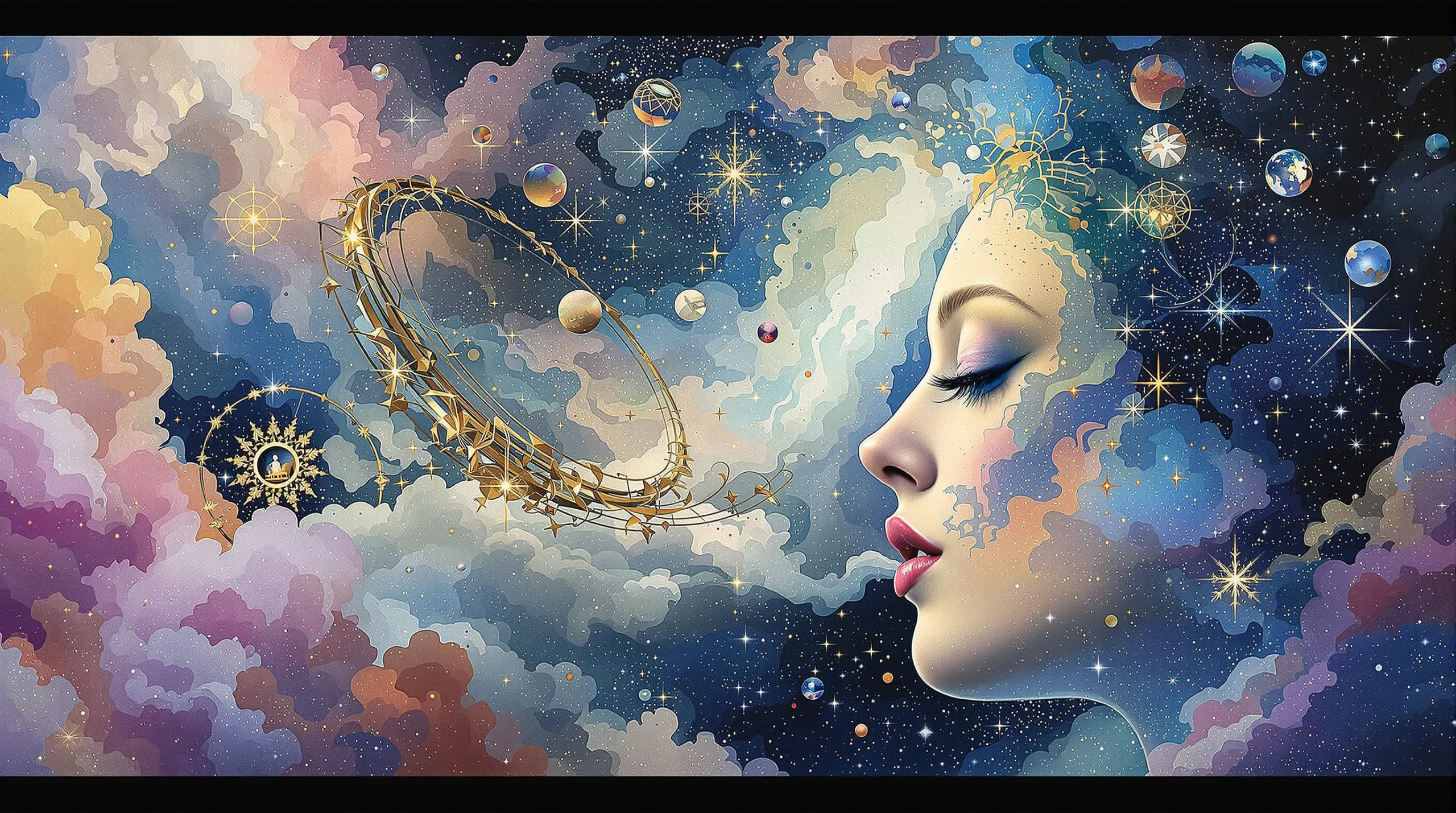


Dimension

Archetype Meaning & Symbolism

Expansive, layered, parallel, liminal, theoretical, unseen, overlapping, vibrational, conceptual, infinite

  • What you perceive as a wall is, from another angle, a doorway.

If Dimension is part of your personal mythology, you may...

Believe

  • That every conscious choice you make fractures reality, creating a new timeline where your alternate self lives out the consequences of the other option.

  • That coincidence is a fiction; moments of synchronicity are actually brief, intentional alignments of parallel dimensions, offering clues or guidance.

  • That the world we perceive is only a sliver of a much larger, unseen reality, and that human consciousness is capable of perceiving these other layers.

Fear

  • Losing your grip on consensus reality, becoming so lost in possibility that you can no longer function in the here and now.

  • That you are living in a 'lesser' or 'wrong' timeline, and that a happier, more successful version of you exists in a dimension you can no longer access.

  • Being profoundly alone and misunderstood, trapped in a multidimensional perception that you cannot share with the people you love.

Strength

  • An extraordinary capacity for creative problem-solving, as you can approach any issue from a multitude of unconventional angles.

  • A deep and abiding resilience to regret, because you see past choices not as mistakes but as doorways to different stories that are still unfolding elsewhere.

  • A natural sense of wonder and curiosity that keeps you intellectually and spiritually engaged with the mysteries of life.

Weakness

  • A tendency toward dissociation or indecisiveness, becoming paralyzed by the sheer number of possibilities and potential outcomes.

  • Difficulty maintaining focus and commitment to long-term, real-world projects, as your attention is constantly pulled toward what else could be.

  • A potential for intellectual elitism or a feeling of separation from others who have a more grounded, linear view of the world.

The Symbolism & Meaning of Dimension

In our personal mythologies, Dimension is the ultimate symbol of potentiality. It is the quiet, persistent whisper of the 'what if.' It represents every path not taken, every choice unmade, not as a source of regret, but as a library of alternate selves existing in tandem with the one we currently inhabit. To integrate this archetype is to accept that you are not one story but an entire anthology, and the 'you' of this moment is simply the story currently being read. The symbolism here is not of escape, but of expansion. It suggests our reality is porous, permeable, and that insights, warnings, and inspirations can bleed through from these adjacent life-streams if we learn how to listen at the seams of our perception.

The archetype also speaks to the nature of perception itself. It posits that what we call 'reality' is a collaboratively curated dimension, a consensus stabilized by shared belief and sensory limitation. To have Dimension in your mythos is to be a quiet dissident of this consensus. You may find meaning not in what is tangible and agreed-upon, but in the anomalies, the synchronicities, the moments where the curtain of reality seems to thin. This could be the strange resonance of a particular place, the feeling of knowing a stranger, or the sudden, inexplicable understanding of a complex idea. These are not glitches in the system; they are glimpses into the vast, interconnected latticework of other dimensions.

Furthermore, Dimension offers a modern framework for the soul or the spirit. It's a secular way of speaking about the eternal, the unseen, the part of us that exists beyond the physical. It could be that our consciousness is an antenna, capable of tuning into different dimensional frequencies. In this light, spiritual practice, creative flow, and even profound love are acts of re-tuning. The mythos becomes one of a traveler, not through physical space, but through the endless corridors of being, learning to navigate the invisible landscapes that shape our supposed 'real' world.


Dimension Relationships With Other Archetypes

The Dreamer

The Dimension is the native soil and the boundless sky for The Dreamer. While The Dreamer creates and explores inner worlds, the Dimension provides the very fabric, the metaphysical laws, and the landscapes for those explorations. The Dreamer may believe they are inventing, but the Dimension whispers that they are merely discovering what already exists. Their relationship is symbiotic: The Dreamer gives a specific form and narrative to the Dimension's infinite potential, while the Dimension ensures The Dreamer never runs out of territory to explore. One is the cartographer of the unseen, the other is the territory itself.

The Scientist

With The Scientist, the relationship is one of tension and pursuit. The Scientist sees the Dimension as the ultimate frontier, a theoretical construct to be proven, mapped, and quantified with equations and experiments. It is a puzzle to be solved. The Dimension, however, remains perpetually just beyond the grasp of empirical tools. It reveals itself not through logic, but through paradox and intuition. The Scientist tries to capture it with instruments of measurement, while the Dimension can only be experienced. It is a dance between the knowable and the felt, where The Scientist's quest for proof is constantly challenged by the Dimension's insistence on faith in the unseen.

The Door

The Door is a specific, tangible point of contact with the abstract vastness of the Dimension. If the Dimension is an infinite ocean of possibility, The Door is the single, unique shoreline where one can enter. The Door requires a key, a choice, an action. It is the practical application of the Dimension's theoretical nature. One cannot simply will oneself into another reality; one must find and pass through The Door. Their relationship highlights the interplay between passive potential and active transition. The Dimension is everything that could be, while The Door is the singular, decisive moment of becoming.

Using Dimension in Every Day Life

Reframing Grief and Loss

When confronted with the finality of loss, the Dimension archetype allows for a different narrative. It may not be about denial, but about understanding. The story could be that a loved one hasn't vanished but has simply shifted into a parallel state, a different vibrational reality. This transforms grief from an ending into a change of address. The work then becomes about learning to perceive their presence in a new way: not as a ghost, but as a resident of a neighboring reality whose influence subtly brushes against your own.

Innovating Beyond Creative Blocks

For the artist or entrepreneur facing a dead end, this archetype offers a way out that isn't forward, but sideways. Instead of trying to break down the wall, one imagines stepping into a dimension where the problem doesn't exist or has already been solved. What does that solution look like? By 'visiting' that parallel reality mentally, one can bring back its artifacts, its novel ideas and frameworks, and apply them to the current, seemingly intractable situation. It is the practice of borrowing answers from your other selves.

Navigating Life Transitions

Major life choices—a career change, a move, the start or end of a relationship—can feel like a death of the old self. The Dimension archetype reframes this as a conscious choice to migrate to a different timeline. The person you were, the life you had, continues to exist in its own dimension. You are not destroying it; you are simply choosing to inhabit a different one. This perspective may alleviate the paralysis of choice and the fear of regret, transforming a single life path into a multiverse of lived and potential experiences that all, in some way, belong to you.

Dimension is Known For

Parallel Realities

The concept that countless other universes, some nearly identical and others wildly different, exist alongside our own, separated by a thin, imperceptible veil. It suggests that every choice spawns a new timeline.

Thresholds and Portals

A reputation for being not just the space beyond, but the very gateways to it. Dimensions are known for their liminal spaces

dreams, moments of intense deja vu, or altered states of consciousness that act as portals to other ways of seeing and being.

Conceptual Space

The representation of purely theoretical or mental landscapes. A dimension can be the space where mathematical formulas live, where a novelist's characters have their own existence, or where a musician hears a symphony before it is written. It is the invisible architecture of thought and potential.

How Dimension Might Affect Your Personal Mythology

How Dimension Might Affect Your Mythos

When Dimension becomes a central feature of your personal mythos, your life story ceases to be a linear progression from A to B. It transforms into a sprawling, multithreaded narrative, a 'choose your own adventure' where past 'wrong turns' are re-contextualized as branchings into alternate, equally valid timelines. The narrative focus shifts from 'what happened' to 'what is being experienced now' as the primary reality, while all other possibilities remain latent, humming just below the surface. Your mythos is not about forging a single destiny, but about navigating the confluence of many potential destinies, with the self as the focal point through which these realities are perceived.

This perspective imbues your story with a sense of the magical and the profound. Regret may lose its sting, as the self that made a different choice is not gone, but is simply thriving in another version of the story. Your personal history might feel less like a series of fixed events and more like a collection of resonant frequencies you've tuned into over time. The defining moments of your mythos are not external achievements, but internal shifts in perception—moments where you consciously chose to step from one reality into another by changing a core belief, ending a relationship, or starting a new life. Your story becomes one of a quiet, deliberate reality-shifter.

How Dimension Might Affect Your Sense of Self

Your sense of self may become wonderfully fluid, less of a solid, immutable object and more of a wave of potential. You might see your personality, your skills, and even your memories not as fixed attributes, but as characteristics of the particular dimension you currently inhabit. This can be liberating, granting you permission to reinvent yourself radically, as you are not betraying a 'true self' but simply choosing to express a different facet of your multidimensional being. The self is the constant traveler, the consciousness that experiences the journey, not the landscape itself.

This can also lead to a kind of existential vertigo. If the self is not defined by its history or choices, what is it? You might struggle with a sense of being ungrounded, a perpetual visitor in your own life. The challenge is to find an anchor, a core sense of identity that persists across all potential realities. This core self may not be defined by what you do, but by how you perceive; not by your story, but by your capacity to be the storyteller. Self-esteem is then derived from your adaptability and your awareness, rather than from any particular outcome in any single timeline.

How Dimension Might Affect Your Beliefs About The World

A worldview informed by the Dimension archetype is one where reality is fundamentally subjective and layered. You may see the world not as a solid, objective stage on which events unfold, but as a shimmering interference pattern of countless overlapping possibilities. What is 'real' is simply a matter of focus and consensus. This fosters a radical openness to strange ideas, unexplained phenomena, and the validity of others’ subjective experiences. You might be less inclined to debunk or dismiss, and more inclined to ask, 'In what reality is that true?'

This can make the mundane world seem both less important and infinitely more magical. A traffic jam is a minor inconvenience in one dimension, but perhaps it's a life-saving delay in another. This perspective challenges the finality of political and social structures, seeing them as temporary constructs that exist only in this particular consensus reality. It is a worldview that favors questions over answers, mystery over certainty, and potential over actuality. The world is not a problem to be solved, but a kaleidoscope to be witnessed.

How Dimension Might Affect Your Relationships

Relationships may be viewed as the convergence of two distinct, personal dimensions. A deep connection is not just a meeting of minds, but an alignment of realities, creating a shared pocket universe with its own rules, language, and emotional gravity. You might appreciate partners and friends for the unique worlds they carry within them, and the purpose of relating is to be granted a temporary visa to explore those worlds. Empathy becomes a form of dimensional travel: an attempt to truly see from within another's reality.

However, this can also create a sense of unbridgeable distance. If every person is their own dimension, then true union is impossible; there is only temporary, partial overlap. Conflicts may be perceived not as disagreements, but as fundamental clashes of reality, where both perspectives are true within their own dimensional framework. This can lead to a feeling of profound loneliness, the awareness that no matter how close you get, you are still ultimately the sole inhabitant of your own perceptual universe.

How Dimension Might Affect Your Role in Life

Your perceived role in life might shift from that of a participant to that of a witness, or a bridge. You may not feel called to be a 'leader' or a 'follower' in the conventional sense, but rather a 'possibility agent.' Your function in any group, family, or workplace could be to gently destabilize rigid thinking by introducing alternate perspectives. You are the one who asks the 'what if' questions that open up new dimensions of thought for others. You don't build the new road; you point out that the landscape is not as solid as it seems and that countless other paths are possible.

This can be a subtle and powerful role, but it can also be an isolating one. People who are invested in the solidity of their reality may find your perspective destabilizing or impractical. You might be seen as a dreamer, a theorist, or someone who is not fully 'plugged in.' Your challenge is to bridge dimensions without losing your footing in the one you share with others, to be the ambassador for the possible without losing your passport to the actual.

Dream Interpretation of Dimension

In a positive context, dreaming of discovering or entering new dimensions could symbolize a profound opening in your waking life. It may represent your subconscious mind embracing new possibilities, perspectives, or a new phase of personal growth. Stepping through a shimmering portal could be a sign that you are ready to leave an old self behind and accept a new identity. Seeing beautiful, geometric, or light-filled dimensions might suggest an expansion of consciousness, a connection to a higher self, or a flood of creative inspiration that is about to enter your life. It is the psyche giving you a glimpse of what you are capable of becoming.

In a negative context, such dreams could manifest as feelings of being lost, trapped between worlds, or seeing reality distort and fracture. This may point to a sense of dissociation in your waking life, a feeling of being ungrounded, or confusion about your identity and purpose. You might be overwhelmed by too many choices ('analysis paralysis') or haunted by 'what-ifs.' A dream of being pursued through shifting dimensions could represent an attempt to escape a difficult truth in your actual life, while a dream of a bleak or empty dimension could symbolize a fear that a chosen path will lead to isolation and meaninglessness.

How Dimension Archetype Might Affect Your Needs

How Dimension Might Affect Your Physiological Needs

The Dimension archetype may subtly reframe your relationship with your body. The physiological self could be seen as an anchor, the one thing that tethers you firmly to *this* specific plane of existence. The needs of the body—for food, water, rest—become grounding rituals, practices that reaffirm your place in the tangible world amidst the pull of infinite possibilities. This could lead to a profound appreciation for sensory experience: the taste of food, the feeling of sunlight, the rhythm of your own breath are not just biological processes, but the very things that make this dimension real.

Alternatively, the body may be viewed as a temporary vessel or even a limitation, a sensory filter that restricts your perception to a narrow bandwidth of reality. Practices that alter physiological states, such as meditation, deep breathing, or intense physical exertion, might be interpreted not merely as health exercises, but as methods of adjusting the 'tuner' of your consciousness. The goal may be to briefly loosen the body's grip on perception, allowing you to glimpse the other dimensions that your normal physiological state keeps veiled.

How Dimension Might Affect Your Ideas of Belonging

The need for belongingness may become a complex and often poignant issue. On one hand, you may feel an expanded sense of belonging to the cosmos itself, a kinship with the grand, mysterious totality of all possible worlds. Your home is not a place, but an idea. You connect with others on the basis of shared curiosity and openness to the unseen, forming bonds that transcend conventional social categories. Love might be defined as the rare and beautiful event of two personal dimensions resonating at the same frequency.

On the other hand, a profound sense of alienation can arise. When you perceive so many layers of reality, the 'normal' world and its social structures can feel like a thin, unconvincing play. You might feel like a traveler with a secret passport, forever an outsider among those who believe this one dimension is all there is. True belonging feels elusive, because no single group or person can encompass all the parts of you that exist across the multiverse of your potential selves. You may feel loved, but perhaps not fully seen.

How Dimension Might Affect Your Feelings of Safety

When the Dimension archetype is active, the concept of safety expands beyond the physical. The primary concern may not be bodily harm, but existential dissolution. The greatest fear is not of an external threat, but of losing your own psychic center of gravity, of becoming unmoored and drifting aimlessly through the sea of infinite realities. Safety is no longer about locking the door at night; it's about maintaining a coherent personal narrative that prevents your sense of self from fracturing under the weight of endless 'what-ifs'.

Security is found in establishing mental and spiritual anchors. These could be core principles, grounding relationships, or consistent daily practices that reinforce your connection to this present reality. You might create deliberate boundaries not against people, but against excessive speculation or imaginative flight, to ensure you don't lose your footing. Safety is the delicate balance between exploring the boundless possibilities of other dimensions and maintaining a firm, conscious presence in this one.

How Dimension Might Affect Your Views of Esteem

Esteem needs may shift away from external validation and toward internal coherence and intellectual agility. Your self-worth could be derived not from what you achieve in this world, but from your capacity to hold multiple, contradictory perspectives at once. You might pride yourself on your imaginative power, your mental flexibility, and your ability to see the hidden potentials in any situation. Respect is earned not through dominance or success, but through wisdom, insight, and the ability to navigate complex, abstract concepts.

However, this can also undermine esteem in a conventional sense. Accomplishments in this single, 'real' world can feel insignificant when measured against the infinite possibilities of what you *could* have been or done in other dimensions. It can be hard to feel proud of climbing a single hill when you are acutely aware of the mountain ranges you could have explored on other timelines. The challenge is to find value and meaning in the specific choices made and the unique reality you inhabit, celebrating it not as the 'best' possible world, but as the one that is yours.

Shadow of Dimension

The shadow of the Dimension archetype is a profound and debilitating escapism. It is the use of infinite possibility as a justification for inaction and a shield against responsibility in this reality. Here, the beautiful concept of parallel worlds becomes a dark cellar where one hides from the consequences of one's choices. A person in this shadow might constantly talk about their potential in other timelines while neglecting to build anything in this one. They may abdicate responsibility for hurting others, reasoning that in another dimension, they made a kinder choice. It is the ultimate intellectualization of avoidance, turning a philosophy of expansion into a prison of stagnation.

When this shadow takes hold, the line between imaginative exploration and outright delusion blurs and then vanishes. The individual may become completely ungrounded, unable to distinguish between what is real and what is imagined, what is a helpful metaphor and what they believe to be literal truth. This can lead to a complete breakdown of relationships and practical life skills. Instead of being a bridge to new perspectives, the person becomes an island of incomprehensible private logic, their creative potential curdling into a solipsistic fantasy world that offers no connection, no growth, and no meaning.

Pros & Cons of Dimension in Your Mythology

Pros

  • It fosters an incredible imagination and the ability to generate novel ideas, making you a source of creativity and innovation.

  • It cultivates a deep tolerance for ambiguity and a profound empathy for differing viewpoints, as you understand that multiple realities can be true at once.

  • It can liberate you from the burdens of regret and the fear of making the 'wrong' choice, promoting a more adventurous and resilient approach to life.

Cons

  • It can lead to a persistent feeling of being ungrounded or dissociated from the practical, everyday world.

  • It may result in 'analysis paralysis,' where the overwhelming awareness of infinite options makes it impossible to commit to any single path.

  • It can create a sense of existential loneliness, a feeling that no one else truly understands your complex, layered perception of reality.