 Believe
 Fear
Fear Strength
 Weakness
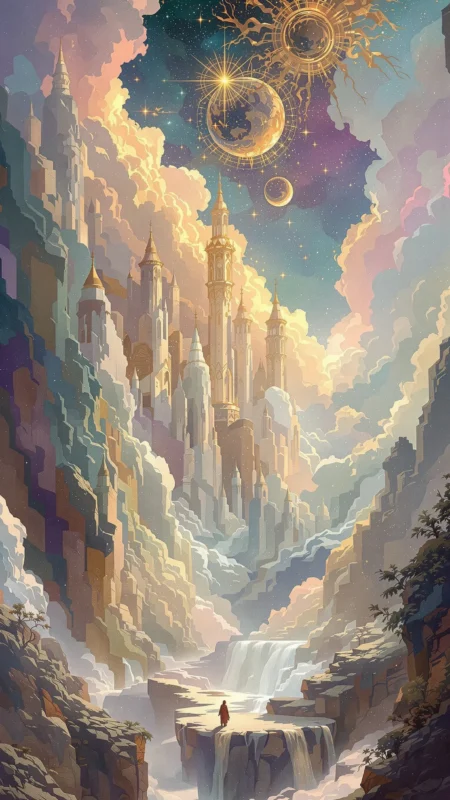
In the personal mythos, Asgard is not a place in the sky but a construct of the psyche: the fortified kingdom of the self. It is the carefully built structure of your beliefs, your ambitions, your values, and your highest ideals. It is the part of you that seeks to impose order on the wild chaos of inner and outer experience. To have Asgard in your mythology is to be a builder of internal citadels, a curator of a personal pantheon of principles. This realm’s golden halls might be your achievements, its high towers your aspirations. Living in this inner Asgard means holding oneself to a higher, almost divine standard, and viewing one's life as a saga worthy of being told.
This archetype also carries the hum of cosmic electricity, the constant tension between creation and destruction. Asgard is defined by its enemies: the giants of chaos, doubt, and entropy are always at the gates. Its existence is not one of peaceful bliss but of glorious, vigilant struggle. Therefore, a personal Asgard is never static. It must be constantly maintained, defended, and expanded. The Bifrost bridge suggests that this realm is not entirely isolated: it must have a connection to the everyday world, a risky but necessary bridge between your highest self and your human experience.
Perhaps most profoundly, Asgard is a realm haunted by its own prophesied doom: Ragnarök. This infuses the archetype with a tragic, beautiful impermanence. Building your inner Asgard is not an attempt to achieve immortality, but to create something of worth within a finite existence. It is the understanding that all great structures eventually fall. The goal, then, is not to avoid the end, but to build a realm so glorious and to live a life so honorably within it that its fall is an epic of its own, a twilight of the gods that gives meaning to everything that came before.